PUBLISHER: Mordor Intelligence | PRODUCT CODE: 2122631

PUBLISHER: Mordor Intelligence | PRODUCT CODE: 2122631
Structural Electronics - Market Share Analysis, Industry Trends & Statistics, Growth Forecasts (2026 - 2031)
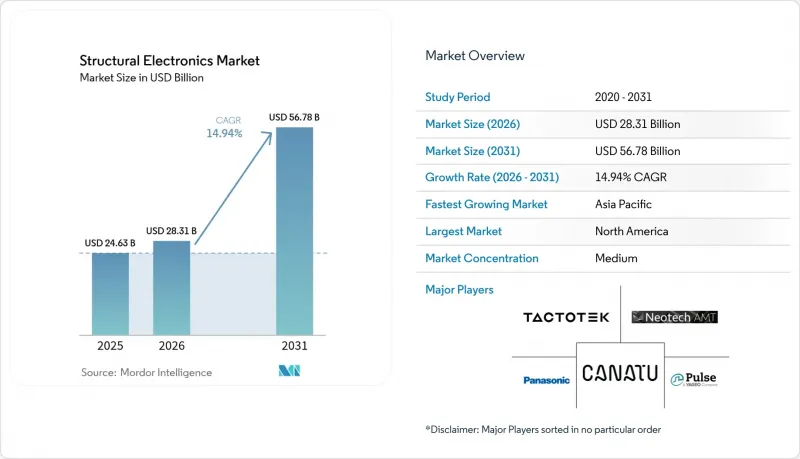
According to Mordor Intelligence, the structural electronics market size was valued at USD 24.63 billion in 2025 and estimated to grow from USD 28.31 billion in 2026 to reach USD 56.78 billion by 2031, at a CAGR of 14.94% during the forecast period (2026-2031).
This report is Segmented by Integrant (Photovoltaics, Batteries/Super-capacitors, and More), Manufacturing Technology (In-Mold Electronics, Additive Manufacturing/3-D Printing, and More), Material (Conductive Inks, Substrates, Encapsulation and Adhesives), Application (Automotive, Aerospace and Defense, and More), and Geography. The Market Forecasts are Provided in Terms of Value (USD).
Global Structural Electronics Market Trends and Insights
Automotive light weighting and EV-centric cabin electronics surge
European automakers face firm fleet-emission rules that prioritize lighter vehicles equipped with integrated power electronics. Sinonus AB's carbon-fiber structural battery shows a 70% range boost coupled with 50% weight reduction, illustrating how a single composite part can both store energy and carry mechanical loads. The design also mitigates thermal-runaway concerns by replacing flammable liquid electrolytes with semi-solid chemistries. Automakers such as Volkswagen link these batteries with silicon-carbide inverters from onsemi to shrink component count and raise drivetrain efficiency. The debate around steel versus aluminum gigacasting further underscores the value of embedding circuitry into any structural material. The result is a rapid uptick in structural electronics market adoption across chassis, doors, and instrument panels.
Mass adoption of 3-D in-mold electronics in Asia-Pacific consumer devices
Consumer-device contract manufacturers in China, South Korea, and Vietnam are standardizing 3-D in-mold electronics that combine conductive inks, films, and resins in a single molding step. TactoTek's injection-molded structural electronics (IMSE) process has verified a 60% drop in greenhouse-gas emissions and 70% less plastic usage versus traditional assembly. Covestro's Makrofol polycarbonate films enable touch lighting and haptic feedback inside ultrathin shells. Regional research, such as organic electrochemical transistors from the University of Hong Kong, drives the next wave of wearable, on-sensor computing. Southeast Asia's PCB sector, already above USD 2 billion in output, supplies multilayer backplanes that mate with these structural housings. Accelerated tooling cycles support product launches in smartphones, hearables, and smart-home hubs, lifting the structural electronics market across personal electronics.
Shortage of conductive nanomaterial supply outside Asia
Carbon-nanotube inks and pastes are concentrated in a handful of Chinese plants that together command over 40% of global output. Hurricanes that disrupted high-purity quartz in North Carolina exposed parallel weaknesses in raw-material chains essential for semiconductor substrates. Recent CNT scale-up announcements from U.S. and European producers remain short of demand growth projections. Automotive and aerospace buyers consequently face longer lead times and price spikes, constraining structural electronics market expansion until diversified sourcing becomes available.
Other drivers and restraints analyzed in the detailed report include:
- FAA push for integrated sensor skins in composite airframes
- Printed photovoltaics for battery-less IoT nodes in smart buildings
- Complex qualification cycles for structural electronics in aerospace
For complete list of drivers and restraints, kindly check the Table Of Contents.
Segment Analysis
The sensor and antenna category contributed 34.25% revenue in 2025, buoyed by mandates for advanced driver-assistance systems and aircraft safety monitoring. Flight composite panels now embed fiber-optic arrays, whereas passenger-vehicle dashboards integrate radar and capacitive touch in one molded insert. Photovoltaics post the strongest 16.88% CAGR through 2031, driven by flexible perovskite modules that curve around building interiors and wearable tags. Structural integration allows power generation without separate housing, shrinking assembly cost, and opening new applications in asset tracking and indoor agriculture.
Structural batteries and micro-super-capacitors move beyond prototypes, illustrated by MXene ink devices delivering 611 F cm-3 volumetric capacitance. Displays follow automotive styling trends toward continuous curved surfaces enabled by OLED and micro-LED films. Interconnect materials confront copper volatility yet gain from silver-nanowire and MXene alternatives that sustain conductivity in bendable formats. Together, these shifts expand the structural electronics market as designers combine sensing, energy, and display functions within a single laminate.
In-mold electronics captured 50.72% revenue in 2025 by fusing films, inks, and resin into lightweight parts that ship ready-to-install. Automotive door trims now host back-lit controls without separate PCBs, cutting wire harness weight. Consumer wearables adopt the same process for IP68-rated casings. Additive manufacturing records the highest 17.46% CAGR, supported by DARPA's AMME program that 3-prints complex micro-circuits directly onto three-dimensional substrates. Aerosol-jet printing of MXene inks scales energy-dense capacitors, while multiphoton lithography pioneers printable organic bioelectronics.
Screen and flexographic presses remain cost-effective for large-area heaters and antennas on appliance panels. Inkjet platforms supply fine-feature prototypes before tooling commits to mass molding. This technology spreads, widening entry options, accelerating structural electronics market adoption in both high-volume and bespoke production runs.
Complete Report Scope:
- By Integrant
- Photovoltaics
- Batteries/Super-capacitors
- Sensors and Antennas
- Displays (OLED/Micro-LED)
- Conductors and Interconnects
- By Manufacturing Technology
- In-Mold Electronics (IME)
- Additive Manufacturing/3-D Printing
- Aerosol Jet and Inkjet Printing
- Screen/Flexographic Printing
- By Material
- Conductive Inks (Silver, Copper, Carbon, Nanomaterial)
- Substrates (Polymer, Glass, Composite, Thermoset)
- Encapsulation and Adhesives
- By Application
- Automotive - Interior and Exterior
- Aerospace and Defense - Airframe, Smart Skins
- Consumer Electronics - Whitegoods and Handhelds
- Healthcare/Medical Devices
- Industrial and Building Automation
- By Geography
- North America
- United States
- Canada
- Mexico
- Europe
- Germany
- United Kingdom
- France
- Italy
- Spain
- Nordics (Denmark, Sweden, Norway, Finland)
- Rest of Europe
- Asia-Pacific
- China
- Japan
- South Korea
- India
- Southeast Asia
- Australia
- Rest of Asia-Pacific
- South America
- Brazil
- Argentina
- Rest of South America
- Middle East
- Gulf Cooperation Council Countries
- Turkey
- Rest of Middle East
- Africa
- South Africa
- Nigeria
- Rest of Africa
- North America
Geography Analysis
Asia-Pacific delivered 37.35% of 2025 revenue by virtue of high-volume semiconductor, PCB, and molding ecosystems. China drives vertical integration, while Thailand and Malaysia add capacity that feeds global supply. Japan supplies over half the world's multilayer ceramic capacitors, and partnerships such as Murata with QuantumScape diversify into solid-state battery ceramics.
Europe's structural electronics market gains from automotive electrification milestones and EUR 80 billion (USD 94.06 billion) in Chips Act funds, targeting a 20% global semiconductor share by 2030. German OEMs refine giga casting with embedded circuits, whereas French construction firms pilot PV-powered sensor skins on retrofit facades.
The Middle East and Africa record the fastest 15.12% CAGR, propelled by defense modernization and smart-city rollouts. UAE's EDGE Group explores AI-enabled satellite links that demand conformal antennas and lightweight power sources. Local governments entice suppliers with offset programs that seed domestic assembly lines, yet the region still imports most nanomaterials, a gap that could temper late-decade growth.
North America keeps momentum through aerospace projects and fresh CHIPS Act subsidies for advanced packaging foundries. Boeing's acquisition of Spirit targets tighter integration of sensor-ready fuselage sections. Federal rules now favor home-grown supply, nudging structural electronics market participants to co-locate material, printing, and molding capabilities.
- TactoTek Oy
- Molex LLC
- Panasonic Holdings Corp.
- Canatu Oy
- Neotech AMT GmbH
- Pulse Electronics (Yageo)
- Optomec Inc.
- Odyssian Technology LLC
- Aconity3D GmbH
- T-ink Inc.
- Boeing Co.
- Henkel AG and Co. KGaA
- DuPont de Nemours Inc.
- 3D Systems Corp.
- Teijin Ltd.
- PPG Industries Inc.
- Flex Ltd.
- General Electric Co.
- Samsung Electro-Mechanics
- Continental AG
Additional Benefits:
- The market estimate (ME) sheet in Excel format
- 3 months of analyst support
TABLE OF CONTENTS
1 INTRODUCTION
- 1.1 Study Assumptions and Market Definition
- 1.2 Scope of the Study
2 RESEARCH METHODOLOGY
3 EXECUTIVE SUMMARY
4 MARKET LANDSCAPE
- 4.1 Market Overview
- 4.2 Market Drivers
- 4.2.1 Automotive Lightweighting and EV-Centric Cabin Electronics Surge in Europe
- 4.2.2 Mass Adoption of 3-D In-Mold Electronics in Asia-Pacific Consumer Devices
- 4.2.3 FAA Push for Integrated Sensor Skins in Composite Airframes (North America)
- 4.2.4 Printed Photovoltaics for Battery-Less IoT Nodes in Smart Buildings
- 4.2.5 Edge-AI Wearables Driving Stretchable Structural Circuits in Healthcare
- 4.2.6 Defense Demand for Conformal Antennas and Smart Surfaces (Israel and US)
- 4.3 Market Restraints
- 4.3.1 Complex Qualification Cycles for Structural Electronics in Aerospace
- 4.3.2 Limited Cycle-Time Throughput of Additive Manufacturing Lines
- 4.3.3 Delamination Risks in High-Heat Polymer Substrates - Automotive
- 4.3.4 Shortage of Conductive Nanomaterial Supply Outside Asia
- 4.4 Industry Ecosystem Analysis
- 4.5 Technological Outlook
- 4.6 Porter's Five Forces Analysis
- 4.6.1 Bargaining Power of Suppliers
- 4.6.2 Bargaining Power of Buyers/Consumers
- 4.6.3 Threat of New Entrants
- 4.6.4 Threat of Substitute Products
- 4.6.5 Intensity of Competitive Rivalry
5 MARKET SIZE AND GROWTH FORECASTS (VALUES)
- 5.1 By Integrant
- 5.1.1 Photovoltaics
- 5.1.2 Batteries/Super-capacitors
- 5.1.3 Sensors and Antennas
- 5.1.4 Displays (OLED/Micro-LED)
- 5.1.5 Conductors and Interconnects
- 5.2 By Manufacturing Technology
- 5.2.1 In-Mold Electronics (IME)
- 5.2.2 Additive Manufacturing/3-D Printing
- 5.2.3 Aerosol Jet and Inkjet Printing
- 5.2.4 Screen/Flexographic Printing
- 5.3 By Material
- 5.3.1 Conductive Inks (Silver, Copper, Carbon, Nanomaterial)
- 5.3.2 Substrates (Polymer, Glass, Composite, Thermoset)
- 5.3.3 Encapsulation and Adhesives
- 5.4 By Application
- 5.4.1 Automotive - Interior and Exterior
- 5.4.2 Aerospace and Defense - Airframe, Smart Skins
- 5.4.3 Consumer Electronics - Whitegoods and Handhelds
- 5.4.4 Healthcare/Medical Devices
- 5.4.5 Industrial and Building Automation
- 5.5 By Geography
- 5.5.1 North America
- 5.5.1.1 United States
- 5.5.1.2 Canada
- 5.5.1.3 Mexico
- 5.5.2 Europe
- 5.5.2.1 Germany
- 5.5.2.2 United Kingdom
- 5.5.2.3 France
- 5.5.2.4 Italy
- 5.5.2.5 Spain
- 5.5.2.6 Nordics (Denmark, Sweden, Norway, Finland)
- 5.5.2.7 Rest of Europe
- 5.5.3 Asia-Pacific
- 5.5.3.1 China
- 5.5.3.2 Japan
- 5.5.3.3 South Korea
- 5.5.3.4 India
- 5.5.3.5 Southeast Asia
- 5.5.3.6 Australia
- 5.5.3.7 Rest of Asia-Pacific
- 5.5.4 South America
- 5.5.4.1 Brazil
- 5.5.4.2 Argentina
- 5.5.4.3 Rest of South America
- 5.5.5 Middle East
- 5.5.5.1 Gulf Cooperation Council Countries
- 5.5.5.2 Turkey
- 5.5.5.3 Rest of Middle East
- 5.5.6 Africa
- 5.5.6.1 South Africa
- 5.5.6.2 Nigeria
- 5.5.6.3 Rest of Africa
- 5.5.1 North America
6 COMPETITIVE LANDSCAPE
- 6.1 Market Concentration
- 6.2 Strategic Moves
- 6.3 Market Share Analysis
- 6.4 Company Profiles (includes Global-Level Overview, Market-Level Overview, Core Segments, Financials as available, Strategic Information, Market Rank/Share, Products and Services, Recent Developments)
- 6.4.1 TactoTek Oy
- 6.4.2 Molex LLC
- 6.4.3 Panasonic Holdings Corp.
- 6.4.4 Canatu Oy
- 6.4.5 Neotech AMT GmbH
- 6.4.6 Pulse Electronics (Yageo)
- 6.4.7 Optomec Inc.
- 6.4.8 Odyssian Technology LLC
- 6.4.9 Aconity3D GmbH
- 6.4.10 T-ink Inc.
- 6.4.11 Boeing Co.
- 6.4.12 Henkel AG and Co. KGaA
- 6.4.13 DuPont de Nemours Inc.
- 6.4.14 3D Systems Corp.
- 6.4.15 Teijin Ltd.
- 6.4.16 PPG Industries Inc.
- 6.4.17 Flex Ltd.
- 6.4.18 General Electric Co.
- 6.4.19 Samsung Electro-Mechanics
- 6.4.20 Continental AG
7 MARKET OPPORTUNITIES AND OUTLOOK
- 7.1 White-Space and Unmet-Need Assessment

