PUBLISHER: Mordor Intelligence | PRODUCT CODE: 2122650

PUBLISHER: Mordor Intelligence | PRODUCT CODE: 2122650
Autonomous Truck - Market Share Analysis, Industry Trends & Statistics, Growth Forecasts (2026 - 2031)
According to Mordor Intelligence, the autonomous truck market size reached USD 42.63 billion in 2026 and is projected to attain USD 74.23 billion by 2031, representing an 11.73% CAGR.
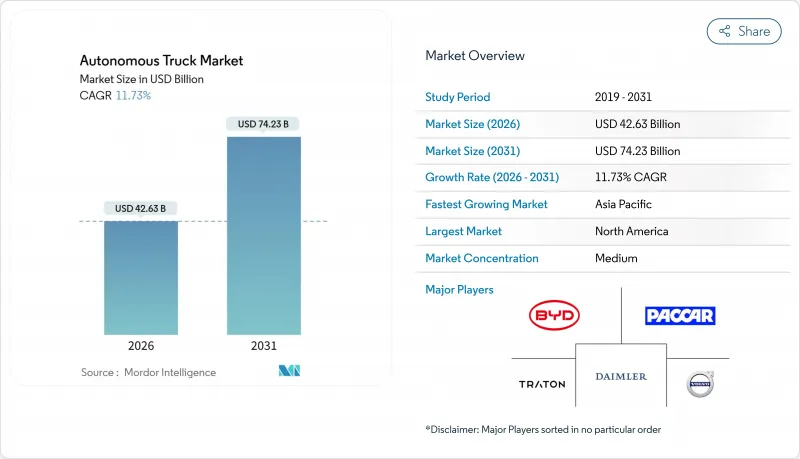
This report is Segmented by Truck Type (Light-Duty Trucks, and More), Level of Autonomy (SAE Level 1-2 (Driver Assist), and More), ADAS Features (Adaptive Cruise Control, Lane Departure Warning, and More), Component (LIDAR, RADAR, Cameras, and More), Drive Type (IC Engine, Battery-Electric, Hybrid, and More), and Geography. The Market Forecasts are Provided in Terms of Value (USD) and Volume (Units).
Global Autonomous Truck Market Trends and Insights
Driver Shortage and Rising Line-Haul Labor Cost
Chronic gaps in driver availability and escalating wages redefine freight economics in favor of automated line-haul operations. The Federal Motor Carrier Safety Administration limits human operators to 11 driving hours within a 14-hour window, a regulation that caps asset utilization at roughly half of every day. Autonomous tractors running mapped interstate corridors can operate for extended hours, limited mainly by fueling/charging, inspections, and maintenance. ATA-reported large-truckload driver turnover has been around/above 90% in some periods, intensifying the incentive to deploy Level 4 trucks on predictable lanes. European and Japanese fleets face similar demographic pressure as younger workers avoid long-haul careers. Autonomous hub-to-hub shuttles, therefore, enable carriers to redeploy scarce human drivers to first-mile and last-mile routes that remain regulation-bound.
Demand for 24/7 Hub-to-Hub Logistics
E-commerce growth and just-in-time manufacturing create demand for nonstop freight flows that manual operations cannot sustain under hours-of-service rules. Autonomous trucks on fixed terminals can deliver round-the-clock service without contravening rest mandates. Freight integrators have already demonstrated overnight pilot lanes (e.g., Dallas-Houston) aimed at materially improving tractor utilization. China's national modernization plan designates key manufacturing corridors for autonomous freight, targeting significant reductions in average transit time. Retailers and third-party logistics providers see continuous autonomy as a hedge against driver-availability volatility, especially during seasonal spikes when spot rates often triple.
Patchwork Global Regulation and Cross-Border Liability
Divergent legal frameworks divide the autonomous truck market across regions. Germany has established a legal framework for Level 4 autonomous driving in defined operating areas, subject to approval and oversight; however, it still requires safety drivers in France and Spain, creating a discontinuity that disrupts cross-border logistics. The United States governs autonomy largely at the state level, resulting in a mosaic of insurance and data-sharing mandates. Liability allocation remains unresolved regarding the distribution of fault among the OEM, software provider, and fleet operator. Such uncertainty elevates insurance premiums and deters small and mid-size carriers from investing until precedents stabilize. Harmonization efforts continue, but the timeline spans beyond the current forecast horizon, thereby tempering growth.
Other drivers and restraints analyzed in the detailed report include:
- Collaboration of Autonomy with Zero-Emission Powertrains
- Edge-AI Foundation Models Cut Validation Cycles
- High LiDAR/Sensor-Suite Costs
For complete list of drivers and restraints, kindly check the Table Of Contents.
Segment Analysis
Heavy-duty tractors retained 46.57% of 2025 revenue due to their dominance in long-haul applications where labor savings and high mileage maximize payback. Light-duty trucks remain niche because lower payload limits dilute the economic advantage of costly sensor suites. Medium-duty platforms account for a smaller base yet will advance at a 13.34% CAGR from 2026 to 2031, driven by regional-haul and last-mile routes within geofenced areas that experience predictable traffic patterns. The autonomous truck market benefits from retailers linking micro-fulfillment centers via dedicated Class 6 box trucks outfitted with Level 4 stacks.
The shift toward medium-duty autonomy aligns with rising e-commerce density inside metropolitan regions. High stop-start duty cycles favor electrification, and electric drivetrains integrate efficiently with autonomous control logic. Heavy-duty tractors continue to test multi-state corridors, yet regulatory risk concentrates investment in locations where statutes explicitly permit driverless operation. Light-duty experimentation centers on campus environments where speed is limited, suggesting that broader scale will follow only when combined payload and autonomy economics improve. Overall, these dynamics reinforce medium-duty trucks as the fastest growing slice of the autonomous truck market.
SAE Level 1-2 driver-assist systems captured 71.87% of the 2025 autonomous truck market, reflecting a large installed base of adaptive cruise control and lane-keeping features. However, Level 4 platforms are projected to scale at a 15.21% CAGR through 2031 as state-approved sandboxes in Texas, Arizona, and Bavaria allow fully driverless operation on mapped highways. The autonomous truck market size for Level 3 systems remains modest because handoff requirements create liability risk that many fleets avoid. Level 5 universal autonomy remains beyond the current forecast window due to sensor and compute constraints.
Commercial pilots show that Level 4 highway-pilot routes capture most of the economic benefit without requiring complete geographic coverage. Remote supervision centers monitor multiple tractors, amplifying labor productivity. Safety regulators focus on performance within defined operating domains rather than theoretical perfection everywhere, which accelerates certification for corridor-specific deployments. Level 1-2 features will continue as mandatory safety baselines, yet their contribution to total addressable value diminishes over time. Consequently, Level 4 systems become the primary revenue engine of the autonomous truck market.
Complete Report Scope:
- By Truck Type
- Light-Duty Trucks
- Medium-Duty Trucks
- Heavy-Duty Trucks
- By Level of Autonomy
- SAE Level 1- 2 (Driver Assist)
- SAE Level 3 (Conditional)
- SAE Level 4 (High)
- SAE Level 5 (Full)
- By ADAS Feature
- Adaptive Cruise Control
- Lane Departure Warning
- Traffic Jam Assist
- Highway Pilot
- Automatic Emergency Braking
- Blind-Spot Detection
- Lane-Keeping Assist
- By Component
- LiDAR
- RADAR
- Cameras
- Ultrasonic and Other Sensors
- AI Compute Modules
- By Drive Type
- Internal-Combustion
- Battery-Electric
- Hybrid
- Hydrogen Fuel-Cell
- By Geography
- North America
- United States
- Canada
- Rest of North America
- South America
- Brazil
- Argentina
- Rest of South America
- Europe
- Germany
- United Kingdom
- France
- Spain
- Russia
- Rest of Europe
- Asia-Pacific
- India
- China
- Japan
- South Korea
- Rest of Asia-Pacific
- Middle East and Africa
- United Arab Emirates
- Saudi Arabia
- Turkey
- Egypt
- South Africa
- Rest of Middle-East and Africa
- North America
Geography Analysis
North America accounted for 37.46% of 2025 revenue and is projected to register a 9.52% CAGR through 2031. Multiple states authorize driverless testing on public highways, making the region the largest commercial sandbox. Ten U.S. DOT-designated Automated Vehicle Proving Grounds support testing and validation, and cross-border lanes into Mexico and Canada stand to benefit once legal harmonization advances. Dense interstate freight networks and generous clean-transport subsidies underpin sustained demand across long-haul, refrigerated, and parcel segments.
Europe is forecasted to expand at a 9.43% CAGR to 2031. EU CO2 standards for new heavy-duty vehicles aim for a reduction of ~45% by 2030, 65% by 2035, and 90% by 2040 (compared to the baseline), with specific rules in place for each vehicle category, catalyzing investment in combined electric and autonomous technologies. Germany leads with dedicated autobahn corridors, while France and Spain progress at a measured pace due to safety driver stipulations. Eastern Europe remains early-stage as infrastructure and financing mature. Western Asia shows double-digit growth as sovereign wealth funds modernize port logistics through 24-hour autonomous container shuttles.
Asia-Pacific will grow fastest at a 13.33% CAGR, reflecting national pilot zones in China and government-backed truck platooning programs in Japan and South Korea. Dense manufacturing clusters and aging workforces accelerate adoption. China's Greater Bay Area supports the world's largest fleet of driverless trucks on dedicated lanes linking factories to port terminals. South Korea invests heavily in 5G-enabled highways tailored for connected autonomy. Southeast Asian nations adopt a wait-and-see approach until sensor costs fall and financing mechanisms adapt to local conditions. Collectively, rising freight volumes and supportive policy drive regional leadership in the autonomous truck market.
- AB Volvo
- Daimler Truck AG
- Traton SE
- PACCAR Inc.
- BYD Co. Ltd.
- Tesla Inc.
- TuSimple
- Aurora Innovation
- Waymo Via
- Plus.ai
- Torc Robotics
- Kodiak Robotics
- Nikola Corp.
- Einride
- Embark Technology
- Hyzon Motors
- Gatik AI
- Volvo - Uber ATG JV
- Scania AB
- Navistar
Additional Benefits:
- The market estimate (ME) sheet in Excel format
- 3 months of analyst support
TABLE OF CONTENTS
1 Introduction
- 1.1 Study Assumptions and Market Definition
- 1.2 Scope of the Study
2 Research Methodology
3 Executive Summary
4 Market Landscape
- 4.1 Market Overview
- 4.2 Market Drivers
- 4.2.1 Driver Shortage and Rising Line-Haul Labor Cost
- 4.2.2 Demand for 24/7 Hub-to-Hub Logistics
- 4.2.3 Collaboration of Autonomy with Zero-Emission Powertrains
- 4.2.4 Edge-AI Foundation Models Cut Validation Cycles
- 4.2.5 Green-Corridor Tax Incentives (IRA, Fit-For-55)
- 4.2.6 Tightening Safety Regulations
- 4.3 Market Restraints
- 4.3.1 Patchwork Global Regulation and Cross-Border Liability
- 4.3.2 High Lidar/Sensor-Suite Costs
- 4.3.3 Cyber-Security and OTA Update Risks
- 4.3.4 Opaque Transformer Models Hinder ISO-26262 Compliance
- 4.4 Value / Supply-Chain Analysis
- 4.5 Regulatory Landscape
- 4.6 Technological Outlook
- 4.7 Porter's Five Forces
- 4.7.1 Threat of New Entrants
- 4.7.2 Bargaining Power of Buyers
- 4.7.3 Bargaining Power of Suppliers
- 4.7.4 Threat of Substitutes
- 4.7.5 Competitive Rivalry
5 Market Size and Growth Forecasts (Value (USD) and Volume (Units))
- 5.1 By Truck Type
- 5.1.1 Light-Duty Trucks
- 5.1.2 Medium-Duty Trucks
- 5.1.3 Heavy-Duty Trucks
- 5.2 By Level of Autonomy
- 5.2.1 SAE Level 1- 2 (Driver Assist)
- 5.2.2 SAE Level 3 (Conditional)
- 5.2.3 SAE Level 4 (High)
- 5.2.4 SAE Level 5 (Full)
- 5.3 By ADAS Feature
- 5.3.1 Adaptive Cruise Control
- 5.3.2 Lane Departure Warning
- 5.3.3 Traffic Jam Assist
- 5.3.4 Highway Pilot
- 5.3.5 Automatic Emergency Braking
- 5.3.6 Blind-Spot Detection
- 5.3.7 Lane-Keeping Assist
- 5.4 By Component
- 5.4.1 LiDAR
- 5.4.2 RADAR
- 5.4.3 Cameras
- 5.4.4 Ultrasonic and Other Sensors
- 5.4.5 AI Compute Modules
- 5.5 By Drive Type
- 5.5.1 Internal-Combustion
- 5.5.2 Battery-Electric
- 5.5.3 Hybrid
- 5.5.4 Hydrogen Fuel-Cell
- 5.6 By Geography
- 5.6.1 North America
- 5.6.1.1 United States
- 5.6.1.2 Canada
- 5.6.1.3 Rest of North America
- 5.6.2 South America
- 5.6.2.1 Brazil
- 5.6.2.2 Argentina
- 5.6.2.3 Rest of South America
- 5.6.3 Europe
- 5.6.3.1 Germany
- 5.6.3.2 United Kingdom
- 5.6.3.3 France
- 5.6.3.4 Spain
- 5.6.3.5 Russia
- 5.6.3.6 Rest of Europe
- 5.6.4 Asia-Pacific
- 5.6.4.1 India
- 5.6.4.2 China
- 5.6.4.3 Japan
- 5.6.4.4 South Korea
- 5.6.4.5 Rest of Asia-Pacific
- 5.6.5 Middle East and Africa
- 5.6.5.1 United Arab Emirates
- 5.6.5.2 Saudi Arabia
- 5.6.5.3 Turkey
- 5.6.5.4 Egypt
- 5.6.5.5 South Africa
- 5.6.5.6 Rest of Middle-East and Africa
- 5.6.1 North America
6 Competitive Landscape
- 6.1 Market Concentration
- 6.2 Strategic Moves
- 6.3 Market Share Analysis
- 6.4 Company Profiles (Includes Global level Overview, Market level overview, Core Segments, Financials as available, Strategic Information, Market Rank/Share for key companies, Products and Services, and Recent Developments)
- 6.4.1 AB Volvo
- 6.4.2 Daimler Truck AG
- 6.4.3 Traton SE
- 6.4.4 PACCAR Inc.
- 6.4.5 BYD Co. Ltd.
- 6.4.6 Tesla Inc.
- 6.4.7 TuSimple
- 6.4.8 Aurora Innovation
- 6.4.9 Waymo Via
- 6.4.10 Plus.ai
- 6.4.11 Torc Robotics
- 6.4.12 Kodiak Robotics
- 6.4.13 Nikola Corp.
- 6.4.14 Einride
- 6.4.15 Embark Technology
- 6.4.16 Hyzon Motors
- 6.4.17 Gatik AI
- 6.4.18 Volvo - Uber ATG JV
- 6.4.19 Scania AB
- 6.4.20 Navistar
7 Market Opportunities and Future Outlook
- 7.1 White-space and Unmet-Need Assessment

