PUBLISHER: Mordor Intelligence | PRODUCT CODE: 2122684

PUBLISHER: Mordor Intelligence | PRODUCT CODE: 2122684
Baby Carrier - Market Share Analysis, Industry Trends & Statistics, Growth Forecasts (2026 - 2031)
According to Mordor Intelligence, the baby carrier market size was valued at USD 652.81 million in 2025 and estimated to grow from USD 698.12 million in 2026 to reach USD 975.49 million by 2031, at a CAGR of 6.92% during the forecast period (2026-2031).
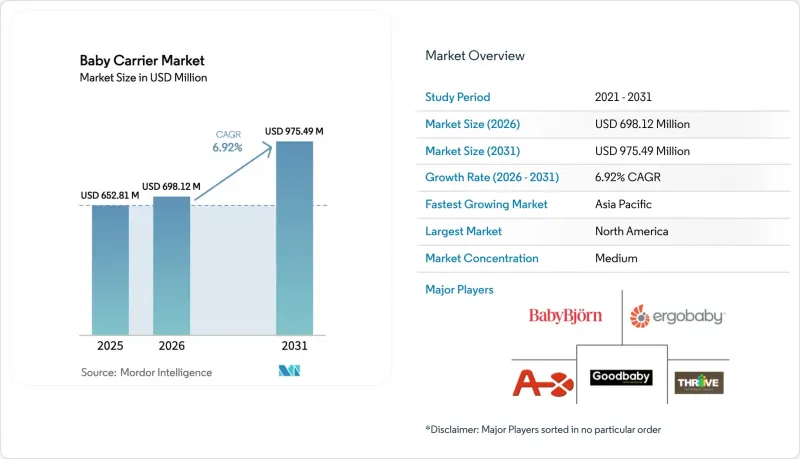
This report is Segmented by Product Type (Buckled Baby Carrier, Baby Wrap Carrier, and More), Price Range (Mass, Premium), Distribution Channel (Supermarkets/Hypermarkets, Online Retail Stores, and More), Age Group (Infant, Baby, and Toddler) and Geography (North America, Europe, Asia-Pacific, South America, and Middle East and Africa). The Market Forecasts are Provided in Terms of Value (USD).
Global Baby Carrier Market Trends and Insights
Urban millennial adoption of baby-wearing culture
Millennial parents, now the dominant cohort of first-time buyers, treat baby-wearing as a lifestyle statement rather than a utilitarian choice, driving demand for aesthetically differentiated products that signal attachment-parenting values. The U.S. Bureau of Labor Statistics reported that 68.3% of mothers with children under 6 participated in the labor force in 2024, creating a structural need for hands-free caregiving solutions that integrate into commuting and errand routines. Ergobaby's 2024 launch of the Embrace Cozy Newborn Carrier, emphasizing soft-structured design for skin-to-skin contact, reflects manufacturers' pivot toward products that blend ergonomic function with emotional resonance. Urban density amplifies this trend, as public-transit navigation and apartment living favor compact, wearable solutions over bulky strollers. The International Hip Dysplasia Institute's endorsement of specific carrier models further legitimizes baby-wearing within pediatric circles, converting clinical recommendations into purchase triggers.
Omni-channel expansion of DTC premium brands
Direct-to-consumer brands bypass traditional retail intermediaries, capturing 25-35% gross margins versus 15-20% for wholesale-dependent peers, and reinvest savings into content marketing and influencer partnerships that drive online conversion rates above 3.5%. Walmart and Kohl's both launched baby registries in 2024-2025 with omni-channel fulfillment, enabling customers to order online and pick up in-store within hours, a capability that premium DTC entrants like BabyBjorn and Ergobaby now replicate through partnerships with specialty retailers. Amazon's dominance in baby products, capturing an estimated 40% of U.S. online baby-gear sales, forces brands to maintain Amazon storefronts while simultaneously building owned e-commerce channels to protect pricing integrity. The shift to omni-channel also reduces inventory risk, as brands can test new SKUs online before committing to retail shelf space, accelerating product-development cycles from 18 months to under 12.
Persistently low birth rates in East Asia and Southern Europe regions
In 2024, Japan's fertility rate stands at 1.2, while South Korea's is even lower at 0.7. These figures highlight a persistent demographic decline in both nations, one that policy interventions have yet to reverse. According to the World Bank, this trend narrows the addressable market in two regions that have historically been deemed high-value. Italy and Spain, also hovering around a fertility rate of 1.2, are on a similar path. Their aging populations further curtail the household spending typically directed towards baby products. Meanwhile, China's fertility rate, recorded at 1.0, continues to reflect the challenges posed by urbanization and escalating education costs. Despite China's 2021 reversal of its one-child policy, these factors have effectively deterred many from considering second or third births. Highlighting the impact of these domestic challenges, Goodbaby International reported a notable 7.9% decline in revenue for the first half of 2024, emphasizing how local headwinds can overshadow potential international growth. Furthermore, these markets are characterized by strong brand loyalty, posing significant challenges for newcomers aiming to displace established players. Compounding this challenge is a trend of distribution consolidation among major retailers, which has led to a diminished shelf space for niche or emerging brands. Looking ahead, this demographic drag is poised to intensify until 2031. As cohorts, born during previous low-fertility periods, reach their prime childbearing years, the cycle is set to perpetuate.
Other drivers and restraints analyzed in the detailed report include:
- Rising birth rates in emerging economies
- Increasing number of working parents
- Proliferation of counterfeit/low-quality products
For complete list of drivers and restraints, kindly check the Table Of Contents.
Geography Analysis
North America accounted for 37.05% of the 2025 market share, supported by the enforcement of 16 CFR Part 1226 by the U.S. Consumer Product Safety Commission (CPSC) in February 2025. This regulation mandates third-party testing for soft infant carriers, creating barriers for non-compliant importers and favoring brands with the resources to fund CPSC-accredited lab testing, which costs USD 5,000-10,000 per SKU. The region benefits from high disposable incomes, with median household income exceeding USD 70,000 in the United States and CAD 85,000 in Canada. This supports an 8.41% CAGR in the premium segment, as consumers increasingly opt for organic fabrics and products certified by reputable organizations, such as the International Hip Dysplasia Institute. In Mexico, the expanding middle class, projected to reach 40 million households by 2030, drives demand for mass-tier carriers priced between USD 30 and USD 60. Brands like Infantino and Baby K'tan are expanding their distribution through retailers such as Walmart and Soriana. However, tariff-driven inflation in early 2025 increased baby-gear prices by 20%, reducing affordability for mass-market buyers while creating opportunities for domestic manufacturers marketing "Made in USA" products. Additionally, the region's 68.3% labor-force participation rate among mothers with children under six sustains demand for hands-free caregiving solutions. Employers' adoption of on-site childcare, following updated U.S. Department of Labor guidelines in 2024, has further normalized baby-wearing in professional settings, as reported by the U.S. Bureau of Labor Statistics.
The Asia-Pacific region is the fastest-growing, with a 5.92% CAGR projected through 2031. This growth is driven by high birth rates in India (16.8 births per 1,000 population) and Indonesia (15.9 births per 1,000 population), which sustain absolute birth volumes despite China's declining total fertility rate of 1.0. Rising disposable incomes in urban centers are shifting consumer preferences from unbranded wraps to structured carriers that emphasize quality and safety, according to the World Bank. Goodbaby's Cybex brand has gained traction in Jakarta and Surabaya through partnerships with premium department stores. However, the company's 7.9% revenue decline in H1 2024 highlights how macroeconomic challenges in China offset gains in other markets. Japan and South Korea, with total fertility rates of 1.2 and 0.7, respectively, face structural demographic declines that have not been reversed by policy interventions, shrinking the addressable market in these historically high-value regions. Southeast Asia's rapid urbanization and growing middle class provide a demographic tailwind; however, fragmented distribution infrastructure and import tariffs ranging from 15% to 35% pose significant challenges. Australia and New Zealand, though smaller markets, exhibit high per-capita spending on baby products and strong consumer preference for safety-certified carriers, benefiting brands like BabyBjorn and Ergobaby that comply with voluntary Australian standards.
Europe's market reflects maturity, characterized by high safety awareness and stringent compliance with the EN 13209-1:2021 standards. Germany, the United Kingdom, and France account for the majority of regional demand, while Southern Europe, including Italy and Spain, faces demographic challenges due to declining birth rates, with total fertility rates near 1.2, as reported by the World Bank. Sustainability is a key driver in the region, with demand for organic cotton and recycled materials on the rise. Brands unable to substantiate environmental claims risk backlash on social media, where accusations of greenwashing can spread rapidly. Poland and Sweden, though smaller markets, show above-average growth due to rising incomes and government childcare subsidies that support household spending on baby products. South America and the Middle East and Africa remain emerging markets. In South America, countries such as Brazil, Argentina, and Colombia exhibit birth rates above 13 per 1,000 population, but face challenges due to fragmented retail infrastructure and import tariffs that add 15-35% to landed costs. In the Middle East, the United Arab Emirates and Saudi Arabia lead regional demand, driven by high expatriate populations and disposable incomes. In Africa, countries like Nigeria and Egypt sustain volume growth with birth rates exceeding 25 per 1,000 population, though affordability constraints limit penetration in the premium segment.
- Artsana Group (Chicco)
- BabyBjorn AB
- Ergobaby Inc.
- Goodbaby International Holdings Ltd
- Thrive International Inc. (Moby Wrap)
- Stokke AS
- Blue Box Corp. (Infantino)
- LILLEbaby LLC
- Boba Inc.
- Be Lenka s.r.o.
- WildBird LLC
- Storchenwiege (Schwartzer GmbH)
- Najell AB
- Onya Baby Inc.
- Baby K'tan LLC
- Tula (Baby Tula)
- Didymos GmbH
- Hoppediz GmbH & Co KG
- Kol Kol Baby Carrier
- i-Angel (Angel Carrier)
- Napro Ltd (KeaBabies)
Additional Benefits:
- The market estimate (ME) sheet in Excel format
- 3 months of analyst support
TABLE OF CONTENTS
1 INTRODUCTION
- 1.1 Study Assumptions and Market Definition
- 1.2 Scope of the Study
2 RESEARCH METHODOLOGY
3 EXECUTIVE SUMMARY
4 MARKET DYNAMICS
- 4.1 Market Overview
- 4.2 Market Drivers
- 4.2.1 Urban millennial adoption of baby-wearing culture
- 4.2.2 Omni-channel expansion of DTC premium brands
- 4.2.3 Post-pandemic outdoor and travel baby-wearing boom
- 4.2.4 Rising birth rates in emerging economies
- 4.2.5 Increasing number of working parents
- 4.2.6 Influence of social-media parenting communities
- 4.3 Market Restraints
- 4.3.1 Fragmented regional safety standards
- 4.3.2 Persistently low birth rates in East Asia and Southern Europe Regions
- 4.3.3 High costs of premium carriers
- 4.3.4 Proliferation of counterfeit/low-quality products
- 4.4 Consumer Behaviour Analysis
- 4.5 Regulatory Outlook
- 4.6 Technological Outlook
- 4.7 Porter's Five Forces
- 4.7.1 Threat of New Entrants
- 4.7.2 Bargaining Power of Buyers
- 4.7.3 Bargaining Power of Suppliers
- 4.7.4 Threat of Substitute Products
- 4.7.5 Intensity of Competitive Rivalry
5 MARKET SIZE AND GROWTH FORECASTS (VALUE)
- 5.1 By Product Type
- 5.1.1 Buckled Baby Carrier
- 5.1.2 Baby Wrap Carrier
- 5.1.3 Baby Sling Carrier
- 5.1.4 Other Product Type
- 5.2 By Price Range
- 5.2.1 Mass
- 5.2.2 Premium
- 5.3 By Age Group
- 5.3.1 Infant (0-6 months)
- 5.3.2 Baby (6-12 months)
- 5.3.3 Toddler (12-36 months)
- 5.4 By Distribution Channel
- 5.4.1 Supermarkets/Hypermarkets
- 5.4.2 Specialty Baby Stores
- 5.4.3 Online Retailers
- 5.4.4 Other Distribution Channels
- 5.5 By Geography
- 5.5.1 North America
- 5.5.1.1 United States
- 5.5.1.2 Canada
- 5.5.1.3 Mexico
- 5.5.1.4 Rest of North America
- 5.5.2 Europe
- 5.5.2.1 Germany
- 5.5.2.2 United Kingdom
- 5.5.2.3 Italy
- 5.5.2.4 France
- 5.5.2.5 Spain
- 5.5.2.6 Netherlands
- 5.5.2.7 Poland
- 5.5.2.8 Belgium
- 5.5.2.9 Sweden
- 5.5.2.10 Rest of Europe
- 5.5.3 Asia-Pacific
- 5.5.3.1 China
- 5.5.3.2 India
- 5.5.3.3 Japan
- 5.5.3.4 Australia
- 5.5.3.5 Indonesia
- 5.5.3.6 South Korea
- 5.5.3.7 Thailand
- 5.5.3.8 Singapore
- 5.5.3.9 Rest of Asia-Pacific
- 5.5.4 South America
- 5.5.4.1 Brazil
- 5.5.4.2 Argentina
- 5.5.4.3 Colombia
- 5.5.4.4 Chile
- 5.5.4.5 Peru
- 5.5.4.6 Rest of South America
- 5.5.5 Middle East and Africa
- 5.5.5.1 South Africa
- 5.5.5.2 Saudi Arabia
- 5.5.5.3 United Arab Emirates
- 5.5.5.4 Nigeria
- 5.5.5.5 Egypt
- 5.5.5.6 Morocco
- 5.5.5.7 Turkey
- 5.5.5.8 Rest of Middle East and Africa
- 5.5.1 North America
6 COMPETITIVE LANDSCAPE
- 6.1 Market Concentration
- 6.2 Strategic Moves
- 6.3 Market Positioning Analysis
- 6.4 Company Profiles (includes Global level Overview, Market level overview, Core Segments, Financials, Strategic Information, Market Rank/Share, Products and Services, Recent Developments)
- 6.4.1 Artsana Group (Chicco)
- 6.4.2 BabyBjorn AB
- 6.4.3 Ergobaby Inc.
- 6.4.4 Goodbaby International Holdings Ltd
- 6.4.5 Thrive International Inc. (Moby Wrap)
- 6.4.6 Stokke AS
- 6.4.7 Blue Box Corp. (Infantino)
- 6.4.8 LILLEbaby LLC
- 6.4.9 Boba Inc.
- 6.4.10 Be Lenka s.r.o.
- 6.4.11 WildBird LLC
- 6.4.12 Storchenwiege (Schwartzer GmbH)
- 6.4.13 Najell AB
- 6.4.14 Onya Baby Inc.
- 6.4.15 Baby K'tan LLC
- 6.4.16 Tula (Baby Tula)
- 6.4.17 Didymos GmbH
- 6.4.18 Hoppediz GmbH & Co KG
- 6.4.19 Kol Kol Baby Carrier
- 6.4.20 i-Angel (Angel Carrier)
- 6.4.21 Napro Ltd (KeaBabies)
7 MARKET OPPORTUNITIES AND FUTURE TRENDS

