PUBLISHER: Mordor Intelligence | PRODUCT CODE: 2122692

PUBLISHER: Mordor Intelligence | PRODUCT CODE: 2122692
Toothpaste - Market Share Analysis, Industry Trends & Statistics, Growth Forecasts (2026 - 2031)
According to Mordor Intelligence, the global toothpaste market size was valued at USD 29.32 billion in 2025 and estimated to grow from USD 29.92 billion in 2026 to reach USD 33.08 billion by 2031, at a CAGR of 2.03% during the forecast period (2026-2031).
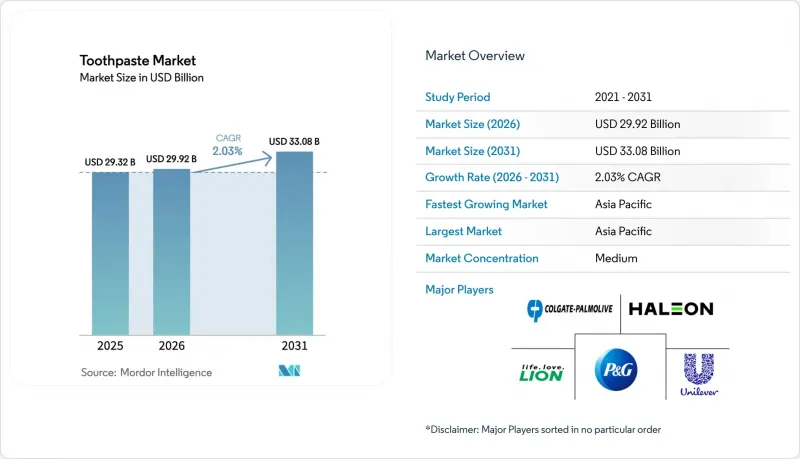
This report is Segmented by Product Type (Standard Toothpaste and Functional/Medicated Toothpaste), Category (Conventional and Natural/Organic), End User (Adult and Kids), Distribution Channel (Supermarkets/Hypermarkets, Convenience/Grocery Stores, and More), and Geography (North America, Europe, Asia-Pacific, and More). The Market Forecasts are Provided in Terms of Value (USD).
Global Toothpaste Market Trends and Insights
Shift in consumer preference toward herbal and natural formulation-based products
The shift in consumer preference toward herbal and natural formulation-based products is driving the market, as oral care is increasingly perceived not merely as a hygiene routine but as a daily wellness and safety choice. Consumers across all age groups are becoming more aware of the long-term effects of synthetic chemicals, particularly in products used multiple times daily and occasionally ingested in small amounts. This awareness has led to a significant shift toward plant-based, gentle, and traditionally inspired oral care solutions. This trend is especially prominent among families with children, health-conscious adults, and individuals adopting holistic or clean-living lifestyles, who prioritize products that align with natural wellness, transparency, and preventive healthcare principles. For example, in December 2024, Dabur India expanded its toothpaste portfolio by launching Dabur Herb'l Kids Toothpaste, designed specifically for cavity protection in children above three years of age. The product is free from harmful chemicals such as fluoride, parabens, peroxide, and triclosan, and contains no artificial flavors. Such product launches highlight how brands are leveraging the herbal and natural movement to build trust, differentiate their offerings, and attract new user groups, particularly in the pediatric and family segments.
Growing demand for toothpaste catering to sensitive teeth
The increasing demand for toothpaste designed for sensitive teeth is driving growth in the global toothpaste market, as sensitivity has become a prevalent and persistent oral health issue across all age groups. Modern diets rich in acidic beverages and sugars, combined with aggressive brushing, whitening practices, and untreated tooth decay, are gradually eroding enamel and exposing dentin. This exposure causes pain or discomfort during activities such as eating, drinking, or brushing. Consequently, toothpaste has evolved from a basic cleaning product to a daily solution for pain management and enamel protection, leading to greater reliance on sensitivity-focused variants for long-term use. For instance, in Saudi Arabia, data from the Ministry of Health indicates that tooth decay affected 96% of children aged 6 years and 93.7% of children aged 12 years in 2025 . These figures underscore the widespread nature of early-stage dental damage, which is likely to progress into chronic sensitivity and enamel issues later in life. Such high prevalence rates are driving both parents and adults to prioritize toothpaste that protects weakened teeth and alleviates discomfort, thereby accelerating the adoption of specialized sensitivity-focused products.
Continued reliance on traditional tooth cleaning practices
Reliance on traditional tooth-cleaning practices continues to restrain the growth of the global toothpaste market. Cultural habits, generational knowledge, and accessibility significantly influence oral care behaviors in many regions. A considerable portion of the population still uses alternatives such as chewing sticks, neem twigs, charcoal, salt, ash, herbal powders, or water-only brushing as their primary oral hygiene methods. These practices are often perceived as more natural, culturally trusted, or spiritually aligned compared to modern toothpaste. As a result, the frequency and volume of toothpaste usage remain limited, even in areas where toothbrush ownership is increasing. Furthermore, traditional methods are deeply ingrained in family routines and local belief systems, making behavioral change gradual despite rising awareness of modern dental care. This presents a structural challenge for toothpaste brands, which must not only compete with other brands but also work to replace entrenched cultural habits. Addressing this issue requires significant investment in education, community outreach, and behavioral change initiatives.
Other drivers and restraints analyzed in the detailed report include:
- Enhanced marketing and advertising strategies by brands
- Product innovation emphasizing ingredients and functionality
- Rising concerns about chemical ingredients in products
For complete list of drivers and restraints, kindly check the Table Of Contents.
Segment Analysis
Standard toothpaste accounted for 53.64% of the total market share in 2025 and continues to dominate due to its role as the primary daily-use oral hygiene solution for the majority of the global population. It serves as the foundation of preventive dental care across all age groups and income levels. Standard toothpaste products primarily focus on cavity protection, plaque removal, basic gum care, and fresh breath, making them suitable for everyday use without the complexities or risks associated with medicated or highly specialized formulations. This category also benefits from its adaptability, as manufacturers consistently enhance standard toothpaste with improved abrasives, advanced foaming systems, enamel-safe whitening agents, herbal extracts, and mild antibacterial compounds. These innovations allow the category to evolve while maintaining its broad consumer appeal.
Functional and medicated toothpaste variants, projected to grow at a 2.53% CAGR through 2031, are emerging as a strategically significant growth driver within the global toothpaste market. As oral care increasingly shifts from basic hygiene to therapeutic, condition-specific treatment, these variants deliver targeted active ingredients such as anti-inflammatory agents, antibacterial compounds, potassium nitrate, arginine, stannous fluoride, hydroxyapatite, enzymes, and biofilm-control systems. This transformation positions toothpaste as a daily therapeutic tool rather than merely a cleaning product. Additionally, the rise in consumer self-diagnosis and preventive health behaviors is encouraging users to proactively select specialized toothpaste options instead of waiting for clinical intervention.
Conventional toothpaste, which held a dominant 72.31% market share in 2025, remains a cornerstone of the industry due to its widespread acceptance, professional endorsement, and ingrained role in daily oral care routines worldwide. This category is deeply rooted in hygiene habits, having been adopted across generations as the primary defense against cavities, plaque, bad breath, and gum issues. Consumers trust conventional toothpaste for its safety, predictability, and effectiveness in long-term daily use, which minimizes resistance to continued consumption. Additionally, the category continues to evolve through incremental improvements, such as enhanced whitening, improved mouthfeel, and advanced protection claims, ensuring its relevance as oral care needs change.
Natural and organic toothpaste, growing at a 2.92% CAGR through 2031, is emerging as a significant growth driver in the global toothpaste market. This category is gaining traction as consumers increasingly associate oral hygiene with overall wellness, long-term safety, and lifestyle alignment. The demand for gentler, more mindful daily-care products that integrate into holistic health and clean-living routines is fueling this growth. Consumers are also prioritizing products perceived as transparent, minimally processed, and aligned with their personal well-being, especially given their frequent and long-term use. Furthermore, sustainability and ethical consumption trends are amplifying the appeal of natural and organic toothpaste, particularly among younger, health-conscious, and environmentally aware consumers who view oral care as part of a broader commitment to responsible living.
Complete Report Scope:
- By Product Type
- Standard Toothpaste
- Functional/Medicated Toothpaste
- By Category
- Conventional
- Natural/Organic
- By End User
- Adult
- Kids
- By Distribution Channel
- Supermarkets/Hypermarkets
- Convenience/Grocery Stores
- Pharmacies/Drug Stores
- Online Retail Stores
- Other Distribution Channels
- By Geography
- North America
- United States
- Canada
- Mexico
- Rest of North America
- Europe
- Germany
- United Kingdom
- Italy
- France
- Spain
- Netherlands
- Poland
- Belgium
- Sweden
- Rest of Europe
- Asia-Pacific
- China
- India
- Japan
- Australia
- Indonesia
- South Korea
- Thailand
- Singapore
- Rest of Asia-Pacific
- South America
- Brazil
- Argentina
- Colombia
- Chile
- Peru
- Rest of South America
- Middle East and Africa
- South Africa
- Saudi Arabia
- United Arab Emirates
- Nigeria
- Egypt
- Morocco
- Turkey
- Rest of Middle East and Africa
- North America
Geography Analysis
In 2025, Asia-Pacific accounted for 33.14% of global toothpaste revenue and is projected to maintain the fastest regional growth with a 4.12% CAGR through 2031. The region's growth is driven by rising middle-class consumption, government-led oral hygiene campaigns, and localized product innovations tailored to diverse cultural and dental needs. Countries in South and Southeast Asia are implementing school-based brushing programs, public dental awareness initiatives, and preventive healthcare measures, embedding toothpaste usage into daily routines from an early age. Simultaneously, manufacturers are introducing region-specific flavors, formats, and benefit-focused variants to align with local preferences, sensitivity levels, and wellness demands. This combination of institutional support, expanding retail access, and tailored innovation positions Asia-Pacific as the largest and fastest-growing consumption hub in the global toothpaste market.
North America and Europe are characterized by mature, high-value toothpaste markets with very high per-capita consumption, strong brand loyalty, and widespread adoption of premium and functional products. In these regions, toothpaste is deeply integrated into preventive healthcare and daily self-care routines, driving consistent replacement and upgrade cycles rather than basic penetration growth. Consumers increasingly demand specialized solutions for gum health, whitening, sensitivity, and enamel protection, supporting premiumization and product innovation despite slower population growth. However, stringent regulatory frameworks and clinical substantiation requirements shape these markets, raising entry barriers while enhancing consumer trust and product credibility. This dynamic enables established brands to sustain stable, high-margin demand.
L39: South America, the Middle East, and Africa present significant growth potential as toothpaste adoption evolves from basic oral hygiene to preventive and wellness-oriented care. However, growth in these regions is tempered by economic volatility, uneven retail infrastructure, and healthcare access challenges. Urbanization, rising health awareness, and the expansion of modern retail formats are driving increased toothpaste usage, particularly among younger and working-age populations. Governments and NGOs are also advancing oral health education and community dental programs, accelerating penetration in underserved areas. While logistical challenges and price sensitivity remain obstacles, these regions represent long-term volume growth opportunities, where improving access, awareness, and brand investment are gradually making toothpaste a daily household necessity.
- The Procter and Gamble Company
- Unilever PLC
- Colgate-Palmolive Company
- Haleon PLC
- Lion Corporation
- Dabur India Limited
- Church and Dwight Co. Inc.
- Sunstar Group
- Katjes International GmbH & Co. KG
- Yunnan Baiyao Group Co. Ltd.
- Vicco Laboratories Ltd
- Livionex Inc
- Perrigo Company plc
- Himalaya Global Holdings Ltd.
- Kao Corporation
- Amway Corporation (Glister)
- Patanjali Ayurved Limited
- Ludovico Martelli Srl (Marvis)
- The Honest Company Inc.
- Dr. Bronner's Magic Soaps
Additional Benefits:
- The market estimate (ME) sheet in Excel format
- 3 months of analyst support
TABLE OF CONTENTS
1 INTRODUCTION
- 1.1 Study Assumptions and Market Definition
- 1.2 Scope of the Study
2 RESEARCH METHODOLOGY
3 EXECUTIVE SUMMARY
4 MARKET DYNAMICS
- 4.1 Market Overview
- 4.2 Market Drivers
- 4.2.1 Shift in consumer preference toward herbal and natural formulation-based products
- 4.2.2 Growing demand for toothpaste catering to sensitive teeth
- 4.2.3 Enhanced marketing and advertising strategies by brands
- 4.2.4 Product innovation emphasizing ingredients and functionality
- 4.2.5 Government initiatives supporting oral hygiene awareness
- 4.2.6 Barriers in oral health impacting market expansion
- 4.3 Market Restraints
- 4.3.1 Continued reliance on traditional tooth cleaning practices
- 4.3.2 Rising concerns about chemical ingredients in products
- 4.3.3 Instability in raw material pricing
- 4.3.4 Proliferation of counterfeit products in the market
- 4.4 Value Chain Analysis
- 4.5 Regulatory Landscape
- 4.6 Technological Outlook
- 4.7 Porter's Five Forces Analysis
- 4.7.1 Threat of New Entrants
- 4.7.2 Bargaining Power of Suppliers
- 4.7.3 Bargaining Power of Buyers
- 4.7.4 Threat of Substitutes
- 4.7.5 Intensity of Competitive Rivalry
5 MARKET SIZE AND GROWTH FORECASTS (VALUE)
- 5.1 By Product Type
- 5.1.1 Standard Toothpaste
- 5.1.2 Functional/Medicated Toothpaste
- 5.2 By Category
- 5.2.1 Conventional
- 5.2.2 Natural/Organic
- 5.3 By End User
- 5.3.1 Adult
- 5.3.2 Kids
- 5.4 By Distribution Channel
- 5.4.1 Supermarkets/Hypermarkets
- 5.4.2 Convenience/Grocery Stores
- 5.4.3 Pharmacies/Drug Stores
- 5.4.4 Online Retail Stores
- 5.4.5 Other Distribution Channels
- 5.5 By Geography
- 5.5.1 North America
- 5.5.1.1 United States
- 5.5.1.2 Canada
- 5.5.1.3 Mexico
- 5.5.1.4 Rest of North America
- 5.5.2 Europe
- 5.5.2.1 Germany
- 5.5.2.2 United Kingdom
- 5.5.2.3 Italy
- 5.5.2.4 France
- 5.5.2.5 Spain
- 5.5.2.6 Netherlands
- 5.5.2.7 Poland
- 5.5.2.8 Belgium
- 5.5.2.9 Sweden
- 5.5.2.10 Rest of Europe
- 5.5.3 Asia-Pacific
- 5.5.3.1 China
- 5.5.3.2 India
- 5.5.3.3 Japan
- 5.5.3.4 Australia
- 5.5.3.5 Indonesia
- 5.5.3.6 South Korea
- 5.5.3.7 Thailand
- 5.5.3.8 Singapore
- 5.5.3.9 Rest of Asia-Pacific
- 5.5.4 South America
- 5.5.4.1 Brazil
- 5.5.4.2 Argentina
- 5.5.4.3 Colombia
- 5.5.4.4 Chile
- 5.5.4.5 Peru
- 5.5.4.6 Rest of South America
- 5.5.5 Middle East and Africa
- 5.5.5.1 South Africa
- 5.5.5.2 Saudi Arabia
- 5.5.5.3 United Arab Emirates
- 5.5.5.4 Nigeria
- 5.5.5.5 Egypt
- 5.5.5.6 Morocco
- 5.5.5.7 Turkey
- 5.5.5.8 Rest of Middle East and Africa
- 5.5.1 North America
6 COMPETITIVE LANDSCAPE
- 6.1 Market Concentration
- 6.2 Strategic Moves
- 6.3 Market Share Analysis
- 6.4 Company Profiles (includes Global level Overview, Market level overview, Core Segments, Financials as available, Strategic Information, Market Rank/Share for key companies, Products and Services, and Recent Developments)
- 6.4.1 The Procter and Gamble Company
- 6.4.2 Unilever PLC
- 6.4.3 Colgate-Palmolive Company
- 6.4.4 Haleon PLC
- 6.4.5 Lion Corporation
- 6.4.6 Dabur India Limited
- 6.4.7 Church and Dwight Co. Inc.
- 6.4.8 Sunstar Group
- 6.4.9 Katjes International GmbH & Co. KG
- 6.4.10 Yunnan Baiyao Group Co. Ltd.
- 6.4.11 Vicco Laboratories Ltd
- 6.4.12 Livionex Inc
- 6.4.13 Perrigo Company plc
- 6.4.14 Himalaya Global Holdings Ltd.
- 6.4.15 Kao Corporation
- 6.4.16 Amway Corporation (Glister)
- 6.4.17 Patanjali Ayurved Limited
- 6.4.18 Ludovico Martelli Srl (Marvis)
- 6.4.19 The Honest Company Inc.
- 6.4.20 Dr. Bronner's Magic Soaps
7 MARKET OPPORTUNITIES AND FUTURE OUTLOOK

