PUBLISHER: Mordor Intelligence | PRODUCT CODE: 2124640

PUBLISHER: Mordor Intelligence | PRODUCT CODE: 2124640
Ayurvedic Toothpaste - Market Share Analysis, Industry Trends & Statistics, Growth Forecasts (2026 - 2031)
According to Mordor Intelligence, the ayurvedic toothpaste market size is expected to grow from USD 1.40 billion in 2025 to USD 1.6 billion in 2026 and is forecast to reach USD 3.09 billion by 2031 at 14.08% CAGR over 2026-2031.
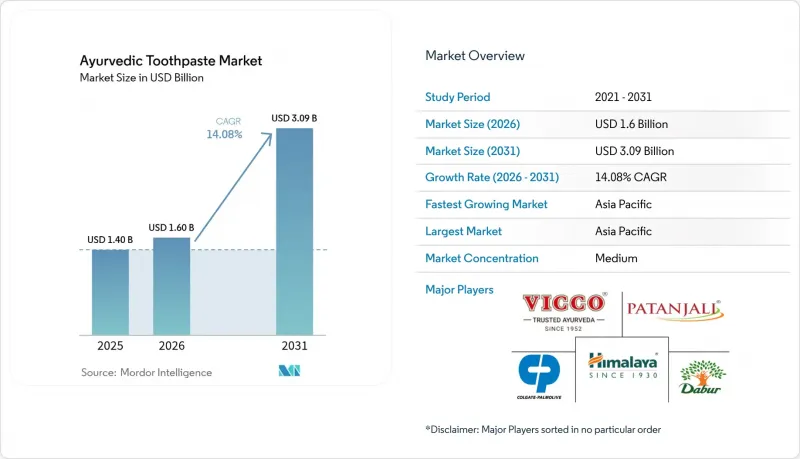
This report is Segmented by Product Type (Gel-Based Toothpaste, Paste-Based Toothpaste, and Others), Price-Tier (Mass and Premium), Packaging Types (Tubes, Jars, and Sachets), End-User (Adults and Kids), Distribution Channel (Supermarkets/Hypermarkets, Convenience Stores, and More) and Geography (North America, Europe, and More). The Market Forecasts are Provided in Terms of Value (USD).
Global Ayurvedic Toothpaste Market Trends and Insights
Rising Preference for Natural Oral Care Products
Consumer preference for Ayurvedic ingredients has reached a tipping point, with over 70% of new toothpaste launches now featuring 'natural' positioning, with Ayurvedic formulations leading this transformation. This shift extends beyond marketing rhetoric to substantive formulation changes, as manufacturers replace synthetic chemicals with traditional Ayurvedic ingredients like neem, miswak, turmeric, and amla. Clinical evidence increasingly supports these Ayurvedic ingredients, with peer-reviewed studies demonstrating that formulations containing neem and propolis achieve plaque reduction comparable to chlorhexidine while producing fewer adverse effects. The trend particularly resonates with health-conscious consumers seeking authentic traditional medicine solutions over conventional alternatives. Companies responding to this demand are experiencing accelerated market penetration, with ayurvedic toothpastes now representing a siginificant share of India's overall oral care market.
Increasing Dental Disease Prevention Awareness
Global health initiatives have elevated oral health awareness to unprecedented levels, creating substantial market expansion opportunities for preventive care products based on traditional Ayurvedic principles. The WHO's comprehensive country profiles reveal that oral diseases affect 3.5 billion people worldwide, with untreated dental caries being the most common health condition globally. This awareness translates into increased consumer willingness to invest in premium oral care solutions, particularly those offering natural antimicrobial properties through time-tested Ayurvedic ingredients. Government health agencies increasingly recognize the connection between oral health and systemic conditions, driving public health campaigns that emphasize prevention over treatment. The economic burden of dental diseases, estimated at hundreds of billions annually in treatment costs, has prompted healthcare systems to explore traditional medicine alternatives. This macro-level awareness creates sustained demand for ayurvedic toothpastes that offer both therapeutic benefits and preventive protection through centuries-old formulation wisdom.
Strong Competition From Synthetic Toothpaste
Established synthetic toothpaste brands maintain formidable competitive advantages through decades of consumer habit formation and extensive clinical validation. Colgate-Palmolive's market share demonstrates the entrenched position of conventional formulations, supported by massive distribution networks and marketing budgets. Synthetic toothpastes benefit from standardized manufacturing processes that ensure consistent quality and efficacy, while Ayurvedic alternatives face formulation challenges related to ingredient variability and seasonal availability of traditional herbs. Consumer switching costs remain significant, as established oral care routines create psychological barriers to adopting Ayurvedic alternatives. The competitive intensity has prompted some major brands to retreat from Ayurvedic positioning, with Colgate strategically shifting away from Ayurvedic positioning back to science-based product communication in certain markets. Price competition from synthetic alternatives limits premium pricing opportunities for Ayurvedic brands, particularly in price-sensitive market segments where mass-market synthetic options offer compelling value propositions despite lacking traditional medicine benefits.
Other drivers and restraints analyzed in the detailed report include:
- Government Support for Traditional Medicine Systems
- Intense Brand Marketing and Promotions
- Regulatory and Compliance Challenges
For complete list of drivers and restraints, kindly check the Table Of Contents.
Segment Analysis
Paste-based toothpaste commands 70.62% market share in 2025 while simultaneously representing the fastest-growing segment at 14.22% CAGR through 2031, reflecting both consumer familiarity and successful integration of traditional Ayurvedic ingredients into conventional formats. This dual leadership position stems from manufacturers' ability to incorporate diverse Ayurvedic herbs like neem, babool, miswak, and turmeric into paste formulations while maintaining the sensory experience consumers expect from modern toothpastes. Gel-based alternatives serve niche consumer preferences for lighter textures and enhanced flavor delivery of traditional ingredients, particularly appealing to younger demographics seeking differentiated Ayurvedic experiences. The "Others" category, encompassing traditional powder and tablet formats, represents authentic Ayurvedic delivery methods gaining traction among purists seeking original formulation approaches.
Clinical research supports paste formulations' efficacy advantages, with studies demonstrating that Ayurvedic paste toothpastes containing bamboo salt and traditional herbs achieve significant antibacterial effects in controlled trials. Traditional powder formats face adoption challenges related to usage convenience and foaming expectations, though authenticity benefits create growth opportunities among consumers seeking pure Ayurvedic experiences. Manufacturing economies of scale favor paste formulations, enabling competitive pricing while supporting extensive Ayurvedic ingredient inclusion. The format's versatility allows for specialized variants targeting specific oral health concerns through traditional Ayurvedic principles, from sensitivity management using clove oil to whitening applications through turmeric and activated charcoal combinations.
Mass-market products maintain 73.45% market share in 2025, yet premium segments demonstrate superior growth dynamics at 16.1% CAGR, indicating consumer willingness to invest in authentic Ayurvedic formulations and traditional ingredient sourcing. This pricing bifurcation reflects market maturation, where established Ayurvedic brands command premium positioning through ingredient authenticity, traditional sourcing practices, and clinical validation of ancient formulations. Premium segments benefit from higher profit margins that support continued research into traditional medicine applications and marketing expenditure emphasizing Ayurvedic heritage. The price gap enables premium brands to incorporate expensive traditional extracts like saffron, gold bhasma, and rare medicinal plants that justify higher retail prices through authentic Ayurvedic positioning.
Consumer research indicates that premium ayurvedic toothpaste purchasers prioritize ingredient authenticity and traditional formulation methods over price considerations, creating relatively inelastic demand patterns. Mass-market segments face intense price competition and margin pressure, driving consolidation among smaller players lacking economies of scale for authentic ingredient sourcing. The premium segment's growth trajectory suggests successful brand building and consumer education efforts that establish ayurvedic toothpastes as legitimate alternatives to conventional premium oral care products. Distribution channel partnerships with Ayurvedic specialty stores and wellness retailers support premium positioning by providing expert recommendation opportunities and enhanced product credibility through traditional medicine context.
Complete Report Scope:
- By Product Type
- Gel-Based Toothpaste
- Paste-Based Toothpaste
- Others
- By Price-Tier
- Mass
- Premium
- By Packaging Type
- Tubes
- Jars
- Others
- By End-User
- Adults
- Kids
- By Distribution Channel
- Supermarkets/Hypermarkets
- Convenience/Grocery Stores
- Pharmacies/Drug Stores
- Online Retail Stores
- Other Distribution Channels
- By Geography
- North America
- United States
- Canada
- Rest of North America
- Europe
- Germany
- United Kingdom
- Italy
- France
- Spain
- Rest of Europe
- Asia-Pacific
- China
- India
- Japan
- Australia
- Rest of Asia-Pacific
- South America
- Brazil
- Argentina
- Rest of South America
- Middle East and Africa
- South Africa
- Saudi Arabia
- United Arab Emirates
- Rest of Middle East and Africa
- North America
Geography Analysis
Asia-Pacific dominates the global ayurvedic toothpaste landscape with 82.44% market share in 2025 and leads growth projections at 15.43% CAGR through 2031, reflecting deep cultural integration of Ayurvedic medicine systems and government policy support for traditional healthcare products. India represents the region's primary growth engine, where ayurvedic toothpastes have captured a significant share of the overall oral care market, supported by companies like Dabur through strategic Ayurvedic positioning and authentic traditional formulations. China's market development follows distinct patterns, with new toothpaste regulations requiring comprehensive safety assessments for traditional ingredients while creating structured pathways for Ayurvedic medicine integration. Japan and Australia contribute to regional growth through premium positioning strategies that emphasize ingredient quality and clinical validation of traditional Ayurvedic principles, appealing to health-conscious consumers willing to pay premium prices for authentic traditional medicine solutions.
North America represents the second-largest regional market, driven by consumer health consciousness trends and increasing acceptance of alternative medicine approaches including traditional Ayurvedic oral care. The US oral care market, valued at USD 14.8 billion in 2022 with 4.2% CAGR through 2030, provides substantial opportunities for ayurvedic toothpaste penetration among consumers seeking natural alternatives to conventional formulations. FDA regulatory frameworks for oral care products create structured pathways for traditional ingredient validation while ensuring consumer safety standards for Ayurvedic formulations. Canadian market development follows similar patterns, with premium positioning and natural health product regulations supporting ayurvedic toothpaste market expansion. The region benefits from advanced e-commerce infrastructure that facilitates direct-to-consumer marketing and education about traditional Ayurvedic ingredients and their historical applications in oral health.
Europe demonstrates growing acceptance of ayurvedic oral care products, supported by traditional herbal medicine regulations that provide market access pathways for standardized Ayurvedic formulations. The European Medicines Agency's recognition frameworks for traditional herbal medicines create regulatory clarity while ensuring product safety and efficacy standards for traditional Indian medicine products. Germany and the United Kingdom lead regional adoption through established natural health product markets and consumer willingness to invest in premium oral care solutions based on traditional medicine principles. However, the region faces regulatory complexity with 2025 cosmetic regulations introducing ingredient restrictions that may affect traditional Ayurvedic formulations, requiring companies to navigate evolving compliance requirements. Southern European markets, including Italy, France, and Spain, show increasing interest in Ayurvedic oral care alternatives, though adoption rates remain below Northern European levels due to stronger conventional brand loyalty and limited familiarity with traditional Indian medicine principles.
- Patanjali Ayurved Limited
- Dabur India Limited
- Colgate-Palmolive Company
- Himalaya Wellness Company
- Viccolabs
- Procter & Gamble
- Unilever PLC
- The Clorox Company
- Amway Corp.
- GlaxoSmithKline plc
- Marico Limited
- Ayurvedic Health Care Pvt. Ltd.
- Neemli Naturals
- Charak Pharma Pvt. Ltd.
- M.S. Kannan & Co.
- Herbalife Nutrition Ltd.
- Nature's Way Products, LLC
- Zandu Realty Ltd.
- Tanmai Biosciences
- Green Veda
Additional Benefits:
- The market estimate (ME) sheet in Excel format
- 3 months of analyst support
TABLE OF CONTENTS
1 INTRODUCTION
- 1.1 Study Assumptions and Market Definition
- 1.2 Scope of the Study
2 RESEARCH METHODOLOGY
3 EXECUTIVE SUMMARY
4 MARKET LANDSCAPE
- 4.1 Market Overview
- 4.2 Market Drivers
- 4.2.1 Rising Preference for Natural Oral Care Products
- 4.2.2 Increasing Dental Disease Prevention Awareness
- 4.2.3 Government Support for Traditional Medicine Systems
- 4.2.4 Intense Brand Marketing and Promotions
- 4.2.5 Growing Sustainability and Ethical Sourcing Focus
- 4.2.6 Expansion of Online and Supermarket Channels
- 4.3 Market Restraints
- 4.3.1 Strong Competition From Synthetic Toothpaste
- 4.3.2 Regulatory and Compliance Challenges
- 4.3.3 Unpleasant Taste Limits Consumer Acceptance
- 4.3.4 Low Awareness in Emerging Markets
- 4.4 Consumer Demand Analysis
- 4.5 Regulatory Landscape
- 4.6 Porter's Five Forces
- 4.6.1 Threat of New Entrants
- 4.6.2 Bargaining Power of Buyers
- 4.6.3 Bargaining Power of Suppliers
- 4.6.4 Threat of Substitutes
- 4.6.5 Competitive Rivalry
5 MARKET SIZE AND GROWTH FORECASTS (VALUE)
- 5.1 By Product Type
- 5.1.1 Gel-Based Toothpaste
- 5.1.2 Paste-Based Toothpaste
- 5.1.3 Others
- 5.2 By Price-Tier
- 5.2.1 Mass
- 5.2.2 Premium
- 5.3 By Packaging Type
- 5.3.1 Tubes
- 5.3.2 Jars
- 5.3.3 Others
- 5.4 By End-User
- 5.4.1 Adults
- 5.4.2 Kids
- 5.5 By Distribution Channel
- 5.5.1 Supermarkets/Hypermarkets
- 5.5.2 Convenience/Grocery Stores
- 5.5.3 Pharmacies/Drug Stores
- 5.5.4 Online Retail Stores
- 5.5.5 Other Distribution Channels
- 5.6 By Geography
- 5.6.1 North America
- 5.6.1.1 United States
- 5.6.1.2 Canada
- 5.6.1.3 Rest of North America
- 5.6.2 Europe
- 5.6.2.1 Germany
- 5.6.2.2 United Kingdom
- 5.6.2.3 Italy
- 5.6.2.4 France
- 5.6.2.5 Spain
- 5.6.2.6 Rest of Europe
- 5.6.3 Asia-Pacific
- 5.6.3.1 China
- 5.6.3.2 India
- 5.6.3.3 Japan
- 5.6.3.4 Australia
- 5.6.3.5 Rest of Asia-Pacific
- 5.6.4 South America
- 5.6.4.1 Brazil
- 5.6.4.2 Argentina
- 5.6.4.3 Rest of South America
- 5.6.5 Middle East and Africa
- 5.6.5.1 South Africa
- 5.6.5.2 Saudi Arabia
- 5.6.5.3 United Arab Emirates
- 5.6.5.4 Rest of Middle East and Africa
- 5.6.1 North America
6 COMPETITIVE LANDSCAPE
- 6.1 Market Concentration
- 6.2 Strategic Moves
- 6.3 Market Share Analysis
- 6.4 Company Profiles (includes Global level Overview, Market level overview, Core Segments, Financials as available, Strategic Information, Market Rank/Share for key companies, Products and Services, and Recent Developments)
- 6.4.1 Patanjali Ayurved Limited
- 6.4.2 Dabur India Limited
- 6.4.3 Colgate-Palmolive Company
- 6.4.4 Himalaya Wellness Company
- 6.4.5 Viccolabs
- 6.4.6 Procter & Gamble
- 6.4.7 Unilever PLC
- 6.4.8 The Clorox Company
- 6.4.9 Amway Corp.
- 6.4.10 GlaxoSmithKline plc
- 6.4.11 Marico Limited
- 6.4.12 Ayurvedic Health Care Pvt. Ltd.
- 6.4.13 Neemli Naturals
- 6.4.14 Charak Pharma Pvt. Ltd.
- 6.4.15 M.S. Kannan & Co.
- 6.4.16 Herbalife Nutrition Ltd.
- 6.4.17 Nature's Way Products, LLC
- 6.4.18 Zandu Realty Ltd.
- 6.4.19 Tanmai Biosciences
- 6.4.20 Green Veda
7 MARKET OPPORTUNITIES AND FUTURE OUTLOOK

