PUBLISHER: Mordor Intelligence | PRODUCT CODE: 2122746

PUBLISHER: Mordor Intelligence | PRODUCT CODE: 2122746
Connected Street Lighting - Market Share Analysis, Industry Trends & Statistics, Growth Forecasts (2026 - 2031)
According to Mordor Intelligence, the connected street lighting market size is projected to reach USD 4.82 billion by 2031, reflecting a 13.49% CAGR over the forecast period, from USD 2.56 billion in 2026.
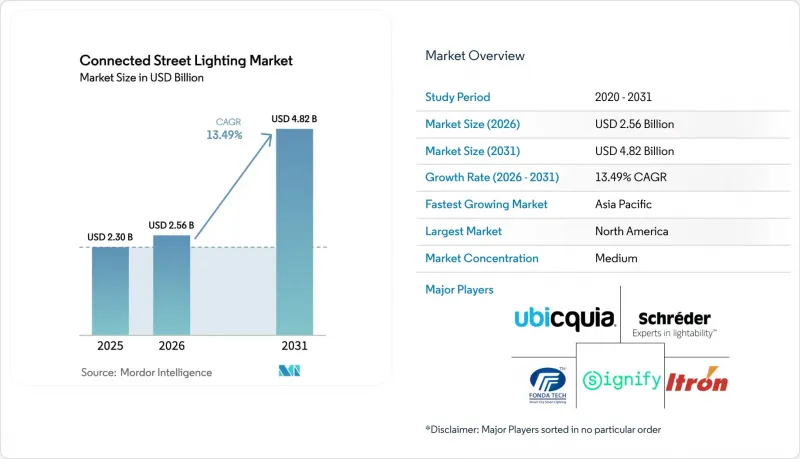
This report is Segmented by Component (Hardware, Software, Services), Connectivity (RF Mesh - Wi-SUN and IEEE 802. 15. 4g, and More), Application (Smart Dimming and Policy-Based Scheduling, and More ), End User (Municipalities and Local Governments, Electric Utilities and Distribution System Operators, and More), and Geography. The Market Forecasts are Provided in Terms of Value (USD).
Global Connected Street Lighting Market Trends and Insights
Rising Electricity Prices and Energy Efficiency Mandates Compound Retrofit Economics
Networked LED streetlights with controls have delivered measurable energy and O&M cuts in large programs, which strengthens the business case for scale. Chicago's 290,000 fixture rollout reduced annual electricity expenses by USD 8.7 million and generated USD 37 million in utility rebates over five years, while carbon reductions totaled 134,600 metric tons by September 2022. Revenue-grade metering in smart lighting platforms supports compliance and streamlined reporting, eliminating the need for costly substation instrumentation. Ontario's 2025 grid-planning guidance emphasizes non-wires strategies during project screening, positioning adaptive lighting as a flexible demand-response tool for utilities and municipalities. Procurement teams increasingly link controller-capable luminaires to rebate eligibility and decarbonization tracking, reinforcing the role of connected lighting in municipal energy policy. These dynamics underpin durable demand in the smart street lighting management systems market as cities aim to protect budgets and meet climate targets.
Acceleration of Smart City Programs and PPP Procurement De-Risks Municipal Balance Sheets
Public-private partnerships enable cities to shift performance risk and transform energy savings into predictable payments over multi-year terms. Serbia's Pozega project under an energy service structure is cited as a practical template for smaller municipalities that lack upfront capital but need modernization and verifiable outcomes. India's Smart Cities Mission directs sizable funding to corridor illumination, intelligent intersections, and connected poles, which sustains high-volume tenders and accelerates digital infrastructure in fast-growing urban clusters. These models also attract infrastructure funds that prefer long-duration, utility-like cash flows anchored in verified energy reductions. As multi-party agreements mature, performance guarantees, remote monitoring, and open-data clauses become standard, which reduces perceived vendor risk and advances bankability. This structural shift supports steady growth in the smart street lighting management systems market where fiscal constraints would otherwise stall upgrades.
High Upfront Costs, Complex Tendering and Financing Disproportionately Burden Smaller Municipalities
Network-ready luminaires and controller rollouts add capital intensity that is difficult for small cities to absorb within one budget cycle. Performance-based contracts and availability-payment PPPs move energy-savings risk to private operators, but they can extend procurement timelines due to verification and monitoring requirements. Municipalities evaluate Lighting-as-a-Service to eliminate upfront equipment costs and shift to predictable monthly fees backed by quantifiable O&M savings. Utility alignment around non-wires solutions makes adaptive lighting more attractive where network upgrades would otherwise be approved, although documentation needs and cross-department coordination can slow approvals. Even with long-term savings, smaller towns face elevated tendering overhead, which tempers near-term adoption in the smart street lighting management systems market.
Other drivers and restraints analyzed in the detailed report include:
- Rapid Shift to Cellular Controls for Plug-and-Play Deployments Sidesteps Mesh Gateway Overhead
- Interoperability via Zhaga-D4i, DALI-2, and TALQ Improving Vendor Neutrality Unlocks Multi-Decade Asset Life
- Cybersecurity, Data Governance, and Sovereignty Concerns Elevate Compliance Overhead and Slow Vendor Selection
For complete list of drivers and restraints, kindly check the Table Of Contents.
Segment Analysis
Hardware captured 62% of the smart street lighting management systems market in 2025, while software and services are growing at 13.65% CAGR as cities adopt central management systems that enable remote control, firmware updates, and carbon-accounting dashboards. City platforms such as Interact and similar SaaS offerings have shifted spending from upfront capital to per-endpoint fees, allowing integration with traffic signals, EV chargers, and public safety feeds through secure APIs. At scale, operators manage millions of telemetry messages per day, which supports digital-twin models of each luminaire and improves service planning and availability metrics across fleets. Software's share expansion also reflects policy that favors revenue-grade metering and verifiable emissions reporting in city sustainability plans. As sockets standardize via ANSI C136.41 and Zhaga Book 18, hardware becomes more interchangeable, which pressures pricing and elevates the role of software differentiation in the smart street lighting management systems market.
Services remain substantial as turnkey PPP contracts bundle installation, commissioning, and multi-year performance obligations, though growth trails software as more value shifts to analytics and automation. Predictive maintenance drives measurable O&M savings, converting reactive truck rolls into scheduled interventions that consolidate tasks and reduce time to repair. These trends continue to draw spend toward SaaS and integration services as the smart street lighting management systems industry uses APIs and standardized data models to share insights across city departments. Over 2026 to 2031, software-led gains are reinforced by policy incentives tied to metering and carbon disclosure, which helps sustain premium pricing for analytics features. This mix strengthens recurring revenue and cushions vendors against hardware margin compression in the smart street lighting management systems market.
Proprietary RF mesh, including Wi-SUN and IEEE 802.15.4g, held a 55.5% connectivity share in 2025, while cellular controls are forecast to grow at a 13.73% CAGR as cities value simpler rollouts and carrier-grade uptime. In Washington, D.C., 75,000 lamp-level cellular controllers reduced deployment complexity while enabling real-time monitoring, eliminating gateway installation and maintenance. Standard device-management frameworks like LwM2M improve reliability and lifecycle control for large distributed endpoint fleets. LoRaWAN remains favored where long-range, low-throughput links are sufficient, and spectrum management is practical, particularly in site-constrained corridors that need battery-friendly endpoints. Project owners weigh subscription fees against gateway overhead, with many choosing cellular when workforce constraints and timelines dominate decision criteria in the smart street lighting management systems market.
RF mesh retains a role in utilities that prefer privately managed networks with deterministic behavior and long operational experience. Niche use cases include power-line communication in conduits where wireless performance is impaired, and Wi-Fi or short-range variants for campus settings that do not require street-scale range. The mix of technologies persists across regions, but interoperability and certification reduce lock-in and allow mixed fleets to be managed via a single CMS. As standards mature, more cities adopt dual-socket controllers to preserve choice in vendor selection and lifecycle upgrades, which keeps procurement competitive in the smart street lighting management systems market. This balance ensures continuity for existing RF networks while enabling cellular-first scale-outs that deliver the best total cost of ownership.
Complete Report Scope:
- By Component
- Hardware
- Software
- Services
- By Connectivity
- RF Mesh (Wi-SUN, IEEE 802.15.4g)
- Cellular (NB-IoT, LTE-M, 4G/5G)
- LoRaWAN
- Power-Line Communication (PLC)
- Wi-Fi and IEEE 802.15.4
- By Application
- Smart Dimming and Policy-Based Scheduling
- Adaptive and Autonomous Lighting (Sensor-Driven)
- Traffic and Safety Analytics Enablement
- Energy Analytics and Asset Management
- Environmental and Microclimate Monitoring
- Public Wi-Fi and Communications Backhaul
- By End User
- Municipalities and Local Governments
- Electric Utilities and Distribution System Operators
- Energy Service Companies (ESCOs)
- Public-Private Concessionaires (PPP Models)
- Private Campuses and Industrial Parks
- By Deployment Model
- Cloud
- On-Premises
- Geography
- North America
- United States
- Canada
- South America
- Brazil
- Argentina
- Rest of South America
- Europe
- Germany
- France
- United Kingdom
- Italy
- Spain
- Russia
- Rest of Europe
- Asia-Pacific
- China
- Japan
- India
- South Korea
- Australia
- Rest of Asia-Pacific
- Middle East
- Saudi Arabia
- United Arab Emirates
- Turkey
- Rest of Middle East
- Africa
- South Africa
- Egypt
- Kenya
- Rest of Africa
- North America
Geography Analysis
Europe held a 65% installed-base lead in 2025, reflecting a decade of coordinated retrofits and policy support that elevated connected controls as a compliance tool and operational backbone for utilities. This share underscores a significant portion of the smart street lighting management systems market, with buyers prioritizing TALQ certification to manage multi-vendor fleets over long asset lives. Projects in Brussels and on national highways demonstrate how standardized interfaces ensure CMS interoperability across controllers and luminaires, reducing integration complexity. Field results from European deployments show large and measurable energy savings and maintenance reductions as connected LED programs scale. Compliance with evolving cybersecurity and data access rules is shaping procurement, which favors platforms built on open standards.
Asia-Pacific is the fastest-growing region at a projected 14.12% CAGR as governments align investment for urban upgrades and corridor illumination across expanding megacities. India's Smart Cities Mission channels significant funding to connected lighting, which stimulates city-scale procurement and multi-application use cases. Australia and New Zealand continue utility-led rollouts, with major cities planning second-generation LED replacements combined with smart controls to deepen savings and improve operations. Vendors adapt product designs to local requirements by balancing cellular and LPWAN coverage with dual-socket controllers to preserve vendor choice. This policy and technology mix strengthens adoption in the smart street lighting management systems market across both retrofit and greenfield deployments.
In North America, large municipal and utility programs focus on fault detection, truck-roll reduction, and analytics-driven maintenance while tapping P3 structures for megaprojects. Chicago's multi-year program highlights energy and rebate outcomes alongside CO2 reductions, which reinforces the value proposition for other cities. Washington, D.C.'s citywide modernization uses cellular controls and expands digital services on top of the lighting backbone to improve equity and uptime. Off-grid solar systems are also part of the toolkit to deter copper theft and speed restoration in high-risk corridors. In the Middle East, street lighting upgrades anchor larger smart infrastructure programs, with new contracts specifying intelligent transportation features and AI-enabled asset management. Dubai's multi-year district lighting plan demonstrates how standards-based LED and controls are applied at scale to deliver energy and reliability gains. These patterns together indicate a broadening base for the smart street lighting management systems market across varied funding models and policy environments.
- Signify N.V.
- Itron, Inc.
- Fonda Technology Co., Ltd.
- Flashnet S.A. (Lucy Group)
- Ubicquia, Inc.
- Schrader S.A.
- Dimonoff Inc.
- LED Roadway Lighting Ltd.
- Rongwen Energy Technology Group Co., Ltd.
- ST Engineering Telematics Wireless Ltd.
- Lucy Zodion Ltd.
- Trilliant Networks, Inc.
- CIMCON Lighting, Inc.
- Sensus USA Inc. (Xylem)
- LACROIX Group SE (Citylone)
- Umpi S.r.l.
- Current Lighting Solutions, LLC
- Telensa Ltd.
- Tvilight B.V.
- Quantela Inc.
Additional Benefits:
- The market estimate (ME) sheet in Excel format
- 3 months of analyst support
TABLE OF CONTENTS
1 INTRODUCTION
- 1.1 Study Assumptions and Market Definition
- 1.2 Scope of the Study
2 RESEARCH METHODOLOGY
3 EXECUTIVE SUMMARY
4 MARKET LANDSCAPE
- 4.1 Market Overview
- 4.2 Market Drivers
- 4.2.1 Rising Electricity Prices and Energy Efficiency Mandates
- 4.2.2 Acceleration of Smart City Programs and PPP Procurement
- 4.2.3 Rapid Shift to Cellular Controls for Plug-and-Play Deployments
- 4.2.4 Interoperability via Zhaga-D4i, DALI-2, and TALQ Improving Vendor Neutrality
- 4.2.5 Data-Driven Operations, Fault Localization, and Predictive Maintenance
- 4.2.6 Lamp-Post-as-a-Platform for 5G, Sensing, and City Services
- 4.3 Market Restraints
- 4.3.1 High Upfront Costs, Complex Tendering and Financing
- 4.3.2 Legacy Infrastructure Integration and Multi-Vendor Interoperability Gaps
- 4.3.3 Cybersecurity, Data Governance, and Sovereignty Concerns
- 4.3.4 Standards Fragmentation and Spectrum Constraints in Dense Urban RF
- 4.4 Impact of Macroeconomic Factors on the Market
- 4.5 Industry Value / Supply-Chain Analysis
- 4.6 Regulatory Landscape
- 4.7 Technological Outlook
- 4.8 Porter's Five Forces Analysis
- 4.8.1 Threat of New Entrants
- 4.8.2 Bargaining Power of Suppliers
- 4.8.3 Bargaining Power of Buyers
- 4.8.4 Threat of Substitutes
- 4.8.5 Competitive Rivalry
5 MARKET SIZE AND GROWTH FORECASTS (VALUE AND VOLUME)
- 5.1 By Component
- 5.1.1 Hardware
- 5.1.2 Software
- 5.1.3 Services
- 5.2 By Connectivity
- 5.2.1 RF Mesh (Wi-SUN, IEEE 802.15.4g)
- 5.2.2 Cellular (NB-IoT, LTE-M, 4G/5G)
- 5.2.3 LoRaWAN
- 5.2.4 Power-Line Communication (PLC)
- 5.2.5 Wi-Fi and IEEE 802.15.4
- 5.3 By Application
- 5.3.1 Smart Dimming and Policy-Based Scheduling
- 5.3.2 Adaptive and Autonomous Lighting (Sensor-Driven)
- 5.3.3 Traffic and Safety Analytics Enablement
- 5.3.4 Energy Analytics and Asset Management
- 5.3.5 Environmental and Microclimate Monitoring
- 5.3.6 Public Wi-Fi and Communications Backhaul
- 5.4 By End User
- 5.4.1 Municipalities and Local Governments
- 5.4.2 Electric Utilities and Distribution System Operators
- 5.4.3 Energy Service Companies (ESCOs)
- 5.4.4 Public-Private Concessionaires (PPP Models)
- 5.4.5 Private Campuses and Industrial Parks
- 5.5 By Deployment Model
- 5.5.1 Cloud
- 5.5.2 On-Premises
- 5.6 Geography
- 5.6.1 North America
- 5.6.1.1 United States
- 5.6.1.2 Canada
- 5.6.2 South America
- 5.6.2.1 Brazil
- 5.6.2.2 Argentina
- 5.6.2.3 Rest of South America
- 5.6.3 Europe
- 5.6.3.1 Germany
- 5.6.3.2 France
- 5.6.3.3 United Kingdom
- 5.6.3.4 Italy
- 5.6.3.5 Spain
- 5.6.3.6 Russia
- 5.6.3.7 Rest of Europe
- 5.6.4 Asia-Pacific
- 5.6.4.1 China
- 5.6.4.2 Japan
- 5.6.4.3 India
- 5.6.4.4 South Korea
- 5.6.4.5 Australia
- 5.6.4.6 Rest of Asia-Pacific
- 5.6.5 Middle East
- 5.6.5.1 Saudi Arabia
- 5.6.5.2 United Arab Emirates
- 5.6.5.3 Turkey
- 5.6.5.4 Rest of Middle East
- 5.6.6 Africa
- 5.6.6.1 South Africa
- 5.6.6.2 Egypt
- 5.6.6.3 Kenya
- 5.6.6.4 Rest of Africa
- 5.6.1 North America
6 COMPETITIVE LANDSCAPE
- 6.1 Market Concentration
- 6.2 Strategic Moves
- 6.3 Market Share Analysis
- 6.4 Company Profiles {(includes Global level Overview, Market level overview, Core Segments, Financials as available, Strategic Information, Market Rank/Share for key companies, Products and Services, and Recent Developments)}
- 6.4.1 Signify N.V.
- 6.4.2 Itron, Inc.
- 6.4.3 Fonda Technology Co., Ltd.
- 6.4.4 Flashnet S.A. (Lucy Group)
- 6.4.5 Ubicquia, Inc.
- 6.4.6 Schrader S.A.
- 6.4.7 Dimonoff Inc.
- 6.4.8 LED Roadway Lighting Ltd.
- 6.4.9 Rongwen Energy Technology Group Co., Ltd.
- 6.4.10 ST Engineering Telematics Wireless Ltd.
- 6.4.11 Lucy Zodion Ltd.
- 6.4.12 Trilliant Networks, Inc.
- 6.4.13 CIMCON Lighting, Inc.
- 6.4.14 Sensus USA Inc. (Xylem)
- 6.4.15 LACROIX Group SE (Citylone)
- 6.4.16 Umpi S.r.l.
- 6.4.17 Current Lighting Solutions, LLC
- 6.4.18 Telensa Ltd.
- 6.4.19 Tvilight B.V.
- 6.4.20 Quantela Inc.
7 MARKET OPPORTUNITIES AND FUTURE OUTLOOK
- 7.1 White-Space and Unmet-Need Assessment

