PUBLISHER: Mordor Intelligence | PRODUCT CODE: 2122751

PUBLISHER: Mordor Intelligence | PRODUCT CODE: 2122751
Fresh Food Packaging - Market Share Analysis, Industry Trends & Statistics, Growth Forecasts (2026 - 2031)
According to Mordor Intelligence, the fresh food packaging market size is projected to be USD 83.40 billion in 2025, USD 88.26 billion in 2026, and reach USD 113.97 billion by 2031, growing at a CAGR of 5.24% from 2026 to 2031.
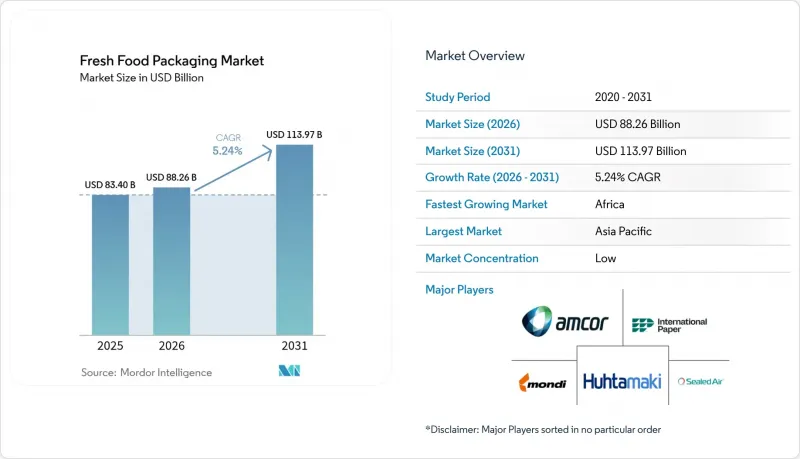
This report is Segmented by Material Type (Plastics, Paper and Paperboard, and More), Packaging Type (Flexible Packaging, and Rigid Packaging), Application (Fruits and Vegetables, Meat/Poultry/Eggs, Seafood, and More), Technology (MAP, Vacuum Skin Packaging, Active and Intelligent Packaging, and More), and Geography. The Market Forecasts are Provided in Terms of Value (USD).
Global Fresh Food Packaging Market Trends and Insights
Surge In E-commerce Grocery Platforms Demanding Shelf-Stable Fresh Produce In Asia
Digital grocery penetration in China hit 28% in 2025, making two-day ambient fulfillment commonplace. Platform operators now specify micro-perforated polyethylene films that moderate respiration, holding leafy green quality for five additional days without chilling, and ethylene-absorbing pouches that push mango and banana salability past regional delivery cycles. Indian quick-commerce firms mirror these requirements, prompting converters to certify ISO 15378 lines that pass the Food Safety and Standards Authority of India migration thresholds. Japanese online grocers are piloting vacuum-sealed tuna packs that preserve color for 10 days at 4 °C, widening domestic shelf presence and reducing reliance on airfreight. The commercial pay-off is reduced shrinkage, lower expedited freight costs, and a tangible differentiation lever in app-based merchandising.
Rapid Adoption Of MAP For Export-Oriented Perishables From South America
Chile shipped 312,000 t of blueberries in 2025, 87% inside gas-flushed lidding that balances 2-5% O2 and 10-15% CO2, suppressing Botrytis and keeping firmness during 21-day ocean trips to Guangzhou and Busan. Peru's avocado industry is following suit, accepting an 18-22% packaging premium because in-transit shrink fell from 12% to below 6%. Argentina's beef processors employ similar regimes for Halal primals bound for the Gulf, while Colombia's rose exporters test MAP sleeves targeting 14-day vase life. Regional resin demand persuaded Saica Group to commission a 15,000 t extrusion plant in Sao Paulo in 2025.
Volatility In Recycled Resin Prices Post-China Import Ban
China's 2024 clampdown on polyethylene terephthalate bale impurities pushed European recycled-flake spot prices up 22% by mid-2025. Converters suddenly blended 40% virgin resin just to stabilize melt strength, undercutting retailer recycled-content pledges and eroding margins. Hot-wash and optical-sorting upgrades are in motion, yet capacity trails demand by two years. Chemical recycling offers a purity hedge, but commercial plants are scarce and capital intensive, delaying broad-scale relief.
Other drivers and restraints analyzed in the detailed report include:
- Retailer Private-Label Expansion Requiring Brand-Friendly Sustainable Packaging In Europe
- Government-Backed Cold-Chain Expansion Boosting Packaged Fresh Milk Volumes In India
- Tightening PFAS Restrictions Curtailing Barrier Paper Adoption In EU
For complete list of drivers and restraints, kindly check the Table Of Contents.
Segment Analysis
Plastics dominated the fresh food packaging market in 2025 with 62.34% value, propelled by polyethylene's low cost, polyethylene terephthalate's transparency, and polypropylene's heat resistance. Post-consumer recycled content climbed from 35% in 2023 to 52% in clamshells two years later under EU mandates. Biodegradable films based on polylactic acid and polyhydroxyalkanoate recorded a 6.23% CAGR, buoyed by private-label berries in Germany and pouch pilots on Asian grocery sites. Paper and paperboard regained ground as molded-fiber berry trays earned EN 13432 logos that align with retailer scorecards, while metal stayed niche in aseptic tomato paste and glass resurged in reusable dairy bottles across Scandinavia. Amcor's 2025 PHA pouch for cut fruit demonstrated marine biodegradation within 6 months, addressing coastal market concerns.
Biodegradable growth is tempered by composting gaps, with only 15% of U.S. municipalities offering curbside compost collection. Chemical recycling is unlocking food-grade polymer loops that match virgin purity, alleviating contamination worries in direct contact. Paper converters race to replace PFAS with waterborne barriers, and glass benefits from 92% return rates under European deposit-refund schemes. Overall, strategic sourcing flexibility and certification literacy are decisive competitive levers as retailers publish ever stricter scorecards.
Flexible packaging captured 52.19% share in 2025, growing at a 5.66% CAGR, as pouches and films slash cubic space by up to 40%, an essential saving for e-grocery fulfillment. Stand-up pouches with reclose features are displacing tubs in fresh-cut veg, and nano-coated wraps push oxygen ingress below 1 cc m-2 day-1 for MAP pasta. Rigid boxes and punnets remain vital for stack strength, yet weight-reduced flutes and water-based coatings help defend cost positions. Mondi's 2025 recyclable polyethylene salad pouch adds oxygen scavengers without metallic layers, proving curbside recyclability and 18% material savings.
Spouted flexibles are entering cultured-dairy aisles, yielding 25% material cuts versus cups. Films that integrate RFID and high-definition variable printing meet Nordic seafood traceability laws. Thermoformed trays such as Sealed Air's Cryovac now contain 60% recycled polyethylene terephthalate, a milestone in the circular rigid supply chain. Crate pooling uses durable polypropylene inserts to meet 100-use-life targets. The fresh food packaging market size gains from this cross-pollination of lightweighting, smart features, and material thinning, lifting supplier differentiators beyond commodity pricing.
Complete Report Scope:
- By Material Type
- Plastics
- Paper and Paperboard
- Metal
- Glass
- Biodegradable / Bio-based Materials
- By Packaging Type
- Flexible Packaging
- Pouches and Bags
- Films and Wraps
- Rigid Packaging
- Boxes and Cartons
- Punnets
- Pallets and Crates
- Other Rigid Packaging
- Flexible Packaging
- By Application
- Fruits and Vegetables
- Meat, Poultry and Eggs
- Seafood
- Dairy Products
- Salads and Greens
- By Technology
- Modified Atmosphere Packaging (MAP)
- Vacuum Skin Packaging
- Active and Intelligent Packaging
- Edible and Antimicrobial Coatings
- By Geography
- North America
- United States
- Canada
- Mexico
- Europe
- Germany
- United Kingdom
- France
- Italy
- Spain
- Russia
- Rest of Europe
- Asia-Pacific
- China
- India
- Japan
- South Korea
- Australia and New Zealand
- Rest of Asia-Pacific
- Middle East
- United Arab Emirates
- Saudi Arabia
- Turkey
- Rest of Middle East
- Africa
- South Africa
- Nigeria
- Egypt
- Rest of Africa
- South America
- Brazil
- Argentina
- Rest of South America
- North America
Geography Analysis
Asia-Pacific led with 33.54% of the 2025 value, through 2031 as e-grocery volumes multiply and governments bankroll cold-chain nodes. China committed CNY 28 billion (USD 3.92 billion) to chilled warehouses in 2025, unlocking the adoption of modified-atmosphere produce and the uptake of pouches in ready meals. India's dairy cooperatives lean on aseptic cartons to reach underserved districts, while Japan pilots vacuum-skin sashimi trays that extend color stability to ten days. South Korean c-stores add antimicrobial fruit cups targeting seven-day inventory cycles, and Oceania growers adopt compostable berry trays ahead of a 70% recycling mandate by 2030.
Europe follows at a 4.9% CAGR, propelled by retailer private-label pushes and the EU's 65% recycled-content decree for polyethylene terephthalate trays by 2030. German discounters adopt molded-fiber punnets with EN 13432 logos, the United Kingdom trials reusable crates targeting 40% cuts in single-use, and French chains roll out oxygen-scavenging pouches offering 12-day salad life. Italian seafood exporters invest in vacuum-skin with blockchain codes for North American premiums, and Spanish citrus shippers deploy MAP liners, slashing transit shrink below 5%. Russia's dairy bottlers ramp HDPE capacity to serve recovering UHT demand.
North America maintains a 5.0% CAGR aided by FDA guidance on recycled-content safety that green-lights chemical recycling streams. U.S. retailers pilot antimicrobial beef overwrap reducing markdowns 25%, and Canadian processors embed nisin films expanding poultry life by six days. Mexico's avocado exporters rely on MAP clamshells for 21-day Pacific routes. Africa records the fastest regional CAGR at 6.27% as donor-funded cold-chain sites in Nigeria and Kenya finally enable packaged meat flows, and Gulf states invest in aseptic milk lines for food security. South America advances 5.5% annually, anchored by Chilean berries and Peruvian avocados that depend on 21-day MAP windows for Asian sailings.
- Amcor plc
- Mondi plc
- Huhtamaki Oyj
- International Paper Company
- Sealed Air Corporation
- Smurfit Westrock plc.
- Reynolds Consumer Products LLC
- Sonoco Products Company
- ProAmpac LLC
- StePac L.A. Ltd
- Graphic Packaging International LLC
- CCL Industries Inc.
- Tetra Pak International SA
- Anchor Packaging Inc.
- Coveris Holdings SA
- Printpack Inc.
- Pactiv Evergreen Inc.
- Cascades Inc.
- ITC Packaging SLU
- Saica Group
- Shanghai Zijiang Enterprise Group
- Crawford Packaging
- DBS Packaging Pvt. Ltd.
Additional Benefits:
- The market estimate (ME) sheet in Excel format
- 3 months of analyst support
TABLE OF CONTENTS
1 INTRODUCTION
- 1.1 Study Assumptions and Market Definition
- 1.2 Scope of the Study
2 RESEARCH METHODOLOGY
3 EXECUTIVE SUMMARY
4 MARKET LANDSCAPE
- 4.1 Market Overview
- 4.2 Market Drivers
- 4.2.1 Surge in E-commerce Grocery Platforms Demanding Shelf-Stable Fresh Produce in Asia
- 4.2.2 Rapid Adoption of MAP for Export-Oriented Perishables from South America
- 4.2.3 Retailer Private-Label Expansion Requiring Brand-Friendly Sustainable Packaging in Europe
- 4.2.4 Government-Backed Cold-Chain Expansion Boosting Packaged Fresh Milk Volumes in India
- 4.2.5 Seafood Traceability Rules Accelerating Vacuum-Skin Packaging Uptake in Nordics
- 4.2.6 Integration of Antimicrobial Films to Reduce Food Waste in North America
- 4.3 Market Restraints
- 4.3.1 Volatility in Recycled Resin Prices Post-China Import Ban
- 4.3.2 Tightening PFAS Restrictions Curtailing Barrier Paper Adoption in EU
- 4.3.3 Limited Composting Infrastructure Hindering Bioplastic Penetration in United States
- 4.3.4 High CAPEX of High-O2 MAP Lines for SME Processors in Africa
- 4.4 Industry Value / Supply-Chain Analysis
- 4.5 Technological Outlook
- 4.6 Regulatory Outlook
- 4.7 Impact of Macroeconomic Factors on the Market
- 4.8 Porter's Five Forces Analysis
- 4.8.1 Bargaining Power of Suppliers
- 4.8.2 Bargaining Power of Buyers
- 4.8.3 Threat of New Entrants
- 4.8.4 Threat of Substitute Products
- 4.8.5 Intensity of Competitive Rivalry
5 MARKET SIZE AND GROWTH FORECASTS (VALUE)
- 5.1 By Material Type
- 5.1.1 Plastics
- 5.1.2 Paper and Paperboard
- 5.1.3 Metal
- 5.1.4 Glass
- 5.1.5 Biodegradable / Bio-based Materials
- 5.2 By Packaging Type
- 5.2.1 Flexible Packaging
- 5.2.1.1 Pouches and Bags
- 5.2.1.2 Films and Wraps
- 5.2.2 Rigid Packaging
- 5.2.2.1 Boxes and Cartons
- 5.2.2.2 Punnets
- 5.2.2.3 Pallets and Crates
- 5.2.2.4 Other Rigid Packaging
- 5.2.1 Flexible Packaging
- 5.3 By Application
- 5.3.1 Fruits and Vegetables
- 5.3.2 Meat, Poultry and Eggs
- 5.3.3 Seafood
- 5.3.4 Dairy Products
- 5.3.5 Salads and Greens
- 5.4 By Technology
- 5.4.1 Modified Atmosphere Packaging (MAP)
- 5.4.2 Vacuum Skin Packaging
- 5.4.3 Active and Intelligent Packaging
- 5.4.4 Edible and Antimicrobial Coatings
- 5.5 By Geography
- 5.5.1 North America
- 5.5.1.1 United States
- 5.5.1.2 Canada
- 5.5.1.3 Mexico
- 5.5.2 Europe
- 5.5.2.1 Germany
- 5.5.2.2 United Kingdom
- 5.5.2.3 France
- 5.5.2.4 Italy
- 5.5.2.5 Spain
- 5.5.2.6 Russia
- 5.5.2.7 Rest of Europe
- 5.5.3 Asia-Pacific
- 5.5.3.1 China
- 5.5.3.2 India
- 5.5.3.3 Japan
- 5.5.3.4 South Korea
- 5.5.3.5 Australia and New Zealand
- 5.5.3.6 Rest of Asia-Pacific
- 5.5.4 Middle East
- 5.5.4.1 United Arab Emirates
- 5.5.4.2 Saudi Arabia
- 5.5.4.3 Turkey
- 5.5.4.4 Rest of Middle East
- 5.5.5 Africa
- 5.5.5.1 South Africa
- 5.5.5.2 Nigeria
- 5.5.5.3 Egypt
- 5.5.5.4 Rest of Africa
- 5.5.6 South America
- 5.5.6.1 Brazil
- 5.5.6.2 Argentina
- 5.5.6.3 Rest of South America
- 5.5.1 North America
6 COMPETITIVE LANDSCAPE
- 6.1 Market Concentration
- 6.2 Strategic Moves
- 6.3 Market Share Analysis
- 6.4 Company Profiles (includes Global Level Overview, Market Level Overview, Core Segments, Financials as available, Strategic Information, Market Rank/Share, Products and Services, Recent Developments)
- 6.4.1 Amcor plc
- 6.4.2 Mondi plc
- 6.4.3 Huhtamaki Oyj
- 6.4.4 International Paper Company
- 6.4.5 Sealed Air Corporation
- 6.4.6 Smurfit Westrock plc.
- 6.4.7 Reynolds Consumer Products LLC
- 6.4.8 Sonoco Products Company
- 6.4.9 ProAmpac LLC
- 6.4.10 StePac L.A. Ltd
- 6.4.11 Graphic Packaging International LLC
- 6.4.12 CCL Industries Inc.
- 6.4.13 Tetra Pak International SA
- 6.4.14 Anchor Packaging Inc.
- 6.4.15 Coveris Holdings SA
- 6.4.16 Printpack Inc.
- 6.4.17 Pactiv Evergreen Inc.
- 6.4.18 Cascades Inc.
- 6.4.19 ITC Packaging SLU
- 6.4.20 Saica Group
- 6.4.21 Shanghai Zijiang Enterprise Group
- 6.4.22 Crawford Packaging
- 6.4.23 DBS Packaging Pvt. Ltd.
7 MARKET OPPORTUNITIES AND FUTURE OUTLOOK
- 7.1 White-Space and Unmet-Need Assessment

