PUBLISHER: Mordor Intelligence | PRODUCT CODE: 2122784

PUBLISHER: Mordor Intelligence | PRODUCT CODE: 2122784
Children's Wear - Market Share Analysis, Industry Trends & Statistics, Growth Forecasts (2026 - 2031)
According to Mordor Intelligence, the children's wear market stands at 283.37 in 2025, to reach USD 302.44 billion in 2026 and is projected to reach USD 403.26 billion by 2031, representing a CAGR of 5.92%.
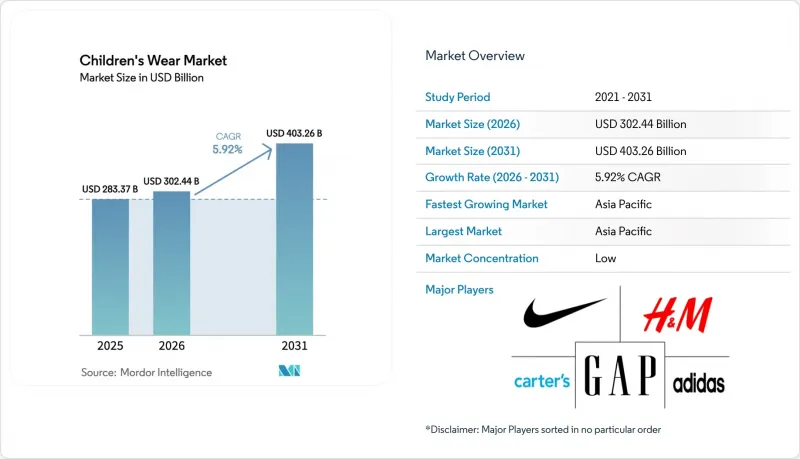
This report is Segmented by Product Type (Apparel, Footwear, and Other Product Types), Age Group (Infant/Toddler and Kids/Children), Category (Mass and Premium), Distribution Channel (Offline Stores and Online Stores), and Geography (North America, Europe, Asia-Pacific, South America, and Middle East and Africa). The Market Forecasts are Provided in Terms of Value (USD).
Global Children's Wear Market Trends and Insights
Frequent replacement cycle due to rapid growth and wear
Children typically outgrow clothing every 6 to 9 months, resulting in shorter product life spans and requiring parents to frequently repurchase essentials such as T-shirts, jeans, and sneakers throughout the year. This inherent obsolescence creates a consistent demand that helps stabilize the category against economic fluctuations. However, this frequent replacement cycle also highlights the importance of durability and quality. Brands that incorporate features like reinforced knees, adjustable waistbands, and abrasion-resistant toe caps can extend product usability by 20% to 30%, reducing the overall cost of ownership and fostering customer loyalty. The emergence of "grow-with-me" designs, including extendable cuffs and modular sizing, reflects a shift from planned obsolescence toward longevity. This approach aligns with parental budget considerations and sustainability priorities. This trend is particularly evident in the Asia-Pacific region, where rising middle-class incomes and smaller family sizes encourage parents to prioritize fewer, higher-quality garments over disposable fast fashion.
Rising focus on quality, durability, and comfort
Parents are increasingly prioritizing fabrics that can endure repeated laundering, maintain shape retention, and provide moisture-wicking properties, particularly for activewear and school uniforms. Brands incorporating performance technologies such as Nike's Dri-FIT moisture management and Adidas's Primeknit seamless construction are gaining traction in the premium segment. Comfort has become an essential attribute, especially post-pandemic, as remote schooling popularized athleisure and elastic-waist joggers over traditional denim. The implementation of the United States Consumer Product Safety Commission's FY 2024 Operating Plan has introduced more stringent safety requirements for children's products, including apparel, directly impacting consumer purchasing decisions and manufacturer compliance standards. Durability also plays a key role in resale value; garments that maintain structural integrity after 10 to 15 washes fetch higher prices on secondhand platforms like Vinted and ThredUp, reinforcing a cycle that benefits quality-focused brands. The focus on comfort extends to footwear, where features such as adjustable closures, cushioned insoles, and breathable mesh uppers are now standard in children's sneakers from brands like Puma and Under Armour.
Rapidly changing fashion trends and seasonality
The kidswear market experiences compressed trend cycles, with micro-seasons influenced by social media influencers and licensed-character collaborations that can rise and decline within 8 to 12 weeks. This volatility compels brands to maintain higher safety stock levels and accept markdowns on unsold inventory, negatively impacting gross margins. Fast-fashion companies like Shein Kids and Zara Kids address this risk with ultra-short lead times, while traditional wholesale brands, dependent on 6-month advance orders, face challenges in adapting to real-time demand signals. Seasonality further intensifies these issues, as winter outerwear and back-to-school apparel account for 40% to 50% of annual revenue within concentrated 8-week periods, creating significant cash-flow fluctuations that strain working capital. The emergence of year-round capsule collections and seasonless basics such as layering tees and versatile joggers, provides a partial solution. However, this approach requires brands to shift consumer behavior from impulse-driven trend purchases to wardrobe-building strategies.
Other drivers and restraints analyzed in the detailed report include:
- High production costs for sustainable and safe materials
- Emergence of AI-driven micro-sizing and on-demand production
- High production costs for sustainable and safe materials
For complete list of drivers and restraints, kindly check the Table Of Contents.
Segment Analysis
In 2025, apparel accounted for 66.83% of the market share, driven by everyday essentials such as T-shirts, jeans, and school uniforms, which benefit from frequent replacement cycles. Within the apparel segment, casualwear and athleisure are growing faster than formalwear, influenced by the rise of remote learning and hybrid schooling, which emphasize comfort over traditional dress codes. H&M Kids reported a 25% increase in jogger and hoodie stock-keeping units (SKUs) in 2025, reflecting this trend. Additionally, gender-neutral clothing lines are gaining popularity, with brands like Primary.com and Tootsa MacGinty offering unisex basics that simplify inventory management and appeal to progressive households.
Conversely, footwear is expected to grow at a compound annual growth rate (CAGR) of 6.32% from 2026 to 2031, surpassing the category average. This growth is attributed to the rapid adoption of adaptive-fit technologies and sustainable materials. Footwear brands are increasingly incorporating recycled rubber outsoles and bio-based foams. For instance, Puma's RE:SUEDE sneaker, designed for industrial composting, highlights circular-design principles that appeal to eco-conscious parents.
The Kids/Children segment, covering ages 2 to 14 years, accounted for 77.58% of the market share in 2025. This dominance is attributed to the longer wear period, higher unit consumption, and a wider range of product offerings compared to the Infant/Toddler segment. The Kids/Children segment's larger market share is due to its broader age range, which includes preschoolers, elementary students, and pre-teens, each with unique style preferences and activity requirements. Growth in this segment is further supported by increasing participation in organized sports and extracurricular activities. According to the National Sporting Goods Association, nearly all youth team sports (ages 7-17) saw increased participation in 2024 compared to their three-year averages. Flag football led with a 21% increase, followed by basketball and tackle football, each growing by 12%.
However, the Infant/Toddler cohort, comprising children under 2 years, is projected to grow at a CAGR of 6.57% from 2026 to 2031. This growth is driven by increased parental emphasis on chemical-free fabrics and adherence to stringent safety regulations. Products such as organic cotton bodysuits and GOTS-certified sleep sacks, are witnessing year-over-year sales growth as millennial and Gen-Z parents prioritize health and sustainability. While the Infant/Toddler segment has a smaller base, its faster growth rate highlights opportunities for brands focusing on organic materials, safety certifications, and gifting-oriented packaging.
Complete Report Scope:
- By Product Type
- Apparel
- Footwear
- Other Product Types
- By Age Group
- Infant/Toddler
- Kids/Children
- By Category
- Mass
- Premium
- By Distribution Channel
- Offline Stores
- Online Stores
- By Geography
- North America
- United States
- Canada
- Mexico
- Rest of North America
- Europe
- Germany
- United Kingdom
- France
- Italy
- Spain
- Netherlands
- Poland
- Belgium
- Sweden
- Rest of Europe
- Asia-Pacific
- China
- India
- Japan
- Australia
- Indonesia
- South Korea
- Thailand
- Singapore
- Rest of Asia-Pacific
- South America
- Brazil
- Argentina
- Colombia
- Chile
- Peru
- Rest of South America
- Middle East and Africa
- Saudi Arabia
- United Arab Emirates
- Turkey
- South Africa
- Nigeria
- Egypt
- Morocco
- Rest of Middle East and Africa
- North America
Geography Analysis
Asia-Pacific accounted for 40.69% of the global market share in 2025 and is projected to grow at a CAGR of 7.92% from 2026 to 2031, the fastest growth rate among all regions. China's live-streaming commerce ecosystem, driven by platforms like Douyin and Tmall, facilitates real-time product demonstrations and flash sales. In India, the expansion of organized retail, led by brands such as FirstCry and Gini, and Jony, is penetrating tier-2 cities like Pune, Jaipur, and Coimbatore. Rising household incomes and nuclear families are driving demand for branded kidswear. Japan's aging population supports premium kidswear sales, as grandparents allocate discretionary spending to grandchildren. In Southeast Asia, markets like Indonesia, Thailand, and Vietnam are experiencing rapid e-commerce adoption.
Europe and North America markets are together driven by premiumization and sustainability mandates. The EU's Corporate Sustainability Due Diligence Directive, effective from 2027, requires brands to disclose supply-chain labor practices and environmental impacts. Germany, the United Kingdom, and France lead in organic cotton adoption, with GOTS-certified garments accounting growing market shares in 2025. In North America, the United States market is consolidating around omnichannel leaders such as Target, Walmart, and Amazon, which leverage scale to negotiate favorable supplier terms. In Canada, bilingual labeling requirements and demand for insulated outerwear create niche opportunities for brands like Canada Goose Kids and Helly Hansen Junior. Mexico's proximity to United States manufacturing and its role in nearshoring supply chains position it as a cost-effective sourcing hub.
In South America, Brazil's large youth population and a growing middle class support steady demand, though economic volatility constrains purchasing power. In Argentina, inflation challenges have shifted consumer preferences toward durable, multi-season garments. Chile's stable economy and high urbanization rate support organized retail expansion. In the Middle East, the United Arab Emirates and Saudi Arabia exhibit high per-capita spending on kidswear, driven by young populations and elevated disposable incomes. Turkey acts as a bridge between Europe and Asia, with domestic brands exporting to neighboring markets. In Africa, South Africa's formal retail sector is the most developed, while Nigeria and Egypt present growth opportunities as urbanization and internet penetration increase.
- Carter's Inc.
- Adidas AG
- Nike, Inc.
- The Gap Inc.
- Hennes & Mauritz AB
- Puma SE
- Benetton Group S.r.l.
- Mothercare plc
- Burberry Group plc
- Dolce & Gabbana S.r.l.
- VF Corporation
- Fast Retailing Co., Ltd.
- Hanesbrands Inc.
- Industria de Diseno Textil S.A.
- LVMH Moet Hennessy Louis Vuitton SE
- Ralph Lauren Corporation
- Under Armour Inc.
- OTB S.p.A.
- The Children's Place, Inc.
- Gini & Jony Ltd.
- Carhartt, Inc.
- Hugo Boss AG
- Oxford Industries, Inc.
- Punto Fa, S.L. (Mango)
- PatPat (InterFocus Inc.)
- FirstCry (BrainBees Solutions)
- Shein Kids (Shein Group)
- Next plc
- C&A Mode GmbH & Co. KG
- Bestseller A/S
- LPP S.A. (Reserved Kids & Sinsay Kids)
- Semir Garment Co., Ltd.
- Anta Sports Products Ltd. (FILA Kids)
- Xtep International Holdings Ltd. (Xtep Kids)
Additional Benefits:
- The market estimate (ME) sheet in Excel format
- 3 months of analyst support
TABLE OF CONTENTS
1 INTRODUCTION
- 1.1 Study Assumptions and Market Definition
- 1.2 Scope of the Study
2 RESEARCH METHODOLOGY
3 EXECUTIVE SUMMARY
4 MARKET LANDSCAPE
- 4.1 Market Overview
- 4.2 Market Drivers
- 4.2.1 Frequent replacement cycle due to rapid growth and wear
- 4.2.2 Rising focus on quality, durability, and comfort
- 4.2.3 Growing demand for sustainable and eco-friendly fabrics
- 4.2.4 Emergence of AI-driven micro-sizing and on-demand production
- 4.2.5 Expansion of kids wear rental/subscription and resale ecosystems
- 4.2.6 Growth of casual, gender-neutral and adaptive apparel lines
- 4.3 Market Restraints
- 4.3.1 Rapidly changing fashion trends and seasonality
- 4.3.2 High production costs for sustainable and safe materials
- 4.3.3 Increasing regulatory scrutiny on chemical safety standards
- 4.3.4 Supply-chain traceability demands burdening SME brands
- 4.4 Consumer Behaviour Analysis
- 4.5 Regulatory Landscape
- 4.6 Technological Outlook
- 4.7 Porter's Five Forces Analysis
- 4.7.1 Bargaining Power of Suppliers
- 4.7.2 Bargaining Power of Buyers/Consumers
- 4.7.3 Threat of New Entrants
- 4.7.4 Threat of Substitute Products
- 4.7.5 Intensity of Competitive Rivalry
5 MARKET SIZE AND GROWTH FORECASTS (VALUE)
- 5.1 By Product Type
- 5.1.1 Apparel
- 5.1.2 Footwear
- 5.1.3 Other Product Types
- 5.2 By Age Group
- 5.2.1 Infant/Toddler
- 5.2.2 Kids/Children
- 5.3 By Category
- 5.3.1 Mass
- 5.3.2 Premium
- 5.4 By Distribution Channel
- 5.4.1 Offline Stores
- 5.4.2 Online Stores
- 5.5 By Geography
- 5.5.1 North America
- 5.5.1.1 United States
- 5.5.1.2 Canada
- 5.5.1.3 Mexico
- 5.5.1.4 Rest of North America
- 5.5.2 Europe
- 5.5.2.1 Germany
- 5.5.2.2 United Kingdom
- 5.5.2.3 France
- 5.5.2.4 Italy
- 5.5.2.5 Spain
- 5.5.2.6 Netherlands
- 5.5.2.7 Poland
- 5.5.2.8 Belgium
- 5.5.2.9 Sweden
- 5.5.2.10 Rest of Europe
- 5.5.3 Asia-Pacific
- 5.5.3.1 China
- 5.5.3.2 India
- 5.5.3.3 Japan
- 5.5.3.4 Australia
- 5.5.3.5 Indonesia
- 5.5.3.6 South Korea
- 5.5.3.7 Thailand
- 5.5.3.8 Singapore
- 5.5.3.9 Rest of Asia-Pacific
- 5.5.4 South America
- 5.5.4.1 Brazil
- 5.5.4.2 Argentina
- 5.5.4.3 Colombia
- 5.5.4.4 Chile
- 5.5.4.5 Peru
- 5.5.4.6 Rest of South America
- 5.5.5 Middle East and Africa
- 5.5.5.1 Saudi Arabia
- 5.5.5.2 United Arab Emirates
- 5.5.5.3 Turkey
- 5.5.5.4 South Africa
- 5.5.5.5 Nigeria
- 5.5.5.6 Egypt
- 5.5.5.7 Morocco
- 5.5.5.8 Rest of Middle East and Africa
- 5.5.1 North America
6 COMPETITIVE LANDSCAPE
- 6.1 Market Concentration
- 6.2 Strategic Moves
- 6.3 Market Share Analysis
- 6.4 Company Profiles (includes Global-level Overview, Market-level Overview, Core Segments, Financials as available, Strategic Information, Market Rank/Share for key companies, Products and Services, and Recent Developments)
- 6.4.1 Carter's Inc.
- 6.4.2 Adidas AG
- 6.4.3 Nike, Inc.
- 6.4.4 The Gap Inc.
- 6.4.5 Hennes & Mauritz AB
- 6.4.6 Puma SE
- 6.4.7 Benetton Group S.r.l.
- 6.4.8 Mothercare plc
- 6.4.9 Burberry Group plc
- 6.4.10 Dolce & Gabbana S.r.l.
- 6.4.11 VF Corporation
- 6.4.12 Fast Retailing Co., Ltd.
- 6.4.13 Hanesbrands Inc.
- 6.4.14 Industria de Diseno Textil S.A.
- 6.4.15 LVMH Moet Hennessy Louis Vuitton SE
- 6.4.16 Ralph Lauren Corporation
- 6.4.17 Under Armour Inc.
- 6.4.18 OTB S.p.A.
- 6.4.19 The Children's Place, Inc.
- 6.4.20 Gini & Jony Ltd.
- 6.4.21 Carhartt, Inc.
- 6.4.22 Hugo Boss AG
- 6.4.23 Oxford Industries, Inc.
- 6.4.24 Punto Fa, S.L. (Mango)
- 6.4.25 PatPat (InterFocus Inc.)
- 6.4.26 FirstCry (BrainBees Solutions)
- 6.4.27 Shein Kids (Shein Group)
- 6.4.28 Next plc
- 6.4.29 C&A Mode GmbH & Co. KG
- 6.4.30 Bestseller A/S
- 6.4.31 LPP S.A. (Reserved Kids & Sinsay Kids)
- 6.4.32 Semir Garment Co., Ltd.
- 6.4.33 Anta Sports Products Ltd. (FILA Kids)
- 6.4.34 Xtep International Holdings Ltd. (Xtep Kids)
7 MARKET OPPORTUNITIES AND FUTURE OUTLOOK

