PUBLISHER: Mordor Intelligence | PRODUCT CODE: 2122802

PUBLISHER: Mordor Intelligence | PRODUCT CODE: 2122802
Veterinary Ultrasound Devices - Market Share Analysis, Industry Trends & Statistics, Growth Forecasts (2026 - 2031)
According to Mordor Intelligence, the veterinary ultrasound devices market size is expected to increase from USD 481.68 million in 2025 to USD 515.64 million in 2026 and reach USD 724.90 million by 2031, growing at a CAGR of 7.05% over 2026-2031.
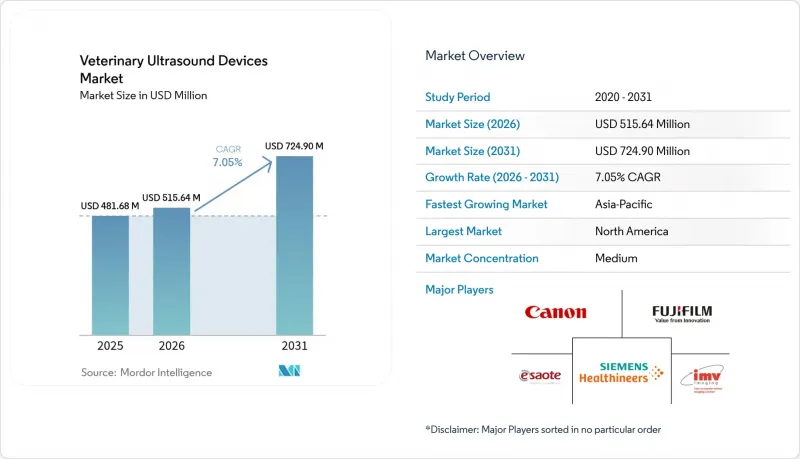
This report is Segmented by Portability (Handheld, Table-Top, and Cart/Trolley-Based), Technology (2-D, Doppler, 3-D/4-D, and Contrast-Enhanced), Application (Obstetrics & Gynecology, and More), Animal Type (Companion Animals, Nd More), End User (Veterinary Clinics, and More), and Geography (North America, Europe, and More). Market Forecasts are Provided in Terms of Value (USD).
Global Veterinary Ultrasound Devices Market Trends and Insights
Rising Companion Animal Healthcare Expenditure
Pet owners in the United States spent USD 38.3 billion on veterinary care in 2023, and insured pets undergo 2.4 times more imaging than uninsured cohorts. Corporate groups now own more than one-quarter of U.S. clinics, enabling fleet procurement and standardized ultrasound protocols. Elective abdominal and cardiac scans for geriatric pets are increasingly routine, yet the 2024 decline in clinic visits shows that discretionary imaging remains sensitive to macroeconomic pressures. Standardized vendor service contracts are helping clinics contain maintenance costs, smoothing revenue during slowdowns. The overall effect is sustained demand for affordable, easy-to-use scanners that preserve diagnostic margins even when visit volumes fluctuate.
Increasing Adoption of Handheld Ultrasound Devices
Handheld probes are expanding at a 9.43% CAGR as chip-based transducers cut manufacturing costs and shrink device footprints. Butterfly's iQ3, cleared in January 2024, introduced automated 3D models that expedite anatomy identification for non-radiologists, while GE's Vscan Air, distributed by Sound Technologies, brings wireless imaging to stall-side equine exams. Monthly leasing plans under USD 800 reduce upfront outlays by 80%, encouraging adoption in single-doctor clinics. Portability is most valuable in large-animal practice and in emergency cages, where cart systems are impractical, though image penetration remains limited in obese patients and in deep-abdomen scans. Continuous software upgrades delivered over Wi-Fi help practices avoid technology obsolescence during multi-year repayment schedules.
High Capital Cost of Advanced Ultrasound Systems
Premium cart systems with Doppler and contrast modules range from USD 15,000 to USD 50,000, a hurdle for clinics averaging fewer than 10 scans per week. Handheld units retail for USD 3,999-8,000 but lack depth penetration for large-animal abdomen work, forcing practices to compromise between price and capability. Subscription bundles that wrap hardware, software, and service into a single monthly fee lower risk, yet rural clinics with low case volume still struggle to meet breakeven within a typical five-year term. Corporate consolidators negotiate fleet discounts, putting independent practitioners at a relative cost disadvantage.
Other drivers and restraints analyzed in the detailed report include:
- Integration of Artificial Intelligence and Tele-Ultrasound Workflows
- Growing Demand for Reproductive Monitoring in Intensive Livestock Farming
- Shortage of Ultrasound-Trained Veterinary Professionals
For complete list of drivers and restraints, kindly check the Table Of Contents.
Segment Analysis
Cart systems retained 48.53% veterinary ultrasound devices market share in 2025 due to superior image quality, probe diversity, and ergonomic consoles prized by referral hospitals. They remain the platform of choice for deep abdominal, cardiac, and guided interventional studies, especially in obese or large-breed dogs. Vendors bundle multi-frequency probes and integrated PACS links, ensuring compatibility with existing workflows.
Handheld devices are growing at a 9.43% CAGR as sub-USD 8,000 pricing and single-probe versatility attract primary-care clinics. The veterinary ultrasound devices market size for this segment is projected to expand steadily as subscription models allow users to upgrade to newer revisions mid-contract. Image resolution continues to improve through semiconductor transducers, and military-drop specifications make these units viable for barn calls. Limitations in penetration depth and battery life still favor carts for complex cardiology or large-animal abdomen scans.
Two-dimensional systems accounted for 56.92% of revenue in 2025 because they meet routine abdominal and obstetric needs at comparatively low cost. Rapid boot times and familiar interfaces keep workflow efficient for high-volume practices. The veterinary ultrasound devices market for 2-D will continue to grow, though the share will shift incrementally to Doppler platforms.
Doppler units are advancing at a 9.32% CAGR as clinics embrace echocardiography and livestock breeders adopt blood-flow assessment of the corpus luteum. The veterinary ultrasound devices market share for Doppler is set to rise further, with vendors embedding the feature in mid-tier carts and even handheld devices. Training programs now teach Doppler basics early, broadening the user base. Three- and four-dimensional imaging remains niche, limited to teaching hospitals due to equipment cost and longer scan times, yet its volumetric data aids complex cardiac surgical planning.
Complete Report Scope:
- By Portability
- Handheld Ultrasound
- Table-Top Ultrasound
- Cart/Trolley-Based Ultrasound
- By Technology
- 2-Dimensional Ultrasound
- Doppler Ultrasound
- 3-D/4-D Ultrasound
- Contrast-Enhanced Ultrasound
- By Application
- Obstetrics & Gynecology
- Cardiology
- Musculoskeletal
- Abdominal & Internal Medicine
- Emergency & Critical Care
- By Animal Type
- Companion Animals
- Dogs
- Cats
- Other Small Companion Animals
- Livestock Animals
- Horse
- Cattle
- Other Livestock Animals
- Other Animals
- Companion Animals
- By End User
- Veterinary Clinics
- Veterinary Hospitals
- Other End Users
- Geography
- North America
- United States
- Canada
- Mexico
- Europe
- Germany
- United Kingdom
- France
- Italy
- Spain
- Rest of Europe
- Asia-Pacific
- China
- Japan
- India
- Australia
- South Korea
- Rest of Asia-Pacific
- Middle East & Africa
- GCC
- South Africa
- Rest of Middle East & Africa
- South America
- Brazil
- Argentina
- Rest of South America
- North America
Geography Analysis
North America led with a 42.54% share in 2025, driven by high per-patient spending and early POCUS adoption. U.S. corporate groups negotiate nationwide equipment deals, boosting vendor volume for integrated archiving. Canada and Mexico are growing steadily as dairy and beef producers formalize reproductive ultrasound protocols. Inflation curtailed elective visits in 2024, but leasing plans soften budget shocks, sustaining replacement cycles.
Asia-Pacific is the fastest-growing region, with a 8.54% CAGR, underpinned by government mandates for livestock disease surveillance and expanding pet ownership in megacities. China's vast swine and dairy sectors drive cart deployments, while Japan and South Korea favor compact Doppler units for small-animal cardiology. India's cooperative dairies adopt portable scanners, though a shortage of trained users slows rural penetration. Australian clinics act as early adopters, trialing AI modules before regional rollout.
Europe maintains solid demand, spurred by stringent animal welfare rules and high pet ownership. Germany, France, and the United Kingdom dominate revenue, and the EU Cyber Resilience Act will obligate five-year patch support from December 2027, likely consolidating market power among cybersecurity-prepared vendors. Eastern Europe expands as veterinary infrastructure modernizes. The Middle East focuses on equine sports medicine, and Latin America leverages ultrasound for beef herd fertility, though cost constraints hinder mass adoption of handheld ultrasound.
- Butterfly Network Inc.
- Canon
- Chison Medical Technologies Co. Ltd
- Clarius Mobile Health Corp.
- DRAMI?SKI SA
- E.I. Medical Imaging
- Edan Instruments Inc.
- Esaote
- FUJIFILM Sonosite Inc.
- GE Healthcare
- Healcerion Co. Ltd
- Heska
- IMV Imaging
- Kaixin Electronic Instrument Co. Ltd
- Mindray Bio-Medical Electronics Co. Ltd
- Samsung Group
- Siemens Healthineers
- Sonostar Technologies Co. Ltd
- SonoScape Medical Corp.
- Telemed Medical Systems
- Xuzhou Palmary Electronics Co. Ltd
Additional Benefits:
- The market estimate (ME) sheet in Excel format
- 3 months of analyst support
TABLE OF CONTENTS
1 Introduction
- 1.1 Study Assumptions & Market Definition
- 1.2 Scope of the Study
2 Research Methodology
3 Executive Summary
4 Market Landscape
- 4.1 Market Overview
- 4.2 Market Drivers
- 4.2.1 Rising Companion Animal Healthcare Expenditure
- 4.2.2 Increasing Adoption of Handheld Ultrasound Devices
- 4.2.3 Technological Advancements in Veterinary Ultrasound Imaging
- 4.2.4 Growing Demand for Reproductive Monitoring In Intensive Livestock Farming
- 4.2.5 Emergence of Subscription-Based Ultrasound Equipment Models
- 4.2.6 Integration of Artificial Intelligence and Tele-Ultrasound Workflows
- 4.3 Market Restraints
- 4.3.1 High Capital Cost of Advanced Ultrasound Systems
- 4.3.2 Shortage of Ultrasound-Trained Veterinary Professionals
- 4.3.3 Limited Reimbursement for Large-Animal Diagnostic Imaging
- 4.3.4 Cybersecurity Concerns Over Cloud-Connected Ultrasound Devices
- 4.4 Value/Supply-Chain Analysis
- 4.5 Regulatory Landscape
- 4.6 Technological Outlook
- 4.7 Sustainability & ESG Considerations
- 4.8 Porter's Five Forces Analysis
- 4.8.1 Threat Of New Entrants
- 4.8.2 Bargaining Power Of Buyers
- 4.8.3 Bargaining Power Of Suppliers
- 4.8.4 Threat Of Substitute Products
- 4.8.5 Intensity Of Competitive Rivalry
5 Market Size & Growth Forecasts (Value, USD)
- 5.1 By Portability
- 5.1.1 Handheld Ultrasound
- 5.1.2 Table-Top Ultrasound
- 5.1.3 Cart/Trolley-Based Ultrasound
- 5.2 By Technology
- 5.2.1 2-Dimensional Ultrasound
- 5.2.2 Doppler Ultrasound
- 5.2.3 3-D/4-D Ultrasound
- 5.2.4 Contrast-Enhanced Ultrasound
- 5.3 By Application
- 5.3.1 Obstetrics & Gynecology
- 5.3.2 Cardiology
- 5.3.3 Musculoskeletal
- 5.3.4 Abdominal & Internal Medicine
- 5.3.5 Emergency & Critical Care
- 5.4 By Animal Type
- 5.4.1 Companion Animals
- 5.4.1.1 Dogs
- 5.4.1.2 Cats
- 5.4.1.3 Other Small Companion Animals
- 5.4.2 Livestock Animals
- 5.4.2.1 Horse
- 5.4.2.2 Cattle
- 5.4.2.3 Other Livestock Animals
- 5.4.3 Other Animals
- 5.4.1 Companion Animals
- 5.5 By End User
- 5.5.1 Veterinary Clinics
- 5.5.2 Veterinary Hospitals
- 5.5.3 Other End Users
- 5.6 Geography
- 5.6.1 North America
- 5.6.1.1 United States
- 5.6.1.2 Canada
- 5.6.1.3 Mexico
- 5.6.2 Europe
- 5.6.2.1 Germany
- 5.6.2.2 United Kingdom
- 5.6.2.3 France
- 5.6.2.4 Italy
- 5.6.2.5 Spain
- 5.6.2.6 Rest of Europe
- 5.6.3 Asia-Pacific
- 5.6.3.1 China
- 5.6.3.2 Japan
- 5.6.3.3 India
- 5.6.3.4 Australia
- 5.6.3.5 South Korea
- 5.6.3.6 Rest of Asia-Pacific
- 5.6.4 Middle East & Africa
- 5.6.4.1 GCC
- 5.6.4.2 South Africa
- 5.6.4.3 Rest of Middle East & Africa
- 5.6.5 South America
- 5.6.5.1 Brazil
- 5.6.5.2 Argentina
- 5.6.5.3 Rest of South America
- 5.6.1 North America
6 Competitive Landscape
- 6.1 Market Concentration
- 6.2 Market Share Analysis
- 6.3 Company Profiles (Includes Global-Level Overview, Market-Level Overview, Core Segments, Financials As Available, Strategic Information, Market Rank/Share For Key Companies, Products & Services, And Recent Developments)
- 6.3.1 Butterfly Network Inc.
- 6.3.2 Canon Inc.
- 6.3.3 Chison Medical Technologies Co. Ltd
- 6.3.4 Clarius Mobile Health Corp.
- 6.3.5 DRAMI?SKI SA
- 6.3.6 E.I. Medical Imaging
- 6.3.7 Edan Instruments Inc.
- 6.3.8 Esaote SpA
- 6.3.9 FUJIFILM Sonosite Inc.
- 6.3.10 GE HealthCare
- 6.3.11 Healcerion Co. Ltd
- 6.3.12 Heska Corporation
- 6.3.13 IMV Imaging
- 6.3.14 Kaixin Electronic Instrument Co. Ltd
- 6.3.15 Mindray Bio-Medical Electronics Co. Ltd
- 6.3.16 Samsung Medison Co. Ltd
- 6.3.17 Siemens Healthineers GmbH
- 6.3.18 Sonostar Technologies Co. Ltd
- 6.3.19 SonoScape Medical Corp.
- 6.3.20 Telemed Medical Systems
- 6.3.21 Xuzhou Palmary Electronics Co. Ltd
7 Market Opportunities & Future Outlook
- 7.1 White-Space & Unmet-Need Assessment

