PUBLISHER: Mordor Intelligence | PRODUCT CODE: 2122816

PUBLISHER: Mordor Intelligence | PRODUCT CODE: 2122816
Camera Module - Market Share Analysis, Industry Trends & Statistics, Growth Forecasts (2026 - 2031)
According to Mordor Intelligence, the camera module market size is expected to grow from USD 41.12 billion in 2025 to USD 43.03 billion in 2026 and is forecast to reach USD 52.91 billion by 2031 at 4.22% CAGR over 2026-2031.
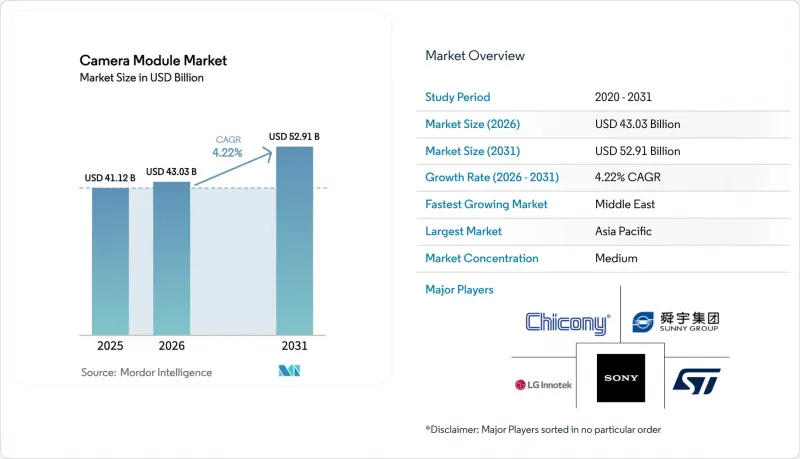
This report is Segmented by Component (Image Sensor, Lens Set, and More), Sensor Type (CMOS, and CCD), Pixel or Resolution (Up To 7 MP, 8-13 MP, and More), Focus Type (Fixed-Focus, and Autofocus), Manufacturing Process (Chip-On-Board, and More), Module Form-Factor (Compact, and MIPI-Interface Modules), Application (Automotive, and More), and Geography. The Market Forecasts are Provided in Terms of Value (USD).
Global Camera Module Market Trends and Insights
Multi-Camera Smartphone Adoption Exceeding Three Lenses
Chinese flagship devices now integrate four or more discrete cameras, adding roughly 1.3 modules per handset. Xiaomi's 17 Ultra debuted a 200-megapixel periscope alongside ultra-wide, wide, and macro units, each with its own autofocus chain. OPPO and vivo mirrored this approach in the Find X8 and X200 Pro series, raising average selling prices while maintaining shipment volumes. Depth-sensing time-of-flight modules, once confined to halo products, are now standard above USD 400 retail, unlocking new augmented-reality shopping features. The cumulative effect is incremental module demand despite a plateau in global smartphone replacements. Samsung's All Lenses on Prism design shaved 22% off periscope z-height, enabling competitors to embed folded optics without sacrificing battery capacity.
Rear-Visibility and ADAS Camera Mandates
Safety regulations are transforming optional camera systems into base-grade hardware. In the United States, FMVSS-111 requires rear-view cameras on all light vehicles from model year 2026. The European Union General Safety Regulation applies similar pressure, mandating forward-facing cameras for lane-keeping and speed-limit assistance on new vehicle types from July 2024. Tier-one suppliers now integrate three to four cameras per vehicle, bundled with radar and lidar, raising module content to a forecast 3.8 units by 2030. Lexus models sold in North America will feature at least four cameras from 2026, accelerating the qualification cycle for automotive-grade components.
VCM Actuator Supply Constraints Post-2024 Earthquake
The April 2024 Hualien earthquake damaged clean rooms at key Taiwanese actuator suppliers, doubling lead times for autofocus and optical image stabilization voice-coil motors. Samsung Electro-Mechanics and LG Innotek reported a 12% sequential decline in module shipments as they paid premium logistics costs to secure limited parts. Restoration reached 85% by late 2025, but OEMs have since dual-sourced from Japanese vendors to mitigate future shocks.
Other drivers and restraints analyzed in the detailed report include:
- AI-Enabled Edge-Analytics Surveillance Rollouts
- Periscope or Folded-Optics Boom
- Wafer-Level Optics Yield Loss in Under-Display Modules
For complete list of drivers and restraints, kindly check the Table Of Contents.
Segment Analysis
The camera module market size for image sensors accounted for 47.17% of revenue in 2025, while actuators captured a smaller share but posted the strongest 5.07% CAGR through 2031. Sony's stacked CMOS parts fetch premium pricing, but demand for dual-axis optical image stabilization actuators in periscope modules is narrowing the gap. Voice-coil motor volumes rose as every additional lens now ships with its own autofocus drive, and automotive programs specify ruggedized actuators rated for -40 °C to 105 °C. Lens sets remained the second-largest element, with glass-molded aspherics replacing plastic in high-temperature environments. Assembly services, though the smallest component share, deliver value in long-life automotive platforms where vibration damping and hermetic sealing outstrip consumer-grade requirements.
A shift in mix is visible across applications. Automotive cameras pay a 30% premium for high-dynamic-range sensors and global shutters, while consumer electronics gravitate toward pixel-binned back-side illuminated chips. STMicroelectronics and ON Semiconductor released 0.1 lux sensors for night-time driver assistance, raising average selling prices even when unit volumes stay modest. Meanwhile, pure-play assemblers face commoditization as flagship smartphone brands bring design in-house.
CMOS technology accounted for 89.22% of 2025 sales and is forecast to grow at a 4.73% CAGR, crowding out charge-coupled devices in scientific niches. Deep-trench isolation, pinned photodiodes, and on-chip analog-to-digital conversion lifted sensitivity while cutting power draw, sealing CMOS dominance. Samsung's 108-megapixel ISOCELL sensors and OmniVision's staggered-HDR OV50K captured automotive awards, displacing legacy CCD units. In contrast, Teledyne's ultra-low-noise CCDs survive in astronomy and lab instruments where pixel purity trumps frame rate.
Next-generation CMOS parts, now boasting global shutters and 16-bit dual-gain output-features that were once the hallmark of CCD-are poised to further erode the market share of CCD in the camera module arena. OEMs are increasingly favoring alternatives over CCDs, reserving the latter primarily for specialty imaging. This shift is driven by the compounded cost advantages and technological advancements that enhance both efficiency and performance.
Modules above 13 megapixels are expanding at a 4.83% CAGR, supported by periscope telephoto lenses and pervasive 4K video capture. Xiaomi's 200-megapixel sensor bins to 12.5 megapixels for low-light shots yet retains full resolution for digital zoom, bridging marketing specs with real-world usability. The entrenched 8-13-megapixel class still accounts for 48.54% of revenue but faces erosion as entry-level smartphones leapfrog to higher resolutions. Security cameras are also being upgraded to 4K to meet municipal procurement rules for facial recognition, retiring 2-megapixel analog inventory.
Optical physics sets boundaries: f/1.8 lenses with 1.0 µm pixels hit diffraction limits past 108 megapixels, making further increases in resolution less practical without compromising image quality. Sony's IMX989, boasting a 1.6 µm pixel pitch at 50 megapixels, emphasizes per-pixel sensitivity over sheer pixel count, ensuring better performance in low-light conditions and enhanced image clarity. In the automotive realm, 8-megapixel sensors strike a balance between cost efficiency and functionality, offering sufficient resolution to recognize license plates from 50 meters. This configuration establishes a practical limit for mainstream vehicles, where affordability and performance must align.
Complete Report Scope:
- By Component
- Image Sensor
- Lens Set
- Camera Module Assembly
- Voice-Coil Motor, AF and OIS
- By Sensor Type
- CMOS
- CCD
- By Pixel or Resolution
- Up to 7 MP
- 8 - 13 MP
- Above 13 MP
- By Focus Type
- Fixed-Focus
- Autofocus
- By Manufacturing Process
- Chip-on-Board
- Flip-Chip/Wafer-Level Packaging
- By Module Form-Factor
- Compact
- MIPI-Interface Modules
- By Application
- Mobile and Smartphones
- Consumer Electronics
- Automotive
- Healthcare and Medical Imaging
- Security and Surveillance
- Industrial and Robotics
- By Geography
- North America
- United States
- Canada
- Mexico
- Europe
- Germany
- United Kingdom
- France
- Russia
- Rest of Europe
- Asia-Pacific
- China
- Japan
- India
- South Korea
- Australia
- Rest of Asia-Pacific
- Middle East and Africa
- Middle East
- Saudi Arabia
- United Arab Emirates
- Rest of Middle East
- Africa
- South Africa
- Egypt
- Rest of Africa
- Middle East
- South America
- Brazil
- Argentina
- Rest of South America
- North America
Geography Analysis
Asia-Pacific commanded 42.37% of the camera module market share in 2025, powered by China's clustering of sensor fabs, lens grinders, and assembly lines that condense design cycles. Sunny Optical, O-Film, and LuxVisions shipped more than 60% of global smartphone modules from plants within 500 kilometers of final assembly sites. India's INR 73,000 crore Production-Linked Incentive scheme (USD 8.77 billion) is redirecting capacity to domestic players Dixon Technologies and Bhagwati Products, giving regional brands faster access to modules. Japan pivots toward automotive-grade sensors, while South Korea leverages vertical integration to bundle sensors and lenses for premium vehicle contracts.
The Middle East, though small, is the fastest-growing region, with a 5.21% CAGR. NEOM and Dubai smart-city mandates for AI-ready surveillance hardware propel high-margin shipments. As Gulf states enhance surveillance at stadiums, transport hubs, and major public venues, the adoption of 4K, 120-fps facial recognition cameras will drive a surge in tender volumes. This expansion is part of broader efforts to strengthen security infrastructure and ensure public safety in high-traffic and sensitive areas.
North America leans heavily towards automotive and industrial sectors, driven by robust demand and innovation, while smartphone production has been offshored to other regions. In Europe, growth faces challenges as EN 303645 cybersecurity regulations delay IoT camera certifications, pushing certain rollouts to 2027 and impacting the pace of technological adoption. South America witnesses a rebound, supported by the recovery of vehicle production in Brazil and Argentina, which is further bolstered by improving economic conditions. Meanwhile, Africa, still a niche market, focuses primarily on the automation of South African mining operations, leveraging advancements in technology to enhance efficiency and productivity.
- LG Innotek Co. Ltd
- Samsung Electro-Mechanics Co. Ltd
- Sunny Optical Technology Group Co. Ltd
- O-Film Group Co. Ltd
- Hon Hai Precision Industry Co., Ltd.
- Chicony Electronics Co. Ltd
- LuxVisions Innovation Ltd, Lite-On
- Cowell E Holdings Inc.
- Sony Group Corporation
- OmniVision Technologies Inc.
- STMicroelectronics N.V.
- AMS Osram AG
- ON Semiconductor Corp.
- Panasonic Corp.
- Largan Precision Co. Ltd
- MINEBEA MITSUMI Inc.
- Canon Inc.
- Robert Bosch GmbH
- Continental AG
- Magna International Inc.
- Valeo SA
- e-con Systems Pvt Ltd
Additional Benefits:
- The market estimate (ME) sheet in Excel format
- 3 months of analyst support
TABLE OF CONTENTS
1 INTRODUCTION
- 1.1 Study Assumptions and Market Definition
- 1.2 Scope of the Study
2 RESEARCH METHODOLOGY
3 EXECUTIVE SUMMARY
4 MARKET LANDSCAPE
- 4.1 Market Overview
- 4.2 Market Drivers
- 4.2.1 Multi-Camera Smartphone Adoption Exceeding Three Lenses in Chinese Flagships
- 4.2.2 Rear-Visibility and ADAS Camera Mandates, FMVSS-111 and EU-GSR
- 4.2.3 AI-Enabled Edge-Analytics Surveillance Roll-outs in Middle-East Smart-City Projects
- 4.2.4 Periscope or Folded-Optics Boom Elevating Lens Count per Module
- 4.2.5 PLI Scheme-Driven Local Assembly of Modules in India
- 4.2.6 3D or Depth-Sensing Demand for XR Headsets in United States and Korea
- 4.3 Market Restraints
- 4.3.1 VCM Actuator Supply Constraints Post-2024 Earthquake in Taiwan
- 4.3.2 Wafer-Level Optics Yield Loss in Under-Display Camera Modules
- 4.3.3 Escalating Patent Litigation on Stacked CIS Architectures
- 4.3.4 EN 303645 Cyber-Security Compliance Delays for Networked Modules in EU
- 4.4 Industry Value Chain Analysis
- 4.5 Impact of Macroeconomic Factors on the Market
- 4.6 Regulatory Landscape
- 4.7 Technological Outlook
- 4.8 Porter's Five Forces Analysis
- 4.8.1 Bargaining Power of Suppliers
- 4.8.2 Bargaining Power of Buyers
- 4.8.3 Threat of New Entrants
- 4.8.4 Threat of Substitutes
- 4.8.5 Intensity of Competitive Rivalry
- 4.9 Pricing Analysis
- 4.10 Ultra-Miniature Camera Module Dynamics
- 4.11 Investment Analysis, CapEx in Assembly and Test Lines
5 MARKET SIZE AND GROWTH FORECASTS (VALUE)
- 5.1 By Component
- 5.1.1 Image Sensor
- 5.1.2 Lens Set
- 5.1.3 Camera Module Assembly
- 5.1.4 Voice-Coil Motor, AF and OIS
- 5.2 By Sensor Type
- 5.2.1 CMOS
- 5.2.2 CCD
- 5.3 By Pixel or Resolution
- 5.3.1 Up to 7 MP
- 5.3.2 8 - 13 MP
- 5.3.3 Above 13 MP
- 5.4 By Focus Type
- 5.4.1 Fixed-Focus
- 5.4.2 Autofocus
- 5.5 By Manufacturing Process
- 5.5.1 Chip-on-Board
- 5.5.2 Flip-Chip/Wafer-Level Packaging
- 5.6 By Module Form-Factor
- 5.6.1 Compact
- 5.6.2 MIPI-Interface Modules
- 5.7 By Application
- 5.7.1 Mobile and Smartphones
- 5.7.2 Consumer Electronics
- 5.7.3 Automotive
- 5.7.4 Healthcare and Medical Imaging
- 5.7.5 Security and Surveillance
- 5.7.6 Industrial and Robotics
- 5.8 By Geography
- 5.8.1 North America
- 5.8.1.1 United States
- 5.8.1.2 Canada
- 5.8.1.3 Mexico
- 5.8.2 Europe
- 5.8.2.1 Germany
- 5.8.2.2 United Kingdom
- 5.8.2.3 France
- 5.8.2.4 Russia
- 5.8.2.5 Rest of Europe
- 5.8.3 Asia-Pacific
- 5.8.3.1 China
- 5.8.3.2 Japan
- 5.8.3.3 India
- 5.8.3.4 South Korea
- 5.8.3.5 Australia
- 5.8.3.6 Rest of Asia-Pacific
- 5.8.4 Middle East and Africa
- 5.8.4.1 Middle East
- 5.8.4.1.1 Saudi Arabia
- 5.8.4.1.2 United Arab Emirates
- 5.8.4.1.3 Rest of Middle East
- 5.8.4.2 Africa
- 5.8.4.2.1 South Africa
- 5.8.4.2.2 Egypt
- 5.8.4.2.3 Rest of Africa
- 5.8.4.1 Middle East
- 5.8.5 South America
- 5.8.5.1 Brazil
- 5.8.5.2 Argentina
- 5.8.5.3 Rest of South America
- 5.8.1 North America
6 COMPETITIVE LANDSCAPE
- 6.1 Market Concentration
- 6.2 Strategic Moves, M&A, JVs, CapEx
- 6.3 Market Share Analysis
- 6.4 Company Profiles (includes Global Level Overview, Market Level Overview, Core Segments, Financials as Available, Strategic Information, Market Rank or Share, Products and Services, and Recent Developments)
- 6.4.1 LG Innotek Co. Ltd
- 6.4.2 Samsung Electro-Mechanics Co. Ltd
- 6.4.3 Sunny Optical Technology Group Co. Ltd
- 6.4.4 O-Film Group Co. Ltd
- 6.4.5 Hon Hai Precision Industry Co., Ltd.
- 6.4.6 Chicony Electronics Co. Ltd
- 6.4.7 LuxVisions Innovation Ltd, Lite-On
- 6.4.8 Cowell E Holdings Inc.
- 6.4.9 Sony Group Corporation
- 6.4.10 OmniVision Technologies Inc.
- 6.4.11 STMicroelectronics N.V.
- 6.4.12 AMS Osram AG
- 6.4.13 ON Semiconductor Corp.
- 6.4.14 Panasonic Corp.
- 6.4.15 Largan Precision Co. Ltd
- 6.4.16 MINEBEA MITSUMI Inc.
- 6.4.17 Canon Inc.
- 6.4.18 Robert Bosch GmbH
- 6.4.19 Continental AG
- 6.4.20 Magna International Inc.
- 6.4.21 Valeo SA
- 6.4.22 e-con Systems Pvt Ltd
7 MARKET OPPORTUNITIES AND FUTURE OUTLOOK
- 7.1 White-Space and Unmet-Need Assessment

