PUBLISHER: Mordor Intelligence | PRODUCT CODE: 2122841

PUBLISHER: Mordor Intelligence | PRODUCT CODE: 2122841
North America Ready-to-Eat Food - Market Share Analysis, Industry Trends & Statistics, Growth Forecasts (2026 - 2031)
According to Mordor Intelligence, north american ready-to-eat food market size in 2026 is estimated at USD 163.89 billion, growing from 2025 value of USD 156.32 billion with 2031 projections showing USD 207.56 billion, growing at 4.84% CAGR over 2026-2031.
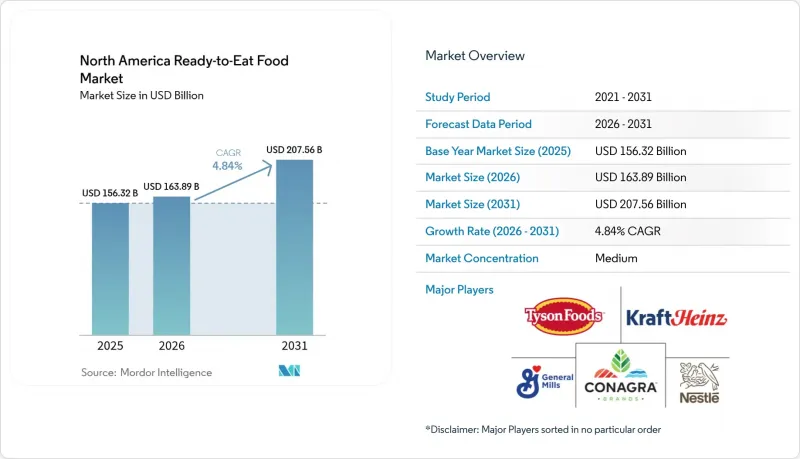
This report is Segmented by Product Type (Instant Breakfast/Cereals, Instant Soups and Snacks, Ready Meals, Baked Goods, Meat Products, Other Product Types), by Distribution Channel (Supermarkets/Hypermarkets, Convenience Stores, and More), and Geography (United States, Canada, Mexico, Rest of North America). The Market Forecasts are Provided in Terms of Value (USD).
North America Ready-to-Eat Food Market Trends and Insights
Availability of Diverse Cuisine Options in Ready-To-Eat Formats
Manufacturers are redefining product development strategies to align with consumers' growing desire for diverse culinary experiences. According to the USDA's Food Processing Ingredients Annual report, the demand for ready-to-eat foods in Mexico is rising, particularly among younger consumers . This shift is fueled by an increasing acceptance of international flavors, which is driving market growth. The trend has evolved beyond traditional ethnic foods to include innovative fusion concepts and regional specialties, enabling brands to stand out in a competitive market. By offering a wider variety of options, companies can command premium pricing while appealing to a broader demographic spectrum. Furthermore, Export Development Canada identifies global flavors, with a strong emphasis on Asian and Indian cuisines, as significant trends for 2025. This reflects a growing consumer preference for authentic international experiences delivered in convenient formats. By adopting a data-driven approach to flavor innovation, brands can strategically launch targeted products, minimizing the risk of failure in emerging cuisine categories and ensuring alignment with consumer expectations.
Growing Number of Single-Person Households
Urban markets are undergoing a significant shift in the ready-to-eat food sector due to the rise of single-person households. These changes, coupled with limited living spaces and fast-paced urban lifestyles, are driving demand for smaller, convenient meal options. Statistics Canada highlights that evolving household structures are reshaping food buying habits. Single-person households, a key consumer segment, prefer premium products and are willing to pay more for high-quality, convenient meals, making cooking for one comparable to buying prepared foods. The US Census Bureau reported 38.1 million single-person households in the U.S. in 2023, up from 37.89 million in 2022, showcasing their growing market influence . Brands can cater to this segment by offering products with resealable packaging, longer shelf life, and portion control. Additionally, these consumers increasingly use online grocery services and meal delivery platforms, boosting digital retail channels. Aligning product offerings and distribution strategies with these trends allows companies to capture demand and strengthen their position in the ready-to-eat food market.
Concerns Over Nutritional Value and Use of Artificial Ingredients
As health awareness campaigns and regulatory changes emphasize ingredient transparency, consumer skepticism toward ultra-processed foods is rising. The FDA's front-of-package nutrition labeling system categorizes products as "Low," "Med," or "High" in saturated fat, sodium, and added sugars, making nutritional shortcomings clearer. This aligns with a trend reported by the International Food Information Council, where more consumers are scrutinizing ingredient and nutrition labels. Demand for clean-label and reduced-sugar products is growing, reflecting a shift toward healthier choices . Regulatory shifts are driving manufacturers to reformulate products, but this often increases costs and alters taste profiles, especially in convenience foods. Products rated poorly under the new system risk losing market appeal, pressuring manufacturers to innovate. The FDA's guidance on Low-Moisture Ready-to-Eat foods highlights a focus on food safety, urging robust sanitation to prevent contamination. Manufacturers are investing in clean-label formulations and functional ingredients to meet regulatory and consumer demands, but balancing these changes with affordability and taste remains a challenge for the processed food market.
Other drivers and restraints analyzed in the detailed report include:
- Advancements In Packaging to Improve Shelf Life and Portability
- Rapid Growth of Online Food Delivery And E-Grocery Platforms
- Growing Preference for Fresh and Organic Food Alternatives
For complete list of drivers and restraints, kindly check the Table Of Contents.
Segment Analysis
In 2025, ready meals hold a 35.78% market share, with a projected CAGR of 4.85% through 2031. This growth highlights the segment's ability to adapt to consumer preferences by offering convenient, restaurant-quality foods. Manufacturers leverage global culinary trends and premium strategies to maintain leadership. The USDA reports rising demand for globally-inspired ready-to-eat meals, especially among younger consumers in Mexico, with similar trends across North America. The "elevated in-home experiences" trend drives demand for premium frozen offerings with authentic flavors and superior ingredients. Ready Meals also address demographic shifts, such as more single-person households and busier lifestyles, by providing portion-controlled, convenient solutions that reduce food waste. FDA nutrition labeling requirements push manufacturers to improve nutritional profiles while retaining taste and convenience.
Export Development Canada identifies innovative meal solutions and global flavors as key 2025 trends. Manufacturers are responding with products featuring international cuisines and clean-label ingredients to meet transparency and quality demands. Advances in packaging, such as metalized films and smart technologies, extend shelf life and maintain food quality, enabling broader distribution. The Institute of Food Technologists highlights these innovations as enhancing product performance and appeal. The segment's growth is further supported by the increasing acceptance of frozen foods as high-quality alternatives to fresh cooking, particularly among younger consumers who prioritize convenience without compromising taste or nutrition.
Complete Report Scope:
- By Product Type
- Instant Breakfast/Cereals
- Instant Soups and Snacks
- Ready Meals
- Baked Goods
- Meat Products
- Other Product Types
- By Distribution Channel
- Supermarkets/Hypermarkets
- Convenience/Grocery Stores
- Speciality Stores
- Online Retail Stores
- Other Distribution Channels
- By Geography
- United States
- Canada
- Mexico
- Rest of North America
List of Companies Covered in this Report:
- Nestle S.A
- Conagra Brands, Inc.
- The Kraft Heinz Company
- General Mills, Inc.
- Tyson Foods, Inc.
- Nomad Foods Limited
- McCain Foods Limited
- J.M. Smucker Company
- Fleury Michon S.A.
- Oetker Group
- Campbell Soup Company
- Amy's Kitchen, Inc.
- Hormel Foods Corporation
- Maple Leaf Foods Inc.
- Kellanova
- B&G Foods, Inc.
- C.J. Foods, Inc
- Post Holdings, Inc.
- SunBasket Inc.
- The Hain Celestial Group, Inc.
Additional Benefits:
- The market estimate (ME) sheet in Excel format
- 3 months of analyst support
TABLE OF CONTENTS
1 INTRODUCTION
- 1.1 Study Assumptions and Market Definition
- 1.2 Scope of the Study
2 RESEARCH METHODOLOGY
3 EXECUTIVE SUMMARY
4 MARKET LANDSCAPE
- 4.1 Market Overview
- 4.2 Market Drivers
- 4.2.1 Availability of Diverse Cuisine Options in Ready-To-Eat Formats
- 4.2.2 Growing Number of Single-Person Households
- 4.2.3 Advancements In Packaging to Improve Shelf Life and Portability
- 4.2.4 Rapid Growth of Online Food Delivery And E-Grocery Platforms
- 4.2.5 Increasing Workforce Participation Boosts Demand for Time-Saving Food Solutions
- 4.2.6 Increasing Consumer Willingness to Spend on Premium Ready-to-Eat Products
- 4.3 Market Restraints
- 4.3.1 Concerns Over Nutritional Value and Use of Artificial Ingredients
- 4.3.2 Growing Preference for Fresh and Organic Food Alternatives
- 4.3.3 Stringent Government Regulations on Food Labeling and Additives
- 4.3.4 Environmental Impact of Packaging Waste from Ready-to-Eat Products
- 4.4 Supply-Chain Analysis
- 4.5 Regulatory Landscape
- 4.6 Porter's Five Forces
- 4.6.1 Threat of New Entrants
- 4.6.2 Bargaining Power of Buyers
- 4.6.3 Bargaining Power of Suppliers
- 4.6.4 Threat of Substitute Products
- 4.6.5 Intensity of Competitive Rivalry
5 MARKET SIZE AND GROWTH FORECASTS (VALUE)
- 5.1 By Product Type
- 5.1.1 Instant Breakfast/Cereals
- 5.1.2 Instant Soups and Snacks
- 5.1.3 Ready Meals
- 5.1.4 Baked Goods
- 5.1.5 Meat Products
- 5.1.6 Other Product Types
- 5.2 By Distribution Channel
- 5.2.1 Supermarkets/Hypermarkets
- 5.2.2 Convenience/Grocery Stores
- 5.2.3 Speciality Stores
- 5.2.4 Online Retail Stores
- 5.2.5 Other Distribution Channels
- 5.3 By Geography
- 5.3.1 United States
- 5.3.2 Canada
- 5.3.3 Mexico
- 5.3.4 Rest of North America
6 COMPETITIVE LANDSCAPE
- 6.1 Market Concentration
- 6.2 Strategic Moves
- 6.3 Market Share Analysis
- 6.4 Company Profiles (includes Global level Overview, Market level overview, Core Segments, Financials as available, Strategic Information, Market Rank/Share for key companies, Products and Services, and Recent Developments)
- 6.4.1 Nestle S.A
- 6.4.2 Conagra Brands, Inc.
- 6.4.3 The Kraft Heinz Company
- 6.4.4 General Mills, Inc.
- 6.4.5 Tyson Foods, Inc.
- 6.4.6 Nomad Foods Limited
- 6.4.7 McCain Foods Limited
- 6.4.8 J.M. Smucker Company
- 6.4.9 Fleury Michon S.A.
- 6.4.10 Oetker Group
- 6.4.11 Campbell Soup Company
- 6.4.12 Amy's Kitchen, Inc.
- 6.4.13 Hormel Foods Corporation
- 6.4.14 Maple Leaf Foods Inc.
- 6.4.15 Kellanova
- 6.4.16 B&G Foods, Inc.
- 6.4.17 C.J. Foods, Inc
- 6.4.18 Post Holdings, Inc.
- 6.4.19 SunBasket Inc.
- 6.4.20 The Hain Celestial Group, Inc.
7 MARKET OPPORTUNITIES AND FUTURE OUTLOOK

