PUBLISHER: Mordor Intelligence | PRODUCT CODE: 2122952

PUBLISHER: Mordor Intelligence | PRODUCT CODE: 2122952
Acute Ischemic Stroke Diagnosis - Market Share Analysis, Industry Trends & Statistics, Growth Forecasts (2026 - 2031)
According to Mordor Intelligence, the acute ischemic stroke diagnosis market size is expected to grow from USD 2.36 billion in 2025 to USD 2.53 billion in 2026 and is forecast to reach USD 3.59 billion by 2031 at 7.27% CAGR over 2026-2031.
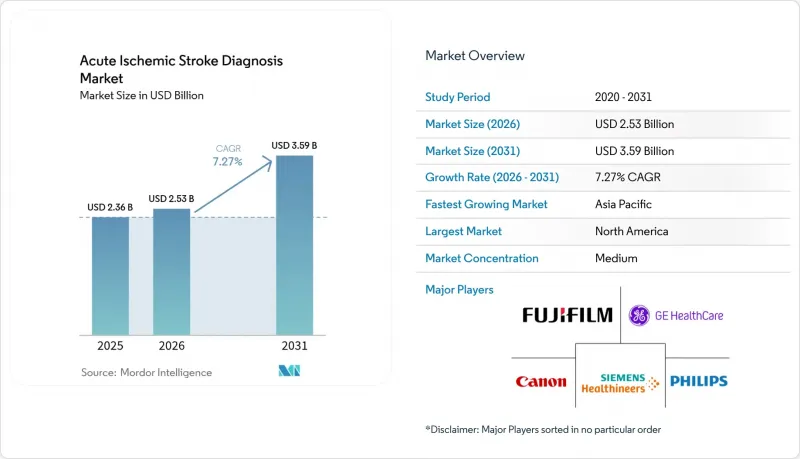
This report is Segmented by Diagnostic Technology (Computed Tomography, Magnetic Resonance Imaging, and More), AI Software Function (Early-Event Triage & Alerting, and More), Care Setting (Emergency Department In-Hospital, and More), End User (Hospitals, Diagnostic Imaging Centers, and More), and Geography (North America, and More). The Market Forecasts are Provided in Terms of Value (USD).
Global Acute Ischemic Stroke Diagnosis Market Trends and Insights
Growing AIS Incidence in 65-Plus Population
The share of the global population aged 65 and older will reach 16% by 2030, and stroke incidence doubles with each successive decade after 65, sustaining diagnostic demand even in regions with plateauing age-adjusted rates. Japan already mandates CT or MRI within 60 minutes of presentation for suspected stroke, a policy response to the fact that 75% of domestic cases occur in seniors. U.S. Medicare data show rising hospitalizations for mild strokes thanks to faster pre-hospital recognition and imaging, further enlarging the pool of patients routed into acute workflows. These demographic realities create a durable tailwind for every segment of the acute ischemic stroke diagnosis market.
Wider Adoption of Multimodal CT & MR Imaging Protocols
Guidelines now recommend CT angiography and CT perfusion for all patients within 24 hours of last-known-well, normalizing tissue-based triage beyond the first 6 hours. U.S. comprehensive stroke centers increased multimodal CT protocol adoption by 18% in 2025, driven by evidence that perfusion mismatch predicts favorable thrombectomy outcomes. Dual-energy CT platforms compress scan time below 3 minutes and help overcrowded emergency departments meet door-to-imaging targets. Although MRI retains superior sensitivity for posterior circulation infarcts, its longer acquisition time keeps CT in the front-line role.
High Capital & Maintenance Cost of Advanced Scanners
Photon-counting CT lists at USD 3.2 million versus USD 1.8 million for a 128-slice CT, and annual service contracts add USD 250,000, numbers that exceed the entire equipment budget of many 200-bed hospitals. District-level hospitals in India illustrate the gap: only 14% possess CT, and fewer than 2% run MRI, constraining adoption despite government subsidies.
Other drivers and restraints analyzed in the detailed report include:
- Expanding Endovascular-Thrombectomy 24-Hour Time-Window
- National Stroke-Care Quality Initiatives & Reimbursement Incentives
- Shortage of Neuroradiologists in Emerging Markets
For complete list of drivers and restraints, kindly check the Table Of Contents.
Segment Analysis
Multimodal CT imaging generated 48.55% of 2025 technology revenue, underscoring its status as the workhorse of the acute ischemic stroke diagnosis market share during hyperacute triage. The acute ischemic stroke diagnosis market size attributed to AI software, though smaller today, is projected to rise fastest because subscription pricing aligns with cash-flow-constrained hospitals. MRI maintains a foothold for posterior fossa strokes and microbleed detection, but its share will erode marginally as photon-counting CT converges on MRI-like resolution with shorter scan times.
AI decision-support software is set to scale at 14.25% CAGR through 2031 because payors reward time-to-treatment performance and radiologist shortages create demand for automated pre-reads. Early adopters report sensitivity exceeding 94% for large-vessel occlusion, while false positives remain under 8%, metrics that justify per-use fees of USD 50-80. The convergence of CT hardware upgrades with cloud-deployed AI suites positions imaging OEMs and pure-play vendors to compete on workflow speed rather than pixel quality alone.
Large-vessel occlusion detection held 40.53% of 2025 AI revenue as every stroke center now prioritizes rapid occlusion identification for thrombectomy routing. Perfusion mismatch quantification tools will capture incremental share because late-window thrombectomy protocols depend on tissue viability rather than elapsed time alone. Vendors packaging occlusion detection, perfusion maps, and hemorrhage exclusion into a single dashboard win contracts by simplifying IT integration. Mobile push notifications reduce team activation times; early data show a 23-minute median reduction in door-to-groin puncture when algorithms auto-page neurointerventional teams.
Complete Report Scope:
- By Diagnostic Technology
- Computed Tomography (NCCT, CTA, CTP)
- Magnetic Resonance Imaging (DWI, SWI, ASL)
- Carotid & Trans-cranial Ultrasound
- Cerebral Angiography (DSA)
- Blood-based Biomarker Tests
- AI-enabled Stroke Decision-Support Software
- By AI Software Function
- Early-Event Triage & Alerting
- Large-Vessel-Occlusion Detection
- Perfusion Mismatch Quantification
- Hemorrhage Exclusion
- By Care Setting
- Emergency Department In-hospital
- Mobile Stroke Unit
- Telestroke Hub & Spoke
- By End User
- Hospitals
- Diagnostic Imaging Centers
- Ambulatory Surgery Centers / Others
- By Geography
- North America
- United States
- Canada
- Mexico
- Europe
- Germany
- United Kingdom
- France
- Italy
- Spain
- Rest of Europe
- Asia-Pacific
- China
- India
- Japan
- Australia
- South Korea
- Rest of Asia-Pacific
- Middle East and Africa
- GCC
- South Africa
- Rest of Middle East and Africa
- South America
- Brazil
- Argentina
- Rest of South America
- North America
Geography Analysis
North America retained 36.23% global share in 2025 because comprehensive stroke centers exceed 200 and reimbursement is tightly linked to imaging-guided quality metrics. The United States Food and Drug Administration has cleared 12 AI stroke algorithms since 2024, supplying hospitals with multiple vendor options that compete on speed, cloud integration, and subscription price. Canada's provincial telestroke networks have shortened remote transfer times, while Mexico added 18 CT scanners to regional hospitals but still struggles with a neuroradiologist deficit that slows interpretation turnaround.
The acute ischemic stroke diagnosis market in Asia-Pacific will expand fastest at 11.42% CAGR because China and India are building stroke registries that compel imaging compliance, and private hospital chains are investing heavily in advanced scanners to appeal to medical tourists. China now operates 1,200 stroke centers, a 35% jump since 2022, and ties reimbursement to imaging protocol adherence. India's 2024-launched cardiovascular and stroke program earmarked USD 145 million for CT procurement and physician training. Japan, already imaging 92% of stroke suspects within 60 minutes, focuses on ultra-high-field MRI to improve microvascular detection in its rapidly aging society.
Europe generated a significant revenue in 2025 as Germany's 340 certified stroke units standardized multimodal CT perfusion, and the United Kingdom added GBP 45 million worth of scanners and AI licenses to expand thrombectomy access. France issued CE-Mark approval to eight AI stroke detection platforms in 2024, triggering rapid procurement by public and private hospitals. Middle East and Africa remain nascent but attract targeted investment; the United Arab Emirates installed 14 new CT scanners in 2024, and South Africa's handful of comprehensive stroke centers are exploring AI to amplify limited neuroradiology capacity. South America is led by Brazil's private chains, yet public hospitals lag, with median door-to-CT times still above 90 minutes.
- Canon
- Ceribell
- Esaote
- FUJIFILM
- GE Healthcare
- Hyperfine
- Koninklijke Philips
- Medtronic Neurovascular
- MicroPort
- MicroVention
- Neusoft
- Nihon Kohden
- NovaSignal
- Penumbra
- RapidAI
- Siemens Healthineers
- Stryker Neurovascular
- Viz.ai
Additional Benefits:
- The market estimate (ME) sheet in Excel format
- 3 months of analyst support
TABLE OF CONTENTS
1 Introduction
- 1.1 Study Assumptions & Market Definition
- 1.2 Scope of the Study
2 Research Methodology
3 Executive Summary
4 Market Landscape
- 4.1 Market Overview
- 4.2 Market Drivers
- 4.2.1 Growing AIS incidence in 65-plus population
- 4.2.2 Wider adoption of multimodal CT & MR imaging protocols
- 4.2.3 Expanding endovascular-thrombectomy 24-h time-window
- 4.2.4 National stroke-care quality initiatives & reimbursement incentives
- 4.2.5 Photon-counting CT & 7 T MRI enabling microvascular stroke detection
- 4.2.6 Subscription AI-triage bundles tied to teleradiology contracts
- 4.3 Market Restraints
- 4.3.1 High capital & maintenance cost of advanced scanners
- 4.3.2 Shortage of neuroradiologists in emerging markets
- 4.3.3 Algorithmic-bias concerns slowing AI regulatory clearance
- 4.3.4 Xenon-CT consumable supply disruptions raising protocol costs
- 4.4 Regulatory Landscape
- 4.5 Technological Outlook
- 4.6 Porter's Five Forces Analysis
- 4.6.1 Threat of New Entrants
- 4.6.2 Bargaining Power of Buyers
- 4.6.3 Bargaining Power of Suppliers
- 4.6.4 Threat of Substitutes
- 4.6.5 Intensity of Competitive Rivalry
5 Market Size & Growth Forecasts (Value, USD)
- 5.1 By Diagnostic Technology
- 5.1.1 Computed Tomography (NCCT, CTA, CTP)
- 5.1.2 Magnetic Resonance Imaging (DWI, SWI, ASL)
- 5.1.3 Carotid & Trans-cranial Ultrasound
- 5.1.4 Cerebral Angiography (DSA)
- 5.1.5 Blood-based Biomarker Tests
- 5.1.6 AI-enabled Stroke Decision-Support Software
- 5.2 By AI Software Function
- 5.2.1 Early-Event Triage & Alerting
- 5.2.2 Large-Vessel-Occlusion Detection
- 5.2.3 Perfusion Mismatch Quantification
- 5.2.4 Hemorrhage Exclusion
- 5.3 By Care Setting
- 5.3.1 Emergency Department In-hospital
- 5.3.2 Mobile Stroke Unit
- 5.3.3 Telestroke Hub & Spoke
- 5.4 By End User
- 5.4.1 Hospitals
- 5.4.2 Diagnostic Imaging Centers
- 5.4.3 Ambulatory Surgery Centers / Others
- 5.5 By Geography
- 5.5.1 North America
- 5.5.1.1 United States
- 5.5.1.2 Canada
- 5.5.1.3 Mexico
- 5.5.2 Europe
- 5.5.2.1 Germany
- 5.5.2.2 United Kingdom
- 5.5.2.3 France
- 5.5.2.4 Italy
- 5.5.2.5 Spain
- 5.5.2.6 Rest of Europe
- 5.5.3 Asia-Pacific
- 5.5.3.1 China
- 5.5.3.2 India
- 5.5.3.3 Japan
- 5.5.3.4 Australia
- 5.5.3.5 South Korea
- 5.5.3.6 Rest of Asia-Pacific
- 5.5.4 Middle East and Africa
- 5.5.4.1 GCC
- 5.5.4.2 South Africa
- 5.5.4.3 Rest of Middle East and Africa
- 5.5.5 South America
- 5.5.5.1 Brazil
- 5.5.5.2 Argentina
- 5.5.5.3 Rest of South America
- 5.5.1 North America
6 Competitive Landscape
- 6.1 Market Concentration
- 6.2 Market Share Analysis
- 6.3 Company Profiles (includes Global level Overview, Market level overview, Core Segments, Financials as available, Strategic Information, Market Rank/Share for key companies, Products & Services, and Recent Developments)
- 6.3.1 Canon Medical Systems
- 6.3.2 Ceribell
- 6.3.3 Esaote SpA
- 6.3.4 Fujifilm Holdings
- 6.3.5 GE HealthCare
- 6.3.6 Hyperfine
- 6.3.7 Koninklijke Philips N.V.
- 6.3.8 Medtronic Neurovascular
- 6.3.9 MicroPort Scientific
- 6.3.10 MicroVention
- 6.3.11 Neusoft Medical
- 6.3.12 Nihon Kohden
- 6.3.13 NovaSignal
- 6.3.14 Penumbra Inc.
- 6.3.15 RapidAI
- 6.3.16 Siemens Healthineers
- 6.3.17 Stryker Neurovascular
- 6.3.18 Viz.ai
7 Market Opportunities & Future Outlook
- 7.1 White-space & Unmet-need Assessment

