PUBLISHER: Mordor Intelligence | PRODUCT CODE: 2122963

PUBLISHER: Mordor Intelligence | PRODUCT CODE: 2122963
Joint Replacement - Market Share Analysis, Industry Trends & Statistics, Growth Forecasts (2026 - 2031)
According to Mordor Intelligence, the joint replacement market size is expected to grow from USD 19.97 billion in 2025 to USD 20.84 billion in 2026 and is forecast to reach USD 25.77 billion by 2031 at 4.30% CAGR over 2026-2031.
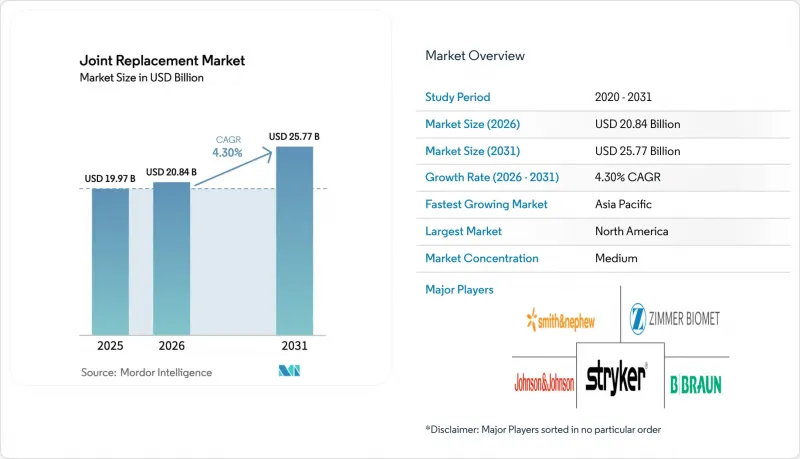
This report is Segmented by Procedure (Hip, Knee, Shoulder, Ankle, Elbow, Others), Product (Implants, Bone Grafts & Substitutes, Fixation & Instrumentation, Others), Technology (Conventional, Robotic-Assisted, Navigation/AR-Guided), End User (Hospitals, Specialty Orthopedic Centers, and More), and Geography (North America, Europe, Asia-Pacific, and More). Market Forecasts are Provided in Value (USD).
Global Joint Replacement Market Trends and Insights
High Osteoarthritis Prevalence
The Global Burden of Disease study counted 607 million osteoarthritis cases in 2021, and forecasts a 75% increase in knee disease by 2050 as people live longer and body-mass-index levels rise. Furthermore, the prevalence of osteoarthritis increases with age. Japan already has 29% of its citizens aged 65 plus, while South Korea will be super-aged in 2025, producing steady joint replacement market demand. Obesity adds complexity and cost, because heavier patients need reinforced implants and face higher revision risk. China's over-70 cohort is set to reach 402 million by 2050, yet procedure rates remain one-fifth of U.S. levels, creating latent joint replacement market upside once insurance reforms mature. The combined effects of aging, obesity, and broader coverage underpin long-run volume growth, although surgeon shortages and sterile processing capacity could slow uptake in some emerging economies.
Growing Preference for Minimally Invasive and Robotic-Assisted TJA
Robotic total knee arthroplasty reached economic break-even at only 24-50 cases annually in 2024, versus 100-plus in 2020, as platform costs fell and OR times shortened. Community hospitals and ASCs now adopt robots, while vendors bundle implants and software to lock in repeat business. Clinical data show better alignment and lower dislocation rates, pushing payers to reimburse robotic procedures that shorten stays and reduce 90-day readmissions. NICE guidance in 2025 endorsed robotic orthopedics, prompting NHS procurement plans . As evidence accumulates, hospitals without robotic capacity risk losing referrals, keeping the joint replacement market on a technology-upgrade cycle.
Other drivers and restraints analyzed in the detailed report include:
- Accelerated Post-Op Rehab Protocols Boosting Outpatient TJA Volumes
- 3D-Printed Patient-Specific Implants Cutting Revision Risk
- High Procedure & Implant Cost
- Revision-Surgery Burden from Metal Hypersensitivity Claims
For complete list of drivers and restraints, kindly check the Table Of Contents.
Segment Analysis
Shoulder procedures are growing at a 5.1% CAGR to 2031 as reverse designs address fractures and revisions once treated non-operatively. FDA clearance of Stryker's Aequalis Perform+ and Zimmer's glenoid reconstruction solutions widened indications. Ten-year survivorship reaches 95%, shifting surgeons from anatomic models for patients over 70. Knee replacement still held 40.1% joint replacement market share in 2025 due to consistent Medicare payment, yet its growth slows as U.S. penetration nears northern European saturation levels. Hip arthroplasty benefits from robotic adoption that cuts dislocations by 40%, while ankle and elbow remain niche but may expand as 3D-printed devices solve complex anatomies.
Synthetic and allograft substitutes are advancing at 4.9% CAGR as older implants reach end-of-life. FDA clearances for demineralized matrices and calcium phosphate ceramics bolster surgeon confidence . Improved donor screening lowered infection risk, but tight supply gives tissue banks pricing power. Implants captured 61% of the joint replacement market size in 2025, though share may slip as graft content per case rises. Highly cross-linked polyethylene and ceramic heads halve wear, while single-use instrument kits cut ASC sterilization costs.
Complete Report Scope:
- By Procedure
- Hip Replacement
- Knee Replacement
- Shoulder Replacement
- Ankle Replacement
- Elbow Replacement
- Others
- By Product
- Implants
- Metallic
- Ceramic
- Polymeric & Hybrid Biomaterials
- Bone Grafts & Substitutes
- Autograft
- Allograft
- Synthetic
- Fixation & Instrumentation
- Others
- Implants
- By Technology
- Conventional
- Robotic-Assisted
- Navigation / AR-Guided
- By End User
- Hospitals
- Specialty Orthopaedic Centres
- Ambulatory Surgery Centres
- By Geography
- North America
- United States
- Canada
- Mexico
- Europe
- Germany
- United Kingdom
- France
- Italy
- Spain
- Rest of Europe
- Asia-Pacific
- China
- Japan
- India
- Australia
- South Korea
- Rest of Asia-Pacific
- Middle East & Africa
- GCC
- South Africa
- Rest of Middle East & Africa
- South America
- Brazil
- Argentina
- Rest of South America
- North America
Geography Analysis
North America held 45.6% of global revenue in 2025, supported by the United States' high procedure rate of 7.2 total knee arthroplasties per 1,000 people and the sale of robotic consoles priced above USD 1 million each. After the Centers for Medicare & Medicaid Services removed total hip arthroplasty from the inpatient-only list in January 2024, more surgeries shifted to outpatient settings, tightening hospital margins and prompting distributor consolidation. Canada's publicly funded system posted a 12-month median wait for hip replacement in 2024, steering patients to U.S. ambulatory surgery centers near the border. Mexico's medical-tourism hubs in Tijuana and Monterrey treated 45,000 joint-replacement patients in 2024, offering ISO 13485-certified implants at half of U.S. prices. Regional growth faces a supply pinch because the FDA issued 23 warning letters for excess ethylene oxide residue in 2024, delaying new product launches by up to nine months.
Asia-Pacific is growing at a 4.5% CAGR, the fastest among all regions. Japan's super-aged profile, with 29% of residents at least 65 in 2024, helped lift total knee procedures to 180,000 that year, a 12% rise since 2020, after reimbursement changes rewarded cementless porous implants. China expanded insurance to cover 95% of urban residents for joint replacement by 2025, adding further momentum. India drew 120,000 overseas patients to Chennai and Mumbai in 2024, thanks to JCI-accredited hospitals and implant prices 60% below Western levels. South Korea's insurer began paying for reverse shoulder arthroplasty in 2025, opening access for rotator-cuff cases, while Australia cut approval times for robotic systems to nine months in 2024, letting firms launch locally in the same quarter as U.S. and EU clearances.
In Europe, Medical Device Regulation compliance now averages EUR 2 million per product family and extends CE-mark timelines to about two years, slowing growth. Germany and France still perform many hip revisions: the German registry logged 28,000 in 2024, 40% tied to cobalt-chromium debris from older metal-on-metal implants. The United Kingdom's National Health Service negotiated a 15% price cut on knee implants for 2025, pushing manufacturers to rely on private-pay volumes to protect margins. The Middle East and Africa gain from government spending. Saudi Arabia's Vision 2030 commits USD 10 billion to build orthopedic centers, aiming for 50,000 annual joint replacements by 2028. South America centers on Brazil, where private insurance covered 27% of citizens in 2024. Public hospitals face wait times longer than 18 months, so private facilities capture demand for premium implants.
- Arthrex
- B. Braun
- Bioimpianti Srl
- Conformis
- Corin Group
- DePuy Synthes
- Enovis
- Exactech
- Globus Medical
- Kyocera Medical
- LimaCorporate
- Medacta Group
- MicroPort
- Smiths Group
- Stryker
- United Orthopedic Corp.
- Uteshiya Medicare
- Waldemar Link
- Zimmer Biomet
Additional Benefits:
- The market estimate (ME) sheet in Excel format
- 3 months of analyst support
TABLE OF CONTENTS
1 Introduction
- 1.1 Study Assumptions & Market Definition
- 1.2 Scope of the Study
2 Research Methodology
3 Executive Summary
4 Market Landscape
- 4.1 Market Overview
- 4.2 Market Drivers
- 4.2.1 High Osteoarthritis Prevalence
- 4.2.2 Rising Geriatric Population
- 4.2.3 Growing Preference for Minimally-Invasive and Robotic-Assisted TJA
- 4.2.4 Accelerated Post-Op Rehab Protocols Boosting Outpatient TJA Volumes
- 4.2.5 3D-Printed Patient-Specific Implants Cutting Revision Risk
- 4.2.6 Strategic Reshoring of Titanium and Cobalt Alloy Supply Chains
- 4.3 Market Restraints
- 4.3.1 High Procedure & Implant Cost
- 4.3.2 Availability of Pharmacological and Arthroscopic Alternatives
- 4.3.3 Revision-Surgery Burden from Metal Hypersensitivity Claims
- 4.3.4 Capacity Bottlenecks in Sterilization and Clean-Room Machining
- 4.4 Supply Chain Analysis
- 4.5 Regulatory Landscape
- 4.6 Technological Outlook
- 4.7 Porter's Five Forces Analysis
- 4.7.1 Bargaining Power of Buyers
- 4.7.2 Bargaining Power of Suppliers
- 4.7.3 Threat of New Entrants
- 4.7.4 Threat of Substitutes
- 4.7.5 Competitive Rivalry
5 Market Size & Growth Forecasts (Value, USD)
- 5.1 By Procedure
- 5.1.1 Hip Replacement
- 5.1.2 Knee Replacement
- 5.1.3 Shoulder Replacement
- 5.1.4 Ankle Replacement
- 5.1.5 Elbow Replacement
- 5.1.6 Others
- 5.2 By Product
- 5.2.1 Implants
- 5.2.1.1 Metallic
- 5.2.1.2 Ceramic
- 5.2.1.3 Polymeric & Hybrid Biomaterials
- 5.2.2 Bone Grafts & Substitutes
- 5.2.2.1 Autograft
- 5.2.2.2 Allograft
- 5.2.2.3 Synthetic
- 5.2.3 Fixation & Instrumentation
- 5.2.4 Others
- 5.2.1 Implants
- 5.3 By Technology
- 5.3.1 Conventional
- 5.3.2 Robotic-Assisted
- 5.3.3 Navigation / AR-Guided
- 5.4 By End User
- 5.4.1 Hospitals
- 5.4.2 Specialty Orthopaedic Centres
- 5.4.3 Ambulatory Surgery Centres
- 5.5 By Geography
- 5.5.1 North America
- 5.5.1.1 United States
- 5.5.1.2 Canada
- 5.5.1.3 Mexico
- 5.5.2 Europe
- 5.5.2.1 Germany
- 5.5.2.2 United Kingdom
- 5.5.2.3 France
- 5.5.2.4 Italy
- 5.5.2.5 Spain
- 5.5.2.6 Rest of Europe
- 5.5.3 Asia-Pacific
- 5.5.3.1 China
- 5.5.3.2 Japan
- 5.5.3.3 India
- 5.5.3.4 Australia
- 5.5.3.5 South Korea
- 5.5.3.6 Rest of Asia-Pacific
- 5.5.4 Middle East & Africa
- 5.5.4.1 GCC
- 5.5.4.2 South Africa
- 5.5.4.3 Rest of Middle East & Africa
- 5.5.5 South America
- 5.5.5.1 Brazil
- 5.5.5.2 Argentina
- 5.5.5.3 Rest of South America
- 5.5.1 North America
6 Competitive Landscape
- 6.1 Market Concentration
- 6.2 Market Share Analysis
- 6.3 Company Profiles (includes Global level Overview, Market level overview, Core Segments, Financials as available, Strategic Information, Market Rank/Share for key companies, Products & Services, and Recent Developments)
- 6.3.1 Arthrex
- 6.3.2 B. Braun
- 6.3.3 Bioimpianti Srl
- 6.3.4 Conformis
- 6.3.5 Corin Group
- 6.3.6 DePuy Synthes
- 6.3.7 Enovis
- 6.3.8 Exactech
- 6.3.9 Globus Medical
- 6.3.10 Kyocera Medical
- 6.3.11 LimaCorporate
- 6.3.12 Medacta Group
- 6.3.13 MicroPort Scientific
- 6.3.14 Smith & Nephew
- 6.3.15 Stryker
- 6.3.16 United Orthopedic Corp.
- 6.3.17 Uteshiya Medicare
- 6.3.18 Waldemar Link
- 6.3.19 Zimmer Biomet
7 Market Opportunities & Future Outlook
- 7.1 White-space & Unmet-need Assessment

