PUBLISHER: Mordor Intelligence | PRODUCT CODE: 2122966

PUBLISHER: Mordor Intelligence | PRODUCT CODE: 2122966
United Kingdom Retail Banking - Market Share Analysis, Industry Trends & Statistics, Growth Forecasts (2026 - 2031)
According to Mordor Intelligence, the United Kingdom retail banking market stands at USD 83.88 billion in 2026 and is projected to reach USD 105.64 billion by 2031, reflecting a market size expansion at a 4.72% CAGR.
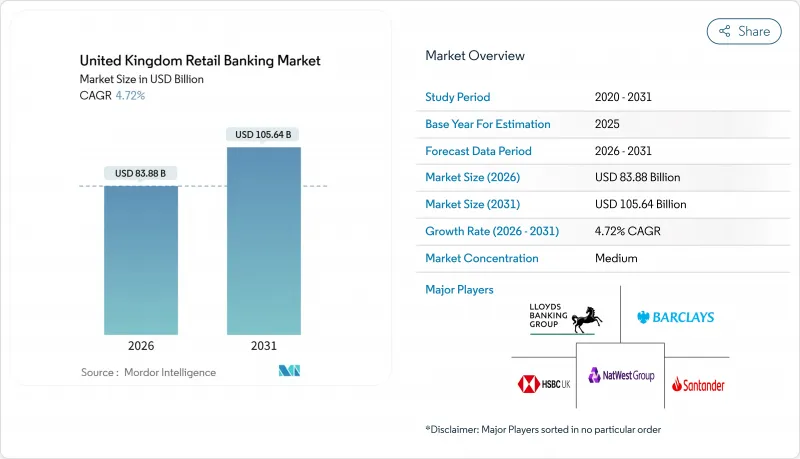
This report is Segmented by Product (Transactional Accounts, Savings Accounts, Debit Cards, Credit Cards, Loans, Other Products), Channel (Online Banking, Offline Banking), Customer Age Group (18-28 Years, 29-44 Years, 45-59 Years, and More), and Bank Type (National Banks, Regional Banks, and More). The Market Forecasts are Provided in Terms of Value (USD Billion).
United Kingdom Retail Banking Market Trends and Insights
Bank Rate-Induced Expansion of Net-Interest Margins
The average Bank of England (BoE) interest rate in the first half of 2024 was 5.25%, which led to a significant improvement in deposit margins and net interest margin (NIM). This mechanical uplift supported top-line resilience during a period when competitive pressures on deposits did not fully pass through lower headline rates. Portfolio dynamics such as higher hedge yields and moderated deposit migration offset rate cuts in the near term. Adjustments to affordability testing parameters created flexibility in retail underwriting without breaching systemwide constraints. The combined effect sustains revenue durability as policy rates trend lower in 2026.
Mandatory Open-Banking APIs Accelerating Account-Switching & Aggregation
As of March 2025, the total number of active open banking users in the United Kingdom stood at around 13.3 million, reflecting steady growth and a broader trend towards digital financial services. Over 23 million one-off payments were successfully processed using open banking by early 2025, with 3.7 million successful Variable Recurring Payment (VRP) transactions recorded in March alone. The Data Use and Access framework created a durable governance structure through a "Future Entity," with the FCA providing supervisory clarity and embedding open banking as permanent infrastructure. API performance metrics demonstrated reliability across billions of monthly calls, reflecting a mature ecosystem that supports higher switching and aggregation. Cross-border interchange interventions by the PSR reinforced incentives for account-to-account payments in specific use cases. Technical standards, including ISO 20022 and clear complaint-handling pathways through the Financial Ombudsman Service, complete the operational stack for adoption.
Interchange-Fee Caps Compressing Card-Fee Income
The PSR's market review into cross-border interchange fees followed material post-Brexit increases for card-not-present transactions, which elevated costs for United Kingdom merchants. The October 2025 consultation advanced a permanent cap approach based on a merchant indifference test, with litigation delaying interim relief and outcomes expected to land in 2026. Banks face fee compression while maintaining fraud prevention investments that the PSR views as necessary for system integrity. Domestic interchange remains bound by EU-derived caps, while cross-border pricing constraints shift economics toward account-to-account alternatives in select flows. The overall effect reduces card-fee income growth in the United Kingdom retail banking market.
Other drivers and restraints analyzed in the detailed report include:
- Rapid Adoption of Mobile Banking in the United Kingdom
- Fixed-Rate Mortgage Maturity Wave Driving Re-Mortgage Volumes
- Branch Closures Creating Rural Financial Exclusion Risk
For complete list of drivers and restraints, kindly check the Table Of Contents.
Segment Analysis
Loans accounted for 31.26% of product share in 2025 within the United Kingdom retail banking market, while other products are set to grow at a 6.89% pace to 2031 as banks expand packaged accounts, wealth bundles, and embedded finance. Fee-generating services gained prominence as lenders balanced risk-weighted assets with capital-light revenues, aided by premium propositions that integrate concierge, travel, and wealth support. Transactional accounts remain ubiquitous, yet commoditization encourages banks to layer services that lift cross-sell and retention in the United Kingdom retail banking market. Deposit preferences reflect dynamic rate expectations, which saw savers rotate between fixed and easy-access options across 2024 and 2025. Payment volumes stayed high, with debit card activity dominating domestic transactions and credit card balances split between interest-bearing users and transactors. Compliance requirements cover fair value in packaged accounts and BNPL regulation, which formalizes installment credit protections in the United Kingdom retail banking market.
The United Kingdom retail banking market size attribution within product lines shows loans as the largest contributor by share in 2025, and other products as the fastest-growing category through 2031. Wealth propositions added premium features to strengthen primary-banking status and deepen balances across current, savings, and investment relationships. Mortgage portfolios served as the anchor for balance sheet growth while credit card books reflected mixed behavior between revolvers and transactors. Deposit flows responded to changing rate expectations as households weighed savings yields against spending pressures. Product governance and reporting standards evolved in parallel with broader Consumer Duty and BNPL oversight requirements.
Online banking held 52.51% in 2025 and is expected to expand at 7.27% through 2031, outpacing offline, as mobile becomes the primary access point in the United Kingdom retail banking market. Banks reported that app-centric journeys now drive most retail sales, while AI-enabled assistants improve self-service rates in digital channels. Contact centers and branches still carry advisory and complex resolutions, which support hybrid delivery despite branch optimization. Mutuals and select regionals preserved larger physical footprints to support vulnerable and high-net-worth segments who prefer in-person engagement. Digital channel compliance emphasizes transparent promotions, fraud reimbursement, and interoperable messaging to standardize customer protection in the United Kingdom retail banking market.
The United Kingdom retail banking market size contribution from online channels grew as app engagement deepened and share shifted away from branch-only usage. Neobanks leveraged cloud-native stacks and API-first design to compress time-to-market for new features, which raised customer expectations of speed and personalization. Incumbents invested in data, AI, and engineering productivity to simplify journeys and reduce cost-to-serve. Payment security, confirmation-of-payee, and APP fraud reimbursement rules are being embedded in mobile flows to maintain trust. The result is a stable hybrid model where digital handles routine needs at scale and physical channels protect service quality for complex tasks in the United Kingdom retail banking market.
Complete Report Scope:
- By Product
- Transactional Accounts
- Savings Accounts
- Debit Cards
- Credit Cards
- Loans
- Other Products
- By Channel
- Online Banking
- Offline Banking
- By Customer Age Group
- 18-28 Years
- 29-44 Years
- 45-59 Years
- 60 Years and Above
- By Bank Type
- National Banks
- Regional Banks
- Neobanks & Others
List of Companies Covered in this Report:
- Lloyds Banking Group plc
- Barclays Bank UK PLC
- HSBC UK Bank plc
- NatWest Group plc
- Santander UK plc
- Nationwide Building Society
- TSB Bank plc
- Virgin Money UK plc
- Metro Bank plc
- Starling Bank Limited
- Monzo Bank Limited
- Revolut Ltd.
- Atom Bank plc
- First Direct
- The Co-operative Bank plc
- Yorkshire Building Society
- Coventry Building Society
- OneSavings Bank (Kent Reliance)
- Tandem Bank Limited
- ClearBank Limited
Additional Benefits:
- The market estimate (ME) sheet in Excel format
- 3 months of analyst support
TABLE OF CONTENTS
1 Introduction
- 1.1 Study Assumptions & Market Definition
- 1.2 Scope of the Study
2 Research Methodology
3 Executive Summary
4 Market Landscape
- 4.1 Market Overview
- 4.2 Market Drivers
- 4.2.1 Bank Rate-Induced Expansion of Net-Interest Margins
- 4.2.2 Mandatory Open-Banking APIs Accelerating Account-Switching & Aggregation
- 4.2.3 Rapid Adoption of Mobile Banking in the United Kingdom
- 4.2.4 Fixed-Rate Mortgage Maturity Wave Driving Re-Mortgage Volumes
- 4.2.5 Regulated 'Buy-Now-Pay-Later' Boosting Unsecured Lending Penetration
- 4.2.6 Rise of ESG-Linked Deposit Products under United Kingdom Green Finance Strategy
- 4.3 Market Restraints
- 4.3.1 Interchange-Fee Caps Compressing Card-Fee Income
- 4.3.2 Branch Closures Creating Rural Financial Exclusion Risk
- 4.3.3 FCA Consumer Duty Escalating Compliance & Product-Design Costs
- 4.3.4 Loan-Impairment Spike from Cost-of-Living Squeeze
- 4.4 Value Chain Analysis
- 4.5 Regulatory Outlook
- 4.6 Technological Outlook
- 4.7 Porter's Five Forces Analysis
- 4.7.1 Threat of New Entrants
- 4.7.2 Bargaining Power of Buyers
- 4.7.3 Bargaining Power of Suppliers
- 4.7.4 Threat of Substitutes
- 4.7.5 Intensity of Competitive Rivalry
5 Market Size & Growth Forecasts (Value)
- 5.1 By Product
- 5.1.1 Transactional Accounts
- 5.1.2 Savings Accounts
- 5.1.3 Debit Cards
- 5.1.4 Credit Cards
- 5.1.5 Loans
- 5.1.6 Other Products
- 5.2 By Channel
- 5.2.1 Online Banking
- 5.2.2 Offline Banking
- 5.3 By Customer Age Group
- 5.3.1 18-28 Years
- 5.3.2 29-44 Years
- 5.3.3 45-59 Years
- 5.3.4 60 Years and Above
- 5.4 By Bank Type
- 5.4.1 National Banks
- 5.4.2 Regional Banks
- 5.4.3 Neobanks & Others
6 Competitive Landscape
- 6.1 Market Concentration
- 6.2 Strategic Moves
- 6.3 Market Share Analysis
- 6.4 Company Profiles (includes Global level Overview, Market level overview, Core Segments, Financials as available, Strategic Information, Market Rank/Share for key companies, Products & Services, and Recent Developments)
- 6.4.1 Lloyds Banking Group plc
- 6.4.2 Barclays Bank UK PLC
- 6.4.3 HSBC UK Bank plc
- 6.4.4 NatWest Group plc
- 6.4.5 Santander UK plc
- 6.4.6 Nationwide Building Society
- 6.4.7 TSB Bank plc
- 6.4.8 Virgin Money UK plc
- 6.4.9 Metro Bank plc
- 6.4.10 Starling Bank Limited
- 6.4.11 Monzo Bank Limited
- 6.4.12 Revolut Ltd.
- 6.4.13 Atom Bank plc
- 6.4.14 First Direct
- 6.4.15 The Co-operative Bank plc
- 6.4.16 Yorkshire Building Society
- 6.4.17 Coventry Building Society
- 6.4.18 OneSavings Bank (Kent Reliance)
- 6.4.19 Tandem Bank Limited
- 6.4.20 ClearBank Limited
7 Market Opportunities & Future Outlook
- 7.1 White-Space & Unmet-Need Assessment

