PUBLISHER: Mordor Intelligence | PRODUCT CODE: 2123003

PUBLISHER: Mordor Intelligence | PRODUCT CODE: 2123003
Environmental Health And Safety (EHS) Software - Market Share Analysis, Industry Trends & Statistics, Growth Forecasts (2026 - 2031)
According to Mordor Intelligence, the environmental health and safety software market size was valued at USD 2.26 billion in 2025 and is estimated to grow from USD 2.48 billion in 2026 to reach USD 3.92 billion by 2031, at a CAGR of 9.64% during the forecast period (2026-2031).
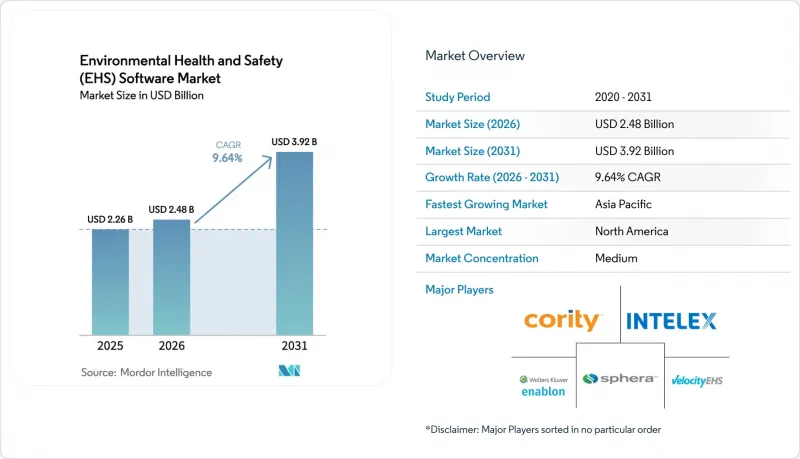
This report is Segmented by Deployment Mode (Cloud, and On-Premise), Component (Software, and Services), End-User Vertical (Oil and Gas, Energy and Utility, Food and Beverage, and More), Solution Type (Incident and Safety Management, Audit and Inspection, and More), Organization Size (Large Enterprises, and More), and Geography. The Market Forecasts are Provided in Terms of Value (USD).
Global Environmental Health And Safety (EHS) Software Market Trends and Insights
Stringent Regulatory Enforcement and Rising Liability Exposure
United States OSHA lifted maximum penalties for willful violations to USD 165,514 and serious violations to USD 16,550 in 2025, moving annual adjustments to an indexed model that climbs each January. Public violation databases heighten reputational risk, prompting companies to automate audit trails and corrective-action records. In parallel, the European Union harmonized occupational safety directives with ISO 45001, nudging multinationals toward a single global platform that satisfies both Brussels and Washington. Chevron's Operations Excellence Management System earned ISO 14001:2015 and ISO 45001:2018 recertification for the 2025-2028 cycle, illustrating how integrated software underpins dual environmental and safety compliance. Heightened personal-liability statutes in China and South Korea further reinforce the business case for predictive, auditable systems.
Expansion of ESG and Sustainability Reporting Mandates
The United States SEC's March 2024 climate-disclosure rules require large accelerated filers to furnish assured Scope 1 and Scope 2 emissions, nudging firms toward platforms that merge environmental, safety, and carbon data streams. Europe's Corporate Sustainability Reporting Directive extends detailed disclosures to 50,000 entities, including non-EU companies with sizable regional activity. Demand for ESG and carbon modules is climbing at an 11.68% CAGR because these tools automate data pulls from meters, asset systems, and supplier portals, then map them into disclosure templates. Sphera and Evonik's TUV-certified automated life-cycle assessment tool slashes product-footprint reporting cycles from weeks to hours, underscoring the operational upside.
AI-Driven Predictive Safety and Compliance Analytics
Cority's Cortex AI engine mines near-miss logs, sensor telemetry, and maintenance data to flag emerging risks and recommend interventions before incidents materialize. Intelex released real-time data-quality validation that automatically highlights anomalous emissions figures and faulty sensor inputs, reducing the likelihood of erroneous regulatory filings. Early adopters report measurable declines in recordable injury rates and lower insurance premiums as underwriters begin referencing predictive-risk dashboards.
Other drivers and restraints analyzed in the detailed report include:
- SaaS-First, Mobile-First EHS Platforms Reduce TCO
- High Upfront Implementation and Change-Management Cost
- Cyber-Security and Data-Privacy Concerns in Cloud Roll-Outs
For complete list of drivers and restraints, kindly check the Table Of Contents.
Segment Analysis
The services slice of the EHS software market posted an 11.42% CAGR outlook, outperforming software revenue growth despite software commanding 70.22% of 2025 turnover. Consulting engagements covering current-state mapping, API development, and multi-language user training routinely span 12 to 18 months for global roll-outs. Managed services appeal to mid-sized firms that prefer OpEx over CapEx, handing vendors the keys to upgrades, regulatory-rule updates, and help-desk support.
AI implementations are enlarging the services pipeline. Data-science teams tune machine-learning models, validate risk scores, and craft executive dashboards that convert raw predictions into board-ready insights. Parallel efforts to certify disclosures under new SEC and EU rules generate demand for assurance and data-lineage validation, again tilting budgets toward service providers. The modularization of incident, audit, ESG, and training tools multiplies integration points, ensuring that services remain the fastest-growing component through 2031.
Cloud deployments held 74.52% share in 2025 and are tracking a 12.84% CAGR through 2031 in the environmental health and safety (EHS) software market. Continuous delivery lets vendors push regulatory templates within days of a new OSHA form or EU annex, a cadence on-premise customers cannot match without weekend maintenance windows and staff overtime. Subscription pricing spreads costs evenly, an advantage for enterprises under pressure to align cash flow with revenue.
On-premise installs persist in defense, nuclear, and certain Chinese operations where data-sovereignty laws require in-country hosting. However, five-year total cost modeling shows cloud deployments 30-40% cheaper once hardware refresh cycles, database patching, and disaster-recovery drills are counted. IoT sensor expansion reinforces the trend: streaming vibration, gas, and air-quality data directly into cloud dashboards is easier than installing edge servers at every site.
Complete Report Scope:
- By Component
- Software
- Services
- By Deployment Mode
- Cloud
- On-premise
- By Solution Type
- Incident and Safety Management
- Audit and Inspection
- Compliance and Risk Management
- ESG / Carbon Management
- Training and Learning
- By Organization Size
- Large Enterprises
- Small and Mid-Sized Enterprises (SMEs)
- By End-user Industry
- Energy and Utilities
- Oil and Gas
- Chemicals and Petro-chemicals
- Healthcare and Life Sciences
- Construction and Manufacturing
- Mining and Metals
- Food and Beverages
- Other End-user Industries
- By Geography
- North America
- United States
- Canada
- Europe
- Germany
- France
- United Kingdom
- Russia
- Rest of Europe
- Asia Pacific
- China
- India
- Japan
- South Korea
- Rest of Asia Pacific
- South America
- Brazil
- Rest of South America
- Middle East
- Saudi Arabia
- United Arab Emirates
- Turkey
- Rest of Middle East
- Africa
- South Africa
- Nigeria
- Kenya
- Rest of Africa
- North America
Geography Analysis
North America captured 37.46% of 2025 revenue, propelled by OSHA's escalating penalties and the SEC's climate-disclosure rule that effectively mandates continuous carbon accounting. High penetration among Fortune 500 firms intensifies competition for mid-market manufacturers and construction contractors still juggling clipboards and legacy databases. Vendor marketing increasingly highlights lower workers' compensation premiums achieved by predictive-risk dashboards, resonating with CFOs seeking immediate savings.
Europe follows closely, anchored by the Corporate Sustainability Reporting Directive, which obliges granular, digitized disclosures across 27 member states. ISO 45001 certification rates are highest in Germany, France, and the United Kingdom, reinforcing the regional appetite for platforms that harmonize audit workflows with sustainability metrics. Cloud uptake is tempered by GDPR requirements, yet sovereign-cloud offerings mitigate data-transfer anxieties, unlocking growth among chemical and aerospace firms.
Asia Pacific is the fastest-growing theater at 10.48% CAGR in the environmental health and safety (EHS) software market. China's revised Work Safety Law imposes criminal liability on executives after serious accidents, driving manufacturers to adopt real-time incident reporting and digital permit-to-work systems. India's formal ISO 45001 guidance and new digital injury-reporting portal align local plants with multinational audit expectations. South Korea's Serious Accidents Punishment Act, in force since 2022 but strictly enforced from 2024 onward, has catalyzed investments across shipbuilding and electronics supply chains.
The Middle East and Africa region gains momentum as national oil companies in Saudi Arabia and the United Arab Emirates embed EHS clauses into contractor agreements to satisfy Vision 2030 diversification goals. South Africa's mining sector, historically plagued by high fatality rates, is shifting to cloud dashboards that surface geotechnical risks in near real-time. South America shows uneven progress: Brazil leads after high-profile dam and offshore incidents spurred Petrobras and Vale to fund enterprise-wide roll-outs, whereas smaller Andean markets remain in earlier adoption phases.
- Enablon France SA (Wolters Kluwer NV)
- Intelex Technologies ULC
- VelocityEHS Holdings Inc.
- Cority Software Inc.
- Sphera Solutions Inc.
- Sai Global Pty Ltd. (Intertek Group PLC)
- Dakota Software Corporation
- Benchmark Digital Partners LLC
- Quentic GmbH
- Metrix Software Solutions (Pty) Ltd. (IsoMetrix)
- SAP SE
- iPoint-Systems GmbH
- Evotix Limited
- DNV Business Assurance Group AS
- EcoOnline Holding AS
- ETQ, LLC (part of Hexagon)
- Origami Risk LLC
- Alcumus Holdings Limited
- Ideagen PLC
- Vector Solutions.com, Inc.
- KPA Services, LLC
- StarTex Software LLC (DBA EHS Insight)
- Quber Technologies, Inc.
- SafetyCulture Pty Ltd.
- Enhesa NV/SA
Additional Benefits:
- The market estimate (ME) sheet in Excel format
- 3 months of analyst support
TABLE OF CONTENTS
1 INTRODUCTION
- 1.1 Study Assumptions and Market Definition
- 1.2 Scope of the Study
2 RESEARCH METHODOLOGY
3 EXECUTIVE SUMMARY
4 MARKET LANDSCAPE
- 4.1 Market Overview
- 4.2 Market Drivers
- 4.2.1 Stringent Regulatory Enforcement and Rising Liability Exposure
- 4.2.2 Expansion of ESG and Sustainability Reporting Mandates
- 4.2.3 SaaS-first, Mobile-first EHS Platforms Reduce TCO
- 4.2.4 AI-driven Predictive Safety and Compliance Analytics
- 4.2.5 Convergence with Digital Twin and Asset Management Stacks
- 4.2.6 Corporate Insurance Linking Premiums to Real-time EHS Metrics
- 4.3 Market Restraints
- 4.3.1 High Upfront Implementation and Change-management Cost
- 4.3.2 Cyber-security and Data-privacy Concerns in Cloud Roll-outs
- 4.3.3 Shortage of Data-science Talent for Next-gen EHS Tools
- 4.3.4 Vendor Consolidation Creating Integration Lock-in Risk
- 4.4 Industry Value Chain Analysis
- 4.5 Regulatory Landscape
- 4.6 Technological Outlook
- 4.7 Impact of Macroeconomic Factors on the Market
- 4.8 Porter's Five Forces Analysis
- 4.8.1 Bargaining Power of Suppliers
- 4.8.2 Bargaining Power of Buyers
- 4.8.3 Threat of New Entrants
- 4.8.4 Threat of Substitutes
- 4.8.5 Competitive Rivalry
5 MARKET SIZE AND GROWTH FORECASTS (VALUE)
- 5.1 By Component
- 5.1.1 Software
- 5.1.2 Services
- 5.2 By Deployment Mode
- 5.2.1 Cloud
- 5.2.2 On-premise
- 5.3 By Solution Type
- 5.3.1 Incident and Safety Management
- 5.3.2 Audit and Inspection
- 5.3.3 Compliance and Risk Management
- 5.3.4 ESG / Carbon Management
- 5.3.5 Training and Learning
- 5.4 By Organization Size
- 5.4.1 Large Enterprises
- 5.4.2 Small and Mid-Sized Enterprises (SMEs)
- 5.5 By End-user Industry
- 5.5.1 Energy and Utilities
- 5.5.2 Oil and Gas
- 5.5.3 Chemicals and Petro-chemicals
- 5.5.4 Healthcare and Life Sciences
- 5.5.5 Construction and Manufacturing
- 5.5.6 Mining and Metals
- 5.5.7 Food and Beverages
- 5.5.8 Other End-user Industries
- 5.6 By Geography
- 5.6.1 North America
- 5.6.1.1 United States
- 5.6.1.2 Canada
- 5.6.2 Europe
- 5.6.2.1 Germany
- 5.6.2.2 France
- 5.6.2.3 United Kingdom
- 5.6.2.4 Russia
- 5.6.2.5 Rest of Europe
- 5.6.3 Asia Pacific
- 5.6.3.1 China
- 5.6.3.2 India
- 5.6.3.3 Japan
- 5.6.3.4 South Korea
- 5.6.3.5 Rest of Asia Pacific
- 5.6.4 South America
- 5.6.4.1 Brazil
- 5.6.4.2 Rest of South America
- 5.6.5 Middle East
- 5.6.5.1 Saudi Arabia
- 5.6.5.2 United Arab Emirates
- 5.6.5.3 Turkey
- 5.6.5.4 Rest of Middle East
- 5.6.6 Africa
- 5.6.6.1 South Africa
- 5.6.6.2 Nigeria
- 5.6.6.3 Kenya
- 5.6.6.4 Rest of Africa
- 5.6.1 North America
6 COMPETITIVE LANDSCAPE
- 6.1 Market Concentration
- 6.2 Strategic Moves
- 6.3 Market Share Analysis
- 6.4 Company Profiles (includes Global level Overview, Market level overview, Core Segments, Financials as available, Strategic Information, Market Rank/Share for key companies, Products and Services, and Recent Developments)
- 6.4.1 Enablon France SA (Wolters Kluwer NV)
- 6.4.2 Intelex Technologies ULC
- 6.4.3 VelocityEHS Holdings Inc.
- 6.4.4 Cority Software Inc.
- 6.4.5 Sphera Solutions Inc.
- 6.4.6 Sai Global Pty Ltd. (Intertek Group PLC)
- 6.4.7 Dakota Software Corporation
- 6.4.8 Benchmark Digital Partners LLC
- 6.4.9 Quentic GmbH
- 6.4.10 Metrix Software Solutions (Pty) Ltd. (IsoMetrix)
- 6.4.11 SAP SE
- 6.4.12 iPoint-Systems GmbH
- 6.4.13 Evotix Limited
- 6.4.14 DNV Business Assurance Group AS
- 6.4.15 EcoOnline Holding AS
- 6.4.16 ETQ, LLC (part of Hexagon)
- 6.4.17 Origami Risk LLC
- 6.4.18 Alcumus Holdings Limited
- 6.4.19 Ideagen PLC
- 6.4.20 Vector Solutions.com, Inc.
- 6.4.21 KPA Services, LLC
- 6.4.22 StarTex Software LLC (DBA EHS Insight)
- 6.4.23 Quber Technologies, Inc.
- 6.4.24 SafetyCulture Pty Ltd.
- 6.4.25 Enhesa NV/SA
7 MARKET OPPORTUNITIES AND FUTURE OUTLOOK
- 7.1 White-space and Unmet-Need Assessment

