PUBLISHER: Mordor Intelligence | PRODUCT CODE: 2123023

PUBLISHER: Mordor Intelligence | PRODUCT CODE: 2123023
Managed Print Services - Market Share Analysis, Industry Trends & Statistics, Growth Forecasts (2026 - 2031)
According to Mordor Intelligence, the managed print services market size reached USD 54.42 billion in 2026 and is forecast to advance to USD 83.26 billion by 2031, registering an 8.88% CAGR over 2026-2031.
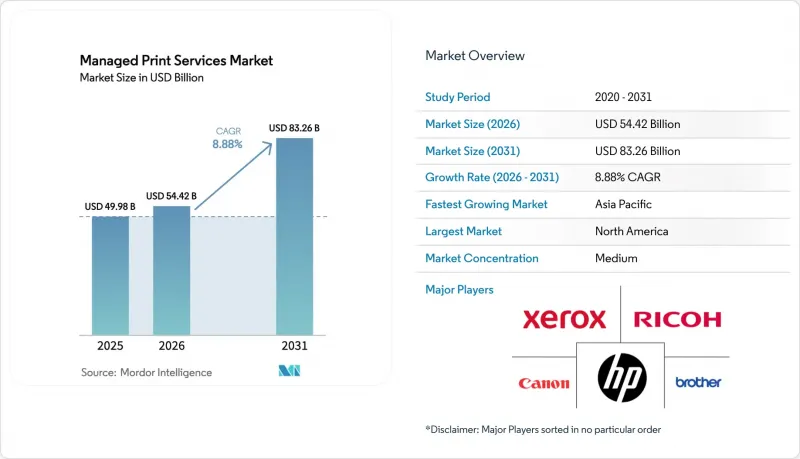
This report is Segmented by Channel Type (Printer/Copier Manufacturers, and More), Service Type (Print Infrastructure Assessment, and More), Deployment Mode (On-Premise, and Cloud-Based), Organization Size (Small and Medium Enterprises (SMEs), and Large Enterprises), End-User Vertical (BFSI, Healthcare, IT and Telecom, and More), and Geography. The Market Forecasts are Provided in Terms of Value (USD).
Global Managed Print Services Market Trends and Insights
Remote Work Print Infrastructure Optimisation Driving MPS Adoption In North America
Hybrid work models fragmented device footprints across homes, co-working sites, and partially occupied headquarters, forcing IT departments to swap static fleets for usage-based provisioning. Secure print release, identity-aware access, and VPN-free job submission became baseline requirements, repositioning the Managed Print Services market as a security solution rather than a cost-center. Xerox's Virtual Print Management service allows workers to send a job from any location and collect it at the nearest authenticated device, eliminating on-premise servers and bespoke VPN tunnels. Enterprises now value zero-trust print architecture and on-demand capacity rightsizing, which explains why cloud-based contracts command premium seat fees while still outpacing the overall growth curve.
Sustainability And Carbon Footprint Mandates Accelerating EU Corporate MPS
The European Union's Corporate Sustainability Reporting Directive compels companies with over 250 employees to disclose Scope 3 emissions, including those from printing, starting in 2025. Print fleet management therefore shifted into the compliance domain. Ricoh reported that 36% of its Office Services clients subscribed to carbon-accounting modules in 2025, a 10-point leap year-over-year, and expects sustainability-linked contracts to exceed 50% of new European bookings by 2027. Procurement guidelines in Germany, France, and the Nordic region now prefer providers that supply page-level emissions data, effectively sidelining vendors lacking granular telemetry.
Declining Office Print Volumes Amid Digital Transformation
Companies in mature economies cut office print usage by up to 20% between 2020 and 2025 as e-signatures, electronic invoicing, and cloud collaboration displaced paper workflows. Lower page counts erode per-click revenue models embedded in legacy contracts, forcing providers to pivot toward value-added modules such as workflow automation and compliance dashboards. Vendors that cling to volume-based billing risk margin compression even as the need for secure fleet oversight increases across the Managed Print Services market.
Other drivers and restraints analyzed in the detailed report include:
- Subscription-Based Everything-As-A-Service Adoption Among SMEs
- Print-Device Security And Compliance Requirements In Regulated Sectors
- Data Sovereignty Concerns Hindering Cloud-Based MPS
For complete list of drivers and restraints, kindly check the Table Of Contents.
Segment Analysis
Independent software vendors erode incumbent share by selling cloud-first, vendor-agnostic platforms that manage fleets spanning HP, Canon, Xerox, Ricoh, and more. Printer and copier makers still generated the largest 2025 channel contribution, but the ISV cohort is outgrowing the total Managed Print Services market by more than one percentage point annually. The Xerox-Lexmark acquisition underscored OEM urgency to acquire software muscle, while Canon's subscription-bundled imageFORCE suite tries to lock mid-market buyers into vertically integrated stacks. Still, large enterprises with heterogeneous fleets gravitate toward ISVs that reduce switching costs and accelerate feature rollouts. As a result, OEM service attach rates are slipping, and channel alliances between resellers and ISVs are proliferating to defend relevance.
ISVs differentiate through rapid cloud releases, open APIs, and analytics that benchmark utilization across mixed fleets, feeding continuous improvement loops. OEMs counter with device-embedded telemetry and hardware-software bundles, but price-to-value gaps remain. Enterprises recognize that renewal flexibility outweighs vendor homogeneity, pushing the Managed Print Services market toward a bifurcated structure. Vendor-agnostic orchestration appeals to global corporations that centralize governance, while integrated OEM suites still resonate with single-brand midsize operations seeking one-throat-to-choke accountability. Competitive intensity will deepen as hyperscaler marketplaces make independent print-management apps discoverable to IT buyers worldwide.
Cloud Print Services are expanding faster than the overall Managed Print Services market, bolstered by Microsoft Universal Print becoming the de facto enterprise standard. Managed Print Operations retain sizeable share because they encompass device monitoring and break-fix support, but cloud delivery models remove on-premise server costs and shrink deployment cycles from weeks to hours. Universal Print integration cuts driver management overhead for IT departments and unlocks secure printing for remote employees without VPN configurations.
Document workflow optimization, though the smallest current revenue pool, unlocks structural savings by automating capture, routing, and archiving. Konica Minolta's AI-enabled Workplace Hub trims redundant prints and reduces processing time for HR and finance documents, illustrating the pivot from device management to process transformation. Providers that marry fleet analytics with workflow re-engineering can decouple earnings from declining page volumes and defend margins, a critical maneuver as print counts fall yet complexity rises across the Managed Print Services market size.
Complete Report Scope:
- By Channel Type
- Printer/Copier Manufacturers
- System Integrators/Resellers
- Independent Software Vendors (ISVs)
- By Service Type
- Print Infrastructure Assessment
- Managed Print Operations
- Device and Fleet Management
- Document Workflow Optimisation
- Cloud Print Services
- By Deployment Mode
- On-Premise
- Cloud-Based
- By Organisation Size
- Small and Medium Enterprises (SMEs)
- Large Enterprises
- By End-User Vertical
- BFSI
- Healthcare
- IT and Telecom
- Government
- Education
- Other End-User Verticals
- By Geography
- North America
- United States
- Canada
- Mexico
- South America
- Brazil
- Argentina
- Rest of South America
- Europe
- Germany
- United Kingdom
- France
- Nordics
- Rest of Europe
- Asia Pacific
- China
- Japan
- India
- South Korea
- Rest of Asia Pacific
- Middle East
- GCC (Saudi Arabia, United Arab Emirates, Qatar)
- Turkey
- Rest of Middle East
- Africa
- South Africa
- Nigeria
- Rest of Africa
- North America
Geography Analysis
North America generated the largest 2025 revenue thanks to early hybrid-work adoption and stringent cybersecurity mandates. Enterprises value zero-trust prints and advanced analytics, lifting average revenue per user above the global mean. Canada mirrors U.S. patterns, while Mexican corporations modernize fleets as part of near-shoring manufacturing expansions.
Asia Pacific, however, is the fastest-growing region with a 10.48% CAGR. Chinese, Indian, Japanese, and South Korean manufacturers integrate IoT telemetry to minimize downtime, directly linking printer availability to production throughput. Local data-sovereignty laws slow pure cloud adoption but boost hybrid deployments supported by regionally hosted analytics. Government digitization agendas in India and smart-factory incentives in China further elevate demand, solidifying the region's outsized contribution to Managed Print Services market growth.
Europe's trajectory hinges on carbon-accounting regulations. German, French, and Nordic enterprises embed lifecycle emissions tracking into vendor scorecards, rapidly expanding contracts that include sustainability dashboards. The Middle East and South America log steady, mid-single-digit expansion as digital government programs and corporate modernization projects unfold. Africa remains nascent yet opportunity-rich for vendors willing to offer low-capex subscription bundles that accommodate infrastructure variability. Collectively, these dynamics diversify revenue sources and hedge currency exposure for global providers in the Managed Print Services market.
- Xerox Corporation
- Ricoh Company, Ltd.
- HP Inc.
- Canon Inc.
- Brother Industries, Ltd.
- Lexmark International, Inc.
- Konica Minolta, Inc.
- Kyocera Document Solutions Inc.
- Sharp Corporation
- Epson (Seiko Epson Corporation)
- Toshiba Tec Corporation
- Fujifilm Business Innovation Corp.
- Dell Technologies Inc.
- EFI (Electronics For Imaging, Inc.)
- PrintFleet (ECI Software Solutions)
- PaperCut Software International
- Quadient SA
- Arc Document Solutions, Inc.
- FlexPrint Managed Print Solutions
- OKI Electric Industry Co., Ltd.
- Pitney Bowes Inc.
- Wipro Ltd.
Additional Benefits:
- The market estimate (ME) sheet in Excel format
- 3 months of analyst support
TABLE OF CONTENTS
1 INTRODUCTION
- 1.1 Study Assumptions and Market Definition
- 1.2 Scope of the Study
2 RESEARCH METHODOLOGY
3 EXECUTIVE SUMMARY
4 MARKET LANDSCAPE
- 4.1 Market Overview
- 4.2 Market Drivers
- 4.2.1 Remote Work Print Infrastructure Optimization Driving MPS Adoption in North America
- 4.2.2 Sustainability and Carbon Footprint Mandates Accelerating EU Corporate MPS
- 4.2.3 Subscription-Based Everything-as-a-Service Adoption Among SMEs
- 4.2.4 Print-Device Security and Compliance Requirements in Regulated Sectors
- 4.2.5 IoT-Enabled Fleet Analytics Reducing Downtime in Large Asian Enterprises
- 4.2.6 Generative-AI-Driven Predictive Maintenance and Auto-Replenishment
- 4.3 Market Restraints
- 4.3.1 Declining Office Print Volumes Amid Digital Transformation
- 4.3.2 Data Sovereignty Concerns Hindering Cloud-Based MPS
- 4.3.3 Vendor Lock-In Perception and Contract Complexity Discouraging SMEs
- 4.3.4 Complexity of Edge Zero-Trust Print Architectures
- 4.4 Industry Value Chain Analysis
- 4.5 Regulatory Outlook
- 4.6 Technological Outlook
- 4.7 Porter's Five Forces Analysis
- 4.7.1 Bargaining Power of Buyers
- 4.7.2 Bargaining Power of Suppliers
- 4.7.3 Threat of New Entrants
- 4.7.4 Threat of Substitutes
- 4.7.5 Intensity of Competitive Rivalry
- 4.8 Impact of Macroeconomic Factors on the Market
5 MARKET SIZE AND GROWTH FORECASTS (VALUE)
- 5.1 By Channel Type
- 5.1.1 Printer/Copier Manufacturers
- 5.1.2 System Integrators/Resellers
- 5.1.3 Independent Software Vendors (ISVs)
- 5.2 By Service Type
- 5.2.1 Print Infrastructure Assessment
- 5.2.2 Managed Print Operations
- 5.2.3 Device and Fleet Management
- 5.2.4 Document Workflow Optimisation
- 5.2.5 Cloud Print Services
- 5.3 By Deployment Mode
- 5.3.1 On-Premise
- 5.3.2 Cloud-Based
- 5.4 By Organisation Size
- 5.4.1 Small and Medium Enterprises (SMEs)
- 5.4.2 Large Enterprises
- 5.5 By End-User Vertical
- 5.5.1 BFSI
- 5.5.2 Healthcare
- 5.5.3 IT and Telecom
- 5.5.4 Government
- 5.5.5 Education
- 5.5.6 Other End-User Verticals
- 5.6 By Geography
- 5.6.1 North America
- 5.6.1.1 United States
- 5.6.1.2 Canada
- 5.6.1.3 Mexico
- 5.6.2 South America
- 5.6.2.1 Brazil
- 5.6.2.2 Argentina
- 5.6.2.3 Rest of South America
- 5.6.3 Europe
- 5.6.3.1 Germany
- 5.6.3.2 United Kingdom
- 5.6.3.3 France
- 5.6.3.4 Nordics
- 5.6.3.5 Rest of Europe
- 5.6.4 Asia Pacific
- 5.6.4.1 China
- 5.6.4.2 Japan
- 5.6.4.3 India
- 5.6.4.4 South Korea
- 5.6.4.5 Rest of Asia Pacific
- 5.6.5 Middle East
- 5.6.5.1 GCC (Saudi Arabia, United Arab Emirates, Qatar)
- 5.6.5.2 Turkey
- 5.6.5.3 Rest of Middle East
- 5.6.6 Africa
- 5.6.6.1 South Africa
- 5.6.6.2 Nigeria
- 5.6.6.3 Rest of Africa
- 5.6.1 North America
6 COMPETITIVE LANDSCAPE
- 6.1 Market Concentration
- 6.2 Strategic Moves
- 6.3 Market Share Analysis
- 6.4 Company Profiles (includes Global Level Overview, Market Level Overview, Core Segments, Financials as Available, Strategic Information, Market Rank/Share for Key Companies, Products and Services, and Recent Developments)
- 6.4.1 Xerox Corporation
- 6.4.2 Ricoh Company, Ltd.
- 6.4.3 HP Inc.
- 6.4.4 Canon Inc.
- 6.4.5 Brother Industries, Ltd.
- 6.4.6 Lexmark International, Inc.
- 6.4.7 Konica Minolta, Inc.
- 6.4.8 Kyocera Document Solutions Inc.
- 6.4.9 Sharp Corporation
- 6.4.10 Epson (Seiko Epson Corporation)
- 6.4.11 Toshiba Tec Corporation
- 6.4.12 Fujifilm Business Innovation Corp.
- 6.4.13 Dell Technologies Inc.
- 6.4.14 EFI (Electronics For Imaging, Inc.)
- 6.4.15 PrintFleet (ECI Software Solutions)
- 6.4.16 PaperCut Software International
- 6.4.17 Quadient SA
- 6.4.18 Arc Document Solutions, Inc.
- 6.4.19 FlexPrint Managed Print Solutions
- 6.4.20 OKI Electric Industry Co., Ltd.
- 6.4.21 Pitney Bowes Inc.
- 6.4.22 Wipro Ltd.
7 MARKET OPPORTUNITIES AND FUTURE OUTLOOK
- 7.1 White-Space and Unmet-Need Assessment

