PUBLISHER: Mordor Intelligence | PRODUCT CODE: 2123094

PUBLISHER: Mordor Intelligence | PRODUCT CODE: 2123094
Biometric In The Automotive - Market Share Analysis, Industry Trends & Statistics, Growth Forecasts (2026 - 2031)
According to Mordor Intelligence, biometric in the automotive market size in 2026 is estimated at USD 4.58 billion, growing from 2025 value of USD 3.89 billion with 2031 projections showing USD 10.39 billion, growing at 17.80% CAGR over 2026-2031.
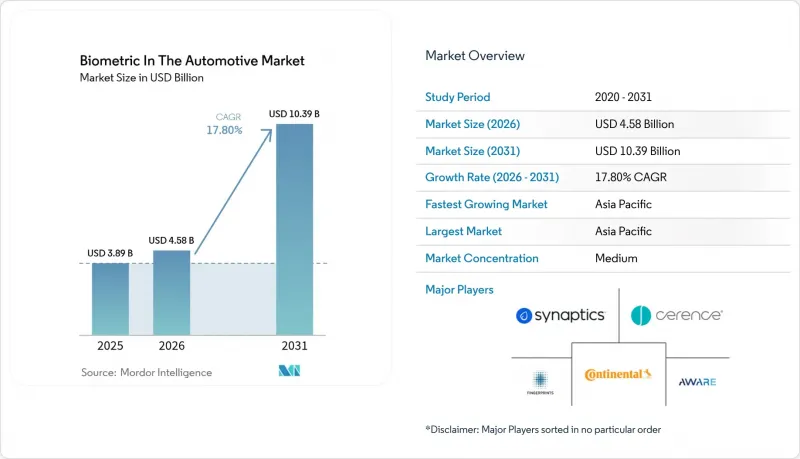
This report is Segmented by Component (Hardware and Software), Biometric Modality (Fingerprint Recognition, Iris Recognition, and More), Vehicle Type (Passenger Cars, Light Commercial Vehicles, and More), Application (Driver Identification and Access, and More), Sales Channel (OEM-Fitted and Aftermarket), and Geography. The Market Forecasts are Provided in Terms of Value (USD).
Global Biometric In The Automotive Market Trends and Insights
Rising Demand for Contactless Vehicle Access and Personalization
Consumers now expect a cabin to recognize them as quickly as a smartphone. Touch-free iris and face systems demonstrated by Smart Eye and FORVIA in 2025 verify driver and passenger identities before a door opens, loading seats, mirrors, and infotainment profiles within one second. Shared-mobility operators gain extra value because each hand-off between drivers no longer requires a manual profile reset. Synaptics has shipped Natural ID fingerprint kits to Tier 1 suppliers since 2016, allowing swipe and tap gestures to double as both authentication and menu navigation. The resulting reduction in cabin-button clutter enhances ergonomics, while sub-second profile loading boosts customer satisfaction scores and provides OEMs with a differentiator that is challenging for rivals to replicate quickly. These gains accelerate the biometric in the automotive market as user-experience benchmarks rise.
Stringent Automotive Safety and Security Regulations
Europe's UNECE driver-monitoring rule, effective from 2026, and Euro NCAP's linkage of driver-monitoring performance to star ratings have converted biometrics from a niche luxury to a compliance requirement. ISO/IEC TS 22604:2024 formalizes contactless biometrics for drivers approaching a vehicle while it is in motion, and ISO standards for in-vehicle secure interfaces harmonize hardware expectations. In China, facial-recognition guidelines issued in June 2025 require data localization for over 100,000 subjects, compelling OEMs to embed on-device matching. Together, these mandates accelerate design cycles and ensure that biometric in the automotive market adoption remains on a structural growth trajectory.
Lack of Global Standards and Interoperability
OEMs must certify hardware separately for Europe, China, and the United States because voluntary ISO and FIDO specifications lack enforceable cross-border reciprocity. China's data-localization rule prevents a European rental car company from reusing its driver database within Chinese territory, forcing fleet operators to maintain siloed systems. Smaller aftermarket vendors struggle with the cost of re-testing, which limits product availability in price-sensitive regions and slows the adoption of biometrics in the automotive market.
Other drivers and restraints analyzed in the detailed report include:
- Lower Sensor Costs and Integration into Electronics Architectures
- Insurance Premium Discounts Linked to Anti-Theft Biometrics
- High Initial System Cost in Mass-Market Vehicle Segments
For complete list of drivers and restraints, kindly check the Table Of Contents.
Segment Analysis
Hardware accounted for 64.55% of revenue in 2025, reflecting the sensor-heavy heritage of biometrics in the automotive market. Software, however, is scaling at 18.62% CAGR because OEMs prefer subscription license models that include continuous authentication, consent management, and over-the-air profile updates. Synaptics' Match-in-Sensor architecture performs capture, matching, and encryption within the sensor die, moving value from the central ECU to the edge and shielding templates from host-level malware.
Edge smartness blurs the hardware-software divide by embedding firmware weights for liveness detection directly onto the module, turning a passive device into an intelligent node. Licensing-focused revenue, therefore, rises faster than physical shipments, enabling gross-margin expansion even as commodity camera prices fall. Tier 1 suppliers that integrate sensors with secure cloud APIs will capture incremental platform fees, accelerating the monetization curve of biometrics in the automotive market.
Fingerprint technology dominated the biometric market share with 40.15% in 2025, due to low-cost capacitive parts that leverage smartphone-scale capabilities. Yet, facial recognition is forecast to rise 20.12% annually, as a single RGB-IR camera now supports driver monitoring, occupant classification, and authentication, eliminating the need for separate fingerprint readers on doors or dashboards. Smart Eye's license of Fingerprint Cards' iris SDK targets premium segments requiring a false-acceptance rate of less than 0.01% for payments and fleet compliance.
Hybrid face-iris configurations reduce spoof risk and satisfy emerging FIDO test protocols, while palm-vein and voice remain niche due to environmental noise and cultural preferences. ISO/IEC TR 24722:2024 formalizes sensor-fusion weighting, encouraging OEMs to adopt multimodal stacks. As cameras consolidate functions, the marginal hardware cost per additional biometric decreases, while software royalties per vehicle increase, reinforcing the shift toward platform economics in the biometric automotive market.
Complete Report Scope:
- By Component
- Hardware
- Software
- By Biometric Modality
- Fingerprint Recognition
- Iris Recognition
- Palm Recognition
- Facial Recognition
- Voice Recognition
- Other Modalities
- By Vehicle Type
- Passenger Cars
- Light Commercial Vehicles
- Heavy Trucks
- Buses and Coaches
- Specialty Vehicles
- By Application
- Driver Identification and Access
- Engine Start / Immobilizer
- In-Car Payments
- Driver Health and Drowsiness Monitoring
- Infotainment Personalization
- Fleet Management and Telematics
- By Sales Channel
- OEM-Fitted
- Aftermarket
- By Geography
- North America
- United States
- Canada
- Mexico
- South America
- Brazil
- Argentina
- Rest of South America
- Europe
- Germany
- United Kingdom
- France
- Italy
- Spain
- Rest of Europe
- Asia-Pacific
- China
- Japan
- India
- South Korea
- Australia
- Rest of Asia-Pacific
- Middle East and Africa
- Middle East
- Saudi Arabia
- United Arab Emirates
- Turkey
- Rest of Middle East
- Africa
- South Africa
- Nigeria
- Egypt
- Rest of Africa
- Middle East
- North America
Geography Analysis
Asia-Pacific held 37.95% of revenue in 2025 and is set to expand 19.98% CAGR thanks to China's dual mandate for intelligent connected vehicles and strict data-localization rules that require on-device processing. Chinese OEMs now integrate domestic camera and fingerprint suppliers to meet quota requirements while avoiding cross-border data transfers. Japan pilots facial-verified autonomous shuttles to address driver shortages at Haneda Airport, while South Korea and Australia leverage high smartphone familiarity to accelerate consumer acceptance. India remains price-sensitive, but insurance incentives for anti-theft biometrics in urban centers spark pilot programs that could widen adoption.
North America and Europe converge on ISO and FIDO standards that enable cross-border rental fleet authentication. Europe's UNECE driver-monitoring law, effective from 2026, compresses program timelines and integrates biometric features into mainstream models. The United States lacks a federal rule; however, Illinois' consent law and California's privacy statute require technology providers to ship region-specific privacy controls, such as Lytx's Dynamic Adjust geofences. Canada and Mexico deploy biometrics in commercial trucking corridors to streamline customs and carrier audits, creating regional momentum for biometric in the automotive market.
The Middle East positions automotive biometrics as an extension of national digital-identity programs. The UAE's facial-ID rollout and Saudi Arabia's IDEMIA-SAMI partnership align vehicle access with civil-ID credentials, fostering early trials of palm-vein and iris modalities adapted to high-temperature environments. Africa remains constrained by high hardware costs and infrastructure gaps, yet South Africa and Nigeria are pursuing fleet biometrics to curb theft in logistics hubs. Hot-climate durability challenges persist, but ruggedized optical modules now pass extended heat-soak tests, slowly opening the door for broader uptake.
- Synaptics Incorporated
- Fingerprint Cards AB
- Aware, Inc.
- Cerence Inc.
- Continental Aktiengesellschaft
- Sensory, Inc.
- Shenzhen Goodix Technology Co., Ltd.
- B-Secur Ltd.
- EyeLock LLC
- Precise Biometrics AB
- Robert Bosch GmbH
- Valeo SA
- Gentex Corporation
- NEC Corporation
- IDEMIA Identity and Security France SAS
- IriTech, Inc.
- BioID GmbH
- Nexteer Automotive Group Limited
- Hella GmbH and Co. KGaA
- Stanley Black and Decker, Inc.
Additional Benefits:
- The market estimate (ME) sheet in Excel format
- 3 months of analyst support
TABLE OF CONTENTS
1 INTRODUCTION
- 1.1 Study Assumptions and Market Definition
- 1.2 Scope of the Study
2 RESEARCH METHODOLOGY
3 EXECUTIVE SUMMARY
4 MARKET LANDSCAPE
- 4.1 Market Overview
- 4.2 Market Drivers
- 4.2.1 Rising demand for contactless vehicle access and personalization
- 4.2.2 Stringent automotive safety and security regulations
- 4.2.3 Lower sensor costs and integration into vehicle electronics architectures
- 4.2.4 Insurance premium discounts linked to anti-theft biometrics
- 4.2.5 Expansion of in-car payment ecosystems requiring secure authentication
- 4.2.6 Escalating OEM focus on driver wellness monitoring via biometrics
- 4.3 Market Restraints
- 4.3.1 Lack of global standards and interoperability
- 4.3.2 High initial system cost in mass-market vehicle segments
- 4.3.3 Privacy and data security concerns
- 4.3.4 Environmental durability limitations of cabin-mounted optical sensors
- 4.4 Industry Value Chain Analysis
- 4.5 Impact of Macroeconomic Factors
- 4.6 Regulatory Landscape
- 4.7 Technological Outlook
- 4.8 Porter's Five Forces Analysis
- 4.8.1 Bargaining Power of Buyers
- 4.8.2 Bargaining Power of Suppliers
- 4.8.3 Threat of New Entrants
- 4.8.4 Threat of Substitute Products
- 4.8.5 Intensity of Competitive Rivalry
5 MARKET SIZE AND GROWTH FORECASTS (VALUE)
- 5.1 By Component
- 5.1.1 Hardware
- 5.1.2 Software
- 5.2 By Biometric Modality
- 5.2.1 Fingerprint Recognition
- 5.2.2 Iris Recognition
- 5.2.3 Palm Recognition
- 5.2.4 Facial Recognition
- 5.2.5 Voice Recognition
- 5.2.6 Other Modalities
- 5.3 By Vehicle Type
- 5.3.1 Passenger Cars
- 5.3.2 Light Commercial Vehicles
- 5.3.3 Heavy Trucks
- 5.3.4 Buses and Coaches
- 5.3.5 Specialty Vehicles
- 5.4 By Application
- 5.4.1 Driver Identification and Access
- 5.4.2 Engine Start / Immobilizer
- 5.4.3 In-Car Payments
- 5.4.4 Driver Health and Drowsiness Monitoring
- 5.4.5 Infotainment Personalization
- 5.4.6 Fleet Management and Telematics
- 5.5 By Sales Channel
- 5.5.1 OEM-Fitted
- 5.5.2 Aftermarket
- 5.6 By Geography
- 5.6.1 North America
- 5.6.1.1 United States
- 5.6.1.2 Canada
- 5.6.1.3 Mexico
- 5.6.2 South America
- 5.6.2.1 Brazil
- 5.6.2.2 Argentina
- 5.6.2.3 Rest of South America
- 5.6.3 Europe
- 5.6.3.1 Germany
- 5.6.3.2 United Kingdom
- 5.6.3.3 France
- 5.6.3.4 Italy
- 5.6.3.5 Spain
- 5.6.3.6 Rest of Europe
- 5.6.4 Asia-Pacific
- 5.6.4.1 China
- 5.6.4.2 Japan
- 5.6.4.3 India
- 5.6.4.4 South Korea
- 5.6.4.5 Australia
- 5.6.4.6 Rest of Asia-Pacific
- 5.6.5 Middle East and Africa
- 5.6.5.1 Middle East
- 5.6.5.1.1 Saudi Arabia
- 5.6.5.1.2 United Arab Emirates
- 5.6.5.1.3 Turkey
- 5.6.5.1.4 Rest of Middle East
- 5.6.5.2 Africa
- 5.6.5.2.1 South Africa
- 5.6.5.2.2 Nigeria
- 5.6.5.2.3 Egypt
- 5.6.5.2.4 Rest of Africa
- 5.6.5.1 Middle East
- 5.6.1 North America
6 COMPETITIVE LANDSCAPE
- 6.1 Market Concentration
- 6.2 Strategic Moves
- 6.3 Market Share Analysis
- 6.4 Company Profiles (includes Global level Overview, Market level overview, Core Segments, Financials as available, Strategic Information, Market Rank/Share for key companies, Products and Services, and Recent Developments)
- 6.4.1 Synaptics Incorporated
- 6.4.2 Fingerprint Cards AB
- 6.4.3 Aware, Inc.
- 6.4.4 Cerence Inc.
- 6.4.5 Continental Aktiengesellschaft
- 6.4.6 Sensory, Inc.
- 6.4.7 Shenzhen Goodix Technology Co., Ltd.
- 6.4.8 B-Secur Ltd.
- 6.4.9 EyeLock LLC
- 6.4.10 Precise Biometrics AB
- 6.4.11 Robert Bosch GmbH
- 6.4.12 Valeo SA
- 6.4.13 Gentex Corporation
- 6.4.14 NEC Corporation
- 6.4.15 IDEMIA Identity and Security France SAS
- 6.4.16 IriTech, Inc.
- 6.4.17 BioID GmbH
- 6.4.18 Nexteer Automotive Group Limited
- 6.4.19 Hella GmbH and Co. KGaA
- 6.4.20 Stanley Black and Decker, Inc.
7 MARKET OPPORTUNITIES AND FUTURE OUTLOOK
- 7.1 White-space and Unmet-Need Assessment

