PUBLISHER: Mordor Intelligence | PRODUCT CODE: 2123099

PUBLISHER: Mordor Intelligence | PRODUCT CODE: 2123099
United States Auditing Services - Market Share Analysis, Industry Trends & Statistics, Growth Forecasts (2026 - 2031)
According to Mordor Intelligence, the United States auditing services market size in 2026 is estimated at USD 53.55 billion, growing from 2025 value of USD 51.88 billion with 2031 projections showing USD 62.81 billion, growing at 3.23% CAGR over 2026-2031.
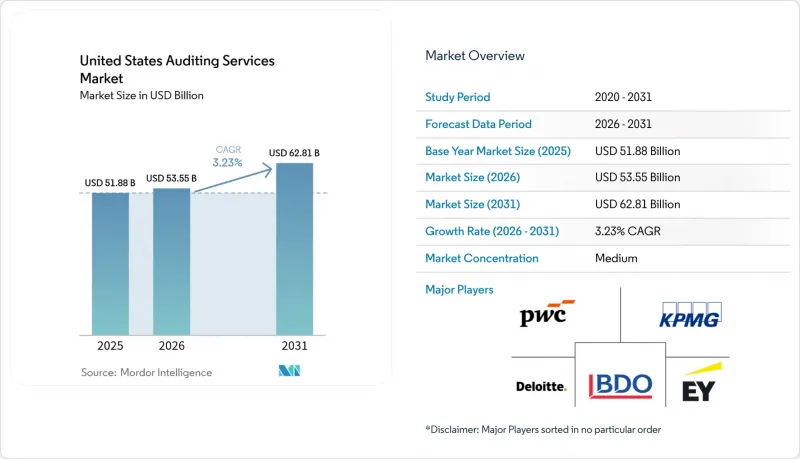
This report is Segmented by Type (Internal Audit, External Audit), Service Line (Operational Audits, Financial Audits, Advisory and Consulting, Investigation Audits, Information System Audits, Other Service Lines), End-User Industry (BFSI, Manufacturing, Other Industries), and Geography (Northeast, Midwest, South, West). The Market Forecasts are Provided in Terms of Value (USD).
United States Auditing Services Market Trends and Insights
Heightened SEC Enforcement of Internal-Control Rules
The Securities and Exchange Commission's intensified focus on internal control deficiencies is reshaping audit scope and methodology requirements across public companies. SEC enforcement actions increased 22% in 2024, with particular emphasis on management's assessment of internal control over financial reporting and auditor testing procedures . This regulatory pressure creates sustained demand for external audit services as companies invest in control remediation and enhanced testing protocols. The PCAOB's expanded inspection focus on audit quality indicators and risk assessment procedures forces audit firms to allocate additional resources to control testing, directly impacting billable hours and engagement profitability while strengthening market demand for specialized internal control advisory services.
Rising Cyber-Risk Demanding Integrated IT Audits
Cybersecurity incidents affecting financial reporting systems have prompted regulators and audit committees to demand integrated IT audit procedures within traditional financial audits. The SEC's cybersecurity disclosure rules, effective December 2023, require public companies to disclose material cybersecurity incidents within 4 business days, creating audit implications for subsequent financial reporting periods. Audit firms are rapidly expanding their IT audit capabilities, with KPMG investing over USD 1 billion in audit technology platforms that integrate cybersecurity risk assessment with financial audit procedures. This convergence of financial and IT auditing creates new revenue streams while requiring significant upfront investment in specialized talent and technology platforms.
Talent Shortages Driving Bill-Rate Inflation
The accounting profession faces an unprecedented talent crisis with CPA exam candidates declining 17% between 2020 and 2024, while demand for audit services continues to expand. This supply-demand imbalance has driven audit staff compensation increases of 15-25% annually, forcing firms to raise client billing rates and potentially pricing out smaller clients from professional audit services. The shortage particularly affects experienced senior and manager-level professionals, creating bottlenecks in audit execution and quality review processes. Firms are responding through accelerated offshore delivery models, increased automation, and alternative staffing arrangements, though these solutions require 2-3 years to fully implement and may not fully offset domestic talent constraints.
Other drivers and restraints analyzed in the detailed report include:
- Mandatory ESG-Related Assurance for Listed Firms
- Rapid Adoption of Continuous Audit Analytics Platforms
- Automation Reducing Repeat Audit Hours
For complete list of drivers and restraints, kindly check the Table Of Contents.
Segment Analysis
Internal audit services are experiencing rapid growth at 8.72% CAGR through 2031, significantly outpacing external audit's more modest expansion, as organizations recognize internal audit's strategic value beyond traditional compliance functions. External audit maintains market dominance with 63.05% share in 2025, reflecting regulatory requirements for public company audits and the substantial revenue base of Big Four firms serving large corporate clients. The internal audit segment's acceleration reflects enterprise demand for continuous risk monitoring, operational efficiency assessments, and integrated governance frameworks that extend beyond financial reporting compliance.
Protiviti's expansion of internal audit services through technology-enabled continuous monitoring platforms exemplifies the segment's evolution toward real-time assurance capabilities. Internal audit functions increasingly incorporate cybersecurity risk assessment, ESG reporting validation, and third-party risk management, creating new revenue streams that command premium pricing compared to traditional compliance-focused procedures. The Institute of Internal Auditors' emphasis on digital transformation and data analytics capabilities reflects the profession's shift toward strategic advisory roles that directly support executive decision-making and board oversight responsibilities.
Complete Report Scope:
- By Type
- Internal Audit
- External Audit
- By Service Line
- Operational Audits
- Financial Audits
- Advisory and Consulting
- Investigation Audits
- Information System Audits
- Compliance Audits
- Other Service Lines
- By End-User Industry
- BFSI
- Manufacturing
- Government & Public Sector
- Healthcare & Life Sciences
- IT & Telecom
- Energy & Utilities
- Other Industries
- By Geography
- Northeast
- Midwest
- South
- West
List of Companies Covered in this Report:
- Deloitte
- PwC
- EY
- KPMG
- BDO USA
- RSM US
- Grant Thornton
- Crowe
- Baker Tilly
- CBIZ/Mayer Hoffman McCann
- CliftonLarsonAllen (CLA)
- Marcum
- EisnerAmper
- Moss Adams
- Withum
- Protiviti
- Schellman
- FORVIS
- CohnReznick
- Plante Moran
Additional Benefits:
- The market estimate (ME) sheet in Excel format
- 3 months of analyst support
TABLE OF CONTENTS
1 Introduction
- 1.1 Study Assumptions & Market Definition
- 1.2 Scope of the Study
2 Research Methodology
3 Executive Summary
4 Market Landscape
- 4.1 Market Overview
- 4.2 Market Drivers
- 4.2.1 Heightened SEC enforcement of internal-control rules
- 4.2.2 Rising cyber-risk demanding integrated IT audits
- 4.2.3 Mandatory ESG-related assurance for listed firms
- 4.2.4 Rapid adoption of continuous audit analytics platforms
- 4.2.5 SME demand for SOC 2 Type II attestation to win SaaS contracts
- 4.2.6 Expansion of federal infrastructure spend triggering single-audit requirements
- 4.3 Market Restraints
- 4.3.1 Talent shortages driving bill-rate inflation
- 4.3.2 Automation reducing repeat audit hours
- 4.3.3 Growing use of internal shared-service centers
- 4.3.4 Litigation exposure and rising E&O insurance premiums
- 4.4 Value / Supply-Chain Analysis
- 4.5 Regulatory Landscape
- 4.6 Technological Outlook
- 4.7 Porter's Five Forces
- 4.7.1 Bargaining Power of Suppliers
- 4.7.2 Bargaining Power of Buyers
- 4.7.3 Threat of New Entrants
- 4.7.4 Threat of Substitutes
- 4.7.5 Competitive Rivalry
5 Market Size & Growth Forecasts
- 5.1 By Type
- 5.1.1 Internal Audit
- 5.1.2 External Audit
- 5.2 By Service Line
- 5.2.1 Operational Audits
- 5.2.2 Financial Audits
- 5.2.3 Advisory and Consulting
- 5.2.4 Investigation Audits
- 5.2.5 Information System Audits
- 5.2.6 Compliance Audits
- 5.2.7 Other Service Lines
- 5.3 By End-User Industry
- 5.3.1 BFSI
- 5.3.2 Manufacturing
- 5.3.3 Government & Public Sector
- 5.3.4 Healthcare & Life Sciences
- 5.3.5 IT & Telecom
- 5.3.6 Energy & Utilities
- 5.3.7 Other Industries
- 5.4 By Geography
- 5.4.1 Northeast
- 5.4.2 Midwest
- 5.4.3 South
- 5.4.4 West
6 Competitive Landscape
- 6.1 Market Concentration
- 6.2 Strategic Moves
- 6.3 Market Share Analysis
- 6.4 Company Profiles (includes Global level Overview, Market level overview, Core Segments, Financials as available, Strategic Information, Market Rank/Share for key companies, Products & Services, and Recent Developments)
- 6.4.1 Deloitte
- 6.4.2 PwC
- 6.4.3 EY
- 6.4.4 KPMG
- 6.4.5 BDO USA
- 6.4.6 RSM US
- 6.4.7 Grant Thornton
- 6.4.8 Crowe
- 6.4.9 Baker Tilly
- 6.4.10 CBIZ/Mayer Hoffman McCann
- 6.4.11 CliftonLarsonAllen (CLA)
- 6.4.12 Marcum
- 6.4.13 EisnerAmper
- 6.4.14 Moss Adams
- 6.4.15 Withum
- 6.4.16 Protiviti
- 6.4.17 Schellman
- 6.4.18 FORVIS
- 6.4.19 CohnReznick
- 6.4.20 Plante Moran
7 Market Opportunities & Future Outlook
- 7.1 Managed service partnerships for continuous auditing of cloud environments
- 7.2 AI-driven anomaly detection tools enabling real-time financial assurance

