PUBLISHER: Mordor Intelligence | PRODUCT CODE: 2123132

PUBLISHER: Mordor Intelligence | PRODUCT CODE: 2123132
Europe Auditing Services - Market Share Analysis, Industry Trends & Statistics, Growth Forecasts (2026 - 2031)
According to Mordor Intelligence, Europe auditing services market size in 2026 is estimated at USD 74.32 billion, growing from 2025 value of USD 70.08 billion with 2031 projections showing USD 99.73 billion, growing at 6.05% CAGR over 2026-2031.
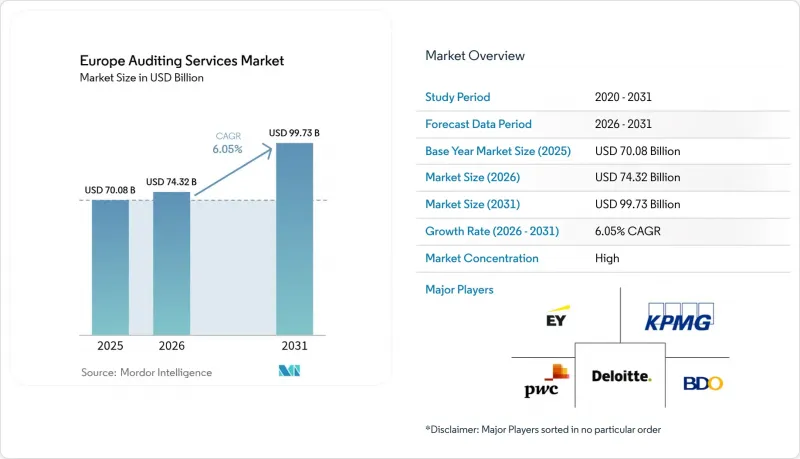
This report is Segmented by Type (Internal Audit, External Audit), Service Line (Operational Audits, Financial Audits, Advisory and Consulting, Investigation Audits, Information System Audits, and Other Service Lines), End-User Industry (BFSI, Manufacturing, Other Industries), and Geography (United Kingdom, and Rest of Europe). The Market Forecasts are Provided in Terms of Value (USD).
Europe Auditing Services Market Trends and Insights
Shift to Continuous Auditing & Real-Time Assurance Solutions
Continuous monitoring platforms allow 100% transaction testing instead of sampling, sharply enhancing fraud-risk coverage across the European auditing services market. Mid-tier networks that deploy standardized analytics quickly gain credibility among mid-market issuers. Big Four firms are revamping legacy systems, yet partner consensus requirements slow enterprise-wide rollouts, creating competitive white space. Real-time dashboards enable boards to identify control breaches within hours rather than weeks, which strengthens governance effectiveness. Audit fees increasingly incorporate subscription pricing tied to data-stream connections instead of hourly billing. The transition also requires reskilling auditors to interpret algorithmic alerts and to evaluate AI model governance. As a result, technology fluency becomes a core competency across the European auditing services industry.
Mandatory Rotation & Tendering Rules Amplify Audit Churn
Statutory rotation mandates generate predictable retender cycles that inject an estimated EUR 2.3 billion in contestable fees into the European auditing services market. Mid-tier networks with sector specialism and competitive rates capitalize on these openings to penetrate large-cap rosters. However, winning new mandates demands upfront investment in bid teams and onboarding capacity, which strains cash flows when talent costs are rising. Incumbents defend positions by bundling multidisciplinary services and highlighting institutional knowledge accumulated over prior audit cycles. Regulators closely monitor fee negotiations to ensure auditor independence, sometimes disallowing ancillary consulting, which reshapes revenue mixes. Rotation also prompts companies to reassess internal control maturity, indirectly lifting demand for pre-transition readiness reviews. Overall, enforced churn diversifies the European auditing services market yet raises compliance complexity for issuers.
Auditor Talent Crunch and Escalating Wage Inflation
Qualified auditor supply lags demand by double-digit percentages, pushing senior-staff wages up 23% in 2024 and squeezing engagement margins across the European auditing services market. Firms respond with hybrid work models and accelerated promotion pathways, yet these perks sometimes dilute mentoring rigor. Scarcity is most acute in IT audit and ESG assurance, where interdisciplinary expertise is required. Recruitment of overseas professionals faces immigration friction, especially post-Brexit, compounding shortages in the United Kingdom. High attrition also erodes institutional memory, raising the cost of maintaining audit quality controls. Automation offsets some resource gaps, but clients remain cautious when junior teams run critical procedures. Unless training pipelines expand, talent deficits could slow delivery timelines and jeopardize fee recovery across the European auditing services industry.
Other drivers and restraints analyzed in the detailed report include:
- Digital-First SMBs Entering Statutory-Audit Bracket
- EU Green Deal Driving ESG-Linked Audit Demand
- Rising Liability Caps & Litigation Risk
For complete list of drivers and restraints, kindly check the Table Of Contents.
Segment Analysis
External audit engagements generated 71.92% of 2025 revenue, confirming statutory compliance as the anchor of the European auditing services market. Mandatory filing deadlines and investor pressure ensure relatively inelastic demand, which supports predictable cash flows for audit networks. Nonetheless, internal audit outsourcing is accelerating at an 7.78% CAGR, reflecting board-level appetite for independent assessments of operational controls without staff overhead. Mid-tier firms leverage sector-specific teams to win managed-service contracts from mid-market enterprises that seek scalability. Simultaneously, Big Four incumbents spin out dedicated internal audit units to avoid independence conflicts with external audit clients while capturing incremental wallet share. Technology deployment, such as continuous control monitoring, allows providers to run lean resource models that improve profitability. Consequently, internal audit gains prominence within the European auditing services market as governance expectations widen beyond financial reporting. This convergence also creates cross-referral pathways, as external auditors recommend internal audit enhancements to improve overall assurance ecosystems.
Internal audit growth alters pricing architecture, shifting from time-and-materials to subscription models tied to the number of control tests or business processes covered. Firms that package risk analytics dashboards with quarterly committee briefings secure multi-year contracts that stabilize utilization rates. Meanwhile, external audit fee pressure rises because tender processes emphasize cost competitiveness amid rotation rules. Pairing both services grants providers negotiation leverage, allowing cross-subsidization strategies. Regulators, however, enforce independence safeguards that limit simultaneous provision to the same client, which nudges the Europe auditing services market toward clearer internal-external delineation. Over the forecast horizon, hybrid sourcing models, where companies keep strategic internal audit planning in-house but outsource execution, are likely to expand. This blend maximizes governance depth while containing payroll costs, underlining the complementary growth trajectories of both audit types.
Complete Report Scope:
- By Type
- Internal Audit
- External Audit
- By Service Line
- Operational Audits
- Financial Audits
- Compliance Audits
- Other Service Lines (Investigation Audit, Information System Audit, etc)
- By End-User Industry
- BFSI
- Manufacturing
- Government & Public Sector
- Healthcare & Life Sciences
- IT & Telecom
- Energy & Utilities
- Other Industries
- By Geography
- United Kingdom
- Germany
- France
- Spain
- Italy
- BENELUX (Belgium, Netherlands, Luxembourg)
- NORDICS (Denmark, Finland, Iceland, Norway, Sweden)
- Rest of Europe
List of Companies Covered in this Report:
- Deloitte
- PwC
- EY
- KPMG
- BDO
- Grant Thornton
- RSM International
- Mazars
- Crowe Global
- Baker Tilly
- PKF International
- Nexia International
- Moore Global
- HLB International
- Kreston Global
- Ecovis
- UHY International
- SMP Europe
- PKF Littlejohn
- MHA MacIntyre Hudson
Additional Benefits:
- The market estimate (ME) sheet in Excel format
- 3 months of analyst support
TABLE OF CONTENTS
1 Introduction
- 1.1 Study Assumptions & Market Definition
- 1.2 Scope of the Study
2 Research Methodology
3 Executive Summary
4 Market Landscape
- 4.1 Market Overview
- 4.2 Market Drivers
- 4.2.1 Shift to continuous auditing & real-time assurance solutions
- 4.2.2 Mandatory rotation & tendering rules amplify audit churn
- 4.2.3 Digital-first SMBs entering statutory-audit bracket
- 4.2.4 EU Green Deal driving ESG-linked audit demand
- 4.2.5 Cloud-native ERP penetration enables remote audit delivery
- 4.2.6 AI-powered anomaly detection raises audit scope
- 4.3 Market Restraints
- 4.3.1 Auditor talent crunch and escalating wage inflation
- 4.3.2 Rising liability caps & litigation risk
- 4.3.3 Blockchain-enabled self-assurance threatens fee pools
- 4.3.4 SME cost-sensitivity limits advisory cross-sell
- 4.4 Value / Supply-Chain Analysis
- 4.5 Regulatory Landscape
- 4.6 Technological Outlook
- 4.7 Porter's Five Forces
- 4.7.1 Threat of New Entrants
- 4.7.2 Bargaining Power of Buyers
- 4.7.3 Bargaining Power of Suppliers
- 4.7.4 Threat of Substitutes
- 4.7.5 Competitive Rivalry
5 Market Size & Growth Forecasts
- 5.1 By Type
- 5.1.1 Internal Audit
- 5.1.2 External Audit
- 5.2 By Service Line
- 5.2.1 Operational Audits
- 5.2.2 Financial Audits
- 5.2.3 Compliance Audits
- 5.2.4 Other Service Lines (Investigation Audit, Information System Audit, etc)
- 5.3 By End-User Industry
- 5.3.1 BFSI
- 5.3.2 Manufacturing
- 5.3.3 Government & Public Sector
- 5.3.4 Healthcare & Life Sciences
- 5.3.5 IT & Telecom
- 5.3.6 Energy & Utilities
- 5.3.7 Other Industries
- 5.4 By Geography
- 5.4.1 United Kingdom
- 5.4.2 Germany
- 5.4.3 France
- 5.4.4 Spain
- 5.4.5 Italy
- 5.4.6 BENELUX (Belgium, Netherlands, Luxembourg)
- 5.4.7 NORDICS (Denmark, Finland, Iceland, Norway, Sweden)
- 5.4.8 Rest of Europe
6 Competitive Landscape
- 6.1 Market Concentration
- 6.2 Strategic Moves
- 6.3 Market Share Analysis
- 6.4 Company Profiles {(includes Global level Overview, Market level overview, Core Segments, Financials as available, Strategic Information, Market Rank/Share for key companies, Products & Services, and Recent Developments)}
- 6.4.1 Deloitte
- 6.4.2 PwC
- 6.4.3 EY
- 6.4.4 KPMG
- 6.4.5 BDO
- 6.4.6 Grant Thornton
- 6.4.7 RSM International
- 6.4.8 Mazars
- 6.4.9 Crowe Global
- 6.4.10 Baker Tilly
- 6.4.11 PKF International
- 6.4.12 Nexia International
- 6.4.13 Moore Global
- 6.4.14 HLB International
- 6.4.15 Kreston Global
- 6.4.16 Ecovis
- 6.4.17 UHY International
- 6.4.18 SMP Europe
- 6.4.19 PKF Littlejohn
- 6.4.20 MHA MacIntyre Hudson
7 Market Opportunities & Future Outlook
- 7.1 Expansion of ESG-Assurance Bundles for Mid-Caps
- 7.2 Platform-based Continuous Audit for SaaS-Centric SMEs

