PUBLISHER: Mordor Intelligence | PRODUCT CODE: 2123295

PUBLISHER: Mordor Intelligence | PRODUCT CODE: 2123295
Uncooled Infrared Imaging - Market Share Analysis, Industry Trends & Statistics, Growth Forecasts (2026 - 2031)
According to Mordor Intelligence, the uncooled infrared imaging market size is expected to grow from USD 4.75 billion in 2025 to USD 5.14 billion in 2026 and is forecast to reach USD 7.63 billion by 2031 at 8.21% CAGR over 2026-2031.
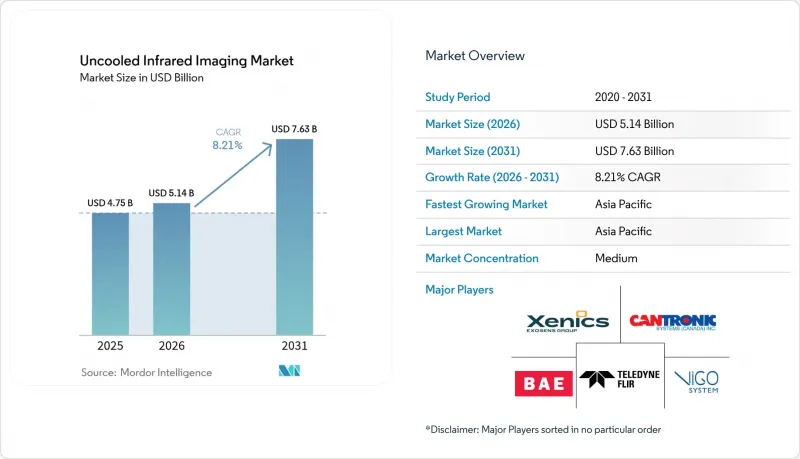
This report is Segmented by Application (Automotive, Military and Defense, Industrial and Manufacturing, and More), Detector Technology (Vanadium Oxide Microbolometers, Amorphous Silicon, and More), Spectral Band (Long-Wave Infrared, Mid-Wave Infrared, and More), Product Type (Handheld Cameras, Fixed-Mount Cameras, and More), and Geography. The Market Forecasts are Provided in Terms of Value (USD).
Global Uncooled Infrared Imaging Market Trends and Insights
Rising Adoption in Automotive ADAS and Night Vision Systems
Pending National Highway Traffic Safety Administration rules that mandate automatic emergency braking capable of night-time pedestrian detection are propelling thermal cameras from luxury options to mainstream safety equipment. Valeo and Teledyne FLIR secured the first Automotive Safety Integrity Level B contract in 2024, validating production readiness for high-volume models. Radar struggles to classify living objects in clutter, lidar performance degrades in rain, and visible sensors fail in low light; thermal imaging closes these gaps at ranges beyond 100 m. Analysts now forecast annual microbolometer volumes exceeding 16 million units by 2030 versus fewer than 2 million in 2024, a scale shift that drives the uncooled infrared imaging market toward single-digit dollar die costs. Magna has already deployed more than 1.2 million thermal systems across its driver-assistance suite, signaling growing OEM confidence.
Growing Demand for Industrial Predictive Maintenance and Inspection
Unplanned downtime in semiconductor fabs, chemical plants, and power stations costs upwards of USD 50,000 per hour, sharpening the business case for real-time thermal inspection. Uncooled handheld cameras priced below USD 5,000 let technicians scan hundreds of assets per shift, flagging hot spots weeks before failures emerge. Edge-inferencing modules embedded within the sensor conduct convolutional-network analysis on-device, removing latency and bandwidth barriers. Electric-vehicle battery lines rely on thermal arrays to catch cell-stacking defects before runaway events, protecting entire production batches. ISO 50001 energy-efficiency audits further stimulate purchases as building managers translate temperature maps into retrofit priorities that cut operating costs.
Performance Limitations Compared to Cooled Infrared Detectors
Noise-equivalent temperature differences of 50-100 mK limit long-range surveillance, precision munitions, and research spectroscopy, domains that still specify cooled mid-wave arrays capable of sub-20 mK performance. Uncooled frame-rates top out near 60 Hz due to thermal time constants, well below the kilohertz speeds needed for ballistic imaging. Military sniper systems and turbine diagnostics therefore keep cooled technology on contract, capping the ceiling for uncooled penetration despite its cost and power benefits.
Other drivers and restraints analyzed in the detailed report include:
- Increasing Defense and Security Expenditure on Thermal Imaging
- Decreasing Cost of Microbolometer Sensors
- Export Control Regulations on Infrared Components
For complete list of drivers and restraints, kindly check the Table Of Contents.
Segment Analysis
Security and surveillance retained 34.10% of 2025 revenue, fueled by perimeter systems that cut false alarms from shadows and headlights. In contrast, automotive applications, though smaller, are forecast to grow at 10.05% through 2031, the fastest among all end-uses, driven by proposed U.S. braking rules that require nighttime detection of pedestrians, cyclists, and large animals. This regulation anchors the uncooled infrared imaging market size opportunity within mass-production vehicle platforms, moving beyond premium marques.
Industrial maintenance gains from thermal scans of switchgear and rotating machinery, while consumer electronics expand via sub-USD 200 smartphone cores that blur professional and prosumer boundaries. Mapping and surveying segments attach uncooled cameras to drones for crop health and power-line inspection, yet remain niche. Healthcare fever-screening demand has normalized post-pandemic, leaving a stable base in hospitals and transit hubs.
Vanadium-oxide designs captured 48.60% revenue in 2025, a legacy of defense funding that honed sensitivity, but amorphous silicon is climbing at 9.62% CAGR as fabs leverage standard CMOS tooling. Amorphous silicon's process affinity slashes per-die costs and simplifies monolithic integration with read-out circuits, critical for automotive economies of scale. The uncooled infrared imaging market share for vanadium-oxide may erode as car volumes dwarf defense demand, tilting capital investment toward silicon lines.
Thermopile and pyroelectric arrays hold low single-digit slices for motion sensing, where resolution is secondary. Emerging quantum-dot prototypes promise short-wave coverage at ambient temperature, yet manufacturability hurdles keep them in labs. Lynred's October 2024 purchase of New Imaging Technologies highlights supplier moves to hedge with short-wave assets as long-wave niches mature
Complete Report Scope:
- By Application
- Automotive
- Military and Defense
- Industrial and Manufacturing
- Security and Surveillance
- Consumer Electronics
- Mapping and Surveying
- Healthcare
- By Detector Technology
- Vanadium Oxide Microbolometers
- Amorphous Silicon Microbolometers
- Thermopile Arrays
- Pyroelectric Arrays
- Other Uncooled Detectors
- By Spectral Band
- Long-Wave Infrared (LWIR)
- Mid-Wave Infrared (MWIR)
- Short-Wave Infrared (SWIR)
- Far Infrared (FIR)
- By Product Type
- Handheld Cameras
- Fixed-Mount Cameras
- Pan-Tilt-Zoom Cameras
- Vehicle-Mounted Sensors
- Smartphone Modules
- By Geography
- North America
- United States
- Canada
- Mexico
- South America
- Brazil
- Argentina
- Chile
- Rest of South America
- Europe
- United Kingdom
- Germany
- France
- Italy
- Spain
- Rest of Europe
- Asia-Pacific
- China
- Japan
- India
- South Korea
- Australia and New Zealand
- Rest of Asia-Pacific
- Middle East and Africa
- Middle East
- United Arab Emirates
- Saudi Arabia
- Turkey
- Rest of Middle East
- Africa
- South Africa
- Kenya
- Nigeria
- Rest of Africa
- Middle East
- North America
Geography Analysis
Asia-Pacific generated 41.10% of 2025 revenue and is projected to post an 11.29% CAGR to 2031, well above the uncooled infrared imaging market average, as Chinese vendors integrate detector growth, wafer processing, and camera assembly under one roof . Vertical integration trims lead times to eight weeks and undercuts Western quotes by up to 40%, winning perimeter and industrial bids across Southeast Asia. India's 60% local-content clause reroutes defense orders to joint ventures, catalyzing domestic fab investment and broadening supply resilience.
North America contributed roughly 29.80% of 2025 revenue. Defense programs such as Stryker NBCRV upgrades, soldier-borne sights, and counter-drone payloads continue to anchor demand, while automotive pilots ramp ahead of night-vision brake mandates. Growth, however, lags Asia as commercial uptake waits for the final regulatory text. Europe secured about 15.20% revenue, buoyed by NATO's 2% GDP defense pledge and EU building-audit mandates. Fragmented procurement and strict export controls temper growth despite world-class R&D.
The Middle East and Africa combined for around 8.10% of 2025 revenue, led by Gulf infrastructure projects that deploy AI-enabled thermal cameras along pipelines and airports. Political risk and currency volatility dampen multi-year forecasts, yet critical-infrastructure protection sustains baseline spending. South America's 5.80% share stems from mining, utility, and wildfire-monitoring use cases in Brazil and Chile; import tariffs and limited incentives restrain broader adoption, yet regional energy-transition projects may unlock incremental demand.
- Teledyne FLIR LLC
- Xenics NV
- Cantronic Systems Inc.
- BAE Systems plc
- Teledyne DALSA Inc.
- Zhejiang ULIRVISION Technology Co., Ltd.
- VIGO System S.A.
- Axis Communications AB
- Lynred USA Inc.
- Seek Thermal Inc.
- Wuhan Guide Infrared Co., Ltd.
- Zhejiang Dali Technology Co., Ltd.
- Yantai IRay Technology Co., Ltd.
- Raytheon Technologies Corporation
- L3Harris Technologies, Inc.
- Leonardo DRS, Inc.
- Fluke Corporation
- Opgal Optronic Industries Ltd.
- Honeywell International Inc.
- Excelitas Technologies Corp.
- InfraTec GmbH Infrarotsensorik und Messtechnik
- Hamamatsu Photonics K.K.
Additional Benefits:
- The market estimate (ME) sheet in Excel format
- 3 months of analyst support
TABLE OF CONTENTS
1 INTRODUCTION
- 1.1 Study Assumptions and Market Definition
- 1.2 Scope of the Study
2 RESEARCH METHODOLOGY
3 EXECUTIVE SUMMARY
4 MARKET LANDSCAPE
- 4.1 Market Overview
- 4.2 Market Drivers
- 4.2.1 Rising Adoption in Automotive ADAS and Night Vision Systems
- 4.2.2 Growing Demand for Industrial Predictive Maintenance and Inspection
- 4.2.3 Increasing Defense and Security Expenditure on Thermal Imaging
- 4.2.4 Decreasing Cost of Microbolometer Sensors
- 4.2.5 Emergence of Smartphone Integrated Thermal Cameras
- 4.2.6 Wafer-Level Packaging Advancements Reducing Pixel Pitch Below 10 µm
- 4.3 Market Restraints
- 4.3.1 Performance Limitations Compared to Cooled Infrared Detectors
- 4.3.2 Export Control Regulations on Infrared Components
- 4.3.3 Price Sensitivity in Mass-Market Consumer Applications
- 4.3.4 Germanium Supply Constraints Impacting Infrared Optics
- 4.4 Industry Value / Supply-Chain Analysis
- 4.5 Regulatory Landscape
- 4.6 Technological Outlook
- 4.7 Impact of Macroeconomic Factors on the Market
- 4.8 Porter's Five Forces Analysis
- 4.8.1 Bargaining Power of Suppliers
- 4.8.2 Bargaining Power of Buyers
- 4.8.3 Threat of New Entrants
- 4.8.4 Threat of Substitutes
- 4.8.5 Intensity of Competitive Rivalry
5 MARKET SIZE AND GROWTH FORECASTS (VALUE)
- 5.1 By Application
- 5.1.1 Automotive
- 5.1.2 Military and Defense
- 5.1.3 Industrial and Manufacturing
- 5.1.4 Security and Surveillance
- 5.1.5 Consumer Electronics
- 5.1.6 Mapping and Surveying
- 5.1.7 Healthcare
- 5.2 By Detector Technology
- 5.2.1 Vanadium Oxide Microbolometers
- 5.2.2 Amorphous Silicon Microbolometers
- 5.2.3 Thermopile Arrays
- 5.2.4 Pyroelectric Arrays
- 5.2.5 Other Uncooled Detectors
- 5.3 By Spectral Band
- 5.3.1 Long-Wave Infrared (LWIR)
- 5.3.2 Mid-Wave Infrared (MWIR)
- 5.3.3 Short-Wave Infrared (SWIR)
- 5.3.4 Far Infrared (FIR)
- 5.4 By Product Type
- 5.4.1 Handheld Cameras
- 5.4.2 Fixed-Mount Cameras
- 5.4.3 Pan-Tilt-Zoom Cameras
- 5.4.4 Vehicle-Mounted Sensors
- 5.4.5 Smartphone Modules
- 5.5 By Geography
- 5.5.1 North America
- 5.5.1.1 United States
- 5.5.1.2 Canada
- 5.5.1.3 Mexico
- 5.5.2 South America
- 5.5.2.1 Brazil
- 5.5.2.2 Argentina
- 5.5.2.3 Chile
- 5.5.2.4 Rest of South America
- 5.5.3 Europe
- 5.5.3.1 United Kingdom
- 5.5.3.2 Germany
- 5.5.3.3 France
- 5.5.3.4 Italy
- 5.5.3.5 Spain
- 5.5.3.6 Rest of Europe
- 5.5.4 Asia-Pacific
- 5.5.4.1 China
- 5.5.4.2 Japan
- 5.5.4.3 India
- 5.5.4.4 South Korea
- 5.5.4.5 Australia and New Zealand
- 5.5.4.6 Rest of Asia-Pacific
- 5.5.5 Middle East and Africa
- 5.5.5.1 Middle East
- 5.5.5.1.1 United Arab Emirates
- 5.5.5.1.2 Saudi Arabia
- 5.5.5.1.3 Turkey
- 5.5.5.1.4 Rest of Middle East
- 5.5.5.2 Africa
- 5.5.5.2.1 South Africa
- 5.5.5.2.2 Kenya
- 5.5.5.2.3 Nigeria
- 5.5.5.2.4 Rest of Africa
- 5.5.5.1 Middle East
- 5.5.1 North America
6 COMPETITIVE LANDSCAPE
- 6.1 Market Concentration
- 6.2 Strategic Moves
- 6.3 Market Share Analysis
- 6.4 Company Profiles (includes Global level Overview, Market level overview, Core Segments, Financials as available, Strategic Information, Market Rank/Share for key companies, Products and Services, and Recent Developments)
- 6.4.1 Teledyne FLIR LLC
- 6.4.2 Xenics NV
- 6.4.3 Cantronic Systems Inc.
- 6.4.4 BAE Systems plc
- 6.4.5 Teledyne DALSA Inc.
- 6.4.6 Zhejiang ULIRVISION Technology Co., Ltd.
- 6.4.7 VIGO System S.A.
- 6.4.8 Axis Communications AB
- 6.4.9 Lynred USA Inc.
- 6.4.10 Seek Thermal Inc.
- 6.4.11 Wuhan Guide Infrared Co., Ltd.
- 6.4.12 Zhejiang Dali Technology Co., Ltd.
- 6.4.13 Yantai IRay Technology Co., Ltd.
- 6.4.14 Raytheon Technologies Corporation
- 6.4.15 L3Harris Technologies, Inc.
- 6.4.16 Leonardo DRS, Inc.
- 6.4.17 Fluke Corporation
- 6.4.18 Opgal Optronic Industries Ltd.
- 6.4.19 Honeywell International Inc.
- 6.4.20 Excelitas Technologies Corp.
- 6.4.21 InfraTec GmbH Infrarotsensorik und Messtechnik
- 6.4.22 Hamamatsu Photonics K.K.
7 MARKET OPPORTUNITIES AND FUTURE OUTLOOK
- 7.1 White-space and Unmet-Need Assessment

