PUBLISHER: Mordor Intelligence | PRODUCT CODE: 2157082

PUBLISHER: Mordor Intelligence | PRODUCT CODE: 2157082
Electrical Inspection Thermography Systems - Market Share Analysis, Industry Trends & Statistics, Growth Forecasts (2026 - 2031)
According to Mordor Intelligence, the electrical inspection thermography systems market size is projected to expand from USD 0.78 billion in 2025 to USD 0.83 billion in 2026, and to USD 1.21 billion by 2031, registering a CAGR of 7.76% between 2026 and 2031.
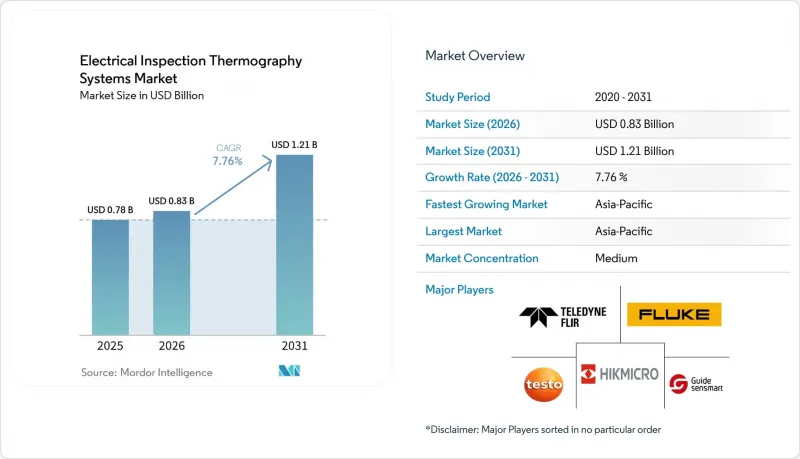
Global Electrical Inspection Thermography Systems Market Trends and Insights
Mandatory Electrical Preventive Maintenance and Thermography Programs
NFPA 70B made infrared thermographic inspection an obligation in its 2023 edition for covered electrical equipment. The standard requires at least annual surveys for Condition 1 and 2 assets. It requires semiannual surveys for Condition 3 equipment, including assets that missed 2 consecutive maintenance cycles or had earlier anomaly alerts. The 2026 edition recognized permanently installed temperature-measurement devices as a means to meet periodic survey requirements. This recognition supports demand for fixed-mount cameras and wireless monitoring systems in the Electrical inspection thermography systems market. The requirement is recurring because each covered asset must be inspected on a defined schedule rather than only during a broad facility review.
Predictive Maintenance for Aging Power Distribution Assets
The American Society of Civil Engineers assigned the US power grid a D+ grade in its 2025 Infrastructure Report Card. It reported that 70% of large power transformers were more than 25 years old. It also reported that 92% of outages originated on the distribution system, where instrumentation levels were low. These conditions support planned inspection programs for energized assets that cannot be easily taken out of service. A 2026 study covering 142,267 substation assets across 18 countries found that 38%-43% of Spanish and Italian substations had an estimated time to critical condition of less than 15 years. The study found that condition-based maintenance reduced lifecycle costs by a median of 19% compared with age-based replacement, supporting the role of non-contact thermal diagnostics in the Electrical inspection thermography systems market.
High Cost of High-Resolution and Cooled Systems
The gap between entry-level uncooled devices and high-resolution cooled platforms creates different purchasing options for different operators. Cooled systems that use mercury cadmium telluride or indium antimonide detectors can cost more than USD 30,000 per unit. Fixed continuous-monitoring arrays for 1 switchgear room can require capital commitments exceeding USD 100,000. IEEE 2969-2025 covers continuous thermal monitoring of switchgear and motor control centers up to 52 kV. The standard has supported interest in continuous monitoring, but it does not remove the cost barrier for smaller building owners and mid-sized operators. The Electrical inspection thermography systems market remains more accessible at the handheld level, while fixed and cooled systems continue to have narrower adoption in cost-sensitive locations.
Other drivers and restraints analyzed in the detailed report include:
- Electricity Demand From Data Centers and Industrial Electrification
- Edge AI and Automated Thermal Anomaly Detection
- Shortage of Certified Thermographers and Interpretation Skills
For complete list of drivers and restraints, kindly check the Table Of Contents.
Segment Analysis
Handheld thermal imagers held 46.81% of the Electrical inspection thermography systems market share in 2025. Their position reflects the installed base and the practical fit of compact devices for many scheduled switchgear inspections. Commercial buildings, light industrial sites, and data centers entering structured maintenance programs can adopt handheld units with lower initial spending. This makes handheld equipment relevant for first-time compliance buyers. Smartphone-attachable imagers can support electricians who prefer a multifunction device. Their limited radiometric resolution restricts their role to qualitative screening rather than detailed diagnosis.
Drone-mounted systems are projected to expand at a CAGR of 10.43% from 2026 to 2031. Utilities use these systems to move from manual patrols to larger-scale thermal surveys of transmission and distribution infrastructure. Fixed-mount cameras support continuous monitoring for equipment that requires repeated observation. Automated and robotic systems serve confined spaces and locations that need recurring scans. These platforms can create a continuing record of asset condition rather than a single inspection result. Other system types remain relevant for specialized deployments where access, safety, or equipment layout limits conventional inspection methods.
Uncooled infrared detectors accounted for 87.41% of the Electrical inspection thermography systems market in 2025. Microbolometer manufacturing has supported thermal sensitivity below 50 mK in mid-tier commercial products. These detectors operate at ambient temperature and do not require cooling maintenance. Their lower operating complexity supports use in handheld tools and drone-mounted utility systems. Broad availability of supplies also supports their use in common electrical inspection tasks. Cooled detectors are used when the required sensitivity and standoff distance exceed the capability of uncooled devices.
Multispectral and hyperspectral detectors are projected to expand at a CAGR of 10.69% from 2026 to 2031. Solar PV and battery storage operators use them when they need cell-level spectral fault discrimination beyond what broadband uncooled imaging provides. A 2026 study of grid-connected PV systems reported 96.88% fault-segmentation precision and a mean intersection-over-union of 77.83% through infrared thermography and advanced signal processing. IEC/TS 62446-3 sets requirements for outdoor infrared thermography of photovoltaic systems. The standard's measurement conditions and procedures favor the use of calibrated detector systems for high-value PV inspection work. Teledyne FLIR introduced the A6450 Long-Life Cooled MWIR camera in February 2026 for continuous industrial process control and nondestructive testing.
Complete Report Scope:
- By System Type
- Handheld Thermal Imagers
- Smartphone-Attachable Thermal Imagers
- Fixed-Mount Thermal Cameras
- Automated and Robotic Thermal Inspection Systems
- Drone-Mounted Thermal Imaging Systems
- Other System Types
- By Detector Technology
- Uncooled Infrared Detectors
- Cooled Infrared Detectors
- Multispectral and Hyperspectral Detectors
- By Application
- Switchgear and Electrical Panel Inspection
- Transformer and Substation Inspection
- Transmission and Distribution Line Inspection
- Solar PV and Battery Storage Inspection
- Motor Control and Industrial Electrical Equipment Inspection
- Other Applications
- By End-User Industry
- Electric Utilities
- Industrial Manufacturing and Process Industries
- Oil and Gas and Petrochemicals
- Commercial Buildings and Data Centers
- Renewable Energy Operators
- Government, Defense, and Public Infrastructure
- Other End-User Industries
- By Geography
- North America
- United States
- Canada
- Mexico
- South America
- Brazil
- Argentina
- Rest of South America
- Europe
- Germany
- United Kingdom
- France
- Italy
- Spain
- Rest of Europe
- Asia-Pacific
- China
- Japan
- India
- South Korea
- ASEAN
- Rest of Asia-Pacific
- Middle East and Africa
- Middle East
- Saudi Arabia
- United Arab Emirates
- Turkey
- Rest of the Middle East
- Africa
- South Africa
- Nigeria
- Rest of Africa
- Middle East
- North America
Geography Analysis
Asia-Pacific held 37.81% of the Electrical inspection thermography systems market share in 2025 and is projected to expand at a CAGR of 9.13% through 2031. China's grid investment program and operating-scale drone inspection activity support demand across transmission lines, substations, and distribution networks. India's National Electricity Plan adds electrical infrastructure that needs inspection. Japan's aging nuclear and thermal fleet supports predictive maintenance activity. HIKMICRO, Guide Sensmart, FOTRIC, ULIRVISION, and DALI Technology support a competitive regional equipment supply base.
North America is the second-largest regional area in the Electrical inspection thermography systems market. The US compliance cycle is creating structured demand among commercial and industrial facilities that previously treated infrared inspection as discretionary. EPRI projected US data center electricity use to rise from 177-192 TWh in 2024 to 380-790 TWh by 2030. This expansion supports commissioning activity across electrical infrastructure at hyperscale campuses. Canada and Mexico add demand through grid-reliability investment and maintenance activity in resource-extraction industries.
Europe is the third-largest region, supported by maintenance standards and the energy transition agenda. Offshore wind operators in Germany and the North Sea need aerial thermographic inspection for large marine asset portfolios. The Middle East and Africa benefit from utility expansion in Gulf Cooperation Council countries. South America follows utility capital program cycles, with Brazil and Argentina offering the largest near-term volumes.
- Teledyne FLIR LLC
- Fluke Corporation
- HIKMICRO
- Testo SE & Co. KGaA
- Guide Sensmart Tech Co., Ltd.
- InfraTec GmbH
- Optris GmbH
- Infrared Cameras Inc.
- Seek Thermal, Inc.
- Opgal Optronic Industries Ltd.
- DIAS Infrared GmbH
- Workswell s.r.o.
- ULIRVISION Technology Co., Ltd.
- SATIR Europe
- Thermoteknix Systems Ltd.
- IRISS Inc
- Xenics NV
- FOTRIC Intelligent Technology Co., Ltd.
- Sierra-Olympic Technologies, Inc.
- DALI Technology Co., Ltd.
- RayThink Technology Co., Ltd.
- Wuhan Guide Infrared Co., Ltd.
Additional Benefits:
- The market estimate (ME) sheet in Excel format
- 3 months of analyst support
TABLE OF CONTENTS
1 INTRODUCTION
- 1.1 Study Assumptions and Market Definition
- 1.2 Scope of the Study
2 RESEARCH METHODOLOGY
3 EXECUTIVE SUMMARY
4 MARKET LANDSCAPE
- 4.1 Market Overview
- 4.2 Impact of Macroeconomic Factors on the Market
- 4.3 Market Drivers
- 4.3.1 Mandatory Electrical Preventive Maintenance and Thermography Programs
- 4.3.2 Predictive Maintenance for Aging Power Distribution Assets
- 4.3.3 Electricity Demand Growth from Data Centers and Industrial Electrification
- 4.3.4 Edge AI and Automated Thermal Anomaly Detection
- 4.3.5 Renewable Generation and Distributed Energy Asset Expansion
- 4.3.6 Drone and Robotic Inspection of Inaccessible Energized Assets
- 4.4 Market Restraints
- 4.4.1 High Cost of High-Resolution and Cooled Systems
- 4.4.2 Shortage of Certified Thermographers and Interpretation Skills
- 4.4.3 Measurement Uncertainty from Emissivity, Load, and Weather Conditions
- 4.4.4 Cybersecurity and Data-Sovereignty Risk in Connected Monitoring
- 4.5 Industry Value Chain Analysis
- 4.6 Regulatory Landscape
- 4.7 Technological Outlook
- 4.8 Porter's Five Forces Analysis
- 4.8.1 Intensity of Competitive Rivalry
- 4.8.2 Threat of New Entrants
- 4.8.3 Bargaining Power of Suppliers
- 4.8.4 Bargaining Power of Buyers
- 4.8.5 Threat of Substitutes
5 MARKET SIZE AND GROWTH FORECASTS (VALUE)
- 5.1 By System Type
- 5.1.1 Handheld Thermal Imagers
- 5.1.2 Smartphone-Attachable Thermal Imagers
- 5.1.3 Fixed-Mount Thermal Cameras
- 5.1.4 Automated and Robotic Thermal Inspection Systems
- 5.1.5 Drone-Mounted Thermal Imaging Systems
- 5.1.6 Other System Types
- 5.2 By Detector Technology
- 5.2.1 Uncooled Infrared Detectors
- 5.2.2 Cooled Infrared Detectors
- 5.2.3 Multispectral and Hyperspectral Detectors
- 5.3 By Application
- 5.3.1 Switchgear and Electrical Panel Inspection
- 5.3.2 Transformer and Substation Inspection
- 5.3.3 Transmission and Distribution Line Inspection
- 5.3.4 Solar PV and Battery Storage Inspection
- 5.3.5 Motor Control and Industrial Electrical Equipment Inspection
- 5.3.6 Other Applications
- 5.4 By End-User Industry
- 5.4.1 Electric Utilities
- 5.4.2 Industrial Manufacturing and Process Industries
- 5.4.3 Oil and Gas and Petrochemicals
- 5.4.4 Commercial Buildings and Data Centers
- 5.4.5 Renewable Energy Operators
- 5.4.6 Government, Defense, and Public Infrastructure
- 5.4.7 Other End-User Industries
- 5.5 By Geography
- 5.5.1 North America
- 5.5.1.1 United States
- 5.5.1.2 Canada
- 5.5.1.3 Mexico
- 5.5.2 South America
- 5.5.2.1 Brazil
- 5.5.2.2 Argentina
- 5.5.2.3 Rest of South America
- 5.5.3 Europe
- 5.5.3.1 Germany
- 5.5.3.2 United Kingdom
- 5.5.3.3 France
- 5.5.3.4 Italy
- 5.5.3.5 Spain
- 5.5.3.6 Rest of Europe
- 5.5.4 Asia-Pacific
- 5.5.4.1 China
- 5.5.4.2 Japan
- 5.5.4.3 India
- 5.5.4.4 South Korea
- 5.5.4.5 ASEAN
- 5.5.4.6 Rest of Asia-Pacific
- 5.5.5 Middle East and Africa
- 5.5.5.1 Middle East
- 5.5.5.1.1 Saudi Arabia
- 5.5.5.1.2 United Arab Emirates
- 5.5.5.1.3 Turkey
- 5.5.5.1.4 Rest of the Middle East
- 5.5.5.2 Africa
- 5.5.5.2.1 South Africa
- 5.5.5.2.2 Nigeria
- 5.5.5.2.3 Rest of Africa
- 5.5.5.1 Middle East
- 5.5.1 North America
6 COMPETITIVE LANDSCAPE
- 6.1 Market Concentration
- 6.2 Strategic Moves
- 6.3 Market Share Analysis
- 6.4 Company Profiles (includes Global Level Overview, Market Level Overview, Core Segments, Financials as available, Strategic Information, Market Rank/Share, Products and Services, Recent Developments)
- 6.4.1 Teledyne FLIR LLC
- 6.4.2 Fluke Corporation
- 6.4.3 HIKMICRO
- 6.4.4 Testo SE & Co. KGaA
- 6.4.5 Guide Sensmart Tech Co., Ltd.
- 6.4.6 InfraTec GmbH
- 6.4.7 Optris GmbH
- 6.4.8 Infrared Cameras Inc.
- 6.4.9 Seek Thermal, Inc.
- 6.4.10 Opgal Optronic Industries Ltd.
- 6.4.11 DIAS Infrared GmbH
- 6.4.12 Workswell s.r.o.
- 6.4.13 ULIRVISION Technology Co., Ltd.
- 6.4.14 SATIR Europe
- 6.4.15 Thermoteknix Systems Ltd.
- 6.4.16 IRISS Inc
- 6.4.17 Xenics NV
- 6.4.18 FOTRIC Intelligent Technology Co., Ltd.
- 6.4.19 Sierra-Olympic Technologies, Inc.
- 6.4.20 DALI Technology Co., Ltd.
- 6.4.21 RayThink Technology Co., Ltd.
- 6.4.22 Wuhan Guide Infrared Co., Ltd.
7 MARKET OPPORTUNITIES AND FUTURE OUTLOOK
- 7.1 White-Space and Unmet-Need Assessment

