PUBLISHER: Mordor Intelligence | PRODUCT CODE: 2123320

PUBLISHER: Mordor Intelligence | PRODUCT CODE: 2123320
Crown Caps - Market Share Analysis, Industry Trends & Statistics, Growth Forecasts (2026 - 2031)
According to Mordor Intelligence, the crown caps market size is expected to grow from USD 1.79 billion in 2025 to USD 1.87 billion in 2026 and is forecast to reach USD 2.33 billion by 2031 at 4.48% CAGR over 2026-2031.
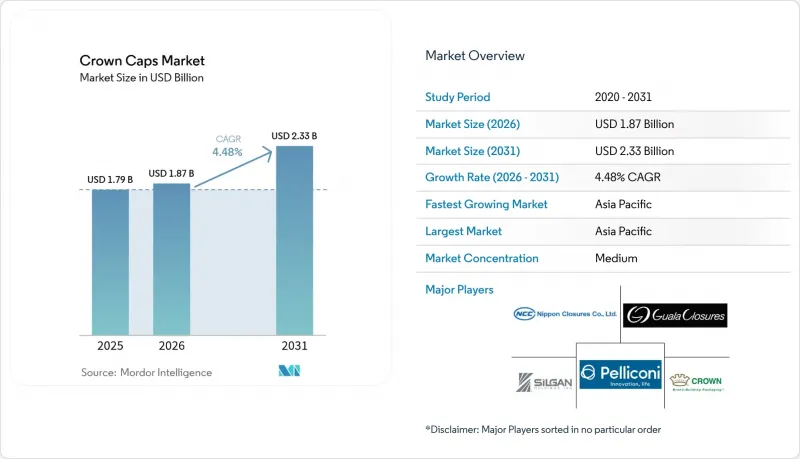
This report is Segmented by Material (Aluminum, Steel, and Tin-Plated Steel), Closure Type (Pry-Off, and Twist-Off), Liner Type (PVC, and PVC-Free), Application (Beverages, Food, Pharmaceuticals and Nutraceuticals, and More), and Geography (North America, South America, Europe, and More). The Market Forecasts are Provided in Terms of Value (USD).
Global Crown Caps Market Trends and Insights
Rising Craft-Beer Micro-Brewery Expansion
More than 9,000 breweries operated in the United States in 2024, up 15% from 2023, and nearly all specify pry-off metal crowns because they seal carbonation reliably at small batch scales. European microbreweries in Germany, Belgium, and the United Kingdom mirror this momentum, prompting converters to develop custom-printed crowns that preserve unique flavor profiles. As taproom-to-retail distribution widens, microbrewers demand liners with tighter oxygen transmission rates and overt tamper evidence. The segment's premium-priced offerings also justify the adoption of lightweight aluminum to reinforce sustainability claims and shelf impact.
Regulation-Driven Shift Toward PVC-Free Liners
Global food-contact legislation is accelerating the migration from PVC to EPE or TPE liners. The FDA's ongoing reassessment of plasticizers and the European Union's Packaging and Packaging Waste Regulation (PPWR) push beverage brands to phase in recyclable, non-chlorinated solutions. The transition entails production line retrofits, resin validation, and higher raw material outlays, yet early adopters secure premium positioning with compliant, eco-friendly closures. Over the forecast period, suppliers that scale PVC-free capacity are expected to gain share as regulators heighten enforcement and brand owners expand life-cycle auditing.
Lightweight PET Bottles with Plastic Screw Caps
Bottle manufacturers now deliver PET packs that weigh 60-70% less than comparable glass containers and integrate tethered screw caps that satisfy the EU Single-Use Plastics Directive, eroding cost-conscious segments traditionally served by metal crowns. PET's logistics savings and improved barrier resins increasingly threaten the carbonated soft drink niche, especially in emerging economies where freight expenses dominate value chains. Crown cap suppliers mitigate the substitution risk by emphasizing heritage aesthetics, recyclability, and premium positioning that PET struggles to replicate.
Other drivers and restraints analyzed in the detailed report include:
- Resurgence of Glass Packaging in Premium Beverages
- Interactive QR-Coded Crown Caps Boost Brand Engagement
- Volatility in Tin-Plate and Aluminum Pricing
For complete list of drivers and restraints, kindly check the Table Of Contents.
Segment Analysis
Steel retained 48.40% share of the crown caps market in 2025 due to its low cost and robustness on high-speed lines. The crown caps market size attributed to steel will edge higher but cede mix to aluminum, whose 5.56% brand lightweighting targets and superior corrosion resistance fuel CAGR. Aluminum recyclability and premium aesthetics appeal to craft distillers that command price premiums covering the material differential. Suppliers experiment with 3104 and 5052 alloys that lower shell mass by up to 20% without compromising cap rigidity.
Second-tier materials such as tin-plated steel serve niche segments requiring glossy finishes or elevated barrier performance but face price sensitivity amid raw-material volatility. Hybrid designs that marry a steel inner shell with an aluminum skirt are emerging to balance cost with shelf appeal. Over the forecast horizon, material evolution may hinge on cradle-to-cradle audits by major beverage groups, making post-consumer scrap recovery rates a critical differentiator.
Pry-off variants commanded 61.75% share in 2025, reflecting entrenched use in mainstream beer markets. Yet twist-offs are projected to outpace at 5.89% CAGR as aging demographics value easy opening and as premium non-alcoholic brands adopt resealability to support multi-serve consumption occasions. The crown caps market embraces thread-forming technologies that maintain seal pressure across repeated openings and closings. Investment in precision die sets and vision inspection drives unit costs higher, but converters recoup through product differentiation and value-added fees.
Hybrid formats combining twistability with overt tamper bands seek to satisfy regulatory scrutiny in pharmaceuticals. Additionally, the ring-pull derivatives pilot in ASEAN breweries, positioning convenience as an alternative growth lever. Suppliers successful in this segment will integrate tooling flexibility that permits rapid changeovers between pry-off and twist-off SKUs without protracted downtime.
Complete Report Scope:
- By Material
- Aluminum
- Steel
- Tin-Plated Steel
- By Closure Type
- Pry-Off
- Twist-Off
- By Liner Type
- PVC
- PVC-Free (EPE / TPE)
- By Application
- Beverages
- Alcoholic Beverages
- Beer
- Wine
- Spirits
- Non-Alcoholic Beverages
- Carbonated Soft Drinks
- Functional and Energy Drinks
- Other Non-Alcoholic Beverages
- Alcoholic Beverages
- Food
- Pharmaceuticals and Nutraceuticals
- Other Applications
- Beverages
- By Geography
- North America
- United States
- Canada
- Mexico
- South America
- Brazil
- Argentina
- Chile
- Rest of South America
- Europe
- United Kingdom
- Germany
- France
- Spain
- Italy
- Rest of Europe
- Asia-Pacific
- China
- India
- Japan
- Australia
- South Korea
- Vietnam
- Rest of Asia-Pacific
- Middle East and Africa
- Middle East
- Saudi Arabia
- United Arab Emirates
- Turkey
- Rest of Middle East
- Africa
- South Africa
- Nigeria
- Egypt
- Rest of Africa
- Middle East
- North America
Geography Analysis
Asia-Pacific led with a 40.10% share in 2025, and its 7.05% CAGR makes it the largest and fastest geography within the crown caps market. Rising disposable incomes in China, India, Indonesia, and Vietnam lift per-capita beer and soft-drink consumption, while foreign direct investment into brewery build-outs underpins closure volumes. Regional converters secure supply-chain resilience by co-locating shell stamping and liner compounding near bottling hubs, minimizing freight costs and customs exposure. Government incentives in China's eastern provinces further encourage aluminum cap manufacturing, bolstering export competitiveness.
North America retains a robust position, fueled by over 9,000 breweries and a strong craft-beer culture. Regulations pushing PVC-free liners prompt early adoption, rewarding domestic suppliers that scale compliant wads ahead of enforcement deadlines. Aluminum import volumes worth USD 4.08 billion from Canada in 2022 underscore the integrated regional metals market supporting closure production.
Europe shows stable demand, anchored by premium beverages and stringent recycling targets. Implementation of deposit-return systems sharpens focus on detachable closure waste, nudging fillers toward tethered or resealable crowns. Producers respond with shell geometry tweaks that allow post-consumer collection without compromising heritage design cues. Meanwhile, breweries in Germany and Belgium pilot ring-pull formats to enhance consumer convenience.
South America and the Middle East and Africa present emerging growth corridors. Brazil's established beer scene underpins steady closure consumption, whereas Mexico's tequila exports drive demand for customized, tamper-evident crowns. In Africa, urbanization accelerates bottled soda uptake, though price sensitivity fosters competition from PET. Manufacturers that localize stamping lines or partner with regional beverage groups reduce import duties and shorten lead times, building a platform for long-term penetration.
- Crown Holdings Inc.
- Pelliconi & C. SpA
- Nippon Closures Co., Ltd.
- Silgan Holdings Inc.
- Guala Closures Group S.p.A.
- Astir Vitogiannis Bros SA
- Finn-Korkki Oy
- Samhwa Crown & Closure Co., Ltd.
- A.M.D. Industries Limited
- Avon Crowncaps & Containers Nigeria Ltd.
- Viscose Closures Ltd.
- Closure Systems International Inc.
- Berlin Packaging LLC
- O.Berk Company LLC
- Tapi S.p.A.
- Evergreen Resources Ltd.
- Yantai Closures Co., Ltd.
- Standard Crown Caps (India) Pvt Ltd.
- SKS Bottle & Packaging Inc.
- Toyo Seikan Group Holdings, Ltd.
Additional Benefits:
- The market estimate (ME) sheet in Excel format
- 3 months of analyst support
TABLE OF CONTENTS
1 INTRODUCTION
- 1.1 Study Assumptions and Market Definition
- 1.2 Scope of the Study
2 RESEARCH METHODOLOGY
3 EXECUTIVE SUMMARY
4 MARKET LANDSCAPE
- 4.1 Market Overview
- 4.2 Market Drivers
- 4.2.1 Rising craft-beer micro-brewery expansion
- 4.2.2 Regulation-driven shift toward PVC-free liners
- 4.2.3 Resurgence of glass packaging in premium beverages
- 4.2.4 Interactive QR-coded crown caps boost brand engagement
- 4.2.5 Emerging demand from kombucha and functional drinks
- 4.2.6 Advanced tamper-evident cap designs
- 4.3 Market Restraints
- 4.3.1 Lightweight PET bottles with plastic screw caps
- 4.3.2 Volatility in tin-plate and aluminum pricing
- 4.3.3 Policy push against single-use metal closures
- 4.3.4 Penetration of ring-pull crowns in ASEAN breweries
- 4.4 Industry Value Chain Analysis
- 4.5 Regulatory Landscape
- 4.6 Technological Outlook
- 4.7 Porter's Five Forces Analysis
- 4.7.1 Bargaining Power of Suppliers
- 4.7.2 Bargaining Power of Consumers
- 4.7.3 Threat of New Entrants
- 4.7.4 Threat of Substitutes
- 4.7.5 Competitive Rivalry
- 4.8 Impact of Macroeconomic Factors on the Market
5 MARKET SIZE AND GROWTH FORECASTS (VALUE)
- 5.1 By Material
- 5.1.1 Aluminum
- 5.1.2 Steel
- 5.1.3 Tin-Plated Steel
- 5.2 By Closure Type
- 5.2.1 Pry-Off
- 5.2.2 Twist-Off
- 5.3 By Liner Type
- 5.3.1 PVC
- 5.3.2 PVC-Free (EPE / TPE)
- 5.4 By Application
- 5.4.1 Beverages
- 5.4.1.1 Alcoholic Beverages
- 5.4.1.1.1 Beer
- 5.4.1.1.2 Wine
- 5.4.1.1.3 Spirits
- 5.4.1.2 Non-Alcoholic Beverages
- 5.4.1.2.1 Carbonated Soft Drinks
- 5.4.1.2.2 Functional and Energy Drinks
- 5.4.1.2.3 Other Non-Alcoholic Beverages
- 5.4.1.1 Alcoholic Beverages
- 5.4.2 Food
- 5.4.3 Pharmaceuticals and Nutraceuticals
- 5.4.4 Other Applications
- 5.4.1 Beverages
- 5.5 By Geography
- 5.5.1 North America
- 5.5.1.1 United States
- 5.5.1.2 Canada
- 5.5.1.3 Mexico
- 5.5.2 South America
- 5.5.2.1 Brazil
- 5.5.2.2 Argentina
- 5.5.2.3 Chile
- 5.5.2.4 Rest of South America
- 5.5.3 Europe
- 5.5.3.1 United Kingdom
- 5.5.3.2 Germany
- 5.5.3.3 France
- 5.5.3.4 Spain
- 5.5.3.5 Italy
- 5.5.3.6 Rest of Europe
- 5.5.4 Asia-Pacific
- 5.5.4.1 China
- 5.5.4.2 India
- 5.5.4.3 Japan
- 5.5.4.4 Australia
- 5.5.4.5 South Korea
- 5.5.4.6 Vietnam
- 5.5.4.7 Rest of Asia-Pacific
- 5.5.5 Middle East and Africa
- 5.5.5.1 Middle East
- 5.5.5.1.1 Saudi Arabia
- 5.5.5.1.2 United Arab Emirates
- 5.5.5.1.3 Turkey
- 5.5.5.1.4 Rest of Middle East
- 5.5.5.2 Africa
- 5.5.5.2.1 South Africa
- 5.5.5.2.2 Nigeria
- 5.5.5.2.3 Egypt
- 5.5.5.2.4 Rest of Africa
- 5.5.5.1 Middle East
- 5.5.1 North America
6 COMPETITIVE LANDSCAPE
- 6.1 Market Concentration
- 6.2 Strategic Moves
- 6.3 Market Share Analysis
- 6.4 Company Profiles (includes Global level Overview, Market level overview, Core Segments, Financials as available, Strategic Information, Market Rank/Share for key companies, Products and Services, and Recent Developments)
- 6.4.1 Crown Holdings Inc.
- 6.4.2 Pelliconi & C. SpA
- 6.4.3 Nippon Closures Co., Ltd.
- 6.4.4 Silgan Holdings Inc.
- 6.4.5 Guala Closures Group S.p.A.
- 6.4.6 Astir Vitogiannis Bros SA
- 6.4.7 Finn-Korkki Oy
- 6.4.8 Samhwa Crown & Closure Co., Ltd.
- 6.4.9 A.M.D. Industries Limited
- 6.4.10 Avon Crowncaps & Containers Nigeria Ltd.
- 6.4.11 Viscose Closures Ltd.
- 6.4.12 Closure Systems International Inc.
- 6.4.13 Berlin Packaging LLC
- 6.4.14 O.Berk Company LLC
- 6.4.15 Tapi S.p.A.
- 6.4.16 Evergreen Resources Ltd.
- 6.4.17 Yantai Closures Co., Ltd.
- 6.4.18 Standard Crown Caps (India) Pvt Ltd.
- 6.4.19 SKS Bottle & Packaging Inc.
- 6.4.20 Toyo Seikan Group Holdings, Ltd.
7 MARKET OPPORTUNITIES AND FUTURE OUTLOOK
- 7.1 White-Space and Unmet-Need Assessment

