PUBLISHER: Mordor Intelligence | PRODUCT CODE: 2123335

PUBLISHER: Mordor Intelligence | PRODUCT CODE: 2123335
Earphones And Headphones - Market Share Analysis, Industry Trends & Statistics, Growth Forecasts (2026 - 2031)
According to Mordor Intelligence, the earphones and headphones market size was valued at USD 26.63 billion in 2025 and is estimated to grow from USD 29.22 billion in 2026 to reach USD 44.71 billion by 2031, at a CAGR of 8.88% during the forecast period (2026-2031).
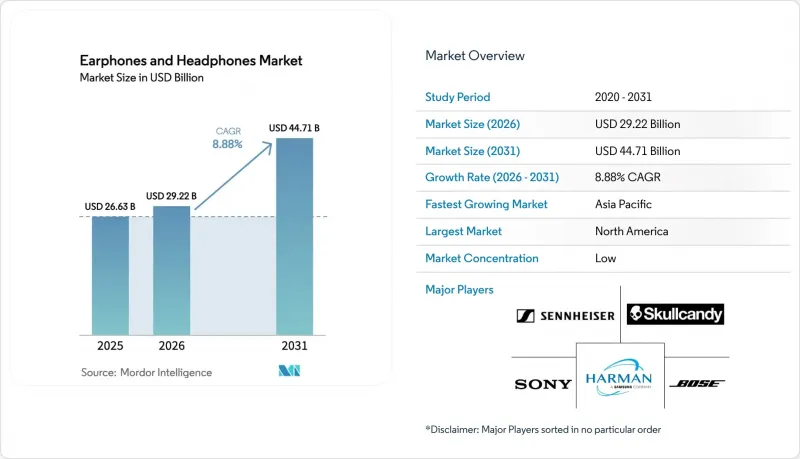
This report is Segmented by Product Type (Headphones, and More), Form Factor (Over-Ear, and More), Connectivity (Wired, and Wireless), Noise-Control Technology (Active Noise-Cancelling (ANC), and More), Price Band (Sub-USD 50, and More), Application (Consumer Entertainment, and More), Distribution Channel (Online and Offline), and Geography. The Market Forecasts are Provided in Terms of Value (USD).
Global Earphones And Headphones Market Trends and Insights
In-App Spatial-Audio Ecosystems Accelerating Premium TWS Adoption in Asia
Streaming platforms in China, Japan, and South Korea now treat earbuds as extensions of mobile operating systems rather than commodity accessories. Dolby Atmos and Apple Spatial Audio became default check-box features on Tencent Video and Apple Music catalogs in 2025, encouraging users to upgrade hardware every 18-24 months when older chipsets cannot process head-tracking commands without latency spikes. Qualcomm's Snapdragon Sound S7 Gen 3 platform carried aptX Lossless and spatial-audio rendering to Android devices, allowing Samsung and Xiaomi to match Apple's experience at a 30-50% price discount. This dual-ecosystem rivalry incentivizes chipset vendors to release annual revisions, embedding headphone upgrades into the same cadence as smartphone refreshes.
Enterprise Hybrid-Work Policies Fueling Demand for Boom-Mic Headsets in North America
Hybrid-work norms have cemented the boom-mic headset as a standard office peripheral. Logitech's Zone Vibe 125 and Jabra's Evolve2 75 pair flip-to-mute arms with AI beamforming that masks keyboard clatter, satisfying corporate mandates for intelligible speech during video calls. Financial services and healthcare firms adopted encrypted USB-C dongles such as Dell's WL5024 Pro to secure voice traffic under privacy regulations. These enterprise-grade models sustain 40% gross margins despite consumer price compression, primarily because IT departments consolidate purchases under multiyear support contracts.
Proliferation of Counterfeit Earbuds Depressing ASPs in South America
Customs authorities in Brazil seized more than 1.2 million fake earbuds in 2024, yet replicas that mimic Apple or Samsung designs still enter informal channels at one-third of authentic retail prices. These products employ uncertified lithium-ion cells that pose fire risks, and when incidents occur, consumers often blame brand owners, eroding goodwill. Multinationals now embed NFC tags and QR-coded serials to enable smartphone verification, but the added USD 1-2 bill-of-materials cost squeezes margins in entry-level tiers. Unless enforcement improves, legitimate vendors will continue facing price erosion and warranty claims they did not cause.
Other drivers and restraints analyzed in the detailed report include:
- Gen-Z Fitness Boom Boosting Open-Ear and Bone-Conduction Sales in Europe
- AI-Enabled Adaptive Noise-Cancellation Differentiating Flagship Models Globally
- Battery-Waste Regulations Increasing Compliance Costs in EU
For complete list of drivers and restraints, kindly check the Table Of Contents.
Segment Analysis
True wireless stereo models accounted for 68.18% of global revenue in 2025 and are projected to expand at a 9.9% CAGR through 2031, keeping the earphones and headphones market on its current innovation treadmill. Flagships combine sub-5 mm system-on-chip packages, six-hour battery endurance per bud, and spatial-audio rendering that once required dedicated digital signal processors. Apple's H2, Samsung's proprietary codec, and Qualcomm's QCC5181 collectively demonstrate how power management and compute convergence enable lighter, more comfortable buds. Over-ear headphones nevertheless maintain carve-outs in studio mixing, professional broadcast, and long-haul travel. Sennheiser's Momentum 4 integrates 42 mm transducers and adaptive ANC, servicing travelers who prize isolation and extended comfort during 12-hour flights. Audio-Technica's ATH-M50x still ships more than 1 million units annually to engineers who insist on the reference flatness of wired monitoring rigs. The coexistence of pocketable convenience and circumaural fidelity suggests each form factor will continue addressing discrete use cases rather than converging into a single hybrid design.
Complementary opportunities emerge for brands that cross-pollinate technologies between categories. Sony's WH-1000XM6 borrows the adaptive ANC cluster from its WF-1000XM earbuds, while Bose's CustomTune references ear-canal scanning techniques perfected in its in-ear line. Gamers remain a separate cohort: Razer's BlackShark V2 Pro and Corsair's HS80 integrate low-latency RF dongles for tournament use, a function less relevant to mainstream listeners. As headset processors become more modular, vendors may introduce modular driver housings that detach for portability, though such innovations risk cannibalizing established segments without clear incremental revenue.
In-ear and canal-fit models secured 55.29% of 2025 revenue thanks to natural passive isolation, silicone tips that attenuate 15-25 dB of ambient noise, and gym-friendly IP ratings. Yet open-ear and bone-conduction designs are expanding at a 9.7% CAGR through 2031 as fitness-oriented Gen-Z users demand situational awareness on urban streets. Shokz's OpenFit Air demonstrates how directional speakers angled toward the ear canal can deliver acceptable bass response without blocking environmental cues, addressing regulatory recommendations that cyclists maintain ambient hearing. Over-ear headphones retain prominence in critical listening environments, benefiting from 40-50 mm drivers that reproduce sub-20 Hz frequencies. On-ear sets, once the style icon of commuter chic, chart a shrinking addressable base as consumers either prioritize the immersive seal of over-ears or the feather-weight freedom of TWS buds.
Manufacturers experiment with hybrid shells combining open-ear frames and detachable ANC pods, but user adoption remains speculative. Weight distribution, sweat ingress protection, and battery compartment placement emerge as engineering constraints. Retailers increasingly group open-ear SKUs inside running-accessory aisles rather than audio displays, suggesting cross-category merchandising will determine velocity as much as acoustics.
Wireless designs contributed 72.63% of 2025 revenue and will widen their lead on a 9.3% CAGR, propelled by Bluetooth LE Audio and the LC3 codec that supports near-CD fidelity at sub-300 kbps bitrates. The protocol's low-latency attribute brings competitive parity with 2.4 GHz gaming dongles, erasing one of the last wired advantages for mainstream users. Neckband-style earbuds retain a following in emerging markets, offering 12-16 hour endurance courtesy of larger battery housings. Wired headphones hang on in studio environments and among audiophiles skeptical of codec claims, with Beyerdynamic's DT 1990 Pro and Grado's SR325x exemplifying USD 500-plus investments centered on signal purity. Infrared and legacy RF links fade into aviation and home-theater niches, unlikely to return as consumer standards.
The cost of Bluetooth silicon dropped 35% between 2023 and 2025, opening the door for USD 25 entry-level buds that still advertise LE Audio compatibility. Yet Wi-Fi congestion and urban spectrum interference remain pain points; brands that optimize adaptive frequency hopping enjoy measurably lower call-drop rates in crowded environments, a selling point visible in user-generated benchmarks on e-commerce portals.
Complete Report Scope:
- By Product Type
- Headphones
- Earphones/Earbuds
- By Form Factor
- Over-Ear
- On-Ear
- In-Ear/Canal
- Open-Ear/Bone-Conduction
- By Connectivity
- Wired
- Wireless
- True Wireless Stereo (TWS)
- Neckband
- RF/Infra-red
- By Noise-Control Technology
- Active Noise-Cancelling (ANC)
- Passive Noise-Isolation
- Open-Transparency/Ambient Mode
- By Price Band
- Sub-USD 50 (Value)
- USD 51-150
- USD 151-300
- Above USD 300
- By Application
- Consumer Entertainment and Music
- Gaming and Esports
- Sports and Fitness
- Professional Studio and Broadcast
- Enterprise/Call-Center/UC&C
- By Distribution Channel
- Online
- E-commerce Marketplaces
- Brand Webstores
- Offline
- Consumer Electronics Chains
- Specialty Audio Stores
- Hypermarkets/Supermarkets
- Online
- By Geography
- North America
- United States
- Canada
- Mexico
- Europe
- Germany
- United Kingdom
- France
- Italy
- Spain
- Nordics
- Rest of Europe
- Asia-Pacific
- China
- Japan
- South Korea
- India
- South East Asia
- Australia
- Rest of Asia-Pacific
- South America
- Brazil
- Rest of South America
- Middle East
- United Arab Emirates
- Saudi Arabia
- Rest of Middle East
- Africa
- South Africa
- Rest of Africa
- North America
Geography Analysis
Asia Pacific held a 28% share of global revenue in 2025, driven by burgeoning smartphone penetration in India, Indonesia, and Vietnam, where first-time buyers outnumber replacement customers by 3 to 1. Domestic Chinese brands that combine design agility with local manufacturing captured more than half of the segment below USD 100, pushing multinationals to localize assembly or cede share. Japan and South Korea still record the highest per-capita spend on premium audio, driven by Sony and Samsung ecosystems that integrate wearables into broader device suites. India's boAt shipped over 15 million units in 2024, using smartwatch bundles to cross-sell earbuds and illustrating how regional specialists can outmaneuver global giants on volume.
North America maintained a 35.78% share in 2025, anchored by an installed base of more than 200 million AirPods that refresh every two to three years and by enterprise headset mandates tied to Microsoft Teams rollouts. Europe followed at 22%, with replacement cycles extending toward 36 months amid macroeconomic caution and regulatory scrutiny on battery sustainability. The Middle East accelerates at 9.5% CAGR through 2031 as Saudi Arabia's Public Investment Fund bankrolls esports arenas, pulling high-fidelity gaming headsets into mainstream retail assortments. South America struggles with counterfeit dilution and currency volatility but represents latent potential once enforcement stabilizes, especially in Brazil's 220 million-strong market. Africa remains nascent, yet mobile-money platforms in Kenya and Nigeria shorten the path between brand webstores and underserved consumers, hinting at a leapfrog pattern similar to smartphone adoption.
- Apple Inc.
- Sony Group Corporation
- Samsung Electronics Co. Ltd.
- Bose Corporation
- Shenzhen Imagine Marketing Ltd. (boAt)
- Skullcandy Inc.
- Sennheiser Electronic GmbH and Co. KG
- Shokz Holding Ltd.
- Logitech International S.A. (Astro)
- Razer Inc.
- Logitech G/Blue
- Panasonic Corp.
- Audio-Technica Corp.
- Corsair Gaming Inc.
- HP Inc. (Poly)
- Pioneer Corporation
- Beyerdynamic GmbH
- Yamaha Corp.
- Grado Labs
- Lenovo Group Ltd. (ThinkPlus)
- Anker Innovations Ltd. (Soundcore)
- Xiaomi Corp. (Redmi, Mi)
Additional Benefits:
- The market estimate (ME) sheet in Excel format
- 3 months of analyst support
TABLE OF CONTENTS
1 INTRODUCTION
- 1.1 Study Assumptions and Market Definition
- 1.2 Scope of the Study
2 RESEARCH METHODOLOGY
3 EXECUTIVE SUMMARY
4 MARKET LANDSCAPE
- 4.1 Market Overview
- 4.2 Market Drivers
- 4.2.1 In-App Spatial-Audio Ecosystems Accelerating Premium-TWS Adoption in Asia
- 4.2.2 Enterprise Hybrid-Work Policies Fueling Demand for Boom-Mic Headsets in North America
- 4.2.3 Gen-Z Fitness Boom Boosting Open-Ear/Bone-Conduction Sales in Europe
- 4.2.4 AI-Enabled Adaptive Noise-Cancellation Differentiating Flagship Models Globally
- 4.2.5 Esports Sponsorships Driving High-Fidelity Gaming Headphones in Middle East
- 4.2.6 Subscription-Bundled Hardware Models (e.g., Apple, Samsung) Lifting Upgrade Cycles
- 4.3 Market Restraints
- 4.3.1 Proliferation of Counterfeit Earbuds Depressing ASPs in South America
- 4.3.2 Battery-Waste Regulations Increasing Compliance Costs in EU
- 4.3.3 Spectrum-Interference Issues Limiting Ultra-Low-Latency Bluetooth LE Audio in Dense Cities
- 4.3.4 Health-Related Concerns on Prolonged SPL Exposure Curbing Volume Limits
- 4.4 Industry Value / Supply-Chain Analysis
- 4.5 Impact of Macroeconomic Factors on the Market
- 4.6 Technological Outlook
- 4.7 Regulatory Landscape
- 4.8 Porter's Five Forces Analysis
- 4.8.1 Bargaining Power of Suppliers
- 4.8.2 Bargaining Power of Buyers
- 4.8.3 Threat of New Entrants
- 4.8.4 Threat of Substitute Products
- 4.8.5 Intensity of Competitive Rivalry
5 MARKET SIZE AND GROWTH FORECASTS (VALUES)
- 5.1 By Product Type
- 5.1.1 Headphones
- 5.1.2 Earphones/Earbuds
- 5.2 By Form Factor
- 5.2.1 Over-Ear
- 5.2.2 On-Ear
- 5.2.3 In-Ear/Canal
- 5.2.4 Open-Ear/Bone-Conduction
- 5.3 By Connectivity
- 5.3.1 Wired
- 5.3.2 Wireless
- 5.3.2.1 True Wireless Stereo (TWS)
- 5.3.2.2 Neckband
- 5.3.2.3 RF/Infra-red
- 5.4 By Noise-Control Technology
- 5.4.1 Active Noise-Cancelling (ANC)
- 5.4.2 Passive Noise-Isolation
- 5.4.3 Open-Transparency/Ambient Mode
- 5.5 By Price Band
- 5.5.1 Sub-USD 50 (Value)
- 5.5.2 USD 51-150
- 5.5.3 USD 151-300
- 5.5.4 Above USD 300
- 5.6 By Application
- 5.6.1 Consumer Entertainment and Music
- 5.6.2 Gaming and Esports
- 5.6.3 Sports and Fitness
- 5.6.4 Professional Studio and Broadcast
- 5.6.5 Enterprise/Call-Center/UC&C
- 5.7 By Distribution Channel
- 5.7.1 Online
- 5.7.1.1 E-commerce Marketplaces
- 5.7.1.2 Brand Webstores
- 5.7.2 Offline
- 5.7.2.1 Consumer Electronics Chains
- 5.7.2.2 Specialty Audio Stores
- 5.7.2.3 Hypermarkets/Supermarkets
- 5.7.1 Online
- 5.8 By Geography
- 5.8.1 North America
- 5.8.1.1 United States
- 5.8.1.2 Canada
- 5.8.1.3 Mexico
- 5.8.2 Europe
- 5.8.2.1 Germany
- 5.8.2.2 United Kingdom
- 5.8.2.3 France
- 5.8.2.4 Italy
- 5.8.2.5 Spain
- 5.8.2.6 Nordics
- 5.8.2.7 Rest of Europe
- 5.8.3 Asia-Pacific
- 5.8.3.1 China
- 5.8.3.2 Japan
- 5.8.3.3 South Korea
- 5.8.3.4 India
- 5.8.3.5 South East Asia
- 5.8.3.6 Australia
- 5.8.3.7 Rest of Asia-Pacific
- 5.8.4 South America
- 5.8.4.1 Brazil
- 5.8.4.2 Rest of South America
- 5.8.5 Middle East
- 5.8.5.1 United Arab Emirates
- 5.8.5.2 Saudi Arabia
- 5.8.5.3 Rest of Middle East
- 5.8.6 Africa
- 5.8.6.1 South Africa
- 5.8.6.2 Rest of Africa
- 5.8.1 North America
6 COMPETITIVE LANDSCAPE
- 6.1 Market Concentration
- 6.2 Strategic Moves
- 6.3 Market Share Analysis
- 6.4 Company Profiles (includes Global-level Overview, Market-level Overview, Core Segments, Financials as available, Strategic Information, Market Rank/Share, Products and Services, Recent Developments)
- 6.4.1 Apple Inc.
- 6.4.2 Sony Group Corporation
- 6.4.3 Samsung Electronics Co. Ltd.
- 6.4.4 Bose Corporation
- 6.4.5 Shenzhen Imagine Marketing Ltd. (boAt)
- 6.4.6 Skullcandy Inc.
- 6.4.7 Sennheiser Electronic GmbH and Co. KG
- 6.4.8 Shokz Holding Ltd.
- 6.4.9 Logitech International S.A. (Astro)
- 6.4.10 Razer Inc.
- 6.4.11 Logitech G/Blue
- 6.4.12 Panasonic Corp.
- 6.4.13 Audio-Technica Corp.
- 6.4.14 Corsair Gaming Inc.
- 6.4.15 HP Inc. (Poly)
- 6.4.16 Pioneer Corporation
- 6.4.17 Beyerdynamic GmbH
- 6.4.18 Yamaha Corp.
- 6.4.19 Grado Labs
- 6.4.20 Lenovo Group Ltd. (ThinkPlus)
- 6.4.21 Anker Innovations Ltd. (Soundcore)
- 6.4.22 Xiaomi Corp. (Redmi, Mi)
7 MARKET OPPORTUNITIES AND FUTURE OUTLOOK
- 7.1 White-Space and Unmet-Need Assessment

