PUBLISHER: Mordor Intelligence | PRODUCT CODE: 2123381

PUBLISHER: Mordor Intelligence | PRODUCT CODE: 2123381
Stents - Market Share Analysis, Industry Trends & Statistics, Growth Forecasts (2026 - 2031)
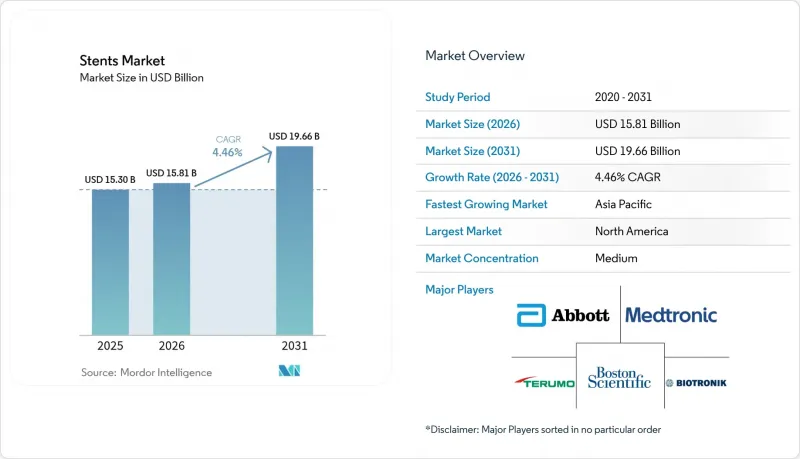
According to Mordor Intelligence, the stents market size is expected to grow from USD 15.30 billion in 2025 to USD 15.81 billion in 2026 and is forecast to reach USD 19.66 billion by 2031 at 4.46% CAGR over 2026-2031.
This report is Segmented by Stent Type (Coronary[Drug-Eluting Coronary Stents and More], Peripheral Vascular [Iliac Artery Stents] and More), Material (Metallic, Polymeric, Natural Biomaterials), Mode of Delivery (Balloon-Expandable, Self-Expandable), End User (Hospitals, Ascs, Cardiac Clinics), and Geography (North America, Europe, Asia-Pacific, MEA, South America). Market Forecasts are Provided in Value (USD).
Global Stents Market Trends and Insights
Rising Prevalence of Cardiovascular & Peripheral Arterial Diseases
Cardiovascular disorders caused 17.9 million deaths in 2024, equal to 32% of all global mortality, elevating demand for revascularization tools such as stents. Diabetes affected 537 million adults in 2025, accelerating atherosclerotic plaque progression and necessitating repeat interventions. In the United States, coronary artery disease affected 20.5 million adults in 2024, with annual PCI procedures surpassing 1 million.Peripheral arterial disease touches 200 million people worldwide, but treatment rates remain below 15% in low-income nations, suggesting untapped pent-up need. Aging populations in Japan and Western Europe are presenting more complex multivessel disease, prompting thinner-strut device design. Emerging data also link prolonged exposure to PM2.5 above 100 µg/m3 in parts of India and China to a 30% surge in acute coronary syndrome admissions.
Growing Demand for Minimally Invasive Percutaneous Interventions
Patients favor catheter-based therapy over surgical bypass owing to shorter stays and quicker recovery. Same-day discharge reached 22% of U.S. elective PCI cases in 2025, up from 8% in 2020, aided by radial access and refined anticoagulation. Drug-eluting stents now secure 18-month patency above 80% in diabetic superficial femoral artery cohorts, broadening peripheral indications. Neurovascular thrombectomy with adjunct flow-diverter implantation is reducing stroke disability when performed within a six-hour window. Outpatient migration is trimming per-case reimbursement, compelling manufacturers to negotiate volume-based contracts. The European Medicines Agency has fast-tracked devices incorporating novel polymers to cut required dual-antiplatelet therapy durations.
Stringent Regulatory Approval & Post-Market Surveillance Demands
The FDA now requires five-year data on 1,500 patients for drug-eluting stent approvals, doubling timelines to 36 months and elevating per-device trial costs to USD 40 million. EU MDR enforcement since May 2024 mandates annual factory audits, producing a 14-month CE-renewal backlog. Japan's PMDA permits conditional entry for bioresorbable scaffolds after two-year data but insists on manufacturer-funded registries. Administrative load favors incumbents with deep regulatory teams and deters venture-backed entrants.
Other drivers and restraints analyzed in the detailed report include:
- Technological Advancements in Drug-Eluting & Bioresorbable Stents
- Outpatient PCI Expansion Via ASC-Friendly Reimbursement Reforms
- In-Stent Thrombosis / Restenosis Risks & Related Litigation
For complete list of drivers and restraints, kindly check the Table Of Contents.
Segment Analysis
Coronary devices retained 61.46% of the 2025 stents market share on the strength of entrenched use in ischemic heart disease. Growth, however, is leveling as drug-eluting penetration tops 90% and bare-metal applications shrink to graft lesions. Neurovascular stents are forecast to post an 8.46% CAGR through 2031, propelled by the widespread rollout of flow-diverter technology that safely treats wide-neck aneurysms without open surgery. Peripheral vascular implants benefit from an endovascular-first approach to limb salvage, with patency above 75% at three years when combined with drug-coated balloons.
Neurovascular momentum underscores a broader shift in the stents market toward complex, high-acuity indications, where reimbursement per case remains robust despite pricing pressure elsewhere. Gastrointestinal, urological, and airway segments together account for a small slice of the overall stents market size but are advancing rapidly as biodegradable polymers eliminate retrieval needs in palliative oncology settings. Bioresorbable coronary scaffolds, although still trial-restricted, are expected to re-enter commercialization on refined polymer chemistry backed by the ABSORB IV data set due in 2026.
Metallic alloys such as cobalt-chromium and platinum-chromium commanded 63.68% of 2025 revenue because they offer thin struts without sacrificing radial strength. Polymeric constructs are projected to climb at a 7.56% CAGR on rising surgeon confidence that resorbable devices reduce late thrombosis. Within that niche, poly-L-lactic acid dominates but newer blends featuring polycaprolactone are tuning degradation to 18-24 months, restoring vasomotion once support is no longer needed.
Interest in natural biomaterials such as collagen coatings remains modest, yet they serve patients with metal hypersensitivity and pediatric congenital defects requiring temporary scaffolds. Polymer-free drug-eluting stents provide a tactical intermediate, keeping metallic reliability while dropping the inflammatory load of carrier polymers. This transition illustrates how the stents market size growth intertwines with material science breakthroughs.
Complete Report Scope:
- By Stent Type
- Coronary Stents
- Drug-Eluting Coronary Stents
- Bare-Metal Coronary Stents
- Bioresorbable Coronary Scaffolds
- Peripheral Vascular Stents
- Iliac Artery Stents
- Femoral-Popliteal Stents
- Carotid Artery Stents
- Renal Artery Stents
- Neurovascular Stents
- Flow-Diverter Stents
- Intracranial Atherosclerotic Stents
- Gastrointestinal Stents
- Biliary Stents
- Esophageal Stents
- Colonic / Enteral Stents
- Urological Stents
- Ureteral Stents
- Prostatic Stents
- Airway Stents
- Tracheal Stents
- Bronchial Stents
- Coronary Stents
- By Material
- Metallic Biomaterials
- Polymeric Biomaterials
- Natural Biomaterials
- By Mode of Delivery
- Balloon-Expandable Stents
- Self-Expandable Stents
- By End User
- Hospitals
- Ambulatory Surgical Centers
- Cardiac & Specialty Clinics
- By Geography
- North America
- United States
- Canada
- Mexico
- Europe
- Germany
- France
- United Kingdom
- Italy
- Spain
- Rest of Europe
- Asia-Pacific
- China
- Japan
- India
- South Korea
- Australia
- Rest of Asia-Pacific
- Middle East & Africa
- GCC
- South Africa
- Rest of Middle East & Africa
- South America
- Brazil
- Argentina
- Rest of South America
- North America
Geography Analysis
North America led with 32.58% of 2025 revenue as sophisticated imaging suites, AI-enabling software, and premium bioresorbable launches kept average selling prices elevated. U.S. procedure counts are steady, but downward price renegotiations with group purchasing organizations are tempering top-line growth. Canada's single-payer system is slower to adopt bioresorbables, yet provincial health authorities are funding robotics pilots to offset rural cardiologist shortages.
Asia-Pacific is projected to deliver a 6.36% CAGR to 2031 and will likely overtake Europe in absolute revenue by late forecast. China's procurement program dropped unit prices to USD 97, propelling a 140% spike in volumes as rural cath-lab build-outs captured previously untreated cases. India performed 1.2 million coronary interventions in 2025 after sustained price caps lowered out-of-pocket costs below catastrophic thresholds. Southeast Asian ministries are drafting copycat tenders, signaling sustained double-digit unit growth even if revenue per case compresses.
Europe faces budget ceilings and growing preference for drug-coated balloons that cost 40% less than metallic drug-eluting stents. Germany, France, and the United Kingdom together make up 60% of regional consumption, yet price erosion dominates as national health services pursue bundled cardiology payments. Japan's ultra-aged demographic is fueling peripheral and neurovascular demand, but biannual fee schedule reductions limit monetization. The Middle East and Africa leverage oil-funded investment in catheterization labs, but a dearth of trained interventionists keeps procedure density low. South America's public-sector expansion lifts basic coronary volumes, although currency swings and tariff burdens complicate supply chains in Brazil and Argentina.
- Abbott Laboratories
- Andramed GmbH
- B. Braun
- Beckton Dickinson
- Blue Sail Medical Co., Ltd. (Biosensors)
- BIOTRONIK
- Boston Scientific
- Cardiovascular Systems Inc. (CSI)
- Cardinal Health
- Cook Group
- Elixir Medical
- Endologix
- Hexacath
- Lepu Medical
- Medtronic
- Meril Life Science
- MicroPort
- Sahajanand Medical Technologies (SMT)
- Shockwave Medical
- Terumo
- Translumina
- Vascular Concepts
- W. L. Gore & Associates
Additional Benefits:
- The market estimate (ME) sheet in Excel format
- 3 months of analyst support
TABLE OF CONTENTS
1 Introduction
- 1.1 Study Assumptions & Market Definition
- 1.2 Scope of the Study
2 Research Methodology
3 Executive Summary
4 Market Landscape
- 4.1 Market Overview
- 4.2 Market Drivers
- 4.2.1 Rising Prevalence of Cardiovascular & Peripheral Arterial Diseases (CAD/PAD)
- 4.2.2 Growing Demand for Minimally Invasive Percutaneous Interventions
- 4.2.3 Technological Advancements in Drug-Eluting & Bioresorbable Stents
- 4.2.4 Outpatient PCI Expansion Via ASC-Friendly Reimbursement Reforms
- 4.2.5 AI-Enabled Imaging & Robotic Navigation Accelerating Adoption
- 4.2.6 Rapid Roll-Out of Budget-Priced, Government-Price-Capped Stents in India & China
- 4.3 Market Restraints
- 4.3.1 Stringent Regulatory Approval & Post-Market Surveillance Demands
- 4.3.2 In-Stent Thrombosis / Restenosis Risks & Related Litigation
- 4.3.3 Supply-Chain Fragility for Cobalt-Chromium & Nitinol Alloys
- 4.3.4 Rising Uptake of Drug-Coated Balloons (DCB) And Intravascular Lithotripsy as Stent-Less Treatment
- 4.4 Value / Supply-Chain Analysis
- 4.5 Regulatory Landscape
- 4.6 Technological Outlook
- 4.7 Porter's Five Forces Analysis
- 4.7.1 Threat of New Entrants
- 4.7.2 Bargaining Power of Suppliers
- 4.7.3 Bargaining Power of Buyers
- 4.7.4 Threat of Substitutes
- 4.7.5 Intensity of Competitive Rivalry
5 Market Size & Growth Forecasts (Value in USD)
- 5.1 By Stent Type
- 5.1.1 Coronary Stents
- 5.1.1.1 Drug-Eluting Coronary Stents
- 5.1.1.2 Bare-Metal Coronary Stents
- 5.1.1.3 Bioresorbable Coronary Scaffolds
- 5.1.2 Peripheral Vascular Stents
- 5.1.2.1 Iliac Artery Stents
- 5.1.2.2 Femoral-Popliteal Stents
- 5.1.2.3 Carotid Artery Stents
- 5.1.2.4 Renal Artery Stents
- 5.1.3 Neurovascular Stents
- 5.1.3.1 Flow-Diverter Stents
- 5.1.3.2 Intracranial Atherosclerotic Stents
- 5.1.4 Gastrointestinal Stents
- 5.1.4.1 Biliary Stents
- 5.1.4.2 Esophageal Stents
- 5.1.4.3 Colonic / Enteral Stents
- 5.1.5 Urological Stents
- 5.1.5.1 Ureteral Stents
- 5.1.5.2 Prostatic Stents
- 5.1.6 Airway Stents
- 5.1.6.1 Tracheal Stents
- 5.1.6.2 Bronchial Stents
- 5.1.1 Coronary Stents
- 5.2 By Material
- 5.2.1 Metallic Biomaterials
- 5.2.2 Polymeric Biomaterials
- 5.2.3 Natural Biomaterials
- 5.3 By Mode of Delivery
- 5.3.1 Balloon-Expandable Stents
- 5.3.2 Self-Expandable Stents
- 5.4 By End User
- 5.4.1 Hospitals
- 5.4.2 Ambulatory Surgical Centers
- 5.4.3 Cardiac & Specialty Clinics
- 5.5 By Geography
- 5.5.1 North America
- 5.5.1.1 United States
- 5.5.1.2 Canada
- 5.5.1.3 Mexico
- 5.5.2 Europe
- 5.5.2.1 Germany
- 5.5.2.2 France
- 5.5.2.3 United Kingdom
- 5.5.2.4 Italy
- 5.5.2.5 Spain
- 5.5.2.6 Rest of Europe
- 5.5.3 Asia-Pacific
- 5.5.3.1 China
- 5.5.3.2 Japan
- 5.5.3.3 India
- 5.5.3.4 South Korea
- 5.5.3.5 Australia
- 5.5.3.6 Rest of Asia-Pacific
- 5.5.4 Middle East & Africa
- 5.5.4.1 GCC
- 5.5.4.2 South Africa
- 5.5.4.3 Rest of Middle East & Africa
- 5.5.5 South America
- 5.5.5.1 Brazil
- 5.5.5.2 Argentina
- 5.5.5.3 Rest of South America
- 5.5.1 North America
6 Competitive Landscape
- 6.1 Market Concentration
- 6.2 Market Share Analysis
- 6.3 Company Profiles (includes Global level Overview, Market level overview, Core Segments, Financials as available, Strategic Information, Market Rank/Share for key companies, Products and Services, and Recent Developments)
- 6.3.1 Abbott Laboratories
- 6.3.2 Andramed GmbH
- 6.3.3 B. Braun Melsungen AG
- 6.3.4 BD
- 6.3.5 Blue Sail Medical Co., Ltd. (Biosensors)
- 6.3.6 BIOTRONIK SE & Co. KG
- 6.3.7 Boston Scientific Corporation
- 6.3.8 Cardiovascular Systems Inc. (CSI)
- 6.3.9 Cardinal Health
- 6.3.10 Cook Medical
- 6.3.11 Elixir Medical
- 6.3.12 Endologix
- 6.3.13 Hexacath
- 6.3.14 Lepu Medical Technology
- 6.3.15 Medtronic plc
- 6.3.16 Meril Life Sciences Pvt. Ltd
- 6.3.17 MicroPort Scientific Corporation
- 6.3.18 Sahajanand Medical Technologies (SMT)
- 6.3.19 Shockwave Medical
- 6.3.20 Terumo Corporation
- 6.3.21 Translumina
- 6.3.22 Vascular Concepts
- 6.3.23 W. L. Gore & Associates
7 Market Opportunities & Future Outlook
- 7.1 White-space & Unmet-Need Assessment

