PUBLISHER: Mordor Intelligence | PRODUCT CODE: 2123387

PUBLISHER: Mordor Intelligence | PRODUCT CODE: 2123387
Medical Implants - Market Share Analysis, Industry Trends & Statistics, Growth Forecasts (2026 - 2031)
According to Mordor Intelligence, the medical implants market size was valued at USD 114.61 billion in 2025 and is estimated to grow from USD 122.57 billion in 2026 to reach USD 171.43 billion by 2031, at a CAGR of 6.94% during the forecast period (2026-2031).
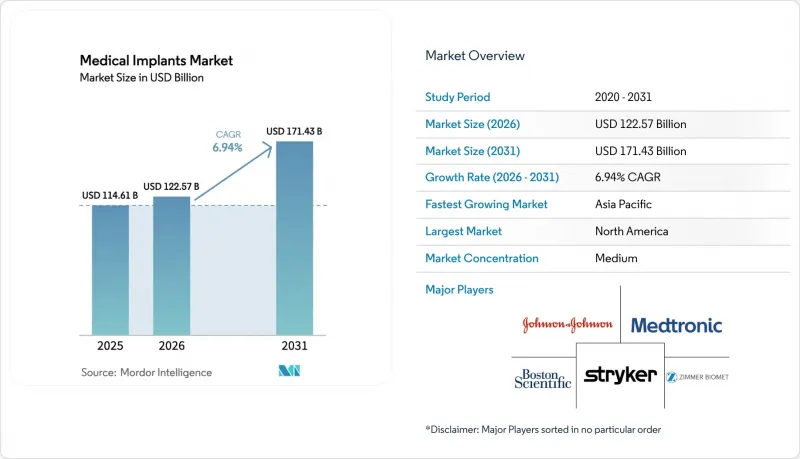
This report is Segmented by Product (Orthopedic, Cardiovascular, Ophthalmic, and More), Material (Metallic, Polymeric, Ceramic, and More), Technology (Conventional, 3D Printed, Smart Sensor-Enabled Implants), End-User (Hospitals, Specialty Clinics, Ambulatory Surgical Centers), and Geography (North America, Europe, APAC, and More). Market Forecasts are Provided in Value (USD)
Global Medical Implants Market Trends and Insights
Aging Population and Higher Chronic Disease Burden Propel Implant Volumes
Adults aged 65 and older numbered 857 million worldwide in 2025 and will exceed 1 billion by 2030, driving sustained demand for joint replacements, pacemakers, and intraocular lenses . Total knee arthroplasty procedures in the United States rose to 1.2 million in 2025, up 24% from 2020, while hip replacements increased 14% during the same period. Cardiac device adoption followed suit, with 3.8 million Americans living with implanted pacemakers or defibrillators in 2025. Chronic kidney disease, which affects 850 million people globally, boosts the need for vascular-access grafts, a subsegment that grew 9% year over year in 2025. These population dynamics underpin a multidecade growth runway even as price pressures mount from value-based procurement.
Expanding Elective Cosmetic and Dental Procedures Unlock New Patient Cohorts
Global elective cosmetic surgeries, such as breast augmentation and facial contouring, grew significantly between 2023 and 2025, helped by social-media influence and installment-based financing. Breast implant placements crossed over 2 million units in 2025, with silicone-gel devices making up the majority due to lower capsular contracture rates. The United States alone saw nearly 3 million dental-implant procedures in 2025. Asia-Pacific clinics captured double-digit growth as private networks offered zirconia and titanium implants at significantly lower prices than Western counterparts, yet with comparable osseointegration. Medical tourists contributed significantly to dental and cosmetic implant revenue in Thailand and Turkey in 2025. This was driven by substantial cost savings compared to U.S. pricing.
Other drivers and restraints analyzed in the detailed report include:
- Continuous Material Science Breakthroughs Enable Ultra-Light and Bio-Active Implants
- Large Language-Model Assisted Design Compresses R&D Timelines
- Intensifying Regulatory Scrutiny and Longer Approval Timelines Delay Market Entry
- High Device Cost and Limited Reimbursement Constrain Adoption in Emerging Markets
For complete list of drivers and restraints, kindly check the Table Of Contents.
Segment Analysis
Orthopedic implants contributed the largest slice of the medical implants market at 36.7% in 2025, benefiting from growing hip, knee, and spine surgeries among aging populations. Dental devices, although smaller, deliver the fastest 8.12% CAGR thanks to aesthetic dentistry and improved implant-bone integration.
Orthopedic leaders focus on robotics and 3D printing to shorten operating times, whereas dental specialists target digital workflows connecting intraoral scanners to design software. Cardiovascular implants held 23.14%, anchored by pacemakers and transcatheter valves from Medtronic and Abbott that improve outcomes in heart-failure patients. Cochlear and auditory implants grew 7.26% on wider indications for pediatric hearing loss. Cosmetic implants, including breast and facial devices, added 11.7% of revenue amid a 22% jump in global elective surgeries.
Metallic biomaterials represented 49.2% of the medical implants market share in 2025, owing to titanium's favorable strength-to-weight profile. Bioresorbable polymers, however, will post a 7.57% CAGR through 2031 as clinicians favor implants that dissolve post-healing.
Polymeric options such as poly-ether-ether-ketone held 28.1%, offering radiolucency for post-operative imaging. Ceramics, mainly zirconia and alumina, captured 14.6% and shine in dental crowns and femoral heads due to high wear resistance. Natural resorbables attracted major research and development spend; Stryker invested heavily to develop screws that degrade safely, lowering revision rates tied to permanent hardware removal. Rising titanium prices accelerate exploration of tantalum and niobium alternatives.
Complete Report Scope:
- By Product
- Orthopedic Implants
- Hip Orthopedic Devices
- Knee Orthopedic Devices
- Spine Orthopedic Devices
- Joint Reconstruction
- Other Orthopedic Products
- Cardiovascular Implants
- Pacing Devices
- Stents
- Structural Cardiac Implants
- Ophthalmic Implants
- Intra-ocular Lens
- Glaucoma Implants
- Dental Implants
- Cochlear & Auditory Implants
- Facial Implants
- Breast Implants
- Other Implants (neurostimulators, contraceptive, etc.)
- Orthopedic Implants
- By Material
- Metallic Biomaterials
- Polymeric Biomaterials
- Ceramic Biomaterials
- Natural / Bioresorbable Biomaterials
- By Technology
- Conventional Implants
- 3-D Printed / Additive Manufactured Implants
- Smart Sensor-Enabled Implants
- By End-User
- Hospitals
- Specialty Clinics
- Ambulatory Surgical Centers
- By Geography
- North America
- United States
- Canada
- Mexico
- Europe
- Germany
- United Kingdom
- France
- Italy
- Spain
- Rest of Europe
- Asia-Pacific
- China
- Japan
- India
- Australia
- South Korea
- Rest of APAC
- Middle East & Africa
- GCC
- South Africa
- Rest of Middle East & Africa
- South America
- Brazil
- Argentina
- Rest of South America
- North America
Geography Analysis
North America anchored 41.3% of the medical implants market in 2025 thanks to the highest per-capita procedure rates and expedited breakthrough-device pathways that shorten time to market. Recent Medicare coverage for robotic joint replacements added USD 2.1 billion in reimbursement headroom and spurred hospital purchases of Stryker's Mako and Zimmer Biomet's Rosa systems. Canada's single-payer caps create nine-month wait lists, sending 12,000 citizens annually to U.S. providers for faster access.
Europe supplied 28.2% of global revenue in 2025, but Medical Device Regulation costs prompted 14 mid-sized firms to exit, consolidating supply with multinationals. Asia-Pacific, by contrast, will drive future gains with an 8.31% CAGR; China's Healthy China 2030 initiative set aside CNY 120 billion to extend orthopedic coverage in tier-2 cities, while India's Ayushman Bharat scheme now covers 500 million citizens for implant procedures. Japan's reimbursement schedules cut device prices 2% every two years, squeezing margins but keeping procedure volumes high as 28% of the population is already over 65 years old.
The Middle East & Africa and South America contributed a combined 14.6% in 2025. The United Arab Emirates approved 22 new implant models after streamlining its review pathway to recruit device makers. Brazil expanded public coverage to include congenital dental implants, adding 180,000 beneficiaries and USD 320 million in demand. South Africa continues to battle shipping delays linked to Red Sea disruptions, prompting distributors to build local inventory hubs.
- Abbott Laboratories
- Arthrex
- BIOTRONIK
- Boston Scientific
- B. Braun
- Cochlear
- Conformis, Inc.
- Conmed
- Cook Group
- Dentsply Sirona
- GC Aesthetics
- Globus Medical
- Straumann Group
- Integra LifeSciences Holdings
- Johnson & Johnson (DePuy Synthes, Ethicon, Mentor)
- Medtronic
- MicroPort
- Smith + Nephew plc
- Stryker
- Zimmer Biomet
- Osstem Implant Co., Ltd.
Additional Benefits:
- The market estimate (ME) sheet in Excel format
- 3 months of analyst support
TABLE OF CONTENTS
1 Introduction
- 1.1 Study Assumptions & Market Definition
- 1.2 Scope of the Study
2 Research Methodology
3 Executive Summary
4 Market Landscape
- 4.1 Market Overview
- 4.2 Market Drivers
- 4.2.1 Aging Population & Higher Chronic Disease Burden
- 4.2.2 Expanding Elective Cosmetic & Dental Procedures
- 4.2.3 Continuous Material Science Breakthroughs Enabling Ultra-Light & Bio-Active Implants
- 4.2.4 Large Language-Model-Assisted Design Compressing R&D Timelines
- 4.3 Market Restraints
- 4.3.1 Intensifying Regulatory Scrutiny & Longer Approval Timelines
- 4.3.2 High Device Cost & Limited Reimbursement
- 4.3.3 Cybersecurity Risks For Smart Implants Eroding Clinician Confidence
- 4.3.4 Global Titanium Supply-Chain Volatility Post-2027
- 4.4 Supply-Chain Analysis
- 4.5 Regulatory Landscape
- 4.6 Technological Outlook
- 4.7 Porter's Five Forces
- 4.7.1 Bargaining Power of Buyers
- 4.7.2 Bargaining Power of Suppliers
- 4.7.3 Threat of New Entrants
- 4.7.4 Threat of Substitutes
- 4.7.5 Intensity of Competitive Rivalry
5 Market Size & Growth Forecasts (Value)
- 5.1 By Product
- 5.1.1 Orthopedic Implants
- 5.1.1.1 Hip Orthopedic Devices
- 5.1.1.2 Knee Orthopedic Devices
- 5.1.1.3 Spine Orthopedic Devices
- 5.1.1.4 Joint Reconstruction
- 5.1.1.5 Other Orthopedic Products
- 5.1.2 Cardiovascular Implants
- 5.1.2.1 Pacing Devices
- 5.1.2.2 Stents
- 5.1.2.3 Structural Cardiac Implants
- 5.1.3 Ophthalmic Implants
- 5.1.3.1 Intra-ocular Lens
- 5.1.3.2 Glaucoma Implants
- 5.1.4 Dental Implants
- 5.1.5 Cochlear & Auditory Implants
- 5.1.6 Facial Implants
- 5.1.7 Breast Implants
- 5.1.8 Other Implants (neurostimulators, contraceptive, etc.)
- 5.1.1 Orthopedic Implants
- 5.2 By Material
- 5.2.1 Metallic Biomaterials
- 5.2.2 Polymeric Biomaterials
- 5.2.3 Ceramic Biomaterials
- 5.2.4 Natural / Bioresorbable Biomaterials
- 5.3 By Technology
- 5.3.1 Conventional Implants
- 5.3.2 3-D Printed / Additive Manufactured Implants
- 5.3.3 Smart Sensor-Enabled Implants
- 5.4 By End-User
- 5.4.1 Hospitals
- 5.4.2 Specialty Clinics
- 5.4.3 Ambulatory Surgical Centers
- 5.5 By Geography
- 5.5.1 North America
- 5.5.1.1 United States
- 5.5.1.2 Canada
- 5.5.1.3 Mexico
- 5.5.2 Europe
- 5.5.2.1 Germany
- 5.5.2.2 United Kingdom
- 5.5.2.3 France
- 5.5.2.4 Italy
- 5.5.2.5 Spain
- 5.5.2.6 Rest of Europe
- 5.5.3 Asia-Pacific
- 5.5.3.1 China
- 5.5.3.2 Japan
- 5.5.3.3 India
- 5.5.3.4 Australia
- 5.5.3.5 South Korea
- 5.5.3.6 Rest of APAC
- 5.5.4 Middle East & Africa
- 5.5.4.1 GCC
- 5.5.4.2 South Africa
- 5.5.4.3 Rest of Middle East & Africa
- 5.5.5 South America
- 5.5.5.1 Brazil
- 5.5.5.2 Argentina
- 5.5.5.3 Rest of South America
- 5.5.1 North America
6 Competitive Landscape
- 6.1 Market Concentration
- 6.2 Market Share Analysis
- 6.3 Company Profiles (includes Global level Overview, Market level overview, Core Segments, Financials as available, Strategic Information, Market Rank/Share for key companies, Products & Services, and Recent Developments)
- 6.3.1 Abbott Laboratories
- 6.3.2 Arthrex, Inc.
- 6.3.3 BIOTRONIK SE & Co. KG
- 6.3.4 Boston Scientific Corporation
- 6.3.5 B. Braun SE
- 6.3.6 Cochlear Ltd.
- 6.3.7 Conformis, Inc.
- 6.3.8 CONMED Corporation
- 6.3.9 Cook Medical
- 6.3.10 Dentsply Sirona
- 6.3.11 GC Aesthetics
- 6.3.12 Globus Medical, Inc.
- 6.3.13 Institut Straumann AG
- 6.3.14 Integra LifeSciences Holdings
- 6.3.15 Johnson & Johnson (DePuy Synthes, Ethicon, Mentor)
- 6.3.16 Medtronic plc
- 6.3.17 MicroPort Scientific
- 6.3.18 Smith + Nephew plc
- 6.3.19 Stryker Corporation
- 6.3.20 Zimmer Biomet Holdings
- 6.3.21 Osstem Implant Co., Ltd.
7 Market Opportunities & Future Outlook
- 7.1 White-space & Unmet-Need Assessment

