PUBLISHER: Mordor Intelligence | PRODUCT CODE: 2123394

PUBLISHER: Mordor Intelligence | PRODUCT CODE: 2123394
Data Center Interconnect - Market Share Analysis, Industry Trends & Statistics, Growth Forecasts (2026 - 2032)
According to Mordor Intelligence, the data center interconnect market size was valued at USD 16.24 billion in 2025 and estimated to grow from USD 18.62 billion in 2026 to reach USD 42.45 billion by 2032, at a CAGR of 14.73% during the forecast period (2026-2032).
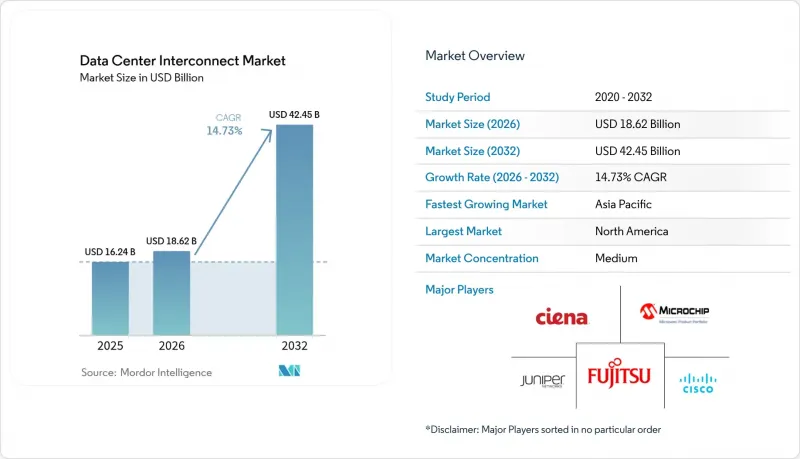
This report is Segmented by Component (Hardware and More), Connectivity Type (Short-Haul and More), Application (Disaster Recovery and More), End-User Industry (Communication Service Providers and More), and Geography (North America and More). Market Forecasts are Provided in Terms of Value (USD).
Global Data Center Interconnect Market Trends and Insights
Expanding Edge and Hyperscale Data-Center Footprints
Hyperscale operators have earmarked USD 180 billion for distributed infrastructure that places compute close to users,forcing interconnect designs to support dense mesh topologies rather than hub-and-spoke layouts. Amazon's USD 100 billion expansion and Meta's USD 65 billion program typify this shift. Edge micro-facilities, projected to grow at a 37.9% CAGR, require power-efficient short-reach optics paired with programmable routing that can rebalance traffic in real time. Carrier hotels now double as edge nodes where cloud, content, and network operators converge, adding fresh demand for multi-tenant intra-metro links.
Surge in AI/HPC Traffic Requiring greater than 400 Gbps Links
AI model training generates all-to-all traffic patterns that saturate legacy 100 Gbps networks. Optical module shipments for 400G/800G exceeded 20 million units in 2024, underscoring aggressive migration timelines. NVIDIA's 800G photonic switch roadmap and IEEE's 800G Ethernet standard illustrate the ecosystem's pivot to coherent optics that push toward 1.6 Tbps lanes. Photonic switching fabrics reduce hop counts and latency, enabling AI clusters to scale without the oversubscription penalties of electrical spine-leaf trees.
High Upfront Cost of Coherent Optics and ROADMs
Advanced coherent engines and reconfigurable optical add-drop multiplexers (ROADMs) command premiums up to 300% over legacy gear, stretching capex budgets for mid-tier carriers. The ROADM market is projected at USD 1.2 billion by 2026, reflecting heavy investment needs. Operators in cost-sensitive regions postpone upgrades, reinforcing a two-tier global adoption pattern.
Other drivers and restraints analyzed in the detailed report include:
- Commercial 5G Roll-outs Accelerating Low-Latency Backhaul Demand
- Campus Liquid-Cooling Retrofits Boosting Short-Reach Optical Spend
- Shortage of Skilled Fiber-Construction Labor
For complete list of drivers and restraints, kindly check the Table Of Contents.
Segment Analysis
Hardware held 47.35% of 2025 revenue as operators procured dense DWDM shelves and coherent transceivers that underpin the data center interconnect market. The software tier will post a 16.12% CAGR as controllers automate bandwidth pooling, latency steering, and failover. Vendors pursuing co-packaged optics blend silicon switching with embedded lasers, lowering power per bit and shrinking footprints. Services revenue grows in tandem, reflecting demand for design, integration, and lifecycle support.
The data center interconnect market size for hardware is forecast to rise alongside AI cluster roll-outs, yet programmable orchestration remains the strategic differentiator. Operators use open APIs to stitch multi-vendor optics into a single intent-based fabric, cutting provisioning cycles from weeks to hours.
Short-haul links (< 80 km) delivered 60.25% of 2025 revenue because metro campuses, cloud on-ramps, and carrier hotels require dense east-west bandwidth. Long-haul systems will outpace with a 14.88% CAGR as hyperscalers pursue resilience across regions. The data center interconnect market size for long-haul will benefit from 1.6 Tbps coherent platforms that squeeze more capacity into existing fiber.
Projects such as the Medusa submarine cable add fresh routes linking Europe and Africa, creating new demand pools. Meanwhile, edge growth sustains short-haul volumes, ensuring balanced capex allocation between metro and backbone domains.
Complete Report Scope:
- by Component
- Hardware (DWDM, OTN, Packets)
- Software-Defined Networking and Control
- Services (Managed, Professional)
- by Connectivity Type
- Short-Haul
- Long-Haul
- by Application
- Disaster Recovery and Business Continuity
- Shared Data and Resource Clustering
- Data (Storage) Mobility
- Other Applications
- by End-user Industry
- Communication Service Providers (CSPs)
- Internet Content / Carrier-Neutral Providers (ICPs/CNPs)
- Government, Research and Education
- Other Verticals
- by Geography
- North America
- United States
- Canada
- Mexico
- South America
- Brazil
- Argentina
- Rest of South America
- Europe
- Germany
- United Kingdom
- France
- Russia
- Spain
- Italy
- Rest of Europe
- Asia-Pacific
- China
- Japan
- India
- South Korea
- Australia and New Zealand
- Rest of Asia-Pacific
- Middle East and Africa
- Middle East
- UAE
- Saudi Arabia
- Turkey
- Rest of Middle East
- Africa
- South Africa
- Nigeria
- Kenya
- Rest of Africa
- Middle East
- North America
Geography Analysis
North America leads the data center interconnect market owing to concentrated hyperscale campuses, advanced fiber corridors, and an active open-source ecosystem. DE-CIX Dallas's 400 GE upgrade highlights metro densification. U.S. projects spearhead photonic-switch adoption, aided by robust venture funding and favorable tax incentives.
Asia-Pacific is the fastest-growing region, with data-center capacity expected to triple by 2033 on the back of cloud adoption in China, Japan, India, and ASEAN markets. Domestic AI ambitions and 5G roll-outs accelerate both short-haul metro builds and cross-border long-haul corridors.
Europe balances sustainability rules and digital sovereignty objectives. Germany alone is projected to reach a USD 25.3 billion data-center valuation by 2029, purchasing high-efficiency optics to align with the EU's carbon-neutral pledge. Submarine cables such as 2Africa improve resilience, supporting content exchange with Middle Eastern and African hubs.
Latin America is a rising investment theater; Brazil accounts for 40% of regional spend, and Brookfield's search for an Ascenty partner underscores confidence in hyperscale growth. Mexico's Queretaro cluster attracts cloud majors seeking sub-20 ms latency to U.S. markets.
The Middle East and Africa pursue sovereign AI and cloud initiatives. Gulf states deploy liquid-cooled campuses tied to solar plants, while terrestrial routes along the Red Sea and new cable landings in Kenya widen continental reach.
- Ciena Corporation
- Cisco Systems Inc.
- Infinera Corporation
- Huawei Technologies Co. Ltd.
- Nokia Corporation (Nokia Networks)
- Juniper Networks Inc.
- ADVA Optical Networking SE
- Fujitsu Ltd.
- ZTE Corporation
- Arista Networks Inc.
- Ribbon Communications Inc.
- Pluribus Networks
- NVIDIA Corp. (Mellanox Networking)
- PacketLight Networks Ltd.
- Sterlite Technologies Ltd. (STL)
- Ekinops SA
- Megaport Ltd.
- Equinix Inc.
- Colt Technology Services Group Ltd.
- Microsemi Corporation
- PCCW Global Ltd.
Additional Benefits:
- The market estimate (ME) sheet in Excel format
- 3 months of analyst support
TABLE OF CONTENTS
1 INTRODUCTION
- 1.1 Study Assumptions and Market Definition
- 1.2 Scope of the Study
2 RESEARCH METHODOLOGY
3 EXECUTIVE SUMMARY
4 MARKET LANDSCAPE
- 4.1 Market Overview
- 4.2 Market Drivers
- 4.2.1 Expanding edge and hyperscale data-centre footprints
- 4.2.2 Surge in AI/HPC traffic requiring greater than 400 Gbps links
- 4.2.3 Commercial 5G roll-outs accelerating low-latency backhaul demand
- 4.2.4 Campus liquid-cooling retrofits boosting short-reach optical spend
- 4.2.5 Satellite ground-station colocation creating novel DCI nodes
- 4.2.6 Net-zero mandates driving adoption of photonic switching fabrics
- 4.3 Market Restraints
- 4.3.1 High upfront cost of coherent optics and ROADMs
- 4.3.2 Multi-vendor interoperability and network-complexity issues
- 4.3.3 Shortage of skilled fibre-construction labour
- 4.3.4 Municipal permitting delays for metro-haul trenching
- 4.4 Value / Supply-Chain Analysis
- 4.5 Regulatory Landscape
- 4.6 Technological Outlook
- 4.7 Porter's Five Forces
- 4.7.1 Bargaining Power of Suppliers
- 4.7.2 Bargaining Power of Consumers
- 4.7.3 Threat of New Entrants
- 4.7.4 Threat of Substitutes
- 4.7.5 Intensity of Competitive Rivalry
5 MARKET SIZE AND GROWTH FORECASTS (VALUE, USD BILLION)
- 5.1 by Component
- 5.1.1 Hardware (DWDM, OTN, Packets)
- 5.1.2 Software-Defined Networking and Control
- 5.1.3 Services (Managed, Professional)
- 5.2 by Connectivity Type
- 5.2.1 Short-Haul
- 5.2.2 Long-Haul
- 5.3 by Application
- 5.3.1 Disaster Recovery and Business Continuity
- 5.3.2 Shared Data and Resource Clustering
- 5.3.3 Data (Storage) Mobility
- 5.3.4 Other Applications
- 5.4 by End-user Industry
- 5.4.1 Communication Service Providers (CSPs)
- 5.4.2 Internet Content / Carrier-Neutral Providers (ICPs/CNPs)
- 5.4.3 Government, Research and Education
- 5.4.4 Other Verticals
- 5.5 by Geography
- 5.5.1 North America
- 5.5.1.1 United States
- 5.5.1.2 Canada
- 5.5.1.3 Mexico
- 5.5.2 South America
- 5.5.2.1 Brazil
- 5.5.2.2 Argentina
- 5.5.2.3 Rest of South America
- 5.5.3 Europe
- 5.5.3.1 Germany
- 5.5.3.2 United Kingdom
- 5.5.3.3 France
- 5.5.3.4 Russia
- 5.5.3.5 Spain
- 5.5.3.6 Italy
- 5.5.3.7 Rest of Europe
- 5.5.4 Asia-Pacific
- 5.5.4.1 China
- 5.5.4.2 Japan
- 5.5.4.3 India
- 5.5.4.4 South Korea
- 5.5.4.5 Australia and New Zealand
- 5.5.4.6 Rest of Asia-Pacific
- 5.5.5 Middle East and Africa
- 5.5.5.1 Middle East
- 5.5.5.1.1 UAE
- 5.5.5.1.2 Saudi Arabia
- 5.5.5.1.3 Turkey
- 5.5.5.1.4 Rest of Middle East
- 5.5.5.2 Africa
- 5.5.5.2.1 South Africa
- 5.5.5.2.2 Nigeria
- 5.5.5.2.3 Kenya
- 5.5.5.2.4 Rest of Africa
- 5.5.5.1 Middle East
- 5.5.1 North America
6 Competitive Landscape
- 6.1 Market Share Analysis
- 6.2 Company Profiles (includes Global-level Overview, Market-level Overview, Core Segments, Financials, Strategic Information, Market Rank/Share, Products and Services, Recent Developments)
- 6.2.1 Ciena Corporation
- 6.2.2 Cisco Systems Inc.
- 6.2.3 Infinera Corporation
- 6.2.4 Huawei Technologies Co. Ltd.
- 6.2.5 Nokia Corporation (Nokia Networks)
- 6.2.6 Juniper Networks Inc.
- 6.2.7 ADVA Optical Networking SE
- 6.2.8 Fujitsu Ltd.
- 6.2.9 ZTE Corporation
- 6.2.10 Arista Networks Inc.
- 6.2.11 Ribbon Communications Inc.
- 6.2.12 Pluribus Networks
- 6.2.13 NVIDIA Corp. (Mellanox Networking)
- 6.2.14 PacketLight Networks Ltd.
- 6.2.15 Sterlite Technologies Ltd. (STL)
- 6.2.16 Ekinops SA
- 6.2.17 Megaport Ltd.
- 6.2.18 Equinix Inc.
- 6.2.19 Colt Technology Services Group Ltd.
- 6.2.20 Microsemi Corporation
- 6.2.21 PCCW Global Ltd.
7 Market Opportunities and Future Outlook
- 7.1 White-space and Unmet-Need Assessment

