PUBLISHER: Mordor Intelligence | PRODUCT CODE: 2185999

PUBLISHER: Mordor Intelligence | PRODUCT CODE: 2185999
South America Data Center Optical Connectivity - Market Share Analysis, Industry Trends & Statistics, Growth Forecasts (2027 - 2032)
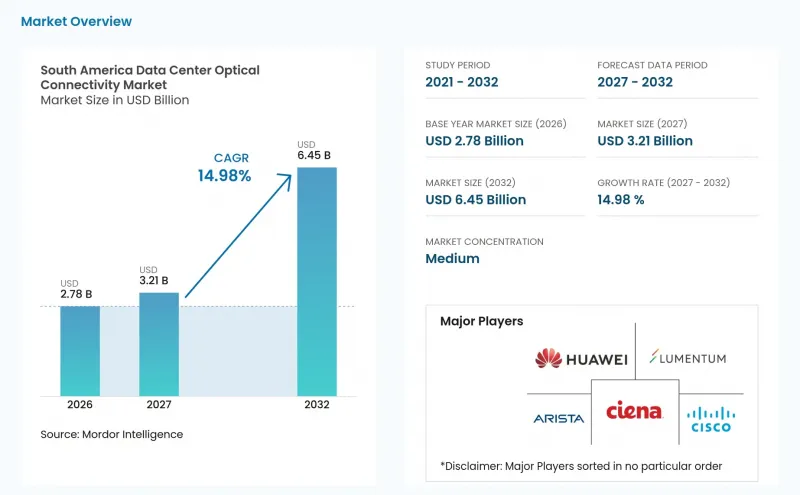
According to Mordor Intelligence, the South America data center optical connectivity market size is expected to increase from USD 2.78 billion in 2026 to USD 3.21 billion in 2027 and reach USD 6.45 billion by 2032, growing at a CAGR of 14.98% over 2027-2032.
South America Data Center Optical Connectivity Market Trends and Insights
AI Cluster and Generative AI Infrastructure Expansion
AI workloads are increasing the number of high-speed optical links needed inside each data center rack and across campus networks. Ascenty announced USD 1.2 billion for 4 AI-focused hyperscale facilities in Sao Paulo state, including a facility at Sumare designed for large-scale AI workloads. These designs require substantial GPU-to-switch and GPU-to-GPU connectivity, which raises optical module intensity per megawatt of installed IT capacity. The South America data center optical connectivity market is consequently becoming more exposed to the technical choices made in AI cluster designs. Higher bandwidth and lower latency requirements favor advanced optical links over copper connections at the most demanding layers. The effect is concentrated in Brazil first, then may extend to other regional hubs as AI capacity is commissioned.
Hyperscale and Colocation Data Center Investment
Large campus investments create procurement cycles that extend from construction through commissioning and later capacity additions. Ada Infrastructure began work on its GRU10 campus in Franco da Rocha with a planned BRL 2.7 billion (USD 500 million) investment through 2030. Equinix opened the SP6 facility in Santana de Parnaiba after a USD 114 million investment, adding carrier-neutral capacity to the Sao Paulo network core. Such facilities require active optics and passive fiber infrastructure as new halls and interconnection rooms are fitted out. Shared colocation sites also need dense cross-connects among tenants, carriers, and cloud providers. This investment pattern supports a broader supplier base for the South America data center optical connectivity market.
Import Duties, Customs Delays, and Long Qualification Cycles
Import duties and administrative procedures can increase the delivered cost and lead time for high-speed optical equipment. The input draft identifies Brazil as the most exposed market because advanced semiconductors, server components, and optical hardware rely on imports. Vendor qualification adds another layer of time, especially for 800G and 1.6 Tbps families that require field testing, firmware validation, and environmental checks. These processes may restrict the ability of operators to shift quickly to alternative suppliers. The South America data center optical connectivity market therefore benefits when vendors can provide local engineering and support. The challenge is most immediate in large Brazilian procurement programs and can also affect Argentina.
Other drivers and restraints analyzed in the detailed report include:
- Subsea Cable Landing and Regional Interconnection Expansion
- 800G Migration Across High-Density Data Center Fabrics
- Limited Regional Availability of Advanced Photonic Engineering Skills
For complete list of drivers and restraints, kindly check the Table Of Contents.
Segment Analysis
Optical Transceivers held 43.17% of the South America data center optical connectivity market share in 2026. They remain the standard pluggable interface for new switches and for upgrades to installed equipment. Their position reflects continuing deployment of 400G and 800G modules at hyperscale, colocation, and enterprise sites. Active Optical Cables are the second-largest product group and serve shorter links where compact routing and thermal performance matter. Fiber-optic cable assemblies, connectors, and optical interconnect assemblies form the passive layer required for each new data hall. These products are purchased alongside active modules as facilities expand or refresh network capacity.
Optical Circuit Switches are projected to expand at a 28.94% CAGR through 2032. They use a photonic path to reduce repeated optical-electrical-optical conversions in dense AI fabrics. The Open Compute Project identifies MEMS, liquid-crystal, piezoelectric, and silicon photonics approaches as relevant optical circuit switching technologies for AI infrastructure. The technology has the clearest fit in large AI campuses where power use and rack density are major design factors. Early adoption in South America should center on the largest Brazilian sites rather than broadly across all facilities. Suppliers will need to show dependable operation and integration support before optical circuit switches move beyond a limited number of high-capacity deployments.
Conventional Pluggable Optics held 74.31% of connectivity architecture revenue in 2026. Their installed base is supported by established interfaces, module replacement practices, and supply chains. Operators can replace or upgrade pluggable modules without redesigning the switching platform. Linear Pluggable Optics and Linear Receive Optics are gaining relevance for short-reach AI links where some digital signal processing functions are unnecessary. Near-Packaged Optics offer a middle path by increasing density while retaining more modularity than fully integrated systems. This balance can appeal to operators who want greater efficiency but remain cautious about a complete architecture change.
Co-Packaged Optics are projected to expand at a 32.46% CAGR through 2032. The Optical Compute Interconnect consortium was formed by AMD, Broadcom, Meta, Microsoft, NVIDIA, and OpenAI to develop an open specification for scale-up optical interconnects. A common interface can reduce the risk of relying on one proprietary supply chain. Lumentum demonstrated a DWDM ELSFP laser module for Optical Compute Interconnect applications and targeted initial availability in the first half of 2027. Co-Packaged Optics initially fit the most advanced AI campuses, where bandwidth density outweighs the benefit of front-panel module replacement. The South America data center optical connectivity market will likely adopt it after operators establish engineering, maintenance, and procurement processes for the new architecture.
Up to 400 Gbps held 39.61% of the data-rate segment in 2026. This range includes a large installed base across colocation, enterprise, and earlier hyperscale networks. New 400G ports still serve edge sites and smaller deployments that do not need 800G capacity. The 800 Gbps tier is receiving more attention for new AI clusters and high-density cloud fabrics. This shift allows operators to add capacity on existing fiber pairs while planning for increased thermal and power requirements. The speed mix will consequently remain varied across South American facilities through the forecast period.
Above 1.6 Tbps is projected to expand at a 30.71% CAGR through 2032. Cisco and NVIDIA introduced the Ultra-Dense Small Form Factor Pluggable at OCP Summit in October 2026, with 400 Gbps per lane in a 16-lane form factor. The announcement indicates continued work on connectivity beyond the current 1.6 Tbps generation. Operators will need denser connectors, improved cable routing, and stronger thermal planning to accommodate these interfaces. South American users are expected to encounter the technology first in new facilities designed for demanding AI workloads. Availability and qualification will determine how quickly these speeds move into regional production networks.
Complete Report Scope:
- By Product Type
- Optical Transceivers
- Active Optical Cables
- Fiber-Optic Cable Assemblies
- Optical Connectors
- Optical Interconnect Assemblies
- Optical Circuit Switches
- By Connectivity Architecture
- Conventional Pluggable Optics
- Linear Pluggable Optics (LPO/LRO)
- Near-Packaged Optics (NPO)
- Co-Packaged Optics (CPO)
- By Data Rate
- Up to 400 Gbps
- 800 Gbps
- 1.6 Tbps
- Above 1.6 Tbps
- By Reach
- Up to 3 Meters
- 3-5 Meters
- 5-7 Meters
- 7-100 Meters
- 100-500 Meters
- Above 500 Meters
- By Application
- GPU-to-Switch
- GPU-to-GPU
- Switch-to-Switch
- Server-to-Switch
- Storage Connectivity
- Data Center Interconnect
- By Network Architecture
- Scale-Up
- Scale-Out
- By Data Center Type
- Hyperscale
- Colocation
- Enterprise
- Edge and Micro Data Centers
- By Country
- Brazil
- Chile
- Argentina
- Rest of South America
List of Companies Covered in this Report:
- Cisco Systems, Inc.
- Huawei Technologies Co., Ltd.
- Coherent Corp.
- Lumentum Holdings Inc.
- Broadcom Inc.
- Arista Networks, Inc.
- Ciena Corporation
- Nokia Corporation
- Telefonaktiebolaget LM Ericsson
- Intel Corporation
- Marvell Technology, Inc.
- Sumitomo Electric Industries, Ltd.
- Accelink Technologies Co., Ltd.
- InnoLight Technology (Suzhou) Ltd.
- Hisense Broadband Multimedia Technologies Co., Ltd.
- Fujitsu Optical Components Limited
- Source Photonics, Inc.
- Padtec S.A.
- Furukawa Electric LatAm S.A.
- Amphenol Corporation
- TE Connectivity Ltd.
Additional Benefits:
- The market estimate (ME) sheet in Excel format
- 3 months of analyst support
TABLE OF CONTENTS
1 INTRODUCTION
- 1.1 Study Assumptions and Market Definition
- 1.2 Scope of the Study
2 RESEARCH METHODOLOGY
3 EXECUTIVE SUMMARY
4 MARKET LANDSCAPE
- 4.1 Market Overview
- 4.2 Market Drivers
- 4.2.1 AI Cluster and Generative AI Infrastructure Expansion
- 4.2.2 Hyperscale and Colocation Data Center Investment
- 4.2.3 Subsea Cable Landing and Regional Interconnection Expansion
- 4.2.4 800G Migration Across High-Density Data Center Fabrics
- 4.2.5 Carrier-Neutral Data Center Interconnection Growth
- 4.2.6 Brazil-Centered AI and Cloud Infrastructure Corridors
- 4.3 Market Restraints
- 4.3.1 Import Duties, Customs Delays, and Long Qualification Cycles
- 4.3.2 Limited Regional Availability of Advanced Photonic Engineering Skills
- 4.3.3 Grid Reliability and High Electricity Costs in Major Data Center Hubs
- 4.3.4 Regional Fragmentation of Procurement, Standards, and Service Support
- 4.4 Industry Value Chain Analysis
- 4.5 Regulatory Landscape
- 4.6 Technological Outlook
- 4.7 Porter's Five Forces Analysis
- 4.7.1 Bargaining Power of Suppliers
- 4.7.2 Bargaining Power of Buyers
- 4.7.3 Threat of New Entrants
- 4.7.4 Threat of Substitutes
- 4.7.5 Intensity of Competitive Rivalry
- 4.8 Impact of Macroeconomic Factors on the Market
5 MARKET SIZE AND GROWTH FORECASTS (VALUE)
- 5.1 By Product Type
- 5.1.1 Optical Transceivers
- 5.1.2 Active Optical Cables
- 5.1.3 Fiber-Optic Cable Assemblies
- 5.1.4 Optical Connectors
- 5.1.5 Optical Interconnect Assemblies
- 5.1.6 Optical Circuit Switches
- 5.2 By Connectivity Architecture
- 5.2.1 Conventional Pluggable Optics
- 5.2.2 Linear Pluggable Optics (LPO/LRO)
- 5.2.3 Near-Packaged Optics (NPO)
- 5.2.4 Co-Packaged Optics (CPO)
- 5.3 By Data Rate
- 5.3.1 Up to 400 Gbps
- 5.3.2 800 Gbps
- 5.3.3 1.6 Tbps
- 5.3.4 Above 1.6 Tbps
- 5.4 By Reach
- 5.4.1 Up to 3 Meters
- 5.4.2 3-5 Meters
- 5.4.3 5-7 Meters
- 5.4.4 7-100 Meters
- 5.4.5 100-500 Meters
- 5.4.6 Above 500 Meters
- 5.5 By Application
- 5.5.1 GPU-to-Switch
- 5.5.2 GPU-to-GPU
- 5.5.3 Switch-to-Switch
- 5.5.4 Server-to-Switch
- 5.5.5 Storage Connectivity
- 5.5.6 Data Center Interconnect
- 5.6 By Network Architecture
- 5.6.1 Scale-Up
- 5.6.2 Scale-Out
- 5.7 By Data Center Type
- 5.7.1 Hyperscale
- 5.7.2 Colocation
- 5.7.3 Enterprise
- 5.7.4 Edge and Micro Data Centers
- 5.8 By Country
- 5.8.1 Brazil
- 5.8.2 Chile
- 5.8.3 Argentina
- 5.8.4 Rest of South America
6 COMPETITIVE LANDSCAPE
- 6.1 Market Concentration
- 6.2 Strategic Moves
- 6.3 Market Share Analysis
- 6.4 Company Profiles (includes Global Level Overview, Market Level Overview, Core Segments, Financials as available, Strategic Information, Market Rank/Share, Products and Services, Recent Developments)
- 6.4.1 Cisco Systems, Inc.
- 6.4.2 Huawei Technologies Co., Ltd.
- 6.4.3 Coherent Corp.
- 6.4.4 Lumentum Holdings Inc.
- 6.4.5 Broadcom Inc.
- 6.4.6 Arista Networks, Inc.
- 6.4.7 Ciena Corporation
- 6.4.8 Nokia Corporation
- 6.4.9 Telefonaktiebolaget LM Ericsson
- 6.4.10 Intel Corporation
- 6.4.11 Marvell Technology, Inc.
- 6.4.12 Sumitomo Electric Industries, Ltd.
- 6.4.13 Accelink Technologies Co., Ltd.
- 6.4.14 InnoLight Technology (Suzhou) Ltd.
- 6.4.15 Hisense Broadband Multimedia Technologies Co., Ltd.
- 6.4.16 Fujitsu Optical Components Limited
- 6.4.17 Source Photonics, Inc.
- 6.4.18 Padtec S.A.
- 6.4.19 Furukawa Electric LatAm S.A.
- 6.4.20 Amphenol Corporation
- 6.4.21 TE Connectivity Ltd.
7 MARKET OPPORTUNITIES AND FUTURE OUTLOOK
- 7.1 White-Space and Unmet-Need Assessment

