PUBLISHER: Mordor Intelligence | PRODUCT CODE: 2123460

PUBLISHER: Mordor Intelligence | PRODUCT CODE: 2123460
Forestry Equipment - Market Share Analysis, Industry Trends & Statistics, Growth Forecasts (2026 - 2031)
According to Mordor Intelligence, the forestry equipment market size is expected to grow from USD 10.98 billion in 2025 to USD 11.41 billion in 2026 and is forecast to reach USD 13.58 billion by 2031 at 3.54% CAGR over 2026-2031.
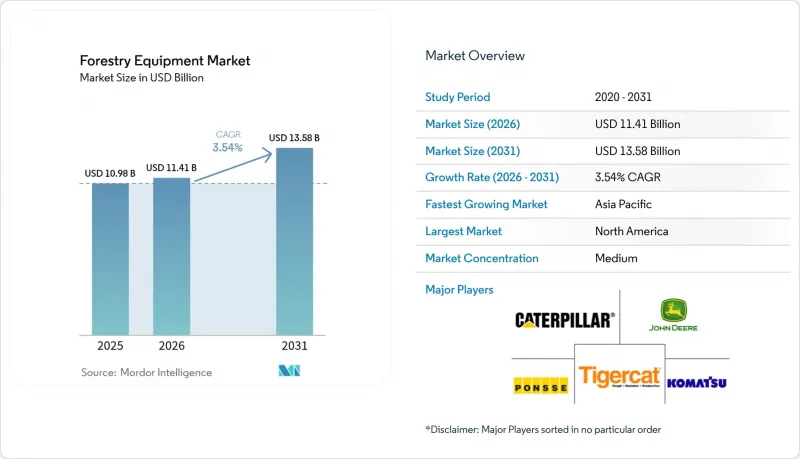
This report is Segmented by Product Type (Felling Equipment, Extracting Equipment, and More), Power Source (Diesel-Powered, Petrol/Oil-Powered, and More), Application (Logging, Land Clearing, Forest Fire Management, and More), End-User (Commercial Logging Companies, Government Forestry Agencies, Rental Service Providers, and More), and Geography. The Market Forecasts are Provided in Terms of Value (USD).
Global Forestry Equipment Market Trends and Insights
Rising Demand for Mechanised Selective Logging
Labor shortages and stricter habitat rules are steering selective logging away from chainsaw crews toward harvesters and forwarders that minimize residual stand damage. Oregon's 80-year Elliott State Research Forest permit highlights this shift because managers must thin steep slopes without harming protected bird habitats. Komatsu's 951XC-1 harvester, released in 2025, uses advanced hydraulics to precisely buck logs on uneven ground, reducing waste and increasing fiber yield. Institutional timberland investors such as Stafford Capital Partners prioritize certification-compliant mechanization to lock in predictable returns across 6.3 million acres. While small contractors still run skidders and chainsaws, rising insurance costs and safety regulations continue to tilt economics toward integrated machines that cut cycle times and reduce labor intensity.
Increasing Adoption of Electric and Hybrid Forestry Machinery
Volvo showcased the first electric articulated dump trucks in 2025, framing a long-range transition to zero-emission haulage. Adoption of deep-forest tasks remains cautious because charging points are scarce beyond 50 kilometers from the grid, and diesel generators undermine emission gains. Nonetheless, European and Californian mandates force pilot programs, with Volvo trialing 5G-controlled electric loaders in Scandinavian forests. Surveys indicate 77% of operators still trust hydraulic diesels over electric-hydraulic hybrids, forecasting a multi-stage path in which hybrids bridge technology gaps until batteries store more energy per kilogram. Government subsidies covering battery packs and fast chargers shorten payback for fleet owners operating near mills, helping the segment outpace the overall forestry equipment market.
High Upfront Capital Expenditure for Advanced Machines
Electric harvesters cost 30-50% more than diesel peers, putting ownership out of reach for many small firms. Morbark's 2355 Flail Chiparvestor, weighing 115,200 pounds, lists above USD 1 million, restricting sales to large loggers and rental companies. Smart controls and Stage V after-treatment add USD 50,000-100,000 to Komatsu excavators. Regions with high interest rates, notably parts of Asia-Pacific and South America, face steeper hurdles because shorter loan tenures inflate monthly outlays. Consequently, many operators sweat older fleets longer, boosting demand for parts and rebuilds instead of new units.
Other drivers and restraints analyzed in the detailed report include:
- Expansion of Global Biomass and Bioenergy Projects
- Government Incentives for Precision and Sustainable Forestry
- Shortage of Skilled Heavy-Equipment Operators in Rural Areas
For complete list of drivers and restraints, kindly check the Table Of Contents.
Segment Analysis
Felling equipment controlled 32.76% of the forestry equipment market share in 2025. Harvesters, feller bunchers, and swing machines dominate both cut-to-length and whole-tree systems, with Komatsu's TN785D improving slope stability to unlock steep-terrain fiber. Extracting gear, mainly forwarders and skidders, remains indispensable because it bridges the stump and landing. On-site processors, such as chippers and delimbers, become relevant when biomass plants pay for uniform chips. Separately sold parts and attachments deliver recurring margins, as OEMs guarantee chain and bar supply for decades.
Other forestry equipment (loaders, mulchers, and others) is poised to grow fastest at a 4.31% CAGR through 2031, boosting the market for loaders, mulchers, and ancillary assets. Bobcat's 32-item attachment range turns compact skid-steers into land-clearing specialists. Rayco's T415 mulcher tackles firebreaks, pipeline corridors, and right-of-way clearing with 415 HP hydrostatic power. Tigercat's reinforced H-Series feller-bunchers extend machine life, helping contractors capture value through harsher cycles. Versatility drives investment as contractors seek assets that pivot between logging, land clearing, and infrastructure jobs to maximize uptime.
Diesel units retained 62.07% forestry equipment market share in 2025 because remote fuel delivery systems, technician familiarity, and robust torque keep them indispensable. Caterpillar's FM528 GF/LL integrates efficient diesels that meet Stage V while maintaining the ruggedness demanded by steep-slope thinnings. Petrol models, mainly chainsaws, fill portable needs.
Electric-powered machines are forecast to post a 4.52% CAGR, yet their advance hinges on batteries and charging. Volvo's A30 and A40 Electric articulated dump trucks headline this frontier, but viable ranges stay near 50 kilometers unless mobile battery banks are financed. Hybrids that capture brake energy stand as stop-gaps, shaving fuel during idle or low-load cycles without range anxiety. Surveys reveal that most operators still rate hydraulic reliability above electric drives, signaling a decade-long transition toward parity.
Complete Report Scope:
- By Product Type
- Felling Equipment
- Chainsaws
- Harvesters
- Feller Bunchers
- Extracting Equipment
- Forwarders
- Skidders
- Other Extracting Equipment
- On-Site Processing Equipment
- Chippers and Grinders
- Delimbers and Slashers
- Other On-Site Processing Equipment
- Separately Sold Parts and Attachments
- Saw Chain, Guide Bars, Discs, and Teeth
- Harvesting and Other Cutting Heads
- Other Separately Sold Parts and Attachments
- Other Forestry Equipment
- Loaders
- Mulchers
- Other Forestry Equipment
- Felling Equipment
- By Power Source
- Diesel-Powered Equipment
- Petrol / Oil-Powered Equipment
- Electric-Powered Equipment
- Hybrid-Powered Equipment
- Other Power Source
- By Application
- Logging
- Land Clearing
- Forest Fire Management
- Forest Road Construction
- Biomass Harvesting
- Other Application
- By End-User
- Commercial Logging Companies
- Timberland Investment Managers
- Government Forestry Agencies
- Individual Contractors and Small Operators
- Rental Service Providers
- By Geography
- North America
- United States
- Canada
- Mexico
- Europe
- Germany
- United Kingdom
- France
- Russia
- Rest of Europe
- Asia-Pacific
- China
- Japan
- India
- South Korea
- Australia
- Rest of Asia-Pacific
- Middle East
- Saudi Arabia
- United Arab Emirates
- Rest of Middle East
- Africa
- South Africa
- Egypt
- Rest of Africa
- South America
- Brazil
- Argentina
- Rest of South America
- North America
Geography Analysis
North America generated 39.32% of 2025 revenue, cementing the region's leadership. Extensive pine plantations in the U.S. South, mechanized Douglas fir stands in the Pacific Northwest, and salvage programs in western states provide a balanced demand base. Canadian loggers invest in steep-slope harvesters to reach fire-prone interior forests, while Mexico's community forestry programs opt for compact loaders and chainsaws. Manufacturers strengthen local assembly: Volvo expanded U.S. capacity in 2025, and John Deere launched L-III skidders optimized for dense hardwood tracts.
Europe emphasizes compliance with emissions standards and ecosystem services. Germany and France push Stage V harvesters integrated with LiDAR silviculture planning, while Sweden's biomass-for-district-heat sector fuels grinder uptake. Russia retains vast unrealized potential, but infrastructure and geopolitics slow mechanization. The forestry equipment market size for European biomass harvesting keeps growing as carbon pricing rewards renewable fuels.
Asia-Pacific is set to post a 4.57% CAGR through 2031. China scales up subsidies for forest harvesters, India modernizes plantation management, and Australia pivots toward fuel-reduction equipment after repeated bushfires. New Zealand logging firms, already early adopters of telematics, now trial hybrid forwarders on radiata pine slopes. Southeast Asian exporters mechanize selectively to satisfy certification audits, driving sales of mid-sized skidders and rough-terrain loaders. Elsewhere, South America's eucalyptus plantations in Brazil and Argentina quicken harvester demand to lift pulpwood yields, while Africa's nascent sectors in South Africa adopt cost-efficient cut-to-length systems as mills expand.
- Deere & Company
- Caterpillar Inc.
- Komatsu Ltd.
- Ponsse Oyj
- Tigercat Industries Inc.
- Volvo Construction Equipment AB
- Hitachi Construction Machinery Co. Ltd.
- Barko Hydraulics LLC
- HD Hyundai Infracore Co. Ltd.
- Kesla Oyj
- Rottne Industri AB
- Eco Log Sweden AB
- AGCO Corporation
- Kubota Corporation
- Bell Equipment Limited
- CNH Industrial N.V.
- Husqvarna AB
- Doosan Bobcat Inc.
- SENNEBOGEN Maschinenfabrik GmbH
- Logset Oy
Additional Benefits:
- The market estimate (ME) sheet in Excel format
- 3 months of analyst support
TABLE OF CONTENTS
1 INTRODUCTION
- 1.1 Study Assumptions and Market Definition
- 1.2 Scope of the Study
2 RESEARCH METHODOLOGY
3 EXECUTIVE SUMMARY
4 MARKET LANDSCAPE
- 4.1 Market Overview
- 4.2 Market Drivers
- 4.2.1 Rising Demand for Mechanised Selective Logging
- 4.2.2 Increasing Adoption of Electric and Hybrid Forestry Machinery
- 4.2.3 Expansion of Global Biomass and Bioenergy Projects
- 4.2.4 Government Incentives for Precision and Sustainable Forestry
- 4.2.5 Integration of Telematics and AI-Enabled Fleet Optimisation
- 4.2.6 Increased Post-Wildfire Salvage Harvesting Needs
- 4.3 Market Restraints
- 4.3.1 High Upfront Capital Expenditure for Advanced Machines
- 4.3.2 Shortage of Skilled Heavy-Equipment Operators in Rural Areas
- 4.3.3 Limited Charging Infrastructure in Remote Forest Regions
- 4.3.4 Volatility of Global Timber Prices Impacting CAPEX Cycles
- 4.4 Industry Value Chain Analysis
- 4.5 Impact of Macroeconomic Factors
- 4.6 Technological Outlook
- 4.7 Regulatory Landscape
- 4.8 Porter's Five Forces Analysis
- 4.8.1 Threat of New Entrants
- 4.8.2 Bargaining Power of Buyers/Consumers
- 4.8.3 Bargaining Power of Suppliers
- 4.8.4 Threat of Substitutes
- 4.8.5 Intensity of Competitive Rivalry
5 MARKET SIZE AND GROWTH FORECASTS (VALUE)
- 5.1 By Product Type
- 5.1.1 Felling Equipment
- 5.1.1.1 Chainsaws
- 5.1.1.2 Harvesters
- 5.1.1.3 Feller Bunchers
- 5.1.2 Extracting Equipment
- 5.1.2.1 Forwarders
- 5.1.2.2 Skidders
- 5.1.2.3 Other Extracting Equipment
- 5.1.3 On-Site Processing Equipment
- 5.1.3.1 Chippers and Grinders
- 5.1.3.2 Delimbers and Slashers
- 5.1.3.3 Other On-Site Processing Equipment
- 5.1.4 Separately Sold Parts and Attachments
- 5.1.4.1 Saw Chain, Guide Bars, Discs, and Teeth
- 5.1.4.2 Harvesting and Other Cutting Heads
- 5.1.4.3 Other Separately Sold Parts and Attachments
- 5.1.5 Other Forestry Equipment
- 5.1.5.1 Loaders
- 5.1.5.2 Mulchers
- 5.1.5.3 Other Forestry Equipment
- 5.1.1 Felling Equipment
- 5.2 By Power Source
- 5.2.1 Diesel-Powered Equipment
- 5.2.2 Petrol / Oil-Powered Equipment
- 5.2.3 Electric-Powered Equipment
- 5.2.4 Hybrid-Powered Equipment
- 5.2.5 Other Power Source
- 5.3 By Application
- 5.3.1 Logging
- 5.3.2 Land Clearing
- 5.3.3 Forest Fire Management
- 5.3.4 Forest Road Construction
- 5.3.5 Biomass Harvesting
- 5.3.6 Other Application
- 5.4 By End-User
- 5.4.1 Commercial Logging Companies
- 5.4.2 Timberland Investment Managers
- 5.4.3 Government Forestry Agencies
- 5.4.4 Individual Contractors and Small Operators
- 5.4.5 Rental Service Providers
- 5.5 By Geography
- 5.5.1 North America
- 5.5.1.1 United States
- 5.5.1.2 Canada
- 5.5.1.3 Mexico
- 5.5.2 Europe
- 5.5.2.1 Germany
- 5.5.2.2 United Kingdom
- 5.5.2.3 France
- 5.5.2.4 Russia
- 5.5.2.5 Rest of Europe
- 5.5.3 Asia-Pacific
- 5.5.3.1 China
- 5.5.3.2 Japan
- 5.5.3.3 India
- 5.5.3.4 South Korea
- 5.5.3.5 Australia
- 5.5.3.6 Rest of Asia-Pacific
- 5.5.4 Middle East
- 5.5.4.1 Saudi Arabia
- 5.5.4.2 United Arab Emirates
- 5.5.4.3 Rest of Middle East
- 5.5.5 Africa
- 5.5.5.1 South Africa
- 5.5.5.2 Egypt
- 5.5.5.3 Rest of Africa
- 5.5.6 South America
- 5.5.6.1 Brazil
- 5.5.6.2 Argentina
- 5.5.6.3 Rest of South America
- 5.5.1 North America
6 COMPETITIVE LANDSCAPE
- 6.1 Market Concentration
- 6.2 Strategic Moves
- 6.3 Market Share Analysis
- 6.4 Company Profiles (includes Global Level Overview, Market Level Overview, Core Segments, Financials as available, Strategic Information, Market Rank/Share, Products and Services, Recent Developments)
- 6.4.1 Deere & Company
- 6.4.2 Caterpillar Inc.
- 6.4.3 Komatsu Ltd.
- 6.4.4 Ponsse Oyj
- 6.4.5 Tigercat Industries Inc.
- 6.4.6 Volvo Construction Equipment AB
- 6.4.7 Hitachi Construction Machinery Co. Ltd.
- 6.4.8 Barko Hydraulics LLC
- 6.4.9 HD Hyundai Infracore Co. Ltd.
- 6.4.10 Kesla Oyj
- 6.4.11 Rottne Industri AB
- 6.4.12 Eco Log Sweden AB
- 6.4.13 AGCO Corporation
- 6.4.14 Kubota Corporation
- 6.4.15 Bell Equipment Limited
- 6.4.16 CNH Industrial N.V.
- 6.4.17 Husqvarna AB
- 6.4.18 Doosan Bobcat Inc.
- 6.4.19 SENNEBOGEN Maschinenfabrik GmbH
- 6.4.20 Logset Oy
7 MARKET OPPORTUNITIES AND FUTURE OUTLOOK
- 7.1 White-Space and Unmet-Need Assessment

