PUBLISHER: Mordor Intelligence | PRODUCT CODE: 2123487

PUBLISHER: Mordor Intelligence | PRODUCT CODE: 2123487
Turf Protection - Market Share Analysis, Industry Trends & Statistics, Growth Forecasts (2026 - 2031)
According to Mordor Intelligence, the turf protection market size was valued at USD 8.7 billion in 2025 and estimated to grow from USD 9.29 billion in 2026 to reach USD 12.91 billion by 2031, at a CAGR of 6.79% during the forecast period (2026-2031).
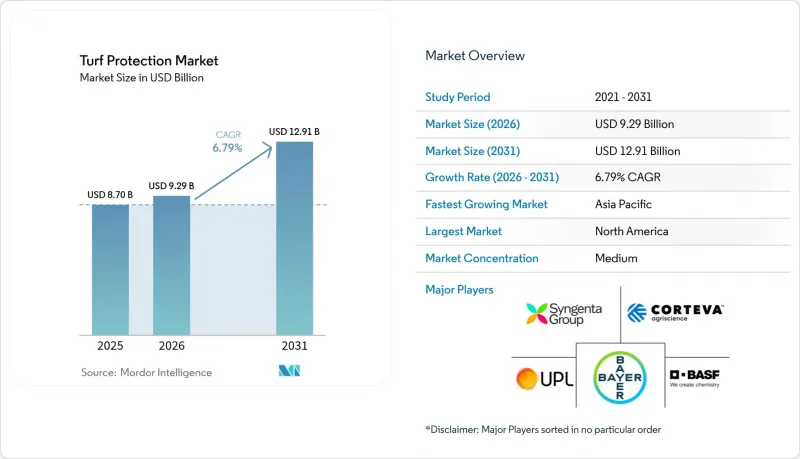
This report is Segmented by Product Type (Fungicides, Herbicides, and More), Application (Landscaping, Golf Courses, Sports Fields, and More), by End-User (Residential Customers, and More), by Mode of Action (Chemical, Biological, and Integrated Solution), by Formulation (Granular, and More) and Geography (North America, Europe, Asia-Pacific, and More). The Report Offers Forecasts in Terms of Value (USD).
Global Turf Protection Market Trends and Insights
Rising construction of golf courses and professional sports venues
Capital allocations for new facilities surged after the pandemic, particularly across India, China, and Gulf states, creating steady pull-through demand for hybrid turf systems that balance durability with natural playability. Professional leagues have formalized surface-quality metrics, prompting venue owners to specify fungicides, plant growth regulators, and stress-mitigation products that pass stricter safety tests. Once built, each venue requires season-long disease control, anchoring recurring revenue for suppliers. Developers also lean on integrated packages that bundle seed, nutrition, and digital monitoring, opening cross-selling opportunities in the turf protection market.
Increasing incidence of turfgrass diseases
Milder winters and prolonged humidity are intensifying outbreaks of dollar spot and brown patch, prompting superintendents to adopt dynamic rotation programs that respond to real-time pathogen pressure instead of calendar schedules. Research shows tall fescue plots receiving high nitrogen suffer 40% higher brown patch severity than moderately fertilized turf, underscoring the need for balanced nutrition strategies. Advanced diagnostic kits and AI models now detect dollar spot with 97% accuracy, enabling earlier interventions and optimized fungicide loads. The trend is pushing the turf protection industry toward predictive analytics and site-specific treatments that preserve beneficial soil organisms.
Rapid penetration of artificial turf solutions
Synthetic fields eliminate routine mowing and pesticide spending, enticing school boards and municipalities wrestling with labor and water constraints. Installations in the United States now run between 1,200 and 1,500 per year. Nonetheless, PFAS contamination findings and microplastic-shed estimates of 16,000 tons annually in Europe have triggered policy reviews that could stall conversions and breathe life into natural alternatives. Turf protection vendors are responding with hybrid technology and communication campaigns highlighting the health and sustainability benefits of natural systems.
Other drivers and restraints analyzed in the detailed report include:
- Growing residential demand for aesthetic lawns
- Shift toward biological fungicides and biostimulants
- Regulatory pressure on conventional fungicides
For complete list of drivers and restraints, kindly check the Table Of Contents.
Segment Analysis
Fungicides generated the largest slice of turf protection market revenue with a 37.50% share in 2025, reflecting the continual threat of dollar spot, brown patch, and Pythium. Sophisticated rotation plans mixing SDHI, QoI, and DMI chemistry remain indispensable for courses aiming to maintain tournament-grade surfaces. However, biostimulants, posting an 10.81% CAGR, highlight the market's pivot toward sustainable inputs backed by proven stress tolerance and root health gains. Herbicides hold a prominent share in total demand as managers tackle annual bluegrass and broadleaf weeds, while plant growth regulators find traction by trimming mower fuel and labor costs.
The turf protection market size for plant growth regulators is poised to expand in tandem with heightened labor constraints and sustainability targets. Iron-based alternatives and microbial cocktails now supplement conventional fungicides, demonstrating equivalent dollar spot suppression with lower environmental risk. Biologicals and synthetics are spawning co-formulations that enhance uptake and persistence, broadening choice for superintendents.
Landscaping maintained 42.10% of overall demand in 2025, supported by steady residential and commercial spending on curb appeal. Product mixes focus on broad-spectrum weed control, slow-release nutrition, and colorants that deliver a uniform appearance. In contrast, sports fields are leading the growth table with a 9.36% CAGR, as franchises and universities prioritize athlete safety and surface consistency. The NFL's push for standardized field testing is already shaping purchasing specifications toward high-performance fungicide programs and hybrid overseeding blends.
The turf protection market size dedicated to golf courses holds a significant share, but growth plateaus relative to sports arenas, as many mature courses transition from capital expansion to a renovation mode. Sod farms, while niche, exert influence through their role in supplying disease-free sod that demands intensive pest control.
Complete Report Scope:
- By Product Type
- Fungicides
- Herbicides
- Insecticides
- Plant Growth Regulators
- Biostimulants and Bio-fertilizers
- By Application
- Landscaping
- Golf Courses
- Sports Fields
- Sod Farms
- By End-user
- Residential Customers
- Commercial Landscape Contractors
- Sports Facility Owners
- Municipalities and Schools
- By Mode of Action
- Chemical
- Biological
- Integrated Solutions
- By Formulation
- Granular
- Liquid Concentrate
- Wettable Powder
- By Geography
- North America
- United States
- Canada
- Mexico
- Rest of the North America
- South America
- Brazil
- Argentina
- Rest of South America
- Europe
- Germany
- United Kingdom
- France
- Italy
- Spain
- Russia
- Rest of Europe
- Asia-Pacific
- China
- India
- Japan
- Australia
- South Korea
- Rest of Asia-Pacific
- Middle East
- Saudi Arabia
- United Arab Emirates
- Rest of Middle East
- Africa
- South Africa
- Egypt
- Rest of Africa
- North America
Geography Analysis
North America retained 34.70% of global revenue in 2025, anchored by more than 15,000 golf courses and one of the world's largest portfolios of professional stadiums. The United States represents roughly 90% of regional demand and benefits from the early adoption of IoT soil probes and AI spray scheduling tools. Canada's shorter growing window concentrates disease outbreaks into intense summer peaks, encouraging premium fungicide programs. Mexico's resort corridors channel investment into salt-tolerant turf cultivars and fertility programs that thrive in coastal soils.
Asia-Pacific is projected to clock an 8.32% CAGR, the fastest worldwide. China's research institutes are expanding germplasm collections for stress-resistant turf, but course operators still import many premium cultivars. India's urban golf and cricket infrastructure underpins robust demand for fungicide and growth-regulator packages capable of withstanding monsoon swings. Japan's mature golf scene is pivoting toward precision irrigation and biological inputs to meet government sustainability targets. Australian course managers face stringent water quotas, increasing reliance on wetting agents and drought-resilient blends to safeguard playing quality.
Europe remains a technology- and regulation-driven arena. The European Commission's push for sustainable pesticide use and microplastic bans incentivizes biological programs and biodegradable carriers. Germany and the United Kingdom spearhead the uptake of connected-sensor networks that fine-tune fungicide timing. France's grounds crews are early adopters of biostimulant seed treatments to comply with national pesticide-reduction objectives, showcasing how policy influences procurement choices.
- Syngenta Group
- Bayer AG
- BASF SE
- UPL Limited
- Nufarm Limited
- AMVAC Chemical Corporation
- Sumitomo Group
- Bioceres LLC (Morrone Bio Innovations)
- ICL Group
- FMC Corporation
- Corteva Agriscience
- SePRO Corporation
- Gowan Company, L.L.C.
- Koch Agronomic Services, LLC
- LebanonTurf (Lebanon Seaboard Corporation)
Additional Benefits:
- The market estimate (ME) sheet in Excel format
- 3 months of analyst support
TABLE OF CONTENTS
1 Introduction
- 1.1 Study Assumptions and Market Definition
- 1.2 Scope of the Study
2 Research Methodology
3 Executive Summary
4 Market Landscape
- 4.1 Market Overview
- 4.2 Market Drivers
- 4.2.1 Rising construction of golf courses and professional sports venues
- 4.2.2 Increasing incidence of turfgrass diseases
- 4.2.3 Growing residential demand for aesthetic lawns
- 4.2.4 Shift toward biological fungicides and biostimulants
- 4.2.5 Adoption of sensor-based precision turf management
- 4.2.6 Climate-change-induced heat-stress mitigation solutions
- 4.3 Market Restraints
- 4.3.1 Rapid penetration of artificial turf solutions
- 4.3.2 High Research and Development cost for novel chemistries
- 4.3.3 Regulatory pressure on conventional fungicides
- 4.3.4 Micro- and nanoplastic pollution concerns from turf inputs
- 4.4 Technological Outlook
- 4.5 Regulatory Landscape
- 4.6 Porter's Five Forces Analysis
- 4.6.1 Threat of New Entrants
- 4.6.2 Bargaining Power of Buyers
- 4.6.3 Bargaining Power of Suppliers
- 4.6.4 Threat of Substitutes
- 4.6.5 Intensity of Competitive Rivalry
5 Market Size and Growth Forecasts (Value)
- 5.1 By Product Type
- 5.1.1 Fungicides
- 5.1.2 Herbicides
- 5.1.3 Insecticides
- 5.1.4 Plant Growth Regulators
- 5.1.5 Biostimulants and Bio-fertilizers
- 5.2 By Application
- 5.2.1 Landscaping
- 5.2.2 Golf Courses
- 5.2.3 Sports Fields
- 5.2.4 Sod Farms
- 5.3 By End-user
- 5.3.1 Residential Customers
- 5.3.2 Commercial Landscape Contractors
- 5.3.3 Sports Facility Owners
- 5.3.4 Municipalities and Schools
- 5.4 By Mode of Action
- 5.4.1 Chemical
- 5.4.2 Biological
- 5.4.3 Integrated Solutions
- 5.5 By Formulation
- 5.5.1 Granular
- 5.5.2 Liquid Concentrate
- 5.5.3 Wettable Powder
- 5.6 By Geography
- 5.6.1 North America
- 5.6.1.1 United States
- 5.6.1.2 Canada
- 5.6.1.3 Mexico
- 5.6.1.4 Rest of the North America
- 5.6.2 South America
- 5.6.2.1 Brazil
- 5.6.2.2 Argentina
- 5.6.2.3 Rest of South America
- 5.6.3 Europe
- 5.6.3.1 Germany
- 5.6.3.2 United Kingdom
- 5.6.3.3 France
- 5.6.3.4 Italy
- 5.6.3.5 Spain
- 5.6.3.6 Russia
- 5.6.3.7 Rest of Europe
- 5.6.4 Asia-Pacific
- 5.6.4.1 China
- 5.6.4.2 India
- 5.6.4.3 Japan
- 5.6.4.4 Australia
- 5.6.4.5 South Korea
- 5.6.4.6 Rest of Asia-Pacific
- 5.6.5 Middle East
- 5.6.5.1 Saudi Arabia
- 5.6.5.2 United Arab Emirates
- 5.6.5.3 Rest of Middle East
- 5.6.6 Africa
- 5.6.6.1 South Africa
- 5.6.6.2 Egypt
- 5.6.6.3 Rest of Africa
- 5.6.1 North America
6 Competitive Landscape
- 6.1 Market Concentration
- 6.2 Strategic Moves
- 6.3 Market Share Analysis
- 6.4 Company Profiles (includes Global level Overview, Market level overview, Core Segments, Financials as available, Strategic Information, Market Rank/Share, Products and Services, Recent Developments)
- 6.4.1 Syngenta Group
- 6.4.2 Bayer AG
- 6.4.3 BASF SE
- 6.4.4 UPL Limited
- 6.4.5 Nufarm Limited
- 6.4.6 AMVAC Chemical Corporation
- 6.4.7 Sumitomo Group
- 6.4.8 Bioceres LLC (Morrone Bio Innovations)
- 6.4.9 ICL Group
- 6.4.10 FMC Corporation
- 6.4.11 Corteva Agriscience
- 6.4.12 SePRO Corporation
- 6.4.13 Gowan Company, L.L.C.
- 6.4.14 Koch Agronomic Services, LLC
- 6.4.15 LebanonTurf (Lebanon Seaboard Corporation)
7 Market Opportunities and Future Outlook

