PUBLISHER: Mordor Intelligence | PRODUCT CODE: 2156978

PUBLISHER: Mordor Intelligence | PRODUCT CODE: 2156978
Europe Turf Protection - Market Share Analysis, Industry Trends & Statistics, Growth Forecasts (2026 - 2031)
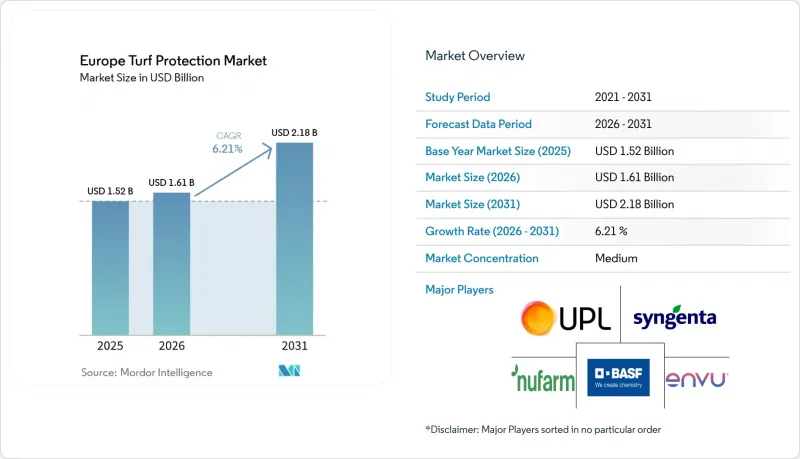
According to Mordor Intelligence, the Europe turf protection market is projected to grow from USD 1.52 billion in 2025 and USD 1.61 billion in 2026 to USD 2.18 billion by 2031, registering a CAGR of 6.21% during the forecast period 2026 and 2031.
Europe Turf Protection Market Trends and Insights
Growth in Professional Sports and Golf Infrastructure
Investment in professional sports facilities, golf courses, training grounds, and multipurpose venues across Europe is supporting demand for turf protection products. New and renovated playing surfaces require intensive maintenance during establishment and throughout their operating life to manage disease, weeds, pests, and turf stress. The increasing emphasis on high-quality, durable playing surfaces also encourages venue operators to adopt structured turf-protection and maintenance programs. As professionally managed facilities place greater importance on surface consistency, playability, and rapid recovery, demand for reliable protection products and accompanying technical support is anticipated to increase. Suppliers that can provide integrated turf-management programs alongside product solutions are therefore well positioned to benefit from continued investment in European sports and golf infrastructure.
Rising Disease and Pest Pressure Under Climate Volatility
Disease pressure is increasing across managed turf in the European turf protection market. In 2024, the British and International Golf Greenkeepers Association (BIGGA) documented dollar spot on golf courses in northern France and Germany, while grey leaf spot was confirmed at sites where it had not previously caused damage . A 2025 study in the International Turfgrass Society Research Journal identified Clarireedia species in samples from courses in Germany, providing evidence of the disease's wider presence across Europe. Courses in northern Europe must also manage Microdochium patch during cold, wet periods, which extend the effective disease season. This overlap favors suppliers with broad disease-control portfolios and supports the rotation of product classes to manage resistance. As a result, the Europe turf protection market shows stronger demand for timely diagnosis, preventive programs, and treatment guidance.
Active-Ingredient Withdrawals and Pesticide-Use Restrictions
Withdrawals under Regulation (EC) No. 1107/2009 are reducing the number of active ingredients available to turf managers. Specialty turf registrations are difficult to support because their commercial volumes are smaller than those of major arable crops. A product authorized at the European Union level must also meet country-specific approval conditions in individual member states. Local rules can differ in approval timing, data requirements, permitted uses, and public procurement standards. Municipal buyers may require pesticide-free or low-impact programs even when a product holds a valid national registration. This fragmented access pattern raises launch costs and may delay the availability of new products across the Europe turf protection market.
Other drivers and restraints analyzed in the detailed report include:
- Demand for High-Quality Commercial and Residential Landscapes
- Adoption of Integrated Turf Management and Biological Solutions
- High Registration and R&D Costs for Specialty Turf Products
For complete list of drivers and restraints, kindly check the Table Of Contents.
Segment Analysis
Fungicides accounted for 31.8% of the Europe turf protection market in 2025, reflecting their central role in disease control across golf, sports, and landscape sites. Disease management programs rely on fungicides to maintain surface quality, player safety, and visual condition. Herbicides remain important for commercial landscaping and sod farms, as weeds affect appearance and grass purity. Insecticides are used where turf pests damage root systems or playing surfaces. Plant growth regulators support mowing management, canopy density, and consistent playing conditions at golf courses.
Biostimulants and bio-fertilizers are forecast to grow at a 9.4% CAGR between 2026 and 2031. These products support soil condition and plant response under compaction, drought, and heavy traffic, and can complement fungicide programs by helping turf tolerate stress. Regulatory pressure is also encouraging managers to include lower-impact products in treatment plans. The Europe turf protection market is not shifting from one product category to another in a simple sequence. Instead, turf managers are building layered programs that maintain disease control while incorporating soil health and stress management inputs. Suppliers offering fungicides, biological products, and plant growth regulators are better positioned to meet these integrated purchasing requirements.
Landscaping accounted for 34.5% of the Europe turf protection market share in 2025. This category includes commercial, residential, and municipal green-space maintenance. Long-term contracts make demand more predictable compared to sites with irregular renovation budgets. Golf courses represent a high-value application, as greens, tees, fairways, and roughs each require distinct protection programs. Sod farms play a smaller role but supply grass to sports venues, golf courses, and landscaping projects. Their need for healthy establishment turf makes them early adopters of effective protection products. These applications support recurring demand across the Europe turf protection market.
The sports fields segment is forecast to expand at a CAGR of 6.8% between 2026 and 2031. Stadium upgrades, new training facilities, and increasingly stringent surface-quality standards are supporting this growth. Higher performance requirements for professional sports pitches make surface damage from disease and weeds less acceptable, increasing the need for reliable disease control and rapid turf recovery. Operators at these facilities, therefore, tend to prioritize consistent product performance and application outcomes, which can reduce price sensitivity for products used in professionally managed pitch programs. Suppliers also benefit when venue managers seek application guidance alongside products, strengthening the role of technical support in sports-field procurement.
Complete Report Scope:
- By Product Type
- Fungicides
- Herbicides
- Insecticides
- Plant Growth Regulators
- Biostimulants and Bio-fertilizers
- By Application
- Landscaping
- Golf Courses
- Sports Fields
- Sod Farms
- By End-user
- Residential Customers
- Commercial Landscape Contractors
- Sports Facility Owners
- Municipalities and Schools
- By Mode of Action
- Chemical
- Biological
- Integrated Solutions
- By Formulation
- Granular
- Liquid Concentrates
- Wettable Powder
- By Geography
- Europe
- Germany
- United Kingdom
- France
- Italy
- Spain
- Netherlands
- Poland
- Russia
- Rest of Europe
- Europe
List of Companies Covered in this Report:
- Syngenta AG
- BASF SE
- UPL Limited
- Nufarm Limited
- Corteva, Inc.
- AMVAC Chemical Corporation (American Vanguard Corporation)
- Sumitomo Chemical Co., Ltd.
- ICL Group Ltd.
- Envu GmbH
- Koppert Biological Systems B.V.
- The Andersons, Inc.
Additional Benefits:
- The market estimate (ME) sheet in Excel format
- 3 months of analyst support
TABLE OF CONTENTS
1 INTRODUCTION
- 1.1 Study Assumptions and Market Definition
- 1.2 Scope of the Study
2 RESEARCH METHODOLOGY
3 EXECUTIVE SUMMARY
4 MARKET LANDSCAPE
- 4.1 Market Overview
- 4.2 Market Drivers
- 4.2.1 Growth in professional sports and golf infrastructure
- 4.2.2 Rising disease and pest pressure under climate volatility
- 4.2.3 Demand for high-quality commercial and residential landscapes
- 4.2.4 Adoption of integrated turf management and biological solutions
- 4.2.5 Precision irrigation and sensor-based turf monitoring
- 4.2.6 EU compliance spending accelerating low-residue product innovation
- 4.3 Market Restraints
- 4.3.1 Active-ingredient withdrawals and pesticide-use restrictions
- 4.3.2 High registration and r&d costs for specialty turf products
- 4.3.3 Short efficacy windows of biologicals in cold, wet conditions
- 4.3.4 Fragmented national approval and municipal procurement requirements
- 4.4 Regulatory Landscape
- 4.5 Technological Outlook
- 4.6 Porter's Five Forces Analysis
- 4.6.1 Intensity of Competitive Rivalry
- 4.6.2 Supplier Bargaining Power
- 4.6.3 Buyer Bargaining Power
- 4.6.4 Threat of New Entrants
- 4.6.5 Threat of Substitutes
5 MARKET SIZE AND GROWTH FORECASTS (VALUE)
- 5.1 By Product Type
- 5.1.1 Fungicides
- 5.1.2 Herbicides
- 5.1.3 Insecticides
- 5.1.4 Plant Growth Regulators
- 5.1.5 Biostimulants and Bio-fertilizers
- 5.2 By Application
- 5.2.1 Landscaping
- 5.2.2 Golf Courses
- 5.2.3 Sports Fields
- 5.2.4 Sod Farms
- 5.3 By End-user
- 5.3.1 Residential Customers
- 5.3.2 Commercial Landscape Contractors
- 5.3.3 Sports Facility Owners
- 5.3.4 Municipalities and Schools
- 5.4 By Mode of Action
- 5.4.1 Chemical
- 5.4.2 Biological
- 5.4.3 Integrated Solutions
- 5.5 By Formulation
- 5.5.1 Granular
- 5.5.2 Liquid Concentrates
- 5.5.3 Wettable Powder
- 5.6 By Geography
- 5.6.1 Europe
- 5.6.1.1 Germany
- 5.6.1.2 United Kingdom
- 5.6.1.3 France
- 5.6.1.4 Italy
- 5.6.1.5 Spain
- 5.6.1.6 Netherlands
- 5.6.1.7 Poland
- 5.6.1.8 Russia
- 5.6.1.9 Rest of Europe
- 5.6.1 Europe
6 COMPETITIVE LANDSCAPE
- 6.1 Market Concentration
- 6.2 Strategic Moves
- 6.3 Market Share Analysis
- 6.4 Company Profiles (Includes Global Level Overview, Market Level Overview, Core Segments, Financials as Available, Strategic Information, Market Rank/Share, Products and Services, Recent Developments)
- 6.4.1 Syngenta AG
- 6.4.2 BASF SE
- 6.4.3 UPL Limited
- 6.4.4 Nufarm Limited
- 6.4.5 Corteva, Inc.
- 6.4.6 AMVAC Chemical Corporation (American Vanguard Corporation)
- 6.4.7 Sumitomo Chemical Co., Ltd.
- 6.4.8 ICL Group Ltd.
- 6.4.9 Envu GmbH
- 6.4.10 Koppert Biological Systems B.V.
- 6.4.11 The Andersons, Inc.
7 MARKET OPPORTUNITIES AND FUTURE OUTLOOK

