PUBLISHER: Mordor Intelligence | PRODUCT CODE: 2123512

PUBLISHER: Mordor Intelligence | PRODUCT CODE: 2123512
Europe Dashboard Camera - Market Share Analysis, Industry Trends & Statistics, Growth Forecasts (2026 - 2031)
According to Mordor Intelligence, the Europe dashboard camera market size is expected to grow from USD 1.28 billion in 2025 to USD 1.41 billion in 2026 and is forecast to reach USD 2.31 billion by 2031 at 10.36% CAGR over 2026-2031.
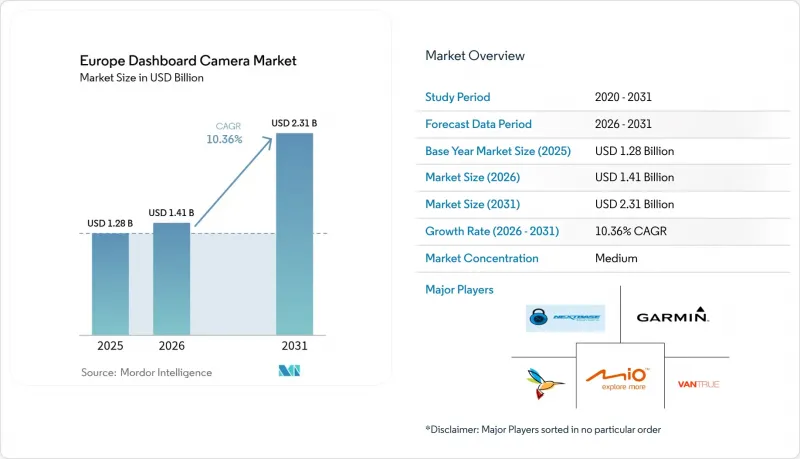
This report is Segmented by Technology (Basic, and Smart), Product Type (Single-Channel, and More), Application (Passenger Vehicles, and Commercial Vehicles), Video Quality/Resolution (Standard Definition, and More), Distribution Channel (Online Retail, and Offline Retail), End-User (Private Vehicle Owners, and More), and Country. The Market Forecasts are Provided in Terms of Value (USD)
Europe Dashboard Camera Market Trends and Insights
Surge in Road-Accident Litigation Evidence Needs
Courts across Europe now accept dashcam video as primary proof in liability disputes, shortening settlement cycles by up to 40% and cutting insurer legal fees. United Kingdom police processed about 125,000 Operation Snap submissions in 2023, with 70% yielding enforcement action. France and Italy allow recordings if retention is limited to seven days unless an incident occurs, reinforcing consumer confidence. Spanish rideshare drivers rely on footage to rebut fraudulent claims, mirroring the country's 13.44% CAGR. Logistics fleets report accident reductions of 15% and premium cuts of up to 18% after deploying cameras. As video admissibility spreads, cameras shift from optional gadgets to legal safeguards.
Insurance Premium Discounts for Dashcam-Equipped Vehicles
Insurers reward policyholders who share footage or telematics data. Aviva's smartphone dashcam app yields average annual savings of GBP 170 (USD 215) and peaks at GBP 250 (USD 316) for high-scoring drivers. Jaguar Land Rover and Allianz subsidize Range Rover premiums by GBP 150 (USD 190) monthly in exchange for data feeds. Adoption is advanced, with 31% of motorists owning dashcams and three-quarters believing all drivers should use one. Dutch fleets report safety scores near 100% after adding video, translating into 12%-18% renewal discounts. As commercial carriers with high mileage face tighter underwriting, cameras are increasingly required equipment.
Stringent GDPR-Driven Data-Privacy Compliance Costs
Germany's revised Federal Data Protection Act and Telecommunications-Telemedia amendments impose end-to-end encryption and restrict continuous recording, adding EUR 50-80 (USD 56-90) to bill-of-materials costs. France's Penal Code limits footage retention to seven days, compelling automatic overwrite functions. Vendors must code geofencing to disable recording in sensitive zones and maintain consent logs, complicating firmware and shrinking entry-level margins. Such fragmentation forces makers to maintain multiple software builds, undermining scale economies.
Other drivers and restraints analyzed in the detailed report include:
- EU Mandates for Advanced Driver Monitoring Systems
- Proliferation of AI-Enabled Connected Dashcams
- National Restrictions on Public-Space Video Recording
For complete list of drivers and restraints, kindly check the Table Of Contents.
Segment Analysis
Smart models, forecast to grow at an 10.95% CAGR, embed AI that coaches drivers and uploads clips instantly, reshaping value from passive to predictive safety. Basic devices held 56.98% of 2025 revenue, yet their share erodes as fleets choose data-rich units that cut accidents by 15% and unlock insurance savings. The Europe dashboard camera market size for smart units is projected to widen most among logistics and rideshare operators that demand compliance dashboards.
Price-sensitive private owners still choose EUR 150 (USD 169) basic models for evidence capture, sustaining volume but pressuring margins. Retail channel promotions clear aging inventory as 4K prices drop. The bifurcation mirrors wider automotive tech adoption: consumers judge cameras as accessories, fleets view them as operational software nodes.
Single-channel devices held 64.25% revenue in 2025, yet dual-channel units will rise at a 12.18% CAGR because EU rules now require cabin-facing monitoring on new truck types. Rideshare drivers also install cabin cameras to document disputes, accelerating uptake in Spain and France.
Fleet buyers pay EUR 250-400 (USD 281-450) for dual-channel bundles that include secure lock-box mounts, avoiding driver tampering. Rear-only units remain niche, aimed at parking-lot scuffs. As OEMs add multiple lenses, after-market suppliers focus on ease of retrofit and superior analytics to retain share.
Complete Report Scope:
- By Technology
- Basic
- Smart
- By Product Type
- Single-Channel
- Dual-Channel
- Rear-View
- By Application
- Passenger Vehicles
- Commercial Vehicles
- By Video Quality/Resolution
- Standard Definition (SD)
- High Definition (HD)
- Full High Definition (FULL HD)
- Ultra High Definition (4K and Above)
- By Distribution Channel
- Online Retail
- Offline Retail
- By End-User
- Private Vehicle Owners
- Fleet Operators
- Law Enforcement and Emergency Services
- Rideshare and Taxi Drivers
- By Country
- United Kingdom
- Germany
- France
- Spain
- Italy
- Rest of Europe
List of Companies Covered in this Report:
- Pittasoft Co., Ltd.
- MiTAC Europe Ltd. (Mio)
- Vantrue Inc.
- Portable Multimedia Ltd. (Nextbase)
- Garmin Ltd.
- Trakm8 Holdings plc (RoadHawk)
- Halfords Group plc
- JVCKENWOOD Corporation
- Samsara Inc.
- Steelmate Automotive (UK) Ltd.
- Thinkware Corporation
- Fine Digital Inc.
- Transcend Information Inc.
- VIOFO Ltd.
- Cobra Electronics Corporation
- Nextbase Manufacturing (Hong Kong) Ltd.
- Anker Innovations Ltd. (ROAV)
- DOD Tech Co., Ltd.
Additional Benefits:
- The market estimate (ME) sheet in Excel format
- 3 months of analyst support
TABLE OF CONTENTS
1 INTRODUCTION
- 1.1 Study Assumptions and Market Definition
- 1.2 Scope of the Study
2 RESEARCH METHODOLOGY
3 EXECUTIVE SUMMARY
4 MARKET LANDSCAPE
- 4.1 Market Overview
- 4.2 Market Drivers
- 4.2.1 Surge in Road-Accident Litigation Evidence Needs
- 4.2.2 Insurance Premium Discounts for Dashcam-Equipped Vehicles
- 4.2.3 EU Mandates for Advanced Driver Monitoring Systems
- 4.2.4 Proliferation of AI-Enabled Connected Dashcams
- 4.2.5 Fleet Telematics Integration Across Logistics and Rideshare
- 4.2.6 Declining Cost of High-Resolution Imaging Sensors
- 4.3 Market Restraints
- 4.3.1 Stringent GDPR-Driven Data-Privacy Compliance Costs
- 4.3.2 National Restrictions on Public-Space Video Recording
- 4.3.3 Competitive Pressure from OEM-Integrated Camera Systems
- 4.3.4 Battery-Drain Concerns During 24-Hour Parking Mode
- 4.4 Industry Value / Supply-Chain Analysis
- 4.5 Impact of Macroeconomic Factors on the Market
- 4.6 Regulatory Landscape
- 4.7 Technological Outlook
- 4.8 Porter's Five Forces Analysis
- 4.8.1 Threat of New Entrants
- 4.8.2 Bargaining Power of Buyers
- 4.8.3 Bargaining Power of Suppliers
- 4.8.4 Threat of Substitute Products
- 4.8.5 Intensity of Competitive Rivalry
5 MARKET SIZE AND GROWTH FORECASTS (VALUE)
- 5.1 By Technology
- 5.1.1 Basic
- 5.1.2 Smart
- 5.2 By Product Type
- 5.2.1 Single-Channel
- 5.2.2 Dual-Channel
- 5.2.3 Rear-View
- 5.3 By Application
- 5.3.1 Passenger Vehicles
- 5.3.2 Commercial Vehicles
- 5.4 By Video Quality/Resolution
- 5.4.1 Standard Definition (SD)
- 5.4.2 High Definition (HD)
- 5.4.3 Full High Definition (FULL HD)
- 5.4.4 Ultra High Definition (4K and Above)
- 5.5 By Distribution Channel
- 5.5.1 Online Retail
- 5.5.2 Offline Retail
- 5.6 By End-User
- 5.6.1 Private Vehicle Owners
- 5.6.2 Fleet Operators
- 5.6.3 Law Enforcement and Emergency Services
- 5.6.4 Rideshare and Taxi Drivers
- 5.7 By Country
- 5.7.1 United Kingdom
- 5.7.2 Germany
- 5.7.3 France
- 5.7.4 Spain
- 5.7.5 Italy
- 5.7.6 Rest of Europe
6 COMPETITIVE LANDSCAPE
- 6.1 Market Concentration
- 6.2 Strategic Moves
- 6.3 Market Share Analysis
- 6.4 Company Profiles (includes Global Level Overview, Market Level Overview, Core Segments, Financials as available, Strategic Information, Market Rank/Share for key companies, Products and Services, and Recent Developments)
- 6.4.1 Pittasoft Co., Ltd.
- 6.4.2 MiTAC Europe Ltd. (Mio)
- 6.4.3 Vantrue Inc.
- 6.4.4 Portable Multimedia Ltd. (Nextbase)
- 6.4.5 Garmin Ltd.
- 6.4.6 Trakm8 Holdings plc (RoadHawk)
- 6.4.7 Halfords Group plc
- 6.4.8 JVCKENWOOD Corporation
- 6.4.9 Samsara Inc.
- 6.4.10 Steelmate Automotive (UK) Ltd.
- 6.4.11 Thinkware Corporation
- 6.4.12 Fine Digital Inc.
- 6.4.13 Transcend Information Inc.
- 6.4.14 VIOFO Ltd.
- 6.4.15 Cobra Electronics Corporation
- 6.4.16 Nextbase Manufacturing (Hong Kong) Ltd.
- 6.4.17 Anker Innovations Ltd. (ROAV)
- 6.4.18 DOD Tech Co., Ltd.
7 MARKET OPPORTUNITIES AND FUTURE OUTLOOK
- 7.1 White-Space and Unmet-Need Assessment

