PUBLISHER: Mordor Intelligence | PRODUCT CODE: 2123525

PUBLISHER: Mordor Intelligence | PRODUCT CODE: 2123525
ELISpot And FluoroSpot Assay - Market Share Analysis, Industry Trends & Statistics, Growth Forecasts (2026 - 2031)
According to Mordor Intelligence, the ELISpot FluoroSpot assay market size is expected to grow from USD 343.68 million in 2025 to USD 371.28 million in 2026 and is forecast to reach USD 546.29 million by 2031 at 8.03% CAGR over 2026-2031.
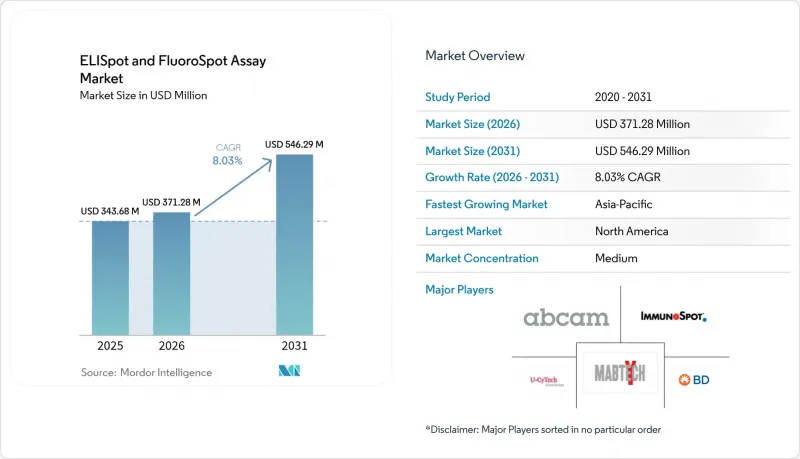
This report is Segmented by Product (Analyzers, Assay Kits, and Ancillary Products), End-User (Hospitals & Clinical Laboratories, Biopharmaceutical & Vaccine Manufacturers, and More), Application (Research and Diagnostics), Technology (Colorimetric ELISpot, Fluorospot, and More), and Geography (North America, Europe, Asia-Pacific, and More). The Market Forecasts are Provided in Terms of Value (USD).
Global ELISpot And FluoroSpot Assay Market Trends and Insights
Rising Incidence of Chronic & Infectious Diseases
Increasing caseloads of tuberculosis, HIV, viral hepatitis and cancer are boosting demand for precise cellular immune-monitoring. The T-SPOT.TB test now registers 99% sensitivity and 94% specificity, outperforming traditional methods and solidifying ELISpot technology as a frontline diagnostic. FDA clearance of automated T-SPOT-compatible liquid-handling workstations in 2025 further validates clinical use. Oncology centres routinely employ interferon-Y and IL-2 ELISpot panels to track neoantigen-specific responses that guide checkpoint-inhibitor dosing. WHO recommendations calling for broader access to quality diagnostics in high-burden regions align with the ELISpot FluoroSpot Assay market expansion because functional assays detect low-frequency T-cells missed by serological tests. As non-communicable disease prevalence rises alongside infectious threats, broad clinical adoption of standardized ELISpot workflows is likely to remain a durable growth pillar.
Rapid Vaccine Pipeline Expansion Post-COVID-19
Vaccine developers are shifting focus from antibody-centric endpoints toward cellular immunity. BARDA-sponsored phase 2b designs for next-generation COVID-19 vaccines explicitly integrate T-cell assays to demonstrate broader and longer-lasting protection. The same requirement now features in seasonal influenza programs attempting to overcome strain-specific limitations. The Center for Biologics Evaluation and Research reported 17 biologics licenses granted in 2024 that necessitated functional immune data, cementing assay use in regulatory dossiers. In turn, CROs and in-house laboratories are scaling the ELISpot FluoroSpot Assay market by installing multiplex readers that quantify cross-reactive immunity across variant lineages. Universal vaccine research targeting conserved epitopes further strengthens the need to capture polyfunctional T-cell outputs that colorimetric ELISA cannot reveal.
Availability of Alternate High-Parameter Flow-Cytometry & CyTOF Platforms
Forty-five-color full-spectrum cytometry and mass cytometry can delineate complex immune landscapes at single-cell resolution, positioning these platforms as credible substitutes where deep phenotyping outweighs functional readouts. Studies comparing 33-marker CyTOF and spectral flow panels demonstrate high concordance in quantifying immune subsets across clinical samples. Laboratories that already own cytometers may upgrade to ultra-high-parameter configurations instead of purchasing separate ELISpot readers, thereby tempering incremental instrument demand. While ELISpot retains an edge in detecting low-frequency functional responses, technology overlap is likely to intensify procurement deliberations in large reference centres.
Other drivers and restraints analyzed in the detailed report include:
- Technological Breakthroughs in Multiplex FluoroSpot Readers
- Regulatory Push for Functional T-Cell Assays in Cell-Therapy QC
- High Capital Cost of Automated Analyzers & Image-Analysis Software
For complete list of drivers and restraints, kindly check the Table Of Contents.
Segment Analysis
At USD 185.97 million revenue in 2025, Assay Kits generated more than half of total spending, echoing the recurring requirement for cytokine-coated wells and detection antibodies. Laboratories reorder these consumables for each run, ensuring steady replenishment streams. Analyzer demand, although forming a smaller base, is projected to outpace kits thanks to a 13.89% CAGR as automation and AI analytics become routine in high-throughput settings. Portable FluoroSpot readers targeting tuberculosis screening programs in community clinics add incremental volume. The ELISpot FluoroSpot Assay market size for analyzers could exceed USD 151.3 million by 2031 under the current replacement cycle, creating a fertile aftermarket for image-analysis upgrades and service contracts. Ancillary items-membrane plates, calibration standards and machine-learning licenses-complement core kit sales, with AI software packages providing premium margin opportunities for vendors.
Assay Kit leadership rests on a robust catalogue that spans single-cytokine IFN-Y kits to multiplex IL-2/Granzyme-B bundles essential for oncology research. Pandemic-era SARS-CoV-2 ELISpot kits still post reorder volumes for booster-shot evaluation, though growth moderates as broader use cases such as tuberculosis and CMV monitoring gain share. Manufacturers are experimenting with universal plate chemistries that cut per-test cost nearly 15%, further expanding global penetration. The rising popularity of open-source 3D-printed plate holders underscores a shift toward cost-sensitive solutions in developing countries, reinforcing consumables' sustained primacy in the ELISpot FluoroSpot Assay market.
Hospitals and clinical laboratories processed the majority of routine tuberculosis, transplant and primary-immunodeficiency ELISpot panels in 2025, capturing roughly USD 222.46 million in kit and service spending. Regulatory endorsement of automated TB workflows boosts test standardization and throughput, allowing these sites to retain leadership. Nonetheless, Research Institutes and CROs are on pace for a 15.46% CAGR, benefiting from outsourced vaccine and immunotherapy programs that require high-volume, rapid-turnaround cellular assays. Contract organizations bundle ELISpot with flow cytometry and cytokine multiplexing, offering integrated immune-monitoring packages attractive to biopharma sponsors.
Biopharmaceutical and vaccine manufacturers rely on in-house potency testing to meet regulatory timelines, representing a steady mid-single-digit growth niche. Academic centres extend market breadth by pursuing fundamental T-cell biology, often piloting advanced FluoroSpot configurations that later migrate into clinical use. As personalized medicine trials proliferate, CROs will likely assume a larger slice of the ELISpot FluoroSpot Assay market size because their global lab networks can enrol geographically diverse subjects and deliver harmonized data sets for regulatory dossiers.
Complete Report Scope:
- By Product
- Analyzers
- Automated Plate Readers
- Portable FluoroSpot Readers
- Assay Kits
- Cytokine-specific ELISpot Kits
- Multiplex FluoroSpot Kits
- SARS-CoV-2 T-cell Kits
- Ancillary Products
- Membrane Plates & Reagents
- Image-analysis Software
- Analyzers
- By End-User
- Hospitals & Clinical Laboratories
- Biopharmaceutical & Vaccine Manufacturers
- Research Institutes & Contract Research Organisations
- By Application
- Research
- Vaccine Development
- Clinical Trials Immunomonitoring
- Cancer Immunotherapy Research
- Cell & Gene-Therapy Release Testing
- Diagnostics
- Infectious Disease Diagnostics
- Transplant Immunology
- Autoimmune Disease Panels
- Tuberculosis Diagnostics
- Research
- By Technology
- Colorimetric ELISpot
- FluoroSpot
- Digital/AI-enhanced ELISpot
- Microfluidic ELISpot-on-Chip
- Geography
- North America
- United States
- Canada
- Mexico
- Europe
- Germany
- United Kingdom
- France
- Italy
- Spain
- Rest of Europe
- Asia-Pacific
- China
- Japan
- India
- South Korea
- Australia
- Rest of Asia-Pacific
- Middle East and Africa
- GCC
- South Africa
- Rest of Middle East and Africa
- South America
- Brazil
- Argentina
- Rest of South America
- North America
Geography Analysis
North America generated USD 131.35 million revenue in 2025, equivalent to 38.22% of global sales, and benefits from advanced biopharmaceutical clusters, strong reimbursement and FDA guidance that enshrines ELISpot in vaccine and cell-therapy submissions. Large reference laboratories run high-volume tuberculosis and CMV panels, and research hospitals integrate multiplex FluoroSpot into immuno-oncology programs. Canada contributes steady growth through public-health diagnostics and a rising cell-therapy manufacturing footprint, reinforcing regional leadership.
Europe follows with entrenched pharmaceutical R&D ecosystems and EMA frameworks that support functional immune monitoring. Germany, the United Kingdom and the Nordics exhibit high analyzer installations, while cross-border academic consortia spur demand for AI-enhanced digital readers. Adoption also leans on European Union funding lines that underwrite translational immunology and personalized-medicine projects requiring standardized cellular assays. The ELISpot FluoroSpot Assay market size captured in Europe is projected to expand at a mid-single-digit CAGR, aided by regulatory harmonization that lowers validation overheads across member states.
Asia-Pacific is the fastest-growing territory at 13.34% CAGR, underpinned by expanding vaccine manufacturing in China, robust biotechnology investment in South Korea and Japan and emerging contract-research clusters in India. Government programs targeting tuberculosis elimination generate bulk kit orders, while rising CAR-T clinical trials open a high-value analyzer and software market. Public-private partnerships establish reference labs equipped with multiplex FluoroSpot systems, accelerating technology diffusion. Southeast Asian nations leverage microfluidic ELISpot-on-chip pilots to deliver point-of-care diagnostics in remote areas, underscoring the region's appetite for cost-efficient innovation. Collectively, Asia-Pacific could command nearly one-third of incremental global revenue through 2031, reshaping geographic hierarchy in the ELISpot FluoroSpot Assay market.
- Oxford Immunotec
- Cellular Technology Limited (CTL)
- Beckton Dickinson
- Mabtech
- U-Cytech Biosciences
- Abcam
- AutoImmun Diagnostika GmbH
- Lophius Biosciences
- Bio-Connect
- Bio-Techne Corp.
- Thermo Fisher Scientific
- Merck
- Siemens Healthineers
- Bio-Rad Laboratories
- PerkinElmer
- Danaher
- QIAGEN
- Agilent Technologies
- AID Diagnostika GmbH
- GenScript Biotech
- Dynex Technologies
Additional Benefits:
- The market estimate (ME) sheet in Excel format
- 3 months of analyst support
TABLE OF CONTENTS
1 Introduction
- 1.1 Study Assumptions & Market Definition
- 1.2 Scope of the Study
2 Research Methodology
3 Executive Summary
4 Market Landscape
- 4.1 Market Overview
- 4.2 Market Drivers
- 4.2.1 Rising Incidence Of Chronic & Infectious Diseases
- 4.2.2 Rapid Vaccine Pipeline Expansion Post-COVID-19
- 4.2.3 Technological Breakthroughs In Multiplex Fluorospot Readers
- 4.2.4 Regulatory Push For Functional T-Cell Assays In Cell-Therapy QC
- 4.2.5 Cost Decline Via Open-Source, 3-D-Printed ELISpot Hardware
- 4.2.6 Microfluidic Elispot-On-Chip Enabling PoC Immunomonitoring
- 4.3 Market Restraints
- 4.3.1 Availability Of Alternate High-Parameter Flow-Cytometry & CyTOF Platforms
- 4.3.2 High Capital Cost Of Automated Analyzers & Image-Analysis Software
- 4.3.3 Data-Analysis Complexity And Lack Of Bio-Informatics Skillsets
- 4.3.4 Inter-Lab Variability Due To Weak Assay Standardization
- 4.4 Technological Outlook
- 4.5 Porter's Five Forces
- 4.5.1 Threat of New Entrants
- 4.5.2 Bargaining Power of Buyers/Consumers
- 4.5.3 Bargaining Power of Suppliers
- 4.5.4 Threat of Substitute Products
- 4.5.5 Intensity of Competitive Rivalry
5 Market Size & Growth Forecasts (Value, USD)
- 5.1 By Product
- 5.1.1 Analyzers
- 5.1.1.1 Automated Plate Readers
- 5.1.1.2 Portable FluoroSpot Readers
- 5.1.2 Assay Kits
- 5.1.2.1 Cytokine-specific ELISpot Kits
- 5.1.2.2 Multiplex FluoroSpot Kits
- 5.1.2.3 SARS-CoV-2 T-cell Kits
- 5.1.3 Ancillary Products
- 5.1.3.1 Membrane Plates & Reagents
- 5.1.3.2 Image-analysis Software
- 5.1.1 Analyzers
- 5.2 By End-User
- 5.2.1 Hospitals & Clinical Laboratories
- 5.2.2 Biopharmaceutical & Vaccine Manufacturers
- 5.2.3 Research Institutes & Contract Research Organisations
- 5.3 By Application
- 5.3.1 Research
- 5.3.1.1 Vaccine Development
- 5.3.1.2 Clinical Trials Immunomonitoring
- 5.3.1.3 Cancer Immunotherapy Research
- 5.3.1.4 Cell & Gene-Therapy Release Testing
- 5.3.2 Diagnostics
- 5.3.2.1 Infectious Disease Diagnostics
- 5.3.2.2 Transplant Immunology
- 5.3.2.3 Autoimmune Disease Panels
- 5.3.2.4 Tuberculosis Diagnostics
- 5.3.1 Research
- 5.4 By Technology
- 5.4.1 Colorimetric ELISpot
- 5.4.2 FluoroSpot
- 5.4.3 Digital/AI-enhanced ELISpot
- 5.4.4 Microfluidic ELISpot-on-Chip
- 5.5 Geography
- 5.5.1 North America
- 5.5.1.1 United States
- 5.5.1.2 Canada
- 5.5.1.3 Mexico
- 5.5.2 Europe
- 5.5.2.1 Germany
- 5.5.2.2 United Kingdom
- 5.5.2.3 France
- 5.5.2.4 Italy
- 5.5.2.5 Spain
- 5.5.2.6 Rest of Europe
- 5.5.3 Asia-Pacific
- 5.5.3.1 China
- 5.5.3.2 Japan
- 5.5.3.3 India
- 5.5.3.4 South Korea
- 5.5.3.5 Australia
- 5.5.3.6 Rest of Asia-Pacific
- 5.5.4 Middle East and Africa
- 5.5.4.1 GCC
- 5.5.4.2 South Africa
- 5.5.4.3 Rest of Middle East and Africa
- 5.5.5 South America
- 5.5.5.1 Brazil
- 5.5.5.2 Argentina
- 5.5.5.3 Rest of South America
- 5.5.1 North America
6 Competitive Landscape
- 6.1 Market Concentration
- 6.2 Market Share Analysis
- 6.3 Company Profiles (includes Global level Overview, Market level overview, Core Segments, Financials as available, Strategic Information, Market Rank/Share for key companies, Products & Services, and Recent Developments)
- 6.3.1 Oxford Immunotec
- 6.3.2 Cellular Technology Limited (CTL)
- 6.3.3 Becton, Dickinson & Company
- 6.3.4 Mabtech AB
- 6.3.5 U-Cytech Biosciences
- 6.3.6 Abcam plc
- 6.3.7 AutoImmun Diagnostika GmbH
- 6.3.8 Lophius Biosciences GmbH
- 6.3.9 Bio-Connect B.V.
- 6.3.10 Bio-Techne Corp.
- 6.3.11 Thermo Fisher Scientific
- 6.3.12 Merck KGaA
- 6.3.13 Siemens Healthineers
- 6.3.14 Bio-Rad Laboratories
- 6.3.15 PerkinElmer
- 6.3.16 Danaher (Beckman Coulter)
- 6.3.17 Qiagen
- 6.3.18 Agilent Technologies
- 6.3.19 AID Diagnostika GmbH
- 6.3.20 GenScript Biotech
- 6.3.21 Dynex Technologies
7 Market Opportunities & Future Outlook
- 7.1 White-Space & Unmet-Need Assessment

