PUBLISHER: Mordor Intelligence | PRODUCT CODE: 2123534

PUBLISHER: Mordor Intelligence | PRODUCT CODE: 2123534
Hypertrophic Cardiomyopathy Therapeutics - Market Share Analysis, Industry Trends & Statistics, Growth Forecasts (2026 - 2031)
According to Mordor Intelligence, the hypertrophic cardiomyopathy therapeutics market size in 2026 is estimated at USD 593.2 million, growing from 2025 value of USD 572.81 million with 2031 projections showing USD 707.18 million, growing at 3.56% CAGR over 2026-2031.
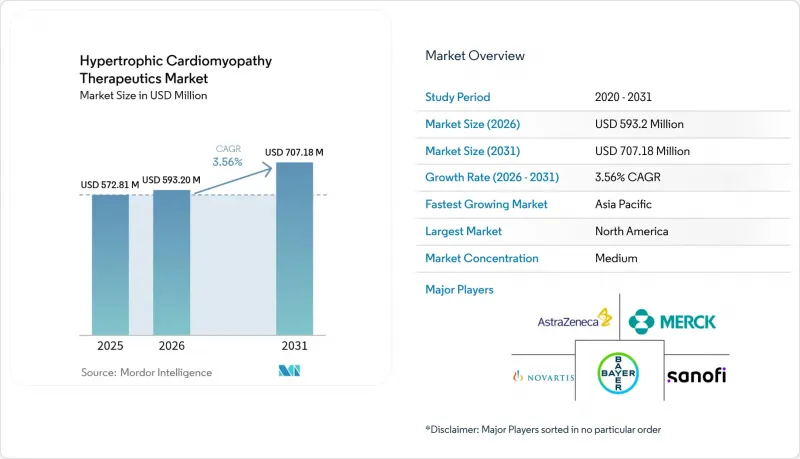
This report is Segmented by Drug Class (Beta-Adrenergic Blocking Agents, Calcium Channel Blockers, and More), Disease Phenotype (Obstructive HCM, Non-Obstructive HCM), Route of Administration (Oral and More), Distribution Channel (Hospital Pharmacies and More), and Geography (North America, and More). The Market Forecasts are Provided in Terms of Value (USD).
Global Hypertrophic Cardiomyopathy Therapeutics Market Trends and Insights
FDA approvals for first-in-class cardiac-myosin inhibitors
Accelerated endorsements for mavacamten and label refinements that cut mandatory echocardiography monitoring from quarterly to biannual intervals improve prescriber confidence and patient convenience . Community cardiologists now feel more comfortable initiating therapy outside specialized centers, broadening access beyond academic hubs. The upcoming aficamten decision, expected in December 2025, may establish a duopoly that tempers price escalation while encouraging evidence-based switching. Such regulatory momentum signals a maturation phase in which mechanistic precision, not symptom palliation, determines standard of care. Nevertheless, the non-obstructive trial miss underscores phenotype-specific complexity that could slow expansive label gambits.
Rising genetic screening and cascade testing of at-risk relatives
Nationwide programs integrating next-generation sequencing with cardiology referral pathways enlarge the diagnosed population and reposition HCM from a late-stage discovery to a proactively managed hereditary condition. Family cascade testing detects asymptomatic carriers earlier, and AI-enhanced ECG tools boasting 94% sensitivity shorten diagnostic odysseys. Asian cohorts, historically underdiagnosed, show rising identification rates as regional payors reimburse panel tests and governments subsidize counseling, reinforcing Asia-Pacific's outsized growth trajectory. Economic ramifications extend to productivity gains when early intervention delays morbidity, supporting payer willingness to finance premium drugs.
Premium pricing and REMS program limiting uptake
An annual therapy cost near USD 90,000 positions mavacamten among the most expensive chronic cardiovascular drugs, restricting adoption in health systems with high patient cost-share burdens. REMS enrollment layers logistical hurdles-specialty pharmacy use, baseline and follow-up echocardiograms, and prescriber certification-that dissuade community physicians. Out-of-pocket costs can exceed USD 10,000 for patients in high-deductible plans, generating a two-tier access dynamic tied to geography and insurance. Even where assistance programs exist, administrative complexity prolongs time-to-therapy, dampening early revenue ramp. Price renegotiations or the arrival of aficamten-driven competition may temper this headwind over the medium term.
Other drivers and restraints analyzed in the detailed report include:
- AI-enabled echocardiography improving diagnosis rates
- Orphan-drug incentives accelerating late-stage pipelines
- Generic beta-blocker competition
For complete list of drivers and restraints, kindly check the Table Of Contents.
Segment Analysis
In 2025, beta-adrenergic blocking agents commanded 37.15% of the hypertrophic cardiomyopathy therapeutics market, reflecting decades of clinical familiarity and broad formulary inclusion. The cardiac myosin inhibitor cohort, although nascent, is set to record a 4.12% CAGR through 2031 as growing physician comfort, guideline integration, and real-world safety validation propel uptake. Premium positioning will likely persist despite competitive entry because mechanistic differentiation supports measurable symptom relief and ventricular remodeling. The hypertrophic cardiomyopathy therapeutics market size for myosin inhibitors is forecast to capture an incremental USD 112.8 million by 2031, offsetting generic erosion in traditional classes.
Second-line classes retain niche relevance. Calcium channel blockers provide an alternative for beta-blocker-intolerant patients, particularly where bradycardia risk is high. Antiarrhythmic use centers on atrial fibrillation management, while anticoagulants expand as physicians increasingly recognize embolic stroke risk in HCM. Gene-therapy and metabolic-modulator pipelines housed within the "Others" segment promise step-change innovation, potentially resetting class hierarchies after 2030. Overall, competitive repositioning around disease modification solidifies the hypertrophic cardiomyopathy therapeutics industry's transition away from purely symptomatic care.
Obstructive HCM retained 59.85% share in 2025, benefiting from well-defined gradients that clearly warrant pharmacologic or surgical intervention. Yet non-obstructive disease is expanding faster, with a projected 4.18% CAGR, fueled by greater awareness, genetic identification, and the clinical void exposed by a pivotal trial miss. The hypertrophic cardiomyopathy therapeutics market size for non-obstructive candidates is small today but represents an attractive white space for next-generation approaches.
The ODYSSEY-HCM setback underscores the need for phenotype-tailored pathways, inviting metabolic or gene-editing interventions that correct distinct molecular drivers . As registries capture richer longitudinal data, precise end-points for non-obstructive efficacy should become clearer, enabling targeted development and premium reimbursement. In the interim, symptomatic control relies on traditional agents, maintaining a dual-tier structure until mechanism-specific efficacy is proven.
Complete Report Scope:
- By Drug Class
- Beta-Adrenergic Blocking Agents
- Calcium Channel Blockers
- Cardiac Myosin Inhibitors
- Antiarrhythmic Agents
- Anticoagulants
- Others
- By Disease Phenotype
- Obstructive HCM (oHCM)
- Non-Obstructive HCM (nHCM)
- By Route of Administration
- Oral
- Parenteral
- Others
- By Distribution Channel
- Hospital Pharmacies
- Retail Pharmacies
- Online Pharmacies
- By Geography
- North America
- United States
- Canada
- Mexico
- Europe
- Germany
- United Kingdom
- France
- Italy
- Spain
- Rest of Europe
- Asia-Pacific
- China
- Japan
- India
- Australia
- South Korea
- Rest of Asia-Pacific
- Middle East and Africa
- GCC
- South Africa
- Rest of Middle East and Africa
- South America
- Brazil
- Argentina
- Rest of South America
- North America
Geography Analysis
North America led the hypertrophic cardiomyopathy therapeutics market with a 40.55% share in 2025, supported by early drug approvals, robust insurance coverage, and a dense network of accredited HCM centers. Adoption, however, is moderating as payers intensify scrutiny of list prices and demand post-marketing evidence linking ventricular remodeling to reduced surgical interventions and hospitalizations. Tele-echocardiography programs are extending specialist oversight to rural areas, mitigating some access disparities, yet overall growth will decelerate relative to emerging regions.
Asia-Pacific is tracking a 4.09% CAGR to 2031, the fastest worldwide, thanks to government-backed genetic testing consortia, expanding echocardiography capacity, and cross-border licensing deals such as LianBio's partnership for mavacamten commercialization. China's tiered hospital reforms, coupled with Japan's early adoption of myosin inhibitors, provide dual growth pillars. Meanwhile, India and Southeast Asia concentrate on upgrading diagnostic hardware, creating a sizeable funnel for future drug uptake once affordability programs mature.
Europe sits between these poles: regulatory alignment through the EMA accelerates multi-country launches, but reimbursement is conditional on country-level cost-effectiveness reviews. Health-technology-assessment agencies in Germany and the United Kingdom demand real-world data, stretching time-to-peak sales yet ultimately reinforcing value-based positioning. Pan-European HCM registries facilitate post-approval commitments, bolstering pharmacovigilance and informing iterative guideline updates.
- Bristol-Myers Squibb
- Cytokinetics
- Novartis
- Pfizer
- Bayer
- Merck
- Sanofi
- Teva Pharmaceutical Industries
- AstraZeneca
- Viatris
- Tenaya Therapeutics
- Imbria Pharmaceuticals
- BridgeBio Pharma
- Mezzion Pharma
- Eli Lilly and Company
- Gilead Sciences
- Daiichi Sankyo Co. Ltd.
- Amgen
- Johnson & Johnson
- Boehringer Ingelheim
- Novo Nordisk
Additional Benefits:
- The market estimate (ME) sheet in Excel format
- 3 months of analyst support
TABLE OF CONTENTS
1 Introduction
- 1.1 Study Assumptions & Market Definition
- 1.2 Scope of the Study
2 Research Methodology
3 Executive Summary
4 Market Landscape
- 4.1 Market Overview
- 4.2 Market Drivers
- 4.2.1 FDA Approvals for First-In-Class Cardiac-Myosin Inhibitors
- 4.2.2 Rising Genetic Screening & Cascade Testing of At-Risk Relatives
- 4.2.3 Growing Prevalence of Obesity & Sedentary Lifestyle
- 4.2.4 Orphan-Drug Incentives Accelerating Late-Stage Pipelines
- 4.2.5 AI-Enabled Echocardiography Improving Diagnosis Rates
- 4.2.6 Payer Shift Toward Outcomes-Based Contracting
- 4.3 Market Restraints
- 4.3.1 Premium Pricing & REMS Program Limiting Uptake
- 4.3.2 Generic Beta-Blocker Competition
- 4.3.3 Uncertain Long-Term Safety Data for Myosin Inhibitors
- 4.3.4 Limited Specialist Prescriber Base for Rare Cardiomyopathies
- 4.4 Regulatory Landscape
- 4.5 Porters Five Forces Analysis
- 4.5.1 Threat of New Entrants
- 4.5.2 Bargaining Power of Buyers
- 4.5.3 Bargaining Power of Suppliers
- 4.5.4 Threat of Substitutes
- 4.5.5 Competitive Rivalry
5 Market Size & Growth Forecasts (Value, USD)
- 5.1 By Drug Class
- 5.1.1 Beta-Adrenergic Blocking Agents
- 5.1.2 Calcium Channel Blockers
- 5.1.3 Cardiac Myosin Inhibitors
- 5.1.4 Antiarrhythmic Agents
- 5.1.5 Anticoagulants
- 5.1.6 Others
- 5.2 By Disease Phenotype
- 5.2.1 Obstructive HCM (oHCM)
- 5.2.2 Non-Obstructive HCM (nHCM)
- 5.3 By Route of Administration
- 5.3.1 Oral
- 5.3.2 Parenteral
- 5.3.3 Others
- 5.4 By Distribution Channel
- 5.4.1 Hospital Pharmacies
- 5.4.2 Retail Pharmacies
- 5.4.3 Online Pharmacies
- 5.5 By Geography
- 5.5.1 North America
- 5.5.1.1 United States
- 5.5.1.2 Canada
- 5.5.1.3 Mexico
- 5.5.2 Europe
- 5.5.2.1 Germany
- 5.5.2.2 United Kingdom
- 5.5.2.3 France
- 5.5.2.4 Italy
- 5.5.2.5 Spain
- 5.5.2.6 Rest of Europe
- 5.5.3 Asia-Pacific
- 5.5.3.1 China
- 5.5.3.2 Japan
- 5.5.3.3 India
- 5.5.3.4 Australia
- 5.5.3.5 South Korea
- 5.5.3.6 Rest of Asia-Pacific
- 5.5.4 Middle East and Africa
- 5.5.4.1 GCC
- 5.5.4.2 South Africa
- 5.5.4.3 Rest of Middle East and Africa
- 5.5.5 South America
- 5.5.5.1 Brazil
- 5.5.5.2 Argentina
- 5.5.5.3 Rest of South America
- 5.5.1 North America
6 Competitive Landscape
- 6.1 Market Concentration
- 6.2 Market Share Analysis
- 6.3 Company Profiles (includes Global level Overview, Market level overview, Core Segments, Financials as available, Strategic Information, Market Rank/Share, Products & Services, Recent Developments)
- 6.3.1 Bristol Myers Squibb
- 6.3.2 Cytokinetics Inc.
- 6.3.3 Novartis AG
- 6.3.4 Pfizer Inc.
- 6.3.5 Bayer AG
- 6.3.6 Merck & Co. Inc.
- 6.3.7 Sanofi S.A.
- 6.3.8 Teva Pharmaceutical Industries Ltd.
- 6.3.9 AstraZeneca plc
- 6.3.10 Viatris
- 6.3.11 Tenaya Therapeutics
- 6.3.12 Imbria Pharmaceuticals
- 6.3.13 BridgeBio Pharma
- 6.3.14 Mezzion Pharma
- 6.3.15 Eli Lilly & Co.
- 6.3.16 Gilead Sciences Inc.
- 6.3.17 Daiichi Sankyo Co. Ltd.
- 6.3.18 Amgen Inc.
- 6.3.19 Johnson & Johnson
- 6.3.20 Boehringer Ingelheim
- 6.3.21 Novo Nordisk A/S
7 Market Opportunities & Future Outlook
- 7.1 White-space & Unmet-need Assessment

