PUBLISHER: Mordor Intelligence | PRODUCT CODE: 2123609

PUBLISHER: Mordor Intelligence | PRODUCT CODE: 2123609
Erotic Lingerie - Market Share Analysis, Industry Trends & Statistics, Growth Forecasts (2026 - 2031)
According to Mordor Intelligence, the erotic lingerie market size was valued at USD 6.24 billion in 2025 and estimated to grow from USD 6.5 billion in 2026 to reach USD 7.95 billion by 2031, at a CAGR of 4.11% during the forecast period (2026-2031).
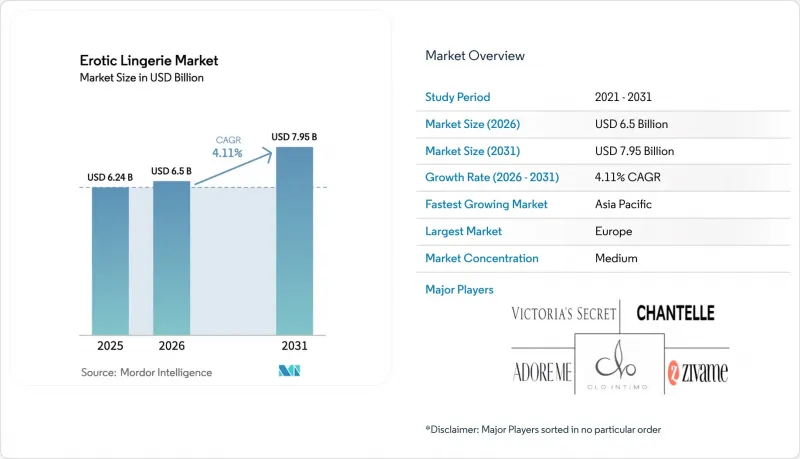
This report is Segmented by Product Type (Bras, Briefs, Bodysuits, and Other Product Types), Category (Mass and Premium), Distribution Channel (Online Stores and Offline Stores), and Geography (North America, Europe, South America, Asia-Pacific, and the Middle East and Africa). The Market Forecasts are Provided in Terms of Value (USD).
Global Erotic Lingerie Market Trends and Insights
Body positivity expanding consumer size inclusivity
Size inclusivity has transitioned from a niche differentiator to a baseline expectation. Savage X Fenty's bra range spans 32A to 46DDD, and underwear extends from XS to 4X, a spectrum that legacy players struggled to match until Victoria's Secret expanded its sizing in 2024 following activist investor pressure from Brett Blundy's BBRC. Wacoal's December 2024 acquisition of Lively for USD 85 million plus contingent payments up to USD 55 million reflects incumbents' recognition that organic innovation lags direct-to-consumer agility in serving diverse body types. The shift also extends to adaptive designs for mastectomy patients and gender-affirming styles, segments that command premium pricing and foster brand loyalty. Retailers report that inclusive sizing drives higher average transaction values as customers purchase multiple items once they find a reliable fit.
Social media and influencer marketing impact
Social media and influencer marketing significantly boost the erotic lingerie market by amplifying brand visibility and shaping consumer preferences through visually engaging content on platforms like Instagram, TikTok, and Pinterest. Influencers lend authenticity and social proof, often increasing trust and driving purchase decisions more effectively than traditional ads, with promoted items sometimes seeing notably higher conversion rates. Their partnerships help normalize intimate apparel, connect brands with diverse audiences, and foster communities centered on body positivity and self-expression. Interactive campaigns, user-generated content, and targeted ads also deepen engagement and loyalty, making social channels key drivers of trend adoption and sales growth in this niche.
High premium product prices deter some buyers
Premium lingerie pricing, often USD 100 to 300 per piece, limits addressable market penetration. La Perla filed for bankruptcy and cycled through ownership by Tennor Holding and Sapinda Asia, struggling to justify luxury price points amid direct-to-consumer alternatives priced lower. Victoria's Secret's premium tier, priced at USD 75 to 150, captured only a small share of its 2025 sales mix, with mass-market offerings at USD 30 to 50 driving volume. Economic headwinds in Europe, where inflation averaged 3.2% in 2025, shifted consumer spending toward essentials, compressing discretionary budgets for intimate apparel, according to the Eurostat. Brands respond by introducing tiered collections: Intimissimi's core line ranges from USD 20 to 60, while its limited-edition collaborations reach USD 120, a strategy that preserves aspirational positioning without alienating price-conscious shoppers.
Other drivers and restraints analyzed in the detailed report include:
- Virtual fitting tech improving online fit confidence
- Shifting cultural acceptance of intimate apparel
- Restrictive advertising regulations hinder promotions
For complete list of drivers and restraints, kindly check the Table Of Contents.
Segment Analysis
Luxury fashion houses embedding bodysuits into ready-to-wear collections propel the segment to 4.34% CAGR through 2031, the fastest pace across all product categories. Bras retain 53.22% of 2025 market share, anchored by wireless innovations that blend comfort with support. MIT's fiber-computer prototypes integrate sensors for breast-cancer monitoring, and Wacoal introduced moisture-wicking, temperature-regulating fabrics in 2024. Sustainable materials gain traction: ECONYL regenerated nylon, organic cotton certified by GOTS (Global Organic Textile Standard) (requiring 70% organic content minimum), and bamboo fibers reduce environmental impact while commanding 15% to 25% price premiums over .
Bodysuits' ascent reflects their versatility, worn alone as tops or layered under blazers, and their flattering silhouette that eliminates tucking and bunching. Brands capitalize by expanding size ranges: Savage X Fenty offers bodysuits from XS to 4X, while Wolford's seamless construction accommodates diverse body types without visible lines. Briefs remain foundational, yet innovation stalls beyond fabric improvements like modal blends and laser-cut edges. Corsets and bustiers, once relegated to special occasions, resurge as outerwear in Gen Z wardrobes, driven by TikTok styling tutorials that amassed 2.3 billion views in 2025. Bras face technical challenges in wireless designs: balancing support for larger cup sizes (DD and above) without underwire requires advanced engineering, a capability that separates premium brands like ThirdLove from mass-market imitators.
Complete Report Scope:
- Product Type
- Bras
- Briefs
- Bodysuits
- Other Types
- Category
- Mass
- Premium
- Distribution Channel
- Offline Stores
- Online Stores
- Geography
- North America
- United States
- Canada
- Mexico
- Rest of North America
- Europe
- Germany
- United Kingdom
- Italy
- France
- Spain
- Netherlands
- Poland
- Belgium
- Sweden
- Rest of Europe
- Asia-Pacific
- China
- India
- Japan
- Australia
- Indonesia
- South Korea
- Thailand
- Singapore
- Rest of Asia-Pacific
- South America
- Brazil
- Argentina
- Colombia
- Chile
- Peru
- Rest of South America
- Middle East and Africa
- South Africa
- Saudi Arabia
- United Arab Emirates
- Nigeria
- Egypt
- Morocco
- Turkey
- Rest of Middle East and Africa
- North America
Geography Analysis
Europe holds 37.21% of 2025 revenue, reflecting mature markets where per-capita lingerie spending averages USD 85 annually, yet Asia-Pacific will expand at 5.27% CAGR through 2031 as rising incomes and cultural shifts unlock latent demand. The broader Asia-Pacific underwear segment, encompassing lingerie, basics, and shapewear, includes contributions from China, India, Japan, Australia, Indonesia, South Korea, Thailand, and Singapore. Wacoal launched in India in 2024, targeting the premium tier with bras priced at INR 2,000 to 4,000, a range that balances aspiration with affordability.
North America, the United States, Canada, and Mexico benefit from direct-to-consumer innovation and influencer-driven discovery, yet face headwinds from department-store closures that historically anchored lingerie distribution. South America (Brazil, Argentina, Colombia, Chile, Peru) and Middle East and Africa (South Africa, Saudi Arabia, UAE (United Arab Emirates), Nigeria, Egypt, Morocco, Turkey) represent emerging opportunities: Ann Summers' March 2025 GCC (Gulf Cooperation Council) partnership with Liwa Trading Enterprises launched knickerbox.ae and a standalone store in July 2025, testing cultural receptivity in markets where intimate apparel traditionally remained private.
In Asia-Pacific, rapid urbanization, expanding middle-class wealth, changing cultural perceptions, and booming online retail make it the fastest-growing market. Latin America sees increasing demand as social media influence, urbanization, and improved digital access expand fashion consciousness. In the Middle East and Africa, growth is emerging from rising urban incomes, greater internet penetration, and discreet online sales that bypass cultural sensitivity barriers. Collectively, these regional drivers reflect economic development, digital adoption, and evolving cultural norms toward self-expression and personal style.
- Ann Summers Ltd
- Victoria's Secret & Co.
- Agent Provocateur
- La Perla
- Savage X Fenty
- Bluebella
- Adore Me
- Honey Birdette
- Fleur du Mal
- Coco de Mer
- Hunkemoller International
- Cosabella
- Oh La La Cheri
- Frederick's of Hollywood
- Trashy Lingerie
- Yandy
- Bondara
- Intimissimi
- Groupe Chantelle
- Zivame
Additional Benefits:
- The market estimate (ME) sheet in Excel format
- 3 months of analyst support
TABLE OF CONTENTS
1 INTRODUCTION
- 1.1 Study Assumptions and Market Definition
- 1.2 Scope of the Study
2 RESEARCH METHODOLOGY
3 EXECUTIVE SUMMARY
4 MARKET LANDSCAPE
- 4.1 Market Overview
- 4.2 Market Drivers
- 4.2.1 Shifting cultural acceptance of intimate apparel
- 4.2.2 Body positivity expanding consumer size inclusivity
- 4.2.3 Social media and influencer marketing impact
- 4.2.4 Virtual fitting tech improving online fit confidence
- 4.2.5 Celebrity collaborations boosting brand visibility
- 4.2.6 Growth of online retail and e-commerce
- 4.3 Market Restraints
- 4.3.1 High premium product prices deter some buyers
- 4.3.2 Restrictive advertising regulations hinder promotions
- 4.3.3 Counterfeit products undermine brand trust
- 4.3.4 Intense competition reduces differentiation opportunities
- 4.4 Consumer Demand Analysis
- 4.5 Regulatory Landscape
- 4.6 Technological Outlook
- 4.7 Porters Five Forces
- 4.7.1 Threat of New Entrants
- 4.7.2 Bargaining Power of Buyers
- 4.7.3 Bargaining Power of Suppliers
- 4.7.4 Threat of Substitutes
- 4.7.5 Competitive Rivalry
5 MARKET SIZE AND GROWTH FORECASTS (VALUE)
- 5.1 Product Type
- 5.1.1 Bras
- 5.1.2 Briefs
- 5.1.3 Bodysuits
- 5.1.4 Other Types
- 5.2 Category
- 5.2.1 Mass
- 5.2.2 Premium
- 5.3 Distribution Channel
- 5.3.1 Offline Stores
- 5.3.2 Online Stores
- 5.4 Geography
- 5.4.1 North America
- 5.4.1.1 United States
- 5.4.1.2 Canada
- 5.4.1.3 Mexico
- 5.4.1.4 Rest of North America
- 5.4.2 Europe
- 5.4.2.1 Germany
- 5.4.2.2 United Kingdom
- 5.4.2.3 Italy
- 5.4.2.4 France
- 5.4.2.5 Spain
- 5.4.2.6 Netherlands
- 5.4.2.7 Poland
- 5.4.2.8 Belgium
- 5.4.2.9 Sweden
- 5.4.2.10 Rest of Europe
- 5.4.3 Asia-Pacific
- 5.4.3.1 China
- 5.4.3.2 India
- 5.4.3.3 Japan
- 5.4.3.4 Australia
- 5.4.3.5 Indonesia
- 5.4.3.6 South Korea
- 5.4.3.7 Thailand
- 5.4.3.8 Singapore
- 5.4.3.9 Rest of Asia-Pacific
- 5.4.4 South America
- 5.4.4.1 Brazil
- 5.4.4.2 Argentina
- 5.4.4.3 Colombia
- 5.4.4.4 Chile
- 5.4.4.5 Peru
- 5.4.4.6 Rest of South America
- 5.4.5 Middle East and Africa
- 5.4.5.1 South Africa
- 5.4.5.2 Saudi Arabia
- 5.4.5.3 United Arab Emirates
- 5.4.5.4 Nigeria
- 5.4.5.5 Egypt
- 5.4.5.6 Morocco
- 5.4.5.7 Turkey
- 5.4.5.8 Rest of Middle East and Africa
- 5.4.1 North America
6 COMPETITIVE LANDSCAPE
- 6.1 Market Concentration
- 6.2 Strategic Moves
- 6.3 Market Share Analysis
- 6.4 Company Profiles (includes Global level Overview, Market level overview, Core Segments, Financials as available, Strategic Information, Market Rank/Share for key companies, Products and Services, and Recent Developments)
- 6.4.1 Ann Summers Ltd
- 6.4.2 Victoria's Secret & Co.
- 6.4.3 Agent Provocateur
- 6.4.4 La Perla
- 6.4.5 Savage X Fenty
- 6.4.6 Bluebella
- 6.4.7 Adore Me
- 6.4.8 Honey Birdette
- 6.4.9 Fleur du Mal
- 6.4.10 Coco de Mer
- 6.4.11 Hunkemoller International
- 6.4.12 Cosabella
- 6.4.13 Oh La La Cheri
- 6.4.14 Frederick's of Hollywood
- 6.4.15 Trashy Lingerie
- 6.4.16 Yandy
- 6.4.17 Bondara
- 6.4.18 Intimissimi
- 6.4.19 Groupe Chantelle
- 6.4.20 Zivame
7 MARKET OPPORTUNITIES AND FUTURE OUTLOOK

