PUBLISHER: Mordor Intelligence | PRODUCT CODE: 2125497

PUBLISHER: Mordor Intelligence | PRODUCT CODE: 2125497
North America Lingerie - Market Share Analysis, Industry Trends & Statistics, Growth Forecasts (2026 - 2031)
According to Mordor Intelligence, the North America lingerie market size in 2026 is estimated at USD 15.21 billion, growing from 2025 value of USD 14.58 billion with 2031 projections showing USD 18.75 billion, growing at 4.28% CAGR over 2026-2031.
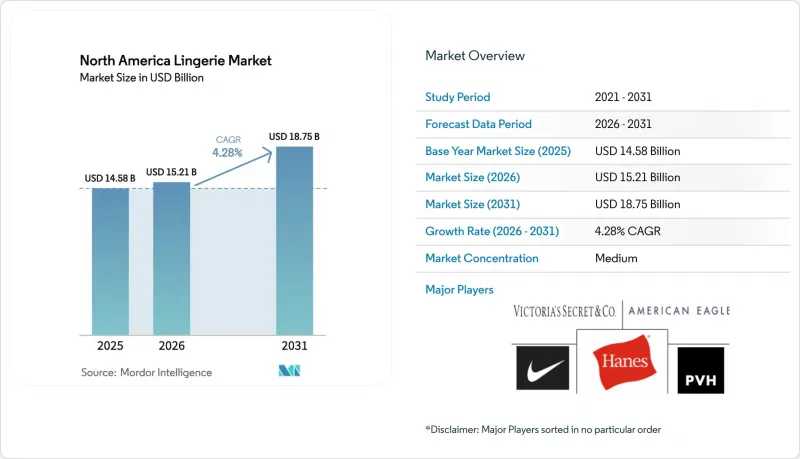
This report is Segmented by Product Type (Brassiere, Briefs, and Other Product Types), Price Range (Mass and Premium), Material (Cotton, Silk, and Satin, and More), Distribution Channel (Supermarkets/Hypermarkets, and More), and Geography (United States, Canada, Mexico, and Rest of North America). The Market Forecasts are Provided in Terms of Value (USD).
North America Lingerie Market Trends and Insights
Demand for Comfortable and Stylish Lingerie
The convergence of comfort and style represents a fundamental shift in consumer priorities, moving beyond traditional aesthetic-focused purchasing decisions toward functionality-driven choices. This trend gained significant momentum during the pandemic as remote work normalized comfort-first apparel, with consumers increasingly refusing to compromise between appearance and wearability. The LYCRA Company's ADAPTIV fiber technology exemplifies this evolution, delivering dynamic compression that adapts to movement while maintaining shaping properties, addressing the core tension between support and comfort. American Eagle's Aerie brand capitalized on this shift, achieving record quarterly revenue of USD 539.7 million in Q4 2024 through collections emphasizing soft fabrics and wireless designs that prioritize comfort without sacrificing style. This driver particularly impacts the premium segment, where consumers demonstrate willingness to pay higher prices for innovative materials and construction techniques that deliver superior comfort. The trend extends beyond product features to encompass brand messaging, with successful companies positioning comfort as a form of self-care rather than compromise.
Growth of Body Positivity and Size Inclusivity
The body positivity movement has evolved from social activism into a core business imperative, fundamentally reshaping product development, marketing strategies, and brand positioning across the industry. This transformation extends beyond expanded size ranges to encompass inclusive design principles, diverse representation in marketing campaigns, and the rejection of traditional beauty standards that historically dominated lingerie advertising. American Eagle's Aerie brand demonstrates the commercial viability of this approach, achieving 21 consecutive quarters of double-digit comparable sales growth through 2024 by embracing unretouched photography and size inclusivity. The movement's impact transcends marketing aesthetics, driving substantive changes in product development processes, with brands investing in fit studies across diverse body types and expanding size ranges to accommodate previously underserved segments. Research indicates that over one-third of women fall between standard cup sizes, creating significant market opportunities for brands offering half-cup sizing and personalized fit solutions. This driver particularly benefits direct-to-consumer brands that can rapidly iterate product offerings based on customer feedback and data analytics.
Proliferation of Counterfeit and Low-Quality Products
Counterfeit intimate apparel poses multifaceted challenges encompassing consumer safety, brand integrity, and market share erosion, with enforcement complexity amplified by cross-border e-commerce and sophisticated distribution networks. U.S. Customs and Border Protection seized counterfeit goods worth nearly USD 1.3 billion in fiscal 2020, with wearing apparel and accessories representing 26.2% of seizure lines by count, indicating the scale of illicit trade affecting legitimate market participants . The largest-ever counterfeit goods seizure in U.S. history occurred in 2023, involving approximately 219,000 items with an estimated manufacturer's suggested retail price of about USD 1.03 billion, demonstrating the sophisticated operations undermining authentic brands . E-commerce platforms facilitate counterfeit distribution, with over 90% of intellectual property rights seizures occurring in international mail and express shipments, complicating enforcement efforts and consumer protection. The restraint particularly impacts premium brands whose higher price points create attractive targets for counterfeiters, while consumer safety concerns arise from substandard materials that may not meet flammability standards required under the Consumer Product Safety Commission's Flammable Fabrics Act .
Other drivers and restraints analyzed in the detailed report include:
- Impact of Social Media and Influencer Marketing
- Innovations in Fabric and Design Technology
- Rapidly Changing Fashion Trends
For complete list of drivers and restraints, kindly check the Table Of Contents.
Segment Analysis
Brassieres command 52.05% market share in 2025, reflecting their fundamental role in women's wardrobes and the category's continued innovation in comfort, support, and style integration. However, briefs emerge as the fastest-growing segment with 4.96% CAGR through 2031, driven by technological advances in moisture-wicking fabrics, seamless construction, and body-positive sizing approaches that address previously underserved market segments. The brassiere segment's dominance stems from higher average selling prices and frequent replacement cycles, with consumers increasingly willing to invest in premium options that deliver superior fit and comfort. Victoria's Secret's Dream Collection launch in 2024, featuring ForeverStretch Lace and Marshmallow Memory Foam padding across sizes 32-40 bands and A-G cups, illustrates how established players are innovating within traditional categories to maintain market leadership.
Other product types, including shapewear, loungewear, and specialty items, represent emerging opportunities as consumer preferences expand beyond traditional intimate apparel categories. The convergence of activewear and intimate apparel has created hybrid products that serve multiple functions, appealing to consumers seeking versatility and value in their purchases. Nike's development of pump-compatible sports bras demonstrates how major brands are expanding into specialized segments that address specific consumer needs while commanding premium pricing. Regulatory compliance factors, particularly Consumer Product Safety Commission flammability standards under 16 CFR Part 1610, influence product development across all segments, requiring manufacturers to ensure materials meet safety requirements while maintaining aesthetic and functional properties.
The mass market segment maintains 70.18% share in 2025, reflecting the broad consumer base seeking accessible pricing for essential intimate apparel, yet premium offerings surge ahead with 6.05% CAGR, indicating significant opportunities for brands that successfully differentiate through quality, innovation, and brand positioning. This divergence reflects a bifurcating market where value-conscious consumers gravitate toward functional, affordable options while a growing segment prioritizes premium features, sustainable materials, and personalized experiences worth higher price points. American Eagle's Aerie brand exemplifies successful premium positioning within accessible luxury, achieving record revenues through inclusive sizing, body-positive messaging, and quality construction that justifies price premiums over fast fashion alternatives.
Victoria's Secret's collaboration with designer Joseph Altuzarra, launching limited-edition pieces priced between USD 95-500, demonstrates how established brands are exploring ultra-premium segments to capture consumers willing to pay luxury prices for exclusive designs and superior craftsmanship. The premium segment's growth trajectory benefits from technological innovations like LYCRA ADAPTIV fiber, which enables brands to deliver measurable performance improvements that justify higher pricing through enhanced comfort and durability. Direct-to-consumer brands particularly benefit from this trend, as they can capture the full margin structure while investing in premium materials, innovative construction techniques, and personalized customer experiences that traditional wholesale models cannot economically support.
Complete Report Scope:
- By Product Type
- Brassiere
- Briefs
- Other Product Types
- By Price Range
- Mass
- Premium
- By Material
- Cotton
- Silk and Satin
- Synthetic
- Recycled and Bio-based Fibers
- By Distribution Channel
- Supermarkets/Hypermarkets
- Specialty Stores
- Online Retail Stores
- Other Distribution Channels
- By Geography
- United States
- Canada
- Mexico
- Rest of North America
List of Companies Covered in this Report:
- PVH Corp.
- Nike Inc.
- Victoria's Secret & Co.
- HANESBRANDS INC.
- AEO Management Co.
- Jockey International Inc.
- The Gap Inc.
- ThirdLove LLC
- Savage X Fenty (Kendo Holdings)
- Natori Company Incorporated
- La Perla Group
- Calvin Klein
- Triumph International Ltd.
- Hunkemoller
- Bare Necessities
- Agent Provocateur
- Clovia
- MAS Holdings
- Amante
- The Lingerie Company
Additional Benefits:
- The market estimate (ME) sheet in Excel format
- 3 months of analyst support
TABLE OF CONTENTS
1 INTRODUCTION
- 1.1 Study Assumptions and Market Definition
- 1.2 Scope of the Study
2 RESEARCH METHODOLOGY
3 EXECUTIVE SUMMARY
4 MARKET LANDSCAPE
- 4.1 Market Overview
- 4.2 Market Drivers
- 4.2.1 Demand for Comfortable and Stylish Lingerie
- 4.2.2 Growth of Body Positivity and Size Inclusivity
- 4.2.3 Impact of Social Media and Influencer Marketing
- 4.2.4 Rising Focus on Sustainability and Eco-friendly Materials
- 4.2.5 Innovations in Fabric and Design Technology
- 4.2.6 Expansion of E-Commerce and Online Sales
- 4.3 Market Restraints
- 4.3.1 Competition from Fast Fashion and Private Labels
- 4.3.2 Proliferation of Counterfeit and Low-Quality Products
- 4.3.3 Fit-related Concerns in Online Purchases
- 4.3.4 Rapidly Changing Fashion Trends
- 4.4 Consumer Behaviour Analysis
- 4.5 Regulatory Landscape
- 4.6 Porter's Five Forces
- 4.6.1 Threat of New Entrants
- 4.6.2 Bargaining Power of Buyers
- 4.6.3 Bargaining Power of Suppliers
- 4.6.4 Threat of Substitutes
- 4.6.5 Competitive Rivalry
5 MARKET SIZE AND GROWTH FORECASTS (VALUE)
- 5.1 By Product Type
- 5.1.1 Brassiere
- 5.1.2 Briefs
- 5.1.3 Other Product Types
- 5.2 By Price Range
- 5.2.1 Mass
- 5.2.2 Premium
- 5.3 By Material
- 5.3.1 Cotton
- 5.3.2 Silk and Satin
- 5.3.3 Synthetic
- 5.3.4 Recycled and Bio-based Fibers
- 5.4 By Distribution Channel
- 5.4.1 Supermarkets/Hypermarkets
- 5.4.2 Specialty Stores
- 5.4.3 Online Retail Stores
- 5.4.4 Other Distribution Channels
- 5.5 By Geography
- 5.5.1 United States
- 5.5.2 Canada
- 5.5.3 Mexico
- 5.5.4 Rest of North America
6 COMPETITIVE LANDSCAPE
- 6.1 Market Concentration
- 6.2 Strategic Moves
- 6.3 Market Share Analysis
- 6.4 Company Profiles (includes Global level Overview, Market level overview, Core Segments, Financials as available, Strategic Information, Market Rank/Share for key companies, Products and Services, and Recent Developments)
- 6.4.1 PVH Corp.
- 6.4.2 Nike Inc.
- 6.4.3 Victoria's Secret & Co.
- 6.4.4 HANESBRANDS INC.
- 6.4.5 AEO Management Co.
- 6.4.6 Jockey International Inc.
- 6.4.7 The Gap Inc.
- 6.4.8 ThirdLove LLC
- 6.4.9 Savage X Fenty (Kendo Holdings)
- 6.4.10 Natori Company Incorporated
- 6.4.11 La Perla Group
- 6.4.12 Calvin Klein
- 6.4.13 Triumph International Ltd.
- 6.4.14 Hunkemoller
- 6.4.15 Bare Necessities
- 6.4.16 Agent Provocateur
- 6.4.17 Clovia
- 6.4.18 MAS Holdings
- 6.4.19 Amante
- 6.4.20 The Lingerie Company
7 MARKET OPPORTUNITIES AND FUTURE OUTLOOK

