PUBLISHER: Mordor Intelligence | PRODUCT CODE: 2123632

PUBLISHER: Mordor Intelligence | PRODUCT CODE: 2123632
Chronic Myelogenous Leukemia Treatment - Market Share Analysis, Industry Trends & Statistics, Growth Forecasts (2026 - 2031)
According to Mordor Intelligence, the chronic myelogenous leukemia treatment market size is expected to increase from USD 7.70 billion in 2025 to USD 7.98 billion in 2026 and reach USD 10.40 billion by 2031, growing at a CAGR of 5.43% over 2026-2031.
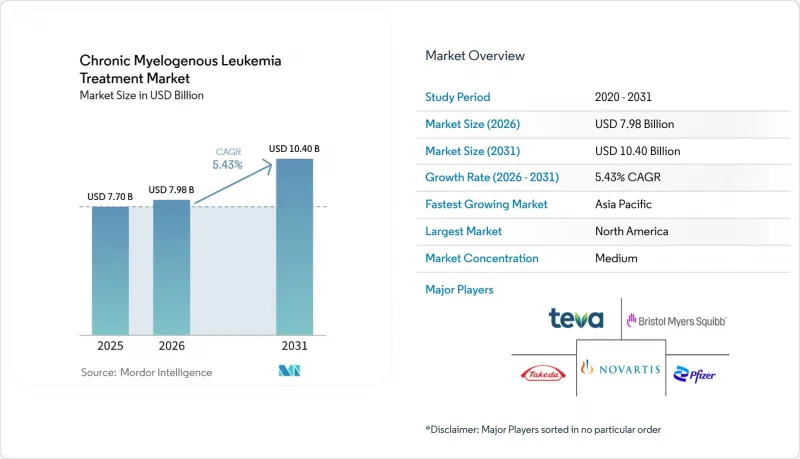
This report is Segmented by Treatment Type (Targeted Therapy, Chemotherapy, and More), Line of Therapy (First-Line, Second-Line and More), Route of Administration (Oral, Intravenous and More), Distribution Channel (Hospital Pharmacies, Retail Pharmacies and More), Patient Age Group (Pediatric, Adults and More) and Geography. The Market Forecasts are Provided in Terms of Value (USD).
Global Chronic Myelogenous Leukemia Treatment Market Trends and Insights
Rising Incidence & Prevalence of CML
Global CML diagnoses are expanding alongside aging demographics, with 8,930 new U.S. cases anticipated in 2024. Earlier detection through routine blood tests leads to more chronic-phase presentations that respond favorably to TKIs. Improved survival enlarges the prevalent patient pool requiring long-term therapy, while underdiagnosis in low- and middle-income countries (LMICs) leaves room for significant future growth. Healthcare systems in Europe and North America already integrate molecular diagnostics as standard of care, setting the stage for similar penetration in Asia Pacific as laboratory infrastructure matures.
Breakthroughs in Next-Gen TKIs
The FDA's 2024 accelerated approval of asciminib for newly diagnosed patients showcases a novel myristoyl-pocket mechanism that achieved a 68% major molecular response versus 49% with comparator TKIs.Mutation-specific agents like olverembatinib address difficult T315I resistance and received breakthrough status in China, signaling a pipeline pivot toward precision targeting that curtails off-target toxicity.
Off-Target Toxicities & Cardiovascular Events with Multi-TKIs
Nilotinib and ponatinib have been linked to arterial events that necessitate baseline cardiovascular risk assessments and frequent monitoring. Sequential TKI use compounds risk, prompting interest in earlier TFR or alternative mutation-specific drugs that offer narrower kinase inhibition profiles.
Other drivers and restraints analyzed in the detailed report include:
- Escalating R&D Funding & Clinical-Trial Volume
- Shift Toward Treatment-Free Remission (TFR) Protocols
- Stringent Regulatory & Pharmacovigilance Requirements
For complete list of drivers and restraints, kindly check the Table Of Contents.
Segment Analysis
Targeted therapy secured 91.39% revenue in 2025 in the Chronic Myelogenous Leukemia Treatment market and chemotherapy segment growing at 6.53% CAGR through 2031. Widespread physician familiarity, broad guideline inclusion, and deep molecular response rates maintain its primacy. Biologic therapy, while representing a smaller segment, is projected to register the highest growth rate owing to increasing clinical interest in interferon-based combination regimens and treatment-free remission (TFR) strategies. The Chronic Myelogenous Leukemia Treatment market size for biologic therapies is expected to expand as studies demonstrate their ability to deepen molecular responses and support sustained remission. Growing adoption of pegylated interferon therapies alongside TKIs, particularly in patients pursuing long-term disease control and potential TFR, is expected to drive segment growth over the forecast period.
Stem-cell transplantation retains curative potential with 80% five-year disease-free survival in chronic-phase recipients, yet its share shrinks as TKIs mitigate early progression. Post-transplant cyclophosphamide broadens donor pools, particularly benefitting genetically diverse populations. Chemotherapy remains limited to blast-phase crises, while monoclonal antibodies aimed at CD20 and other markers advance through early trials.
First-line regimens held 53.38% of the Chronic Myelogenous Leukemia Treatment market share in 2025, anchored by imatinib's longevity and wider availability of 2G alternatives. Second-line therapies are forecast for 5.72% CAGR as resistance mutations accumulate over extended patient lifespans. NCCN guidelines increasingly tailor initial TKI choice to Sokal or ELTS risk scores, age, and comorbidity burden. Mutation-guided sequencing with asciminib and olverembatinib is set to lift third-line uptake. The Chronic Myelogenous Leukemia Treatment market size for later-line settings is projected to reach new highs as clinicians adopt combination and mutation-specific regimens.
Complete Report Scope:
- By Treatment Type
- Targeted Therapy
- Chemotherapy
- Biologic Therapy
- Stem Cell Transplantation
- Other Treatment Types
- By Line of Therapy
- First-line
- Second-line
- Third-line & Beyond
- By Route of Administration
- Oral
- Intravenous
- Subcutaneous
- By Distribution Channel
- Hospital Pharmacies
- Retail Pharmacies
- Online Pharmacies
- Specialty Clinics
- By Patient Age Group
- Pediatric
- Adults
- Geriatric
- By Geography
- North America
- United States
- Canada
- Mexico
- Europe
- Germany
- United Kingdom
- France
- Italy
- Spain
- Rest of Europe
- Asia-Pacific
- China
- Japan
- India
- Australia
- South Korea
- Rest of Asia-Pacific
- Middle East and Africa
- GCC
- South Africa
- Rest of Middle East and Africa
- South America
- Brazil
- Argentina
- Rest of South America
- North America
Geography Analysis
North America held 42.20% of global revenue in 2025, supported by early FDA approvals, comprehensive insurance coverage, and the world's highest density of molecular labs. U.S. academic hubs pioneer TFR studies and combination trials that set clinical benchmarks worldwide. Canadian universal coverage widens TKI access, though adoption of brand-new agents can lag due to provincial formulary reviews.
Asia Pacific leads future growth at an 6.25% CAGR. China fast-tracks breakthrough therapies through the National Reimbursement Drug List, while India leverages rising private insurance penetration to pay for TKIs. Japan's super-aged society sustains steady demand, and South Korea's precision-medicine initiatives promote AI-based monitoring. Regional disparities persist: rural areas in India and Indonesia still lack real-time PCR capacity, delaying optimal therapy adjustments.
Europe constitutes a mature but innovation-friendly arena. Project Orbis collaboration allows simultaneous EMA-FDA reviews, shrinking access gaps. Germany and the United Kingdom spearhead adaptive trial designs, whereas budget constraints in Southern Europe can slow uptake of premium therapies. The Middle East and Africa remain nascent markets whose expansion hinges on lab-network investments and donor-funded medication programs.
- Novartis
- Bristol-Myers Squibb
- Pfizer
- Takeda Pharmaceuticals
- Incyte Corp.
- Merck
- Roche
- Sanofi
- Boehringer Ingelheim
- Teva Pharmaceutical Industries
- Viatris
- Cipla
- Amneal Pharmaceuticals
- Accord Healthcare
- Fresenius
- Ascentage Pharma Group Corp.
- Hansoh Pharmaceutical Group Co. Ltd.
- Sun Pharma Industries Ltd.
- Dr. Reddy's Laboratories Ltd.
- Hikma Pharmaceuticals
Additional Benefits:
- The market estimate (ME) sheet in Excel format
- 3 months of analyst support
TABLE OF CONTENTS
1 Introduction
- 1.1 Study Assumptions and Market Definition
- 1.2 Scope of the Study
2 Research Methodology
3 Executive Summary
4 Market Landscape
- 4.1 Market Overview
- 4.2 Market Drivers
- 4.2.1 Rising Incidence & Prevalence Of CML
- 4.2.2 Breakthroughs In Next-Gen TKIs
- 4.2.3 Escalating R&D Funding & Clinical-Trial Volume
- 4.2.4 Shift Toward Treatment-Free Remission (TFR) Protocols
- 4.2.5 Imminent Wave Of Generic 2G TKIs Reducing Therapy Cost
- 4.2.6 AI-Enabled Molecular Monitoring For Dose Optimisation
- 4.3 Market Restraints
- 4.3.1 Off-Target Toxicities & Cardiovascular Events With Multi-Tkis
- 4.3.2 Stringent Regulatory & Pharmacovigilance Requirements
- 4.3.3 Rising Real-World TKI Resistance From Poor Adherence
- 4.3.4 Inadequate Molecular-Monitoring Access In LMICs
- 4.4 Value / Supply-Chain Analysis
- 4.5 Regulatory Landscape
- 4.6 Technology Outlook
- 4.7 Porter's Five Forces Analysis
- 4.7.1 Bargaining Power of Suppliers
- 4.7.2 Bargaining Power of Buyers
- 4.7.3 Threat of New Entrants
- 4.7.4 Threat of Substitutes
- 4.7.5 Intensity of Competitive Rivalry
5 Market Size and Growth Forecasts (Value-USD)
- 5.1 By Treatment Type
- 5.1.1 Targeted Therapy
- 5.1.2 Chemotherapy
- 5.1.3 Biologic Therapy
- 5.1.4 Stem Cell Transplantation
- 5.1.5 Other Treatment Types
- 5.2 By Line of Therapy
- 5.2.1 First-line
- 5.2.2 Second-line
- 5.2.3 Third-line & Beyond
- 5.3 By Route of Administration
- 5.3.1 Oral
- 5.3.2 Intravenous
- 5.3.3 Subcutaneous
- 5.4 By Distribution Channel
- 5.4.1 Hospital Pharmacies
- 5.4.2 Retail Pharmacies
- 5.4.3 Online Pharmacies
- 5.4.4 Specialty Clinics
- 5.5 By Patient Age Group
- 5.5.1 Pediatric
- 5.5.2 Adults
- 5.5.3 Geriatric
- 5.6 By Geography
- 5.6.1 North America
- 5.6.1.1 United States
- 5.6.1.2 Canada
- 5.6.1.3 Mexico
- 5.6.2 Europe
- 5.6.2.1 Germany
- 5.6.2.2 United Kingdom
- 5.6.2.3 France
- 5.6.2.4 Italy
- 5.6.2.5 Spain
- 5.6.2.6 Rest of Europe
- 5.6.3 Asia-Pacific
- 5.6.3.1 China
- 5.6.3.2 Japan
- 5.6.3.3 India
- 5.6.3.4 Australia
- 5.6.3.5 South Korea
- 5.6.3.6 Rest of Asia-Pacific
- 5.6.4 Middle East and Africa
- 5.6.4.1 GCC
- 5.6.4.2 South Africa
- 5.6.4.3 Rest of Middle East and Africa
- 5.6.5 South America
- 5.6.5.1 Brazil
- 5.6.5.2 Argentina
- 5.6.5.3 Rest of South America
- 5.6.1 North America
6 Competitive Landscape
- 6.1 Market Concentration
- 6.2 Market Share Analysis
- 6.3 Company profiles (includes Global level Overview, Market level overview, Core Segments, Financials as available, Strategic Information, Market Rank/Share for key companies, Products and Services, and Recent Developments)
- 6.3.1 Novartis AG
- 6.3.2 Bristol Myers Squibb Co.
- 6.3.3 Pfizer Inc.
- 6.3.4 Takeda Pharmaceutical Co. Ltd.
- 6.3.5 Incyte Corp.
- 6.3.6 Merck & Co., Inc.
- 6.3.7 F. Hoffmann-La Roche Ltd.
- 6.3.8 Sanofi SA
- 6.3.9 Boehringer Ingelheim GmbH
- 6.3.10 Teva Pharmaceutical Industries Ltd.
- 6.3.11 Viatris Inc.
- 6.3.12 Cipla Ltd.
- 6.3.13 Amneal Pharmaceuticals LLC
- 6.3.14 Accord Healthcare Inc.
- 6.3.15 Fresenius Kabi AG
- 6.3.16 Ascentage Pharma Group Corp.
- 6.3.17 Hansoh Pharmaceutical Group Co. Ltd.
- 6.3.18 Sun Pharma Industries Ltd.
- 6.3.19 Dr. Reddy's Laboratories Ltd.
- 6.3.20 Hikma Pharmaceuticals plc
7 Market Opportunities and Future Outlook
- 7.1 White-Space and Unmet-Need Assessment

