PUBLISHER: Mordor Intelligence | PRODUCT CODE: 2123685

PUBLISHER: Mordor Intelligence | PRODUCT CODE: 2123685
High-Performance Liquid Chromatography (HPLC) - Market Share Analysis, Industry Trends & Statistics, Growth Forecasts (2026 - 2031)
According to Mordor Intelligence, the high-Performance liquid chromatography market size is expected to grow from USD 5.44 billion in 2025 to USD 5.62 billion in 2026 and is forecast to reach USD 7.01 billion by 2031 at 4.49% CAGR over 2026-2031.
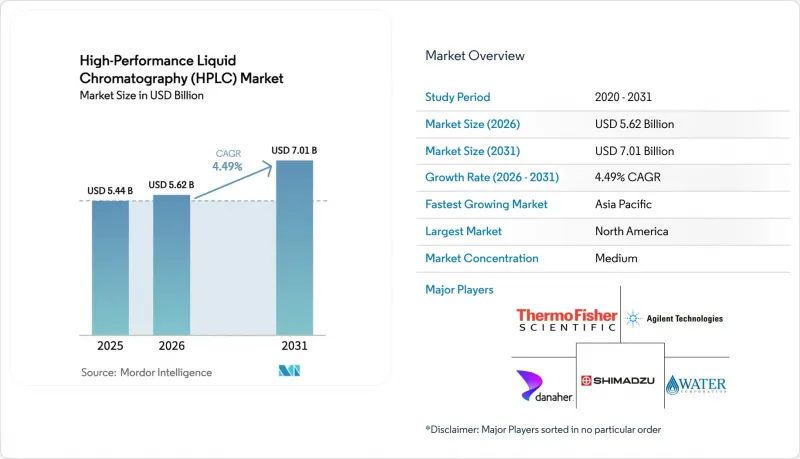
This report is Segmented by Product Type (Instruments, Consumables, Accessories), Application (Pharmaceutical & Biotechnology Research, and More), Separation Mode (Reverse-Phase, and More), Detection Method (UV/Vis, and More), End-User (Pharmaceutical & Biotechnology Companies, and More), and Geography (North America, and More). The Market Forecasts are Provided in Terms of Value (USD).
Global High-Performance Liquid Chromatography (HPLC) Market Trends and Insights
Rising Demand for Biopharmaceuticals & Monoclonal Antibodies
Eighteen monoclonal antibodies won FDA approval in 2024, sustaining a pipeline that now depends on multi-column purification trains combining affinity, ion-exchange, and size-exclusion modes to assure 99% purity thresholds. Contract manufacturers without in-house method-development talent are therefore acquiring complete HPLC workstations bundled with vendor service contracts covering validation and lifecycle support. Biosimilar producers in India and China face 18-month bioequivalence windows that reward validated UHPLC methods over legacy protocols, compressing buying cycles for high-throughput instruments. EMA's 2025 revision of ICH Q6B now compels orthogonal glycosylation confirmation, driving demand for dual-detector configurations that pair UV with fluorescence or mass spectrometry. Cell- and gene-therapy vectors require quantification of residual plasmid DNA at parts-per-billion levels, catalyzing column innovation toward sub-2 µm particle beds that withstand 18,000 psi operating pressures. Collectively, these factors enlarge the High-Performance Liquid Chromatography market footprint in bioprocess analytics.
Increasing Adoption in Food Safety & Environmental Testing
The U.S. FDA's final preventive-controls rule added mandatory mycotoxin screening for imported grains, triggering around 2,500 instrument placements across border laboratories in 2024. China released 47 new food-safety standards in 2025, most citing HPLC as the reference technique for pesticides, thereby shifting provincial budgets toward columns and solvent packs rather than gas-chromatography alternatives. The European Union incorporated HPLC-MS into its 2024 Drinking Water Directive update to monitor PFAS compounds that lack chromophores. Brazil now obliges aflatoxin verification in coffee exports using HPLC, illustrating how emerging economies retrofit facilities to meet EU thresholds, which in turn fertilizes regional demand in the High-Performance Liquid Chromatography market. Authenticity testing for olive oil and honey further expands column throughput by applying chromatographic fingerprints to verify geographic origin for premium labeling.
High Cost of Instruments & Maintenance
Entry-level systems priced at USD 40,000 escalate to >USD 250,000 when mass-spectrometry compatibility and CFR Part 11 software are included, intimidating small labs in emerging economies. Annual service contracts add another 8-12% of purchase price, yet forgoing OEM maintenance often voids warranties and jeopardizes regulatory compliance. High-throughput sites may burn through 30 columns per year at USD 500-1,500 each, lifting total ownership above USD 500,000 across ten years, a barrier that stretches replacement cycles and dampens High-Performance Liquid Chromatography market growth. Lease-to-own models offer relief but impose interest costs near 8%, and clauses frequently restrict buyers to vendor consumables.
Other drivers and restraints analyzed in the detailed report include:
- Growing Prominence of UHPLC for High-Throughput Screening
- Advances in Microfluidic / Chip-Based HPLC Platforms
- Shortage of Skilled Chromatographers
For complete list of drivers and restraints, kindly check the Table Of Contents.
Segment Analysis
Consumables are projected to grow at 8.26% through 2031, nearly twice the overall High-Performance Liquid Chromatography market. Column turnover every 200-500 injections, solvent consumption that averages 10-20 L of acetonitrile weekly, and proprietary buffer packs together reinforce a steady consumable pull. The instruments segment, which captured 48.25% in 2025, expands more slowly because robust UHPLC chassis remain serviceable for >10 years with regular maintenance.
Column innovations extend lifetime by up to 50%, yet higher UHPLC pressures hasten wear, ensuring recurring demand. Accessories-autosamplers, degassers, column ovens-add incremental upgrades as labs retrofit legacy systems for data-integrity compliance. Vendors leveraging razor-and-blade economics secure durable footholds in the High-Performance Liquid Chromatography market, especially when validated methods embed exclusive column chemistries.
Food and beverage testing advances at 7.23% CAGR to 2031, driven by import regulations, contamination scandals, and authenticity verification. Pharmaceutical and biotechnology research still represents the single largest slice at 37.47% in 2025, but its share erodes as generic competition compresses R&D budgets and biologics rely on orthogonal analytics.
Clinical diagnostics grows slowly because point-of-care immunoassays replace many HPLC tests, relegating chromatography to specialist panels. Environmental monitoring remains stable, while forensic labs expand usage for seized-drug profiling and toxicology. Demand diversification cushions the High-Performance Liquid Chromatography market against cyclical swings in pharmaceutical capital expenditure.
Complete Report Scope:
- By Product Type
- Instruments
- Consumables
- Accessories
- By Application
- Pharmaceutical & Biotechnology Research
- Clinical Diagnostics
- Food & Beverage Testing
- Environmental Analysis
- Forensic Science
- Other Industrial Applications
- By Separation Mode
- Reverse-Phase HPLC
- Ion-Exchange HPLC
- Size-Exclusion HPLC
- Affinity HPLC
- Hydrophobic-Interaction HPLC
- Other Modes
- By Detection Method
- UV/Vis Detectors
- Fluorescence Detectors
- Refractive-Index Detectors
- Mass-Spectrometry Detectors
- Electrochemical Detectors
- Others
- By End-User
- Pharmaceutical & Biotechnology Companies
- Academic & Research Institutes
- Contract Research Organizations
- Hospitals & Clinics
- Environmental Agencies
- Food & Beverage Companies
- By Geography
- North America
- United States
- Canada
- Mexico
- Europe
- Germany
- France
- United Kingdom
- Italy
- Spain
- Rest of Europe
- Asia-Pacific
- China
- Japan
- India
- South Korea
- Australia
- Rest of Asia-Pacific
- Middle East & Africa
- GCC
- South Africa
- Rest of Middle East & Africa
- South America
- Brazil
- Argentina
- Rest of South America
- North America
Geography Analysis
North America commanded 37.66% of 2025 revenue courtesy of FDA-driven validation norms that stipulate triplicate HPLC runs for each batch release. An aging installed base-40% of systems exceed 10 years-creates a ripe replacement pool as vendors offer trade-in credits toward AI-enabled UHPLC platforms. Canada and Mexico contribute incremental growth, the latter benefitting from near-shoring that places analytical labs near manufacturing plants to shorten logistics.
Asia-Pacific advances at 6.72% CAGR through 2031 as China, India, and South Korea tighten GMP parity with Western agencies. China's 2024 Drug Administration Law amendment forces chromatographic testing even for traditional medicines, while Indian generic producers invest in data-integrity upgrades to satisfy FDA observations. Southeast Asian exporters adopt HPLC to meet EU pesticide residue limits, diffusing demand across Thailand, Vietnam, and Indonesia and enlarging the regional High-Performance Liquid Chromatography market.
Europe exhibits steady uptake anchored by EMA and EFSA directives. Western European nations modernize fleets with solvent-savings accessories aligned to the EU Green Deal, and Southern Europe's olive-oil and wine sectors deploy HPLC authenticity assays to secure denomination-of-origin labels. Eastern Europe attracts pharmaceutical investments seeking EU-based yet cost-effective production, channeling instrument placements into Poland and the Czech Republic. Middle East & Africa and South America maintain modest shares, yet public investment in food-safety and local drug manufacturing underpins incremental growth, with Brazil and GCC states leading regional adoption.
- Agilent Technologies
- Bio-Rad Laboratories
- Danaher
- Gilson
- Hamilton Company
- Hitachi
- Jasco Inc.
- Knauer Wissenschaftliche Gerate
- LECO
- Merck KGaA (MilliporeSigma)
- Restek
- Revvity Inc
- Shimadzu
- Thermo Fisher Scientific
- Tosoh
- Trajan Scientific
- Waters Corporation
- YMC Co., Ltd.
Additional Benefits:
- The market estimate (ME) sheet in Excel format
- 3 months of analyst support
TABLE OF CONTENTS
1 Introduction
- 1.1 Study Assumptions & Market Definition
- 1.2 Scope of the Study
2 Research Methodology
3 Executive Summary
4 Market Landscape
- 4.1 Market Overview
- 4.2 Market Drivers
- 4.2.1 Rising Demand for Biopharmaceuticals & Monoclonal Antibodies
- 4.2.2 Increasing Adoption in Food Safety & Environmental Testing
- 4.2.3 Growing Prominence of UHPLC For High-Throughput Screening
- 4.2.4 Advances in Microfluidic / Chip-Based HPLC Platforms
- 4.2.5 Integration of AI-Driven Predictive Maintenance
- 4.2.6 Stringent Regulatory Guidelines for Pharma QA
- 4.3 Market Restraints
- 4.3.1 High Cost of Instruments & Maintenance
- 4.3.2 Shortage of Skilled Chromatographers
- 4.3.3 Regulatory Push Toward Greener Analytical Techniques
- 4.3.4 Competition From Alternative Separation Technologies
- 4.4 Value / Supply-Chain Analysis
- 4.5 Regulatory Landscape
- 4.6 Technological Outlook
- 4.7 Porter's Five Forces Analysis
- 4.7.1 Threat of New Entrants
- 4.7.2 Bargaining Power of Suppliers
- 4.7.3 Bargaining Power of Buyers
- 4.7.4 Threat of Substitutes
- 4.7.5 Intensity of Competitive Rivalry
5 Market Size & Growth Forecasts (Value in USD)
- 5.1 By Product Type
- 5.1.1 Instruments
- 5.1.2 Consumables
- 5.1.3 Accessories
- 5.2 By Application
- 5.2.1 Pharmaceutical & Biotechnology Research
- 5.2.2 Clinical Diagnostics
- 5.2.3 Food & Beverage Testing
- 5.2.4 Environmental Analysis
- 5.2.5 Forensic Science
- 5.2.6 Other Industrial Applications
- 5.3 By Separation Mode
- 5.3.1 Reverse-Phase HPLC
- 5.3.2 Ion-Exchange HPLC
- 5.3.3 Size-Exclusion HPLC
- 5.3.4 Affinity HPLC
- 5.3.5 Hydrophobic-Interaction HPLC
- 5.3.6 Other Modes
- 5.4 By Detection Method
- 5.4.1 UV/Vis Detectors
- 5.4.2 Fluorescence Detectors
- 5.4.3 Refractive-Index Detectors
- 5.4.4 Mass-Spectrometry Detectors
- 5.4.5 Electrochemical Detectors
- 5.4.6 Others
- 5.5 By End-User
- 5.5.1 Pharmaceutical & Biotechnology Companies
- 5.5.2 Academic & Research Institutes
- 5.5.3 Contract Research Organizations
- 5.5.4 Hospitals & Clinics
- 5.5.5 Environmental Agencies
- 5.5.6 Food & Beverage Companies
- 5.6 By Geography
- 5.6.1 North America
- 5.6.1.1 United States
- 5.6.1.2 Canada
- 5.6.1.3 Mexico
- 5.6.2 Europe
- 5.6.2.1 Germany
- 5.6.2.2 France
- 5.6.2.3 United Kingdom
- 5.6.2.4 Italy
- 5.6.2.5 Spain
- 5.6.2.6 Rest of Europe
- 5.6.3 Asia-Pacific
- 5.6.3.1 China
- 5.6.3.2 Japan
- 5.6.3.3 India
- 5.6.3.4 South Korea
- 5.6.3.5 Australia
- 5.6.3.6 Rest of Asia-Pacific
- 5.6.4 Middle East & Africa
- 5.6.4.1 GCC
- 5.6.4.2 South Africa
- 5.6.4.3 Rest of Middle East & Africa
- 5.6.5 South America
- 5.6.5.1 Brazil
- 5.6.5.2 Argentina
- 5.6.5.3 Rest of South America
- 5.6.1 North America
6 Competitive Landscape
- 6.1 Market Concentration
- 6.2 Market Share Analysis
- 6.3 Company Profiles (includes Global level Overview, Market level overview, Core Segments, Financials as available, Strategic Information, Market Rank/Share for key companies, Products and Services, and Recent Developments)
- 6.3.1 Agilent Technologies
- 6.3.2 Bio-Rad Laboratories
- 6.3.3 Danaher
- 6.3.4 Gilson Inc.
- 6.3.5 Hamilton Company
- 6.3.6 Hitachi High-Tech Corporation
- 6.3.7 Jasco Inc.
- 6.3.8 Knauer Wissenschaftliche Gerate
- 6.3.9 LECO Corporation
- 6.3.10 Merck KGaA (MilliporeSigma)
- 6.3.11 Restek Corporation
- 6.3.12 Revvity Inc
- 6.3.13 Shimadzu Corporation
- 6.3.14 Thermo Fisher Scientific
- 6.3.15 Tosoh Bioscience
- 6.3.16 Trajan Scientific
- 6.3.17 Waters Corporation
- 6.3.18 YMC Co., Ltd.
7 Market Opportunities & Future Outlook
- 7.1 White-space & Unmet-Need Assessment

