PUBLISHER: Mordor Intelligence | PRODUCT CODE: 2123686

PUBLISHER: Mordor Intelligence | PRODUCT CODE: 2123686
Drug Eluting Stent - Market Share Analysis, Industry Trends & Statistics, Growth Forecasts (2026 - 2031)
According to Mordor Intelligence, the drug eluting stent market size is expected to increase from USD 8.91 billion in 2025 to USD 9.46 billion in 2026 and reach USD 13.28 billion by 2031, growing at a CAGR of 7.03% over 2026-2031.
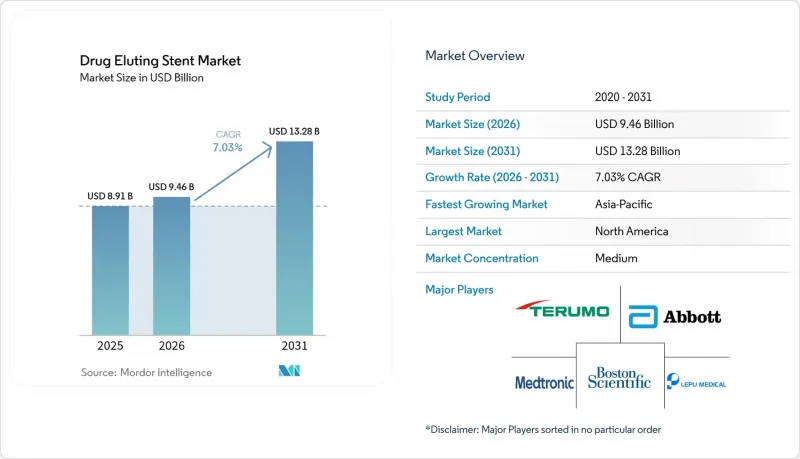
This report is Segmented by Coating Type (Durable Polymer-Based, Bioresorbable Polymer-Based, Polymer-Free), Material (Cobalt-Chromium Alloy, Platinum-Chromium Alloy, Stainless Steel, Nitinol, Magnesium Alloy/Composite), Drug Type (Sirolimus & Analogues, and More), End User (Hospitals, and More), and Geography (North America, and More). Market Forecasts are Provided in Terms of Value (USD).
Global Drug Eluting Stent Market Trends and Insights
Rising Prevalence of Coronary Artery Disease & Aging Population
Global CAD incidence is rising in lock-step with a doubling of the >= 65-year demographic, and patients now present with multivessel disease that demands two or more implants per procedure, sustaining device volumes despite preventive cardiology gains. Age-stratified enrollment, now mandatory in pivotal trials, ensures data relevance for the 40% of interventions performed in Medicare beneficiaries, while chronic kidney disease comorbidity makes bioresorbable polymer stents attractive because they remove long-term foreign material. Geriatric cardiology societies in Europe and Japan endorse ultra-thin strut scaffolds with abbreviated antiplatelet regimens, guidance that converges with evolving ISO-14155 requirements for age-specific analyses.
Growth in PCI Volumes & Preference for Minimally Invasive Interventions
U.S. annual PCI volume touched 550,000 in 2024, but the Asia-Pacific surge is more pronounced as China logged 950,000 interventions on the back of rural insurance expansion. Radial access and same-day discharge are now commonplace, lowering vascular complications and freeing hospital capacity. Drug-eluting stent market adoption accelerates because target-lesion revascularization remains below 5% at 12 months, a metric embedded in payer scorecards.
Stringent Long-Term Regulatory Evidence Requirements
Europe's MDR obliges five-year follow-up for every bioresorbable scaffold, adding USD 8 million and up to three years to pivotal programs, while the FDA now demands head-to-head non-inferiority against best-in-class comparators, doubling sample size to as many as 3,000 subjects. Post-market registry mandates covering the first 10,000 implants stretch smaller firms yet improve surveillance fidelity.
Other drivers and restraints analyzed in the detailed report include:
- Advances in Polymer Coatings & Ultra-Thin Strut Platforms
- One-Month DAPT Labeling Expanding Eligible Patient Pool
- High Device & Procedure Cost in Low-Income Regions
For complete list of drivers and restraints, kindly check the Table Of Contents.
Segment Analysis
Durable polymer devices held 51.44% drug-eluting stent market share in 2025, sustained by extensive legacy data, yet bioresorbable coatings are pacing a 10.36% CAGR through 2031 because 12-month degradation eliminates chronic foreign-body reactions. Polymer-free alternatives reached 12% share in 2025 and now headline abbreviated antiplatelet strategies. ISO 10993-13 toxicity assays have raised upfront costs yet boosted clinician confidence, helping the drug-eluting stent market size for bioresorbable platforms climb steadily.
Operators continue to select durable polymers for complex diabetes-associated lesions that require extended drug elution, but mainstream use is shifting. The BIOFLOW-VI trial presented at ACC 2025 showed 25% lower late-stent thrombosis with bioresorbable coatings beyond two years, an effect expected to accelerate cannibalization of older platforms and reinforce the drug-eluting stent market trend toward thinner, faster-absorbing polymers.
Cobalt-chromium remained the backbone with 37.66% share in 2025, yet magnesium alloy composites are outpacing at an 11.77% CAGR as full resorption within 12 months restores vasomotion. Platinum-chromium alloys deliver the thinnest struts-60 µm-while holding 28% share, retaining a foothold in calcified vessels that demand high radial force. Stainless steel shrank to single digits as surgeons prioritize accelerated endothelialization. Animal-model degradation studies mandated by ISO 10993-15 have lengthened product timelines but cleared toxicity concerns, bolstering clinician acceptance of novel metals and supporting the drug-eluting stent market size outlook for magnesium devices.
Esprit BTK's 95% resorption at 12 months demonstrated functional restoration in below-the-knee lesions and provides a template for future magnesium platforms, an advance set to divert peripheral applications from permanent nitinol cages and further diversify the drug-eluting stent market.
Complete Report Scope:
- By Coating Type
- Durable Polymer-based
- Bioresorbable Polymer-based
- Polymer-free
- By Material
- Cobalt-Chromium Alloy
- Platinum-Chromium Alloy
- Stainless Steel
- Nitinol
- Magnesium Alloy / Composite
- By Drug Type
- Sirolimus & Analogues (Everolimus, Zotarolimus, Biolimus A9)
- Paclitaxel
- Dual-therapy / Combination-drug Stents
- By Application
- Coronary Artery Disease
- Peripheral Artery Disease
- By End User
- Hospitals
- Cardiac Catheterization / PCI Centers
- Ambulatory Surgical Centers
- By Geography
- North America
- United States
- Canada
- Mexico
- Europe
- Germany
- France
- United Kingdom
- Italy
- Spain
- Rest of Europe
- Asia-Pacific
- China
- Japan
- India
- South Korea
- Australia
- Rest of Asia-Pacific
- Middle East & Africa
- GCC
- South Africa
- Rest of Middle East & Africa
- South America
- Brazil
- Argentina
- Rest of South America
- North America
Geography Analysis
North America generated 39.43% of 2025 revenue, buoyed by premium pricing for bioresorbable platforms and one-month labeling that widened the candidate pool by 150,000 cases. Growth is moderating as drug-coated balloons cannibalize 32% of in-stent restenosis procedures, yet AI-guided imaging adoption offsets some deceleration, keeping the regional drug-eluting stent market sizable.
Asia-Pacific is the fastest-growing region at a 9.21% CAGR through 2031 as China's annual PCI volumes approach 1 million and domestic manufacturers offer sub-USD 600 devices that satisfy emerging-market price ceilings. Harmonized dossier pathways now allow a single submission for Japan, South Korea, Taiwan, and ASEAN, streamlining access and accelerating export diffusion, catalysts that elevate the drug-eluting stent market size across developing economies.
Europe, wrestles with MDR-instigated evidence burdens that lengthen approvals by two to three years and cost another USD 8 million per scaffold, a deterrent for smaller firms. Nonetheless, rising PCI-to-CABG ratios and one-month dual-therapy endorsements maintain steady demand. Middle East & Africa, at 6%, suffers adoption drag from unit prices equaling half of per-capita health spending, though GCC investment in cath-lab infrastructure is nudging volumes higher. South America holds 8% share, driven largely by Brazil's 180,000 annual PCIs, while Argentina and Chile post double-digit CAGR as essential-device listings expand reimbursement coverage.
- Abbott Laboratories
- Alvimedica
- B. Braun
- Balton Sp.z.o.o
- Biosensors International Group, Ltd.
- BIOTRONIK
- Boston Scientific
- Cook Group
- Elixir Medical
- Johnson & Johnson Services LLC
- JW Medical Systems
- Lepu Medical
- Medtronic
- Meril Life Science
- MicroPort
- OrbusNeich Medical
- Sahajanand Medical Technologies Pvt. Ltd.
- Sino Medical Sciences Technology Inc.
- Terumo
- Translumina
Additional Benefits:
- The market estimate (ME) sheet in Excel format
- 3 months of analyst support
TABLE OF CONTENTS
1 Introduction
- 1.1 Study Assumptions & Market Definition
- 1.2 Scope of the Study
2 Research Methodology
3 Executive Summary
4 Market Landscape
- 4.1 Market Overview
- 4.2 Market Drivers
- 4.2.1 Rising Prevalence of Coronary Artery Disease & Aging Population
- 4.2.2 Growth in PCI Volumes & Preference for Minimally-Invasive Interventions
- 4.2.3 Advances in Polymer Coatings & Ultra-Thin Strut Platforms
- 4.2.4 One-Month DAPT Labeling Expanding Eligible Patient Pool
- 4.2.5 Domestic Low-Cost DES Production Boosting Adoption in Emerging Asia
- 4.2.6 AI-Guided Intravascular Imaging Improving Stent Placement Success
- 4.3 Market Restraints
- 4.3.1 Stringent Long-Term Regulatory Evidence Requirements
- 4.3.2 High Device & Procedure Cost in Low-Income Regions
- 4.3.3 Supply-Chain Vulnerabilities in Medical-Grade Polymers & Apis
- 4.3.4 Competitive Cannibalization from Drug-Coated Balloons In ISR/Small Vessels
- 4.4 Value / Supply-Chain Analysis
- 4.5 Regulatory Landscape
- 4.6 Technological Outlook
- 4.7 Porter's Five Forces Analysis
- 4.7.1 Threat of New Entrants
- 4.7.2 Bargaining Power of Suppliers
- 4.7.3 Bargaining Power of Buyers
- 4.7.4 Threat of Substitutes
- 4.7.5 Intensity of Competitive Rivalry
5 Market Size & Growth Forecasts (Value in USD)
- 5.1 By Coating Type
- 5.1.1 Durable Polymer-based
- 5.1.2 Bioresorbable Polymer-based
- 5.1.3 Polymer-free
- 5.2 By Material
- 5.2.1 Cobalt-Chromium Alloy
- 5.2.2 Platinum-Chromium Alloy
- 5.2.3 Stainless Steel
- 5.2.4 Nitinol
- 5.2.5 Magnesium Alloy / Composite
- 5.3 By Drug Type
- 5.3.1 Sirolimus & Analogues (Everolimus, Zotarolimus, Biolimus A9)
- 5.3.2 Paclitaxel
- 5.3.3 Dual-therapy / Combination-drug Stents
- 5.4 By Application
- 5.4.1 Coronary Artery Disease
- 5.4.2 Peripheral Artery Disease
- 5.5 By End User
- 5.5.1 Hospitals
- 5.5.2 Cardiac Catheterization / PCI Centers
- 5.5.3 Ambulatory Surgical Centers
- 5.6 By Geography
- 5.6.1 North America
- 5.6.1.1 United States
- 5.6.1.2 Canada
- 5.6.1.3 Mexico
- 5.6.2 Europe
- 5.6.2.1 Germany
- 5.6.2.2 France
- 5.6.2.3 United Kingdom
- 5.6.2.4 Italy
- 5.6.2.5 Spain
- 5.6.2.6 Rest of Europe
- 5.6.3 Asia-Pacific
- 5.6.3.1 China
- 5.6.3.2 Japan
- 5.6.3.3 India
- 5.6.3.4 South Korea
- 5.6.3.5 Australia
- 5.6.3.6 Rest of Asia-Pacific
- 5.6.4 Middle East & Africa
- 5.6.4.1 GCC
- 5.6.4.2 South Africa
- 5.6.4.3 Rest of Middle East & Africa
- 5.6.5 South America
- 5.6.5.1 Brazil
- 5.6.5.2 Argentina
- 5.6.5.3 Rest of South America
- 5.6.1 North America
6 Competitive Landscape
- 6.1 Market Concentration
- 6.2 Market Share Analysis
- 6.3 Company Profiles (includes Global level Overview, Market level overview, Core Segments, Financials as available, Strategic Information, Market Rank/Share for key companies, Products and Services, and Recent Developments)
- 6.3.1 Abbott Laboratories
- 6.3.2 Alvimedica
- 6.3.3 B. Braun Melsungen AG
- 6.3.4 Balton Sp.z.o.o
- 6.3.5 Biosensors International Group, Ltd.
- 6.3.6 Biotronik SE & Co. KG
- 6.3.7 Boston Scientific Corporation
- 6.3.8 Cook Medical Inc.
- 6.3.9 Elixir Medical Corporation
- 6.3.10 Johnson & Johnson Services LLC
- 6.3.11 JW Medical Systems
- 6.3.12 Lepu Medical Technology Co., Ltd.
- 6.3.13 Medtronic plc
- 6.3.14 Meril Life Sciences Pvt. Ltd.
- 6.3.15 MicroPort Scientific Corporation
- 6.3.16 OrbusNeich Medical
- 6.3.17 Sahajanand Medical Technologies Pvt. Ltd.
- 6.3.18 Sino Medical Sciences Technology Inc.
- 6.3.19 Terumo Corporation
- 6.3.20 Translumina GmbH
7 Market Opportunities & Future Outlook
- 7.1 White-space & Unmet-Need Assessment

