PUBLISHER: Mordor Intelligence | PRODUCT CODE: 2123716

PUBLISHER: Mordor Intelligence | PRODUCT CODE: 2123716
Upholstered Furniture - Market Share Analysis, Industry Trends & Statistics, Growth Forecasts (2026 - 2031)
According to Mordor Intelligence, the upholstered furniture market size is expected to increase from USD 65.72 billion in 2025 to USD 69.18 billion in 2026 and reach USD 89.36 billion by 2031, growing at a CAGR of 5.25% over 2026-2031.
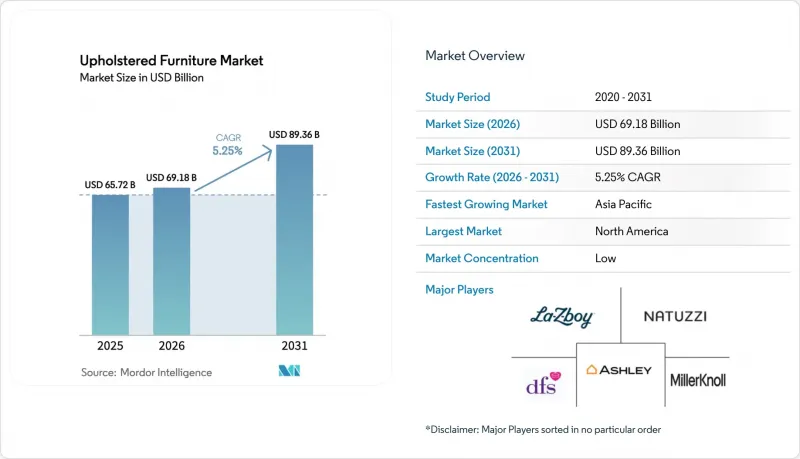
This report is Segmented by Product (Chair, Sofas, Tables, Beds, and More), by Material (Fabric, Leather, and More), by Price Range (Economy, Mid-Range, and Premium), by End User (Residential, and Commercial), by Distribution Channel (B2C/Retail, and B2B/Projects), and Geography (North America, South America, Europe, Asia-Pacific, and More). The Market Forecasts are Provided in Terms of Value (USD).
Global Upholstered Furniture Market Trends and Insights
Growing urban populations and demand for compact living solutions
Rapid urbanization is transforming how households use space for seating, sleeping, and storage, driving demand for modular and convertible upholstered furniture. Smaller apartments and dense city living are increasing the popularity of sofa beds, storage ottomans, and stackable lounge chairs that optimize utility without sacrificing comfort. Advanced engineering, including durable mechanisms and carefully calibrated foam densities, ensures long-lasting performance for dual-purpose furniture. Performance textiles with stain-resistant and antimicrobial properties help maintain hygiene and durability in high-use compact homes. Digital tools, such as room planners and augmented reality previews, reduce consumer hesitation by allowing easy customization of modules and fabrics. The United Nations projects that the share of the world's population living in urban areas will rise from around 55% today to about 68% by mid-century, adding roughly 2.5 billion urban residents, mainly in Asia and Africa. As living spaces shrink, multifunctional and space-efficient furniture becomes essential for urban households, reflecting changing lifestyle needs. Manufacturers and retailers are responding by designing furniture that combines adaptability, comfort, and long-term durability to meet this growing urban demand.
Rapid expansion of online retail channels
Digital transformation is reshaping the upholstered furniture market, allowing direct-to-consumer brands to scale without relying on traditional showrooms. Tools such as AR visualizers, 3D visualization, and room planners provide buyers with realistic views of proportions, colors, and layouts, boosting purchase confidence and reducing the need for multiple store visits. Faster delivery is achieved through vertically integrated inventories and regional fulfillment centers, appealing to new movers and time-sensitive buyers who value speed, selection, and price. Although online return rates for upholstery remain higher than in-store, brands are developing robust reverse logistics and resale or refurbishment channels to protect margins. Regulatory compliance, including data handling, product traceability, and labeling requirements in Europe, has become standard for online upholstery operations. Across regions, the momentum of online sales remains strong, as digital tools and configurators are now mainstream in the consumer's furniture-buying journey. Retailers report 65% growth in online sales, 78% use digital tools to enhance customer experience, and 72% of executives expect digital channels to drive future revenue.
Volatile foam and leather prices compress margins
Polyurethane foam costs remain sensitive to energy prices and petrochemical inputs, which have driven pronounced swings in cushion costs and weighed on margins across the upholstered furniture market. The U.S. Producer Price Index for polyurethane foam formed and slab stock reached 159.343 in September 2025 on a 2005 base, underscoring sustained inflationary pressure that manufacturers have had to manage through sourcing and pricing actions. Leather pricing has also been under strain due to hide availability and finishing constraints, while synthetic leather alternatives mirror petrochemical volatility. Tariff scenarios and origin shifts have added complexity, prompting many suppliers to review nearshoring options, buffer inventories, and hedging strategies to manage total landed costs and lead-time risk. Fire safety standards continue to limit foam substitution in regulated markets and reinforce the need for consistent quality documentation in shipments. The net effect has been higher working capital demands and tighter pricing windows, which have amplified the role of proactive category management in upholstery.
Other drivers and restraints analyzed in the detailed report include:
- Surge in hospitality and commercial construction projects
- Rising preference for sustainable and eco-certified textiles among millennials
- Rapid disposal of low-cost imports and waste scrutiny
For complete list of drivers and restraints, kindly check the Table Of Contents.
Segment Analysis
Sofas captured 31.37% of the total product market size in 2025, reflecting hybrid living patterns and the growing adoption of convertible and modular designs that integrate storage, bed functions, and quick reconfiguration.
Chairs show the fastest projected growth, with a 7.26% CAGR through 2031, as corporate ergonomic mandates and home-office investments favor adjustable support solutions. Mesh-and-performance-fabric hybrids gained traction for ventilation and durability, aligning with residential and workspace trends. Smart features like posture sensing and app-based adjustments expanded from flagship models to scaled price points as procurement teams incorporated technology into specifications. The market for ergonomic upholstered seating with soft-touch fabrics is set to grow as hybrid work policies stabilize through the decade. Compliance frameworks such as ISO 9001 and OEKO-TEX Standard 100 anchor safety and quality claims, supporting consistent procurement globally.
Fabric held a 59.33% market share in 2025, supported by its variety of textures, colors, and performance chemistries that balance cost and durability. Contract and family-use segments prefer performance fabrics that are stain-resistant and bleach-cleanable, reducing maintenance costs in hospitality and workplace settings. Residential demand for velvet and boucle textures is rising due to comfort and appearance, aligning with durable weave constructions from leading brands. Sustainability trends include recycled polyester, GOTS-certified organic cotton, and cellulosic fibers like Tencel, meeting strict testing and labeling norms. Digital fabric selection tools further support fabric's market share by simplifying customization and colorway decisions without in-person visits.
Leather is projected to grow at a 5.53% CAGR through 2031, driven by its premium appeal, which emphasizes patina, longevity, and status. Supply constraints and evolving finishing standards, including substance restrictions, are encouraging innovations in water-based and vegetable-derived processes while maintaining performance. Contract and high-end residential projects often blend materials, using leather for high-wear panels and performance fabrics for cushions to balance costs and upkeep. Soy-blend foams and low-VOC adhesives are increasingly paired with leather in higher-spec ranges to enhance indoor air quality. The industry aligns material choices with certifications and compliance standards, ensuring consistent signals for buyers and regulators during specification.
Complete Report Scope:
- By Product
- Chairs
- Sofas
- Tables
- Beds
- Stools
- Other Products (poufs, ottoman, etc.)
- By Material
- Fabric
- Leather
- Other Materials
- By Price Range
- Economy
- Mid-Range
- Premium
- By End User
- Residential
- Commercial
- By Distribution Channel
- B2C/Retail
- Home Centers
- Specialty Furniture Stores (including exclusive brand outlets)
- Online
- Other Distribution Channels (includes hypermarkets, supermarkets, teleshopping, warehouse clubs, departmental stores, etc.)
- B2B/Projects (directly to businesses)
- B2C/Retail
- By Geography
- North America
- Canada
- United States
- Mexico
- South America
- Brazil
- Peru
- Chile
- Argentina
- Rest of South America
- Europe
- United Kingdom
- Germany
- France
- Spain
- Italy
- BENELUX (Belgium, Netherlands, and Luxembourg)
- NORDICS (Denmark, Finland, Iceland, Norway, and Sweden)
- Rest of Europe
- Asia-Pacific
- India
- China
- Japan
- Australia
- South Korea
- South East Asia (Singapore, Malaysia, Thailand, Indonesia, Vietnam, and Philippines)
- Rest of Asia-Pacific
- Middle East And Africa
- United Arab of Emirates
- Saudi Arabia
- South Africa
- Nigeria
- Rest of Middle East And Africa
- North America
Geography Analysis
North America held a 38.35% share of the upholstered furniture market size in 2025, driven by higher disposable incomes, robust housing activity in growth corridors, and a well-established network of specialty and direct-to-consumer (DTC) players. Tariff mechanisms prompted suppliers to reassess sourcing strategies and domestic production capacity, complementing existing capabilities in upholstery hubs catering to residential and contract buyers. Labor constraints in upholstery impacted lead times, encouraging selective automation in cutting and sewing processes, while brands expanded apprenticeship programs to increase capacity. Corporate office refresh cycles and hospitality projects supported lounge seating demand as flexible spaces became standard layouts. The market also benefited from brand equity built on performance fabrics and durable finishes designed for family and public-space use cases.
Asia-Pacific is projected to grow at a 7.17% CAGR, supported by urbanization, rising incomes, and manufacturing capabilities in China, India, and Vietnam. Regional suppliers served both export and domestic markets, reducing lead times and offering a broader product range for mid-range and premium consumers. As domestic consumption grew, brands customized fabric and color options to align with local preferences while maintaining international specifications for export. Japan and South Korea experienced higher adoption of technology-integrated seating, while India's growth was fueled by urban middle-class households creating flexible living spaces. The market catered to both contract and residential buyers as supply chains adapted to dual-track manufacturing for local and international customers.
Europe, South America, and the Middle East and Africa followed varied growth trajectories influenced by regulation, tourism, and construction cycles. Europe's focus on circularity drove stricter requirements for reducing textile and furniture waste, with producer-funded take-back and recycling programs gaining momentum under Extended Producer Responsibility (EPR) measures. The EU Deforestation Regulation, effective from late 2024, mandated detailed sourcing data for wood and leather inputs, increasing due diligence costs for suppliers. In the Middle East, large-scale hospitality projects boosted demand for high-durability seating and upscale materials for public spaces, supporting contract upholstery orders. South America's demand remained inconsistent due to currency fluctuations, but urban household formation sustained mid-range seating purchases where value and quality intersected. The market grew as suppliers aligned localized preferences with global compliance and performance standards.
- La-Z-Boy Incorporated
- Ashley Furniture Industries
- DFS Furniture PLC
- Natuzzi S.p.A.
- MillerKnoll, Inc.
- Man Wah Holdings Ltd.
- B&B Italia
- Ekornes ASA
- HNI Corporation
- Hooker Furnishings Corporation
- Godrej Interio
- Rolf Benz
- Flexsteel Industries, Inc.
- Kimball International, Inc.
- Rowe Furniture, Inc.
- Ethan Allen Interiors Inc.
- IKEA
- Style Upholstering Inc.
- Bassett Furniture Industries
- Universal Furniture
Additional Benefits:
- The market estimate (ME) sheet in Excel format
- 3 months of analyst support
TABLE OF CONTENTS
1 Introduction
- 1.1 Study Assumptions & Market Definition
- 1.2 Scope of the Study
2 Research Methodology
3 Executive Summary
4 Market Landscape
- 4.1 Market Overview
- 4.2 Market Drivers
- 4.2.1 Growing urban populations and demand for compact living solutions
- 4.2.2 Rapid expansion of online retail channels
- 4.2.3 Surge in hospitality and commercial construction projects
- 4.2.4 Rising preference for sustainable and eco-certified textiles among millennials
- 4.2.5 Adoption of hybrid work models and redesign of office lounge areas
- 4.2.6 Increasing integration of smart home features and connected furniture
- 4.3 Market Restraints
- 4.3.1 Volatile foam and leather prices compress margins
- 4.3.2 Rapid disposal of low-cost imports and waste scrutiny
- 4.3.3 Increasing regulatory pressure on sustainable sourcing
- 4.3.4 Rising competition from unorganized local furniture makers
- 4.4 Industry Value Chain Analysis
- 4.5 Porter's Five Forces Analysis
- 4.5.1 Threat of New Entrants
- 4.5.2 Bargaining Power of Suppliers
- 4.5.3 Bargaining Power of Buyers
- 4.5.4 Threat of Substitutes
- 4.5.5 Competitive Rivalry
- 4.6 Insights into the Latest Trends and Innovations in the Market
- 4.7 Insights on Recent Developments (New Product Launches, Strategic Initiatives, Investments, Partnerships, JVs, Expansion, M&As, etc.) in the Market
5 Market Size & Growth Forecasts
- 5.1 By Product
- 5.1.1 Chairs
- 5.1.2 Sofas
- 5.1.3 Tables
- 5.1.4 Beds
- 5.1.5 Stools
- 5.1.6 Other Products (poufs, ottoman, etc.)
- 5.2 By Material
- 5.2.1 Fabric
- 5.2.2 Leather
- 5.2.3 Other Materials
- 5.3 By Price Range
- 5.3.1 Economy
- 5.3.2 Mid-Range
- 5.3.3 Premium
- 5.4 By End User
- 5.4.1 Residential
- 5.4.2 Commercial
- 5.5 By Distribution Channel
- 5.5.1 B2C/Retail
- 5.5.1.1 Home Centers
- 5.5.1.2 Specialty Furniture Stores (including exclusive brand outlets)
- 5.5.1.3 Online
- 5.5.1.4 Other Distribution Channels (includes hypermarkets, supermarkets, teleshopping, warehouse clubs, departmental stores, etc.)
- 5.5.2 B2B/Projects (directly to businesses)
- 5.5.1 B2C/Retail
- 5.6 By Geography
- 5.6.1 North America
- 5.6.1.1 Canada
- 5.6.1.2 United States
- 5.6.1.3 Mexico
- 5.6.2 South America
- 5.6.2.1 Brazil
- 5.6.2.2 Peru
- 5.6.2.3 Chile
- 5.6.2.4 Argentina
- 5.6.2.5 Rest of South America
- 5.6.3 Europe
- 5.6.3.1 United Kingdom
- 5.6.3.2 Germany
- 5.6.3.3 France
- 5.6.3.4 Spain
- 5.6.3.5 Italy
- 5.6.3.6 BENELUX (Belgium, Netherlands, and Luxembourg)
- 5.6.3.7 NORDICS (Denmark, Finland, Iceland, Norway, and Sweden)
- 5.6.3.8 Rest of Europe
- 5.6.4 Asia-Pacific
- 5.6.4.1 India
- 5.6.4.2 China
- 5.6.4.3 Japan
- 5.6.4.4 Australia
- 5.6.4.5 South Korea
- 5.6.4.6 South East Asia (Singapore, Malaysia, Thailand, Indonesia, Vietnam, and Philippines)
- 5.6.4.7 Rest of Asia-Pacific
- 5.6.5 Middle East And Africa
- 5.6.5.1 United Arab of Emirates
- 5.6.5.2 Saudi Arabia
- 5.6.5.3 South Africa
- 5.6.5.4 Nigeria
- 5.6.5.5 Rest of Middle East And Africa
- 5.6.1 North America
6 Competitive Landscape
- 6.1 Market Concentration
- 6.2 Strategic Moves
- 6.3 Market Share Analysis
- 6.4 Company Profiles (includes Global level Overview, Market level overview, Core Segments, Financials as available, Strategic Information, Market Rank/Share for key companies, Products & Services, and Recent Developments)
- 6.4.1 La-Z-Boy Incorporated
- 6.4.2 Ashley Furniture Industries
- 6.4.3 DFS Furniture PLC
- 6.4.4 Natuzzi S.p.A.
- 6.4.5 MillerKnoll, Inc.
- 6.4.6 Man Wah Holdings Ltd.
- 6.4.7 B&B Italia
- 6.4.8 Ekornes ASA
- 6.4.9 HNI Corporation
- 6.4.10 Hooker Furnishings Corporation
- 6.4.11 Godrej Interio
- 6.4.12 Rolf Benz
- 6.4.13 Flexsteel Industries, Inc.
- 6.4.14 Kimball International, Inc.
- 6.4.15 Rowe Furniture, Inc.
- 6.4.16 Ethan Allen Interiors Inc.
- 6.4.17 IKEA
- 6.4.18 Style Upholstering Inc.
- 6.4.19 Bassett Furniture Industries
- 6.4.20 Universal Furniture
7 Market Opportunities & Future Outlook
- 7.1 Adoption of Digital Cutting & Customization Technologies
- 7.2 Growing Demand for Modular & Multi-functional Furniture

