PUBLISHER: Mordor Intelligence | PRODUCT CODE: 2124616

PUBLISHER: Mordor Intelligence | PRODUCT CODE: 2124616
Europe Upholstered Furniture - Market Share Analysis, Industry Trends & Statistics, Growth Forecasts (2026 - 2031)
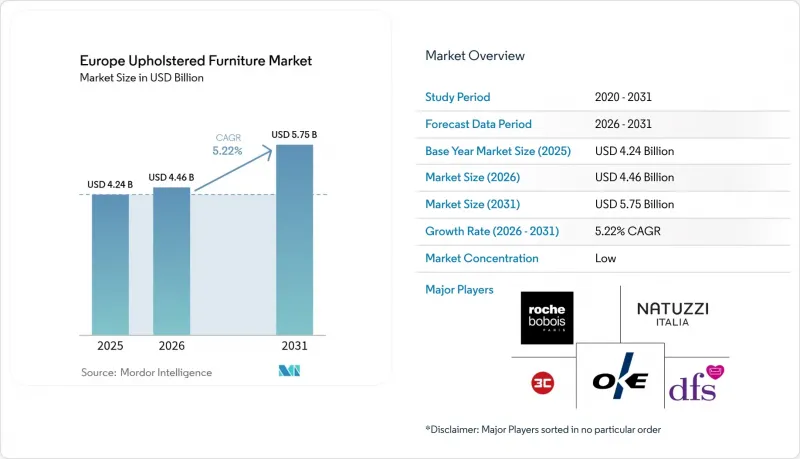
According to Mordor Intelligence, the Europe upholstered furniture market size is expected to grow from USD 4.24 billion in 2025 to USD 4.46 billion in 2026 and is forecast to reach USD 5.75 billion by 2031 at 5.22% CAGR over 2026-2031.
This report is Segmented by Product Type (Chairs, Sofas, Tables, Other Product Types), Application (Residential, Commercial), Distribution Channel (Home Centers, Flagship Stores, Specialty Stores, Online Platforms, Other Distribution Channels), and Geography (United Kingdom, Germany, France, Spain, Italy, BENELUX, NORDICS, Rest of Europe). The Market Forecasts are Provided in Terms of Value (USD).
Europe Upholstered Furniture Market Trends and Insights
Growing Home-Renovation & Replacement Cycle
Home-improvement spending continues to climb as hybrid work routines make living spaces multifunctional, shrinking the renovation interval from 7-10 years to roughly 5-7 years. Furniture retailers across Germany reported double-digit growth in replacement purchases during 2024, with ergonomic sofas and height-adjustable loungers topping wish lists . The shorter cycle benefits the Europe upholstered furniture market by boosting volume demand at mid- and premium price bands. It also pressures manufacturers to accelerate model refresh rates, adopt modular platforms, and shorten development lead times. Government incentives for energy-efficient refurbishments further nudge consumers toward new furnishings that meet eco-label criteria. Consequently, supply chains invest in fast-response capabilities, enabling just-in-time upholstery production aligned with seasonal decor shifts.
Premiumisation Among Gen-Y & Gen-Z Buyers
Young European consumers allocate up to 30% more per upholstered item than older demographics, valuing sustainable materials and bespoke aesthetics over entry-level pricing. Their preference for modular sectional sofas, convertible daybeds, and smart-fabric finishes lifts average selling prices across the Europe upholstered furniture market. Social-media influence accelerates trend cycles, driving micro-collections and limited-edition collaborations that keep showrooms fresh. Retailers counter assortment complexity by expanding digital configurators, allowing shoppers to mix fabrics, leg designs, and accessory add-ons in real time. Brands with transparent sourcing stories win loyalty, as Gen-Z buyers check traceability labels and carbon-footprint scores before checkout. The shift to higher-value transactions raises margins but also heightens expectations for durability and end-of-life take-back programs.
Inflation-Linked Squeeze on Discretionary Spending
Persistent inflation drives a wedge between nominal wage growth and real purchasing power, prompting many households to postpone big-ticket furniture acquisitions. Retail sales volumes for household furnishings dipped 12-15% in Spain and Italy during 2024, even as headline revenues rose on price hikes. The Europe upholstered furniture market thus witnesses polarizing demand: luxury brands record steady orders, value chains push aggressive promotions, and mid-market labels struggle to differentiate. Retailers deploy 0% financing and buy-now-pay-later schemes to stimulate turnover, but credit-risk profiles tighten under macro-economic uncertainty. Manufacturers hedge by diversifying into commercial contracts to offset softer retail demand. As inflation moderates, pent-up replacement demand could unlock a rebound, yet consumer confidence remains the swing factor for the next two years.
Other drivers and restraints analyzed in the detailed report include:
- Build-to-Rent Residential Projects Expansion
- Hospitality Refurbishment Wave Ahead of Major Events
- Volatile Wood & Foam Input Prices
For complete list of drivers and restraints, kindly check the Table Of Contents.
Segment Analysis
Sofas generated 34.72% of Europe upholstered furniture market share in 2025, underscoring their role as living-room centerpieces across European households. Modular configurations, built-in USB chargers, and stain-proof performance fabrics keep the category at the forefront of design innovation. Beds, meanwhile, are projected to post a 6.78% CAGR on the back of heightened consumer focus on sleep health, adjustable frames, and smart-sensor integrations. The Europe upholstered furniture market size for beds is forecast to reach USD 1.57 billion by 2031, reflecting consumers' willingness to pay premiums for wellness-oriented features. Chairs and recliners benefit from hybrid work norms, with ergonomic certifications turning into must-have selling points for home offices. Niche items such as storage ottomans and convertible sofas cleverly address shrinking urban dwellings, reinforcing demand for space-efficient solutions across the product spectrum.
Continuous product differentiation propels repeat purchases as fabrics, finishes, and modular add-ons refresh the aesthetic appeal of standard SKUs. Digital-printing technology from suppliers such as Limonta enables rapid customization without large minimum orders, giving mid-sized brands an affordable path to personalization. Cross-category design language shared leg profiles coordinated color palettes helps manufacturers streamline component sourcing and cut downtime between model transitions. Meanwhile, end-of-life considerations influence new product development, with easy-to-disassemble frames and mono-material cushions facilitating recycling compliance. These trends push R&D teams to pursue cradle-to-cradle certifications that resonate with eco-conscious buyers. As a result, product-level innovation remains a decisive lever in sustaining premium pricing and combating commoditization pressures.
Complete Report Scope:
- By Product Type
- Chairs
- Sofas
- Tables
- Beds
- Other Product Types
- By Application
- Residential
- Commercial
- By Distribution Channel
- Home Centers
- Flagship Stores
- Specialty Stores
- Online Platforms
- Other Distribution Channels
- By Geography
- Europe
- United Kingdom
- Germany
- France
- Spain
- Italy
- BENELUX (Belgium, Netherlands, Luxembourg)
- NORDICS (Denmark, Finland, Iceland, Norway, Sweden)
- Rest of Europe
- Europe
List of Companies Covered in this Report:
- IKEA Group
- Steinhoff International
- Natuzzi S.p.A.
- Poltrona Frau
- DFS Furniture Plc
- Ligne Roset
- Vitra International AG
- Roche Bobois
- Ekornes ASA (Stressless)
- Calligaris S.p.A.
- BoConcept
- Himolla
- Hulsta
- Kinnarps
- Muuto
- Tetrad Ltd
- Fama Sofas
- La-Z-Boy (Europe)
- Duresta Upholstery
Additional Benefits:
- The market estimate (ME) sheet in Excel format
- 3 months of analyst support
TABLE OF CONTENTS
1 Introduction
- 1.1 Study Assumptions & Market Definition
- 1.2 Scope of the Study
2 Research Methodology
3 Executive Summary
4 Market Landscape
- 4.1 Market Overview
- 4.2 Market Drivers
- 4.2.1 Growing home-renovation & replacement cycle
- 4.2.2 Premiumisation of living spaces among Gen-Y & Gen-Z buyers
- 4.2.3 Expansion of build-to-rent residential projects
- 4.2.4 Hospitality refurbishment wave ahead of 2028 Olympics & Euro 2032
- 4.2.5 Furniture subscription & "as-a-service" models gaining traction
- 4.2.6 Digitally printed performance fabrics enabling mass-customisation
- 4.3 Market Restraints
- 4.3.1 Inflation-linked squeeze on discretionary spending
- 4.3.2 Volatile wood & foam input prices
- 4.3.3 Rising sustainability-compliance costs under EU Ecodesign rules
- 4.3.4 Shortage of skilled upholsterers in Western Europe
- 4.4 Value / Supply-Chain Analysis
- 4.5 Regulatory Landscape
- 4.6 Technological Outlook
- 4.7 Porter's Five Forces
- 4.7.1 Threat of New Entrants
- 4.7.2 Bargaining Power of Suppliers
- 4.7.3 Bargaining Power of Buyers
- 4.7.4 Threat of Substitutes
- 4.7.5 Competitive Rivalry
5 Market Size & Growth Forecasts (Value)
- 5.1 By Product Type
- 5.1.1 Chairs
- 5.1.2 Sofas
- 5.1.3 Tables
- 5.1.4 Beds
- 5.1.5 Other Product Types
- 5.2 By Application
- 5.2.1 Residential
- 5.2.2 Commercial
- 5.3 By Distribution Channel
- 5.3.1 Home Centers
- 5.3.2 Flagship Stores
- 5.3.3 Specialty Stores
- 5.3.4 Online Platforms
- 5.3.5 Other Distribution Channels
- 5.4 By Geography
- 5.4.1 Europe
- 5.4.1.1 United Kingdom
- 5.4.1.2 Germany
- 5.4.1.3 France
- 5.4.1.4 Spain
- 5.4.1.5 Italy
- 5.4.1.6 BENELUX (Belgium, Netherlands, Luxembourg)
- 5.4.1.7 NORDICS (Denmark, Finland, Iceland, Norway, Sweden)
- 5.4.1.8 Rest of Europe
- 5.4.1 Europe
6 Competitive Landscape
- 6.1 Market Concentration
- 6.2 Strategic Moves
- 6.3 Market Share Analysis
- 6.4 Company Profiles (includes Global level Overview, Market level overview, Core Segments, Financials as available, Strategic Information, Market Rank/Share for key companies, Products & Services, and Recent Developments)
- 6.4.1 IKEA Group
- 6.4.2 Steinhoff International
- 6.4.3 Natuzzi S.p.A.
- 6.4.4 Poltrona Frau
- 6.4.5 DFS Furniture Plc
- 6.4.6 Ligne Roset
- 6.4.7 Vitra International AG
- 6.4.8 Roche Bobois
- 6.4.9 Ekornes ASA (Stressless)
- 6.4.10 Calligaris S.p.A.
- 6.4.11 BoConcept
- 6.4.12 Himolla
- 6.4.13 Hulsta
- 6.4.14 Kinnarps
- 6.4.15 Muuto
- 6.4.16 Tetrad Ltd
- 6.4.17 Fama Sofas
- 6.4.18 La-Z-Boy (Europe)
- 6.4.19 Duresta Upholstery
7 Market Opportunities & Future Outlook
- 7.1 Emerging eco-friendly upholstery materials (mushroom leather, bio-PU, recycled PET)
- 7.2 Smart & modular furniture integration with IoT and space-saving mechanisms

