PUBLISHER: Mordor Intelligence | PRODUCT CODE: 2123721

PUBLISHER: Mordor Intelligence | PRODUCT CODE: 2123721
Delivery Drones - Market Share Analysis, Industry Trends & Statistics, Growth Forecasts (2026 - 2031)
According to Mordor Intelligence, the delivery drones market size reached USD 1.47 billion in 2026 and is projected to attain USD 6.74 billion by 2031, expanding at a 35.69% CAGR through the forecast period.
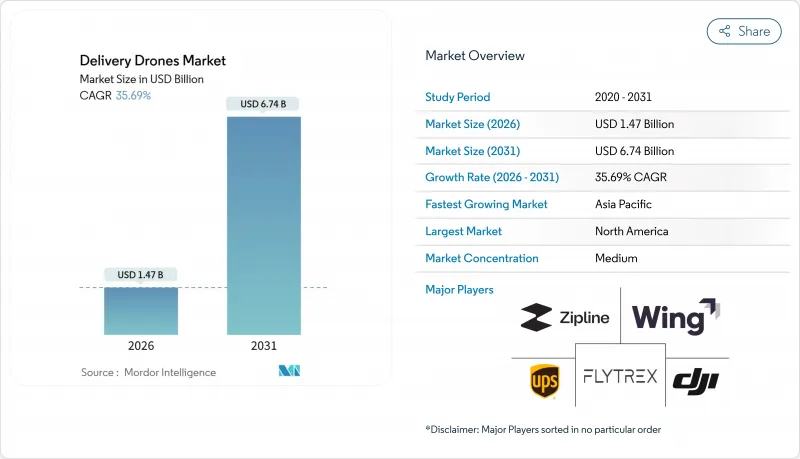
This report is Segmented by Drone Type (Rotary-Wing, Fixed-Wing), Payload Capacity (Less Than 5 Kg, 5 To 10 Kg, More Than 10 Kg), Delivery Range (Less Than 25 Km, 25 To 50 Km, More Than 50 Km), End-User Industry (Retail and E-Commerce, and More), and Geography (North America, and More). The Market Forecasts are Provided in Terms of Value (USD).
Global Delivery Drones Market Trends and Insights
Accelerating Demand for Same-Day E-Commerce Fulfillment in Densely Populated Urban Centers
Urban consumers increasingly expect delivery within two hours, a benchmark that ground fleets miss during peak congestion. Drones avoid surface traffic, allowing retailers to ship from micro-fulfillment hubs located near downtown districts. Walmart expanded its Wing Aviation program to 100 US stores in June 2025, indicating that aerial logistics has transitioned from a trial to a core service. Unit economics improve as parcel costs fall toward USD 2 once fleet density reaches scale, compared with USD 13.50 for truck-based last-mile routes. Labor shortages amplify this advantage, especially in North American and European cities where wages remain high. As a result, the delivery drones market is integrating deeply into omnichannel retail strategies to safeguard customer loyalty.
Rising Need for Reliable Healthcare Delivery Solutions in Geographically Isolated and Underserved Areas
Road gaps delay life-critical supplies for rural clinics, so health systems turn to drones for predictable, rapid service. Zipline surpassed 1 million autonomous flights, moving blood and vaccines across Rwanda, Ghana, and remote US counties. A 2025 partnership with the Cleveland Clinic reduced prescription lead times from hours to minutes for patients in suburban Ohio. India designated dedicated corridors for medical payloads under its Drone Rules, accelerating adoption in hard-to-reach districts. These programs demonstrate that drones can leapfrog limited road infrastructure, thereby reinforcing growth prospects for the delivery drones market across emerging economies.
Complex Airspace Integration with Existing Civil Aviation Systems Limiting Operational Scalability
Unmanned traffic management remains in pilot testing, constraining route density near busy airports. The FAA's concept of dynamic flight corridors still lacks full interoperability with manned aircraft systems, forcing operators to throttle frequency in metropolitan skies. EASA's U-space rules require geofencing and mandatory collision-avoidance protocols; however, adoption rates differ across member states, resulting in fragmented service design. NASA research indicates that current algorithms can handle only hundreds, not thousands, of simultaneous drone flights. Until scalable UTM networks mature, the growth of the delivery drone market in densely populated regions will lag behind its technical potential.
Other drivers and restraints analyzed in the detailed report include:
- Global Expansion of Regulatory Frameworks Enabling Commercial Delivery Drone Operations
- Operational Cost Reductions Through More Efficient Last-Mile Delivery in High-Traffic Environments
- Low Payload Capacity Restricting Revenue Potential in High-Volume Segments
For complete list of drivers and restraints, kindly check the Table Of Contents.
Segment Analysis
Rotary-wing craft delivered 72.56% of shipments in 2025. They excel where rooftops double as drop zones and curbside space is scarce. Yet, fixed-wing systems, projected to grow at a 29.15% annual rate, glide during cruise, slashing energy use per kilometer. Zipline's P2 travels 100 km on a single charge, allowing operators to serve multiple counties from a single hub. This range economy is critical in Asia-Pacific's patchy transport grid, where JD Logistics uses fixed-wing drones on 200 rural routes. Regulatory bodies are now funneling Part 135 approvals toward designs that combine long endurance and automated detect-and-avoid capabilities. Consequently, the delivery drones market is tilting toward hybrid craft that merge rotary lift with fixed-wing cruise, narrowing the operational gap between city blocks and distant clinics.
Fixed-wing expansion reshapes fleet-planning math. Operators can retire several short-hop bases and instead run a single centralized launch site. This consolidation frees capital for route density and value-added services such as cold-chain pods for vaccines. Rotary-wing models still dominate instant restaurant delivery and under-15-minute urban promises, so adoption becomes a portfolio decision rather than a binary switch. Future platform roadmaps incorporate modular wings that detach for pure hover missions, indicating an adaptable architecture that flexes with demand spikes across the delivery drones market.
Shipments under 5 kg held a 65.71% share in 2025, aligning with prescriptions, meal kits, and small consumer goods that fit within standard wing lockers. Fleet managers favor this class because batteries, control logic, and drop mechanisms are off-the-shelf, and they satisfy most aviation authorities without requiring lengthy proof-of-concept phases. The 5-10 kg band grows as grocery chains experiment with mid-basket orders and as regulations mature around packaging standards. Drones weighing above 10 kg will advance at a 31.9% CAGR, albeit from a lower base, serving offshore rigs or construction sites where helicopters have historically dominated.
Engineering trade-offs remain stark. Every additional kilogram reduces flight time unless energy density increases. Hybrid gasoline-electric prototypes promise relief, although certification timelines are stretched longer. Heavy-lift niches therefore charge a premium for their services, covering higher maintenance and risk insurance costs. Over time, as powertrain efficiency improves, weight ceilings will climb, setting the stage for broader heavy-lift adoption throughout the delivery drones market.
Complete Report Scope:
- By Drone Type
- Rotary-wing
- Fixed-wing
- By Payload Capacity
- Less than 5 kg
- 5 to 10 kg
- More than 10 kg
- By Delivery Range
- Less than 25 km
- 25 to 50 km
- More than 50 km
- By End-User Industry
- Retail and E-commerce
- Food and Grocery
- Healthcare and Pharma Logistics
- Postal and Express Parcel
- Industrial and Construction
- By Geography
- North America
- United States
- Canada
- Mexico
- Europe
- Germany
- United Kingdom
- France
- Italy
- Spain
- Rest of Europe
- Asia-Pacific
- China
- Japan
- India
- South Korea
- Rest of Asia-Pacific
- South America
- Brazil
- Argentina
- Rest of South America
- Middle East and Africa
- Middle East
- United Arab Emirates
- Saudi Arabia
- Rest of Middle East
- Africa
- South Africa
- Rest of Africa
- Middle East
- North America
Geography Analysis
North America remains the largest regional base with a 42.84% share in 2025, thanks to progressive FAA rulings, robust consumer spending, and investments by Amazon Prime Air, Wing, and Walmart. Urban architectures accommodate rooftop drop-off pads and micro-fulfillment nodes integrated into existing retail footprints. Healthcare use cases thrive in Alaska, Appalachia, and desert counties where road access is seasonal, anchoring long-range demand. Venture funding concentrates in US tech hubs, enabling hardware and software iterations that ripple out to global partners. Despite its lead, the region grapples with crowded airspace, which complicates route approvals and moderates the pace of expansion within the delivery drones market.
The Asia-Pacific region is poised for the fastest growth, with a 33.68% CAGR through 2031. China mainstreamed drones into JD Logistics' network, connecting rural farms to city sort centers across more than 200 fixed corridors. India's Production-Linked Incentive scheme offers subsidies for local manufacturing and design, drawing startups into cost-sensitive niches such as agri-input deliveries. Japan green-lit Rakuten's multi-prefecture operations, signaling regulatory convergence with Western safety standards. Infrastructure deficits in Indonesia and the Philippines further spotlight drones as substitutes for unpaved or island-hopping truck routes. Consequently, the delivery drones market sees the APAC leapfrog incremental improvements and adopt aerial logistics as the first-choice supply chain in remote provinces.
Europe enjoys policy alignment under EASA, which facilitates smooth cross-border services as operators scale from local to regional footprints. Manna's operations in Ireland and the UK advanced when it secured a US FAA waiver, illustrating the benefits of transatlantic harmonization. Environmental policy accelerates the adoption of low-emission credentials, with carriers leveraging these credentials to win municipal freight tenders. Growth remains tempered by privacy activism and dense controlled airspace, yet high per-capita income sustains premium delivery fees. Collectively, these dynamics underpin steady but measured expansion for the delivery drones market across Europe. At the same time, Latin America, the Middle East, and Africa progress through smaller healthcare-led pilots that will scale as regulatory clarity improves.
- Prime Air (Amazon.com, Inc.)
- Wing Aviation LLC (Alphabet Inc.)
- United Parcel Service of America, Inc.
- FedEx Corporation
- Airbus SE
- Zipline International Inc.
- SZ DJI Technology Co., Ltd.
- Wingcopter GmbH
- Guangzhou EHang Intelligent Technology Co. Ltd.
- Drone Delivery Canada Corp.
- Flytrex Inc.
- Matternet Inc.
- Kite Aero
- Manna Drone Delivery
- Skyports Drone Services
- Speedbird Aero
- Rakuten Group, Inc.
- JDLogistics, Inc
- DroneUp, LLC
Additional Benefits:
- The market estimate (ME) sheet in Excel format
- 3 months of analyst support
TABLE OF CONTENTS
1 INTRODUCTION
- 1.1 Study Assumptions and Market Definition
- 1.2 Scope of the Study
2 RESEARCH METHODOLOGY
3 EXECUTIVE SUMMARY
4 MARKET LANDSCAPE
- 4.1 Market Overview
- 4.2 Market Drivers
- 4.2.1 Accelerating demand for same-day e-commerce fulfillment in densely populated urban centers
- 4.2.2 Rising need for reliable healthcare delivery solutions in geographically isolated and underserved areas
- 4.2.3 Global expansion of regulatory frameworks enabling commercial drone delivery operations
- 4.2.4 Operational cost reductions through more efficient last-mile delivery in high-traffic environments
- 4.2.5 Increased adoption of sustainable logistics practices driven by corporate and government emissions targets
- 4.2.6 Technological advancements in hybrid VTOL systems enabling longer-range and more flexible delivery missions
- 4.3 Market Restraints
- 4.3.1 Complex airspace integration with existing civil aviation systems limiting operational scalability
- 4.3.2 Low payload capacity restricting revenue potential in high-volume delivery segments
- 4.3.3 Persistent public concerns over privacy and noise in densely populated residential areas
- 4.3.4 High upfront fleet investment requirements posing barriers for small and medium-sized enterprises
- 4.4 Value Chain Analysis
- 4.5 Regulatory Outlook and Technological Outlook
- 4.6 Porter's Five Forces Analysis
- 4.6.1 Bargaining Power of Suppliers
- 4.6.2 Bargaining Power of Buyers
- 4.6.3 Threat of New Entrants
- 4.6.4 Threat of Substitutes
- 4.6.5 Competitive Rivalry
5 MARKET SIZE AND GROWTH FORECASTS (VALUE)
- 5.1 By Drone Type
- 5.1.1 Rotary-wing
- 5.1.2 Fixed-wing
- 5.2 By Payload Capacity
- 5.2.1 Less than 5 kg
- 5.2.2 5 to 10 kg
- 5.2.3 More than 10 kg
- 5.3 By Delivery Range
- 5.3.1 Less than 25 km
- 5.3.2 25 to 50 km
- 5.3.3 More than 50 km
- 5.4 By End-User Industry
- 5.4.1 Retail and E-commerce
- 5.4.2 Food and Grocery
- 5.4.3 Healthcare and Pharma Logistics
- 5.4.4 Postal and Express Parcel
- 5.4.5 Industrial and Construction
- 5.5 By Geography
- 5.5.1 North America
- 5.5.1.1 United States
- 5.5.1.2 Canada
- 5.5.1.3 Mexico
- 5.5.2 Europe
- 5.5.2.1 Germany
- 5.5.2.2 United Kingdom
- 5.5.2.3 France
- 5.5.2.4 Italy
- 5.5.2.5 Spain
- 5.5.2.6 Rest of Europe
- 5.5.3 Asia-Pacific
- 5.5.3.1 China
- 5.5.3.2 Japan
- 5.5.3.3 India
- 5.5.3.4 South Korea
- 5.5.3.5 Rest of Asia-Pacific
- 5.5.4 South America
- 5.5.4.1 Brazil
- 5.5.4.2 Argentina
- 5.5.4.3 Rest of South America
- 5.5.5 Middle East and Africa
- 5.5.5.1 Middle East
- 5.5.5.1.1 United Arab Emirates
- 5.5.5.1.2 Saudi Arabia
- 5.5.5.1.3 Rest of Middle East
- 5.5.5.2 Africa
- 5.5.5.2.1 South Africa
- 5.5.5.2.2 Rest of Africa
- 5.5.5.1 Middle East
- 5.5.1 North America
6 COMPETITIVE LANDSCAPE
- 6.1 Market Concentration
- 6.2 Strategic Moves
- 6.3 Market Share Analysis
- 6.4 Company Profiles (includes global and market overview, core segments, financials, strategic info, market rank/share, products and services, recent developments)
- 6.4.1 Prime Air (Amazon.com, Inc.)
- 6.4.2 Wing Aviation LLC (Alphabet Inc.)
- 6.4.3 United Parcel Service of America, Inc.
- 6.4.4 FedEx Corporation
- 6.4.5 Airbus SE
- 6.4.6 Zipline International Inc.
- 6.4.7 SZ DJI Technology Co., Ltd.
- 6.4.8 Wingcopter GmbH
- 6.4.9 Guangzhou EHang Intelligent Technology Co. Ltd.
- 6.4.10 Drone Delivery Canada Corp.
- 6.4.11 Flytrex Inc.
- 6.4.12 Matternet Inc.
- 6.4.13 Kite Aero
- 6.4.14 Manna Drone Delivery
- 6.4.15 Skyports Drone Services
- 6.4.16 Speedbird Aero
- 6.4.17 Rakuten Group, Inc.
- 6.4.18 JDLogistics, Inc
- 6.4.19 DroneUp, LLC
7 MARKET OPPORTUNITIES AND FUTURE OUTLOOK
- 7.1 White-space and Unmet-Need Assessment

