PUBLISHER: Mordor Intelligence | PRODUCT CODE: 2123755

PUBLISHER: Mordor Intelligence | PRODUCT CODE: 2123755
Spoil Detection Based Smart Labels - Market Share Analysis, Industry Trends & Statistics, Growth Forecasts (2026 - 2031)
According to Mordor Intelligence, the spoil detection based smart labels market size was valued at USD 1.11 billion in 2025 and estimated to grow from USD 1.23 billion in 2026 to reach USD 2.07 billion by 2031, at a CAGR of 10.92% during the forecast period (2026-2031).
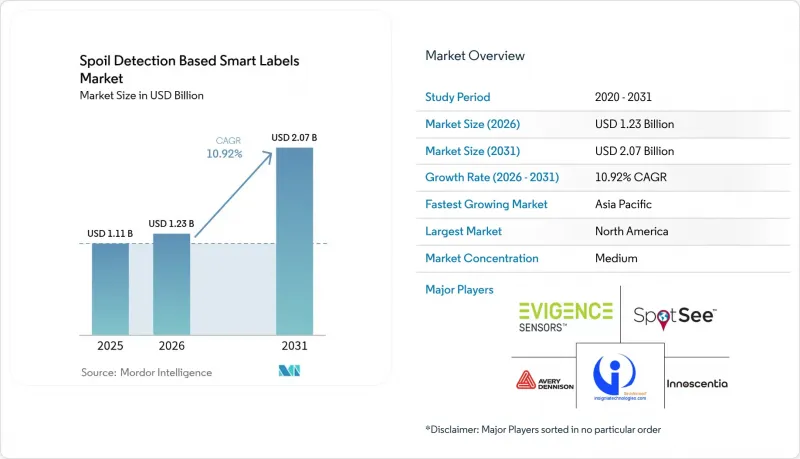
This report is Segmented by Technology (RFID, NFC, Sensing Labels, and More), End-User Industry (Food and Beverage, Pharmaceutical, and More), Packaging Format (Flexible Pouches, Rigid Bottles/Jars, and More), Freshness Indicator Mechanism (Colorimetric Chemical Indicators, Biosensor-Based Indicators, and More), and Geography. The Market Forecasts are Provided in Terms of Value (USD).
Global Spoil Detection Based Smart Labels Market Trends and Insights
Growing Demand for Real-Time Food Freshness Monitoring
Food distributors are replacing static date codes with sensors that confirm freshness throughout transit, because time-temperature abuse can make products unsafe days before printed dates. The United Nations Environment Programme reported that 13.2% of food is lost between harvest and retail and a further 19% is wasted beyond retail, a footprint that generates 8-10% of global greenhouse-gas emissions. Walmart's October 2025 requirement that suppliers attach RFID tags to all fresh-food shipments turns food waste into a compliance issue, pushing producers to adopt spoilage indicators that trigger automatic inventory adjustments. SpotSee's battery-free WarmMark QR, launched in January 2025, offers +-1 °C accuracy and a two-year shelf life, illustrating the new economics that make single-use sensors viable at scale. The trajectory ensures that the spoil detection based smart labels market will benefit from both regulatory enforcement and private cost avoidance.
Rising Consumer Emphasis on Food Safety and Hygiene
Post-pandemic shoppers now treat verifiable freshness as essential, particularly parents and caregivers for immunocompromised consumers. Retail pilots in Japan and South Korea use NFC-enabled labels that allow smartphone scans, turning cold-chain data into a point-of-sale marketing asset. Brands that deliver real-time spoilage status gain shelf preference, while those relying solely on printed dates risk reputational damage. Price-premium segments such as organic produce and grass-fed meats can absorb the 5-10-fold cost premium of smart labels. China's State Council cold-chain mandates reinforce the trend by penalizing non-compliant freshness monitoring. These forces promote steady penetration of the spoil detection based smart labels market in urban Asia-Pacific.
High Unit Cost Versus Traditional Date Codes
Smart labels cost five to ten times more than printed expiration dates, eroding margins on low-value SKUs such as bagged salads. Procurement teams revert to cheaper date codes unless compelled by regulation or retailer mandate. Energous and other vendors now pursue battery-free sensor designs to lower total cost of ownership, while SpotSee promotes WarmMark QR's recyclable materials to align with sustainability-driven purchasing. The price hurdle is particularly binding in South America and Africa, where buyers prioritize refrigeration hardware over monitoring.
Other drivers and restraints analyzed in the detailed report include:
- Expansion of Cold-Chain Logistics Networks Globally
- Integration of Spoil Detection Labels with IoT Platforms
- Lack of Global Interoperability Standards
For complete list of drivers and restraints, kindly check the Table Of Contents.
Segment Analysis
RFID captured 45.40% revenue in 2025, reflecting established reader infrastructure in warehouses and stores. The spoil detection based smart labels market size for RFID is projected to reach USD 0.94 billion by 2031, expanding in lockstep with automated inventory systems. Conversely, NFC is forecast to grow at 11.62%, outpacing the overall spoil detection based smart labels market as smartphone scanning becomes mainstream. The RAIN RFID Alliance highlights that ultra-high-frequency RFID reads hundreds of items per second without line-of-sight, making it indispensable for pallet and case tracking. NFC's proximity requirement turns each package into a point of interaction, opening new promotional and data-collection channels. Energous' battery-free e-Sense tags, introduced June 2025, promise to lower operating costs for both RFID and future ambient-IoT hybrids. As economies improve, hybrid deployments that alternate between long-range RFID for logistics and NFC for consumer engagement will accelerate.
Sensing labels and time-temperature indicators serve high-value pharmaceuticals, where regulators treat excursion records as part of batch-release documentation. Photonic and oxygen-reactive labels remain niche but are indispensable for modified-atmosphere packaging in ready-to-eat meals. Innovations such as printed graphene antennas and enzyme-linked biosensors will further diversify the technology mix, ensuring continued fragmentation and rapid innovation in the spoil detection based smart label industry.
Food and beverage maintained 61.20% of 2025 revenue, equal to the largest slice of the spoil detection based smart labels market size, and benefits directly from retailer mandates and stringent hygiene norms. Logistics and supply-chain applications are projected to post an 11.34% CAGR, lifting their share as third-party logistics providers embed liability protections. Pharmaceutical cold chains adopt the highest-cost sensor suites, because regulatory fines dwarf labelling expenses and because biologics spoilage is irreversible. Cosmetics, personal care, tissue samples, and specialty chemicals round out demand as spoilage detection crosses into new perishable categories. Walmart's 2025 RFID requirement converts smart labels from optional to obligatory in North America, demonstrating how a single retailer can bend the growth trajectory of the spoil detection based smart labels market.
A shift toward direct-to-consumer grocery delivery widens use cases for item-level sensors. Brands that link fin-to-fork or farm-to-fork data in mobile apps gain measurable lifts in repeat purchase rates. Logistics providers, under pressure to document chain-of-custody, now view smart labels as both marketing moat and compliance shield, driving cross-industry convergence in device specifications.
Complete Report Scope:
- By Technology
- RFID
- NFC
- Sensing Labels
- Time-Temperature Indicators
- Photonic/Oxygen-Reactive Labels
- By End-User Industry
- Food and Beverage
- Pharmaceutical
- Logistics and Supply-Chain
- Cosmetics and Personal Care
- Other End-User Industries
- By Packaging Format
- Flexible Pouches
- Rigid Bottles/Jars
- Cartons and Boxes
- Other Packaging Format
- By Freshness Indicator Mechanism
- Colorimetric Chemical Indicators
- Biosensor-Based Indicators
- Gas-Sensing Indicators
- Hybrid Multi-Parameter Indicators
- By Geography
- North America
- United States
- Canada
- Mexico
- Europe
- United Kingdom
- Germany
- France
- Italy
- Rest of Europe
- Asia-Pacific
- China
- Japan
- India
- South Korea
- Rest of Asia
- Middle East
- Israel
- Saudi Arabia
- United Arab Emirates
- Turkey
- Rest of Middle East
- Africa
- South Africa
- Egypt
- Rest of Africa
- South America
- Brazil
- Argentina
- Rest of South America
- North America
Geography Analysis
Asia-Pacific led with 32.10% 2025 revenue and is projected to expand at a 12.01% CAGR, the highest among all regions in the spoil detection based smart labels market. China's State Council mandated end-to-end cold-chain traceability, transforming voluntary monitoring into legal obligation and boosting label uptake among importers and domestic packers. Japan's Food Loss Reduction Promotion Act promotes technologies that extend shelf life or enable dynamic pricing, while South Korea funds smart farm projects that integrate spoilage sensors from greenhouse to retailer. India's FSSAI guidelines create demand but uneven enforcement tempers near-term growth. Australia and New Zealand adopt sensors quickly for high-value meat exports, and Southeast Asian economies follow, spurred by cross-border retail chains.
North America benefits from mature RFID infrastructure. Walmart's 2025 supplier mandate accelerates penetration, but retailer bargaining power compresses margins for label makers. The U.S. EPA Food Recovery Challenge nudges adoption, while Canada largely mirrors U.S. retailer requirements. Mexico's emerging cold-chain corridor for berries and avocados creates incremental opportunities but lags in enforcement.
Europe enforces some of the strictest waste and traceability rules. The EU Farm-to-Fork Strategy sets 2030 food-waste reduction targets, and the Digital Product Passport demands life-cycle transparency. GDPR data-protection requirements add cost to NFC and RFID deployments, but retailers such as Tesco and Sainsbury's test OnVu indicators to automate markdowns. Germany, the United Kingdom, and France dominate regional spend, while Eastern Europe and the Balkans follow at a slower pace. The Middle East and Africa show patchy adoption; however, Gulf Cooperation Council states invest in cold-chain security under Vision 2030, and South Africa's organized retail sector is piloting smart labels for premium imports.
- Evigence Sensors Ltd.
- Insignia Technologies Ltd.
- Avery Dennison Corporation
- Innoscentia AB
- SpotSee LLC
- SATO Holdings Corporation
- Scanbuy Inc.
- Zebra Technologies Corporation
- Ensurge Micropower ASA
- CCL Industries Inc.
- Temptime Corporation
- Timestrip UK Ltd.
- Varcode Ltd.
- DeltaTrak Inc.
- SMARTRAC Technology GmbH
- Checkpoint Systems Inc.
- Ynvisible Interactive Inc.
- Shenzhen Freshlabel Systems Co., Ltd.
- Apex Labels Ltd.
- Freshpoint Labelling Solutions Inc.
Additional Benefits:
- The market estimate (ME) sheet in Excel format
- 3 months of analyst support
TABLE OF CONTENTS
1 INTRODUCTION
- 1.1 Study Assumptions and Market Definition
- 1.2 Scope of the Study
2 RESEARCH METHODOLOGY
3 EXECUTIVE SUMMARY
4 MARKET LANDSCAPE
- 4.1 Market Overview
- 4.2 Market Drivers
- 4.2.1 Growing Demand for Real-Time Food Freshness Monitoring
- 4.2.2 Rising Consumer Emphasis on Food Safety and Hygiene
- 4.2.3 Expansion of Cold-Chain Logistics Networks Globally
- 4.2.4 Integration of Spoil Detection Labels with IoT Platforms
- 4.2.5 Retailer Push for Dynamic Pricing Based on Freshness
- 4.2.6 Government Subsidies for Anti-Food-Waste Technologies
- 4.3 Market Restraints
- 4.3.1 High Unit Cost Versus Traditional Date Codes
- 4.3.2 Lack of Global Interoperability Standards
- 4.3.3 Data-Privacy Concerns in NFC and RFID-Based Labels
- 4.3.4 Limited Shelf-Life of Certain Chemical Indicator Inks
- 4.4 Value-Chain Analysis
- 4.5 Regulatory Landscape
- 4.6 Technological Outlook
- 4.7 Impact of Macroeconomic Factors on the Market
- 4.8 Porters Five Forces Analysis
- 4.8.1 Threat of New Entrants
- 4.8.2 Bargaining Power of Buyers
- 4.8.3 Bargaining Power of Suppliers
- 4.8.4 Threat of Substitute Products
- 4.8.5 Intensity of Competitive Rivalry
5 MARKET SIZE AND GROWTH FORECASTS (VALUE)
- 5.1 By Technology
- 5.1.1 RFID
- 5.1.2 NFC
- 5.1.3 Sensing Labels
- 5.1.4 Time-Temperature Indicators
- 5.1.5 Photonic/Oxygen-Reactive Labels
- 5.2 By End-User Industry
- 5.2.1 Food and Beverage
- 5.2.2 Pharmaceutical
- 5.2.3 Logistics and Supply-Chain
- 5.2.4 Cosmetics and Personal Care
- 5.2.5 Other End-User Industries
- 5.3 By Packaging Format
- 5.3.1 Flexible Pouches
- 5.3.2 Rigid Bottles/Jars
- 5.3.3 Cartons and Boxes
- 5.3.4 Other Packaging Format
- 5.4 By Freshness Indicator Mechanism
- 5.4.1 Colorimetric Chemical Indicators
- 5.4.2 Biosensor-Based Indicators
- 5.4.3 Gas-Sensing Indicators
- 5.4.4 Hybrid Multi-Parameter Indicators
- 5.5 By Geography
- 5.5.1 North America
- 5.5.1.1 United States
- 5.5.1.2 Canada
- 5.5.1.3 Mexico
- 5.5.2 Europe
- 5.5.2.1 United Kingdom
- 5.5.2.2 Germany
- 5.5.2.3 France
- 5.5.2.4 Italy
- 5.5.2.5 Rest of Europe
- 5.5.3 Asia-Pacific
- 5.5.3.1 China
- 5.5.3.2 Japan
- 5.5.3.3 India
- 5.5.3.4 South Korea
- 5.5.3.5 Rest of Asia
- 5.5.4 Middle East
- 5.5.4.1 Israel
- 5.5.4.2 Saudi Arabia
- 5.5.4.3 United Arab Emirates
- 5.5.4.4 Turkey
- 5.5.4.5 Rest of Middle East
- 5.5.5 Africa
- 5.5.5.1 South Africa
- 5.5.5.2 Egypt
- 5.5.5.3 Rest of Africa
- 5.5.6 South America
- 5.5.6.1 Brazil
- 5.5.6.2 Argentina
- 5.5.6.3 Rest of South America
- 5.5.1 North America
6 COMPETITIVE LANDSCAPE
- 6.1 Market Concentration
- 6.2 Strategic Moves
- 6.3 Market Share Analysis
- 6.4 Company Profiles (includes Global level Overview, Market level overview, Core Segments, Financials as available, Strategic Information, Market Rank/Share for key companies, Products and Services, and Recent Developments)
- 6.4.1 Evigence Sensors Ltd.
- 6.4.2 Insignia Technologies Ltd.
- 6.4.3 Avery Dennison Corporation
- 6.4.4 Innoscentia AB
- 6.4.5 SpotSee LLC
- 6.4.6 SATO Holdings Corporation
- 6.4.7 Scanbuy Inc.
- 6.4.8 Zebra Technologies Corporation
- 6.4.9 Ensurge Micropower ASA
- 6.4.10 CCL Industries Inc.
- 6.4.11 Temptime Corporation
- 6.4.12 Timestrip UK Ltd.
- 6.4.13 Varcode Ltd.
- 6.4.14 DeltaTrak Inc.
- 6.4.15 SMARTRAC Technology GmbH
- 6.4.16 Checkpoint Systems Inc.
- 6.4.17 Ynvisible Interactive Inc.
- 6.4.18 Shenzhen Freshlabel Systems Co., Ltd.
- 6.4.19 Apex Labels Ltd.
- 6.4.20 Freshpoint Labelling Solutions Inc.
7 MARKET OPPORTUNITIES AND FUTURE OUTLOOK
- 7.1 White-Space and Unmet-Need Assessment

