PUBLISHER: Mordor Intelligence | PRODUCT CODE: 2123766

PUBLISHER: Mordor Intelligence | PRODUCT CODE: 2123766
Power Generator Rental - Market Share Analysis, Industry Trends & Statistics, Growth Forecasts (2026 - 2031)
According to Mordor Intelligence, power generator rental market size in 2026 is estimated at USD 14.05 billion, growing from 2025 value of USD 13.26 billion with 2031 projections showing USD 18.75 billion, growing at 5.95% CAGR over 2026-2031.
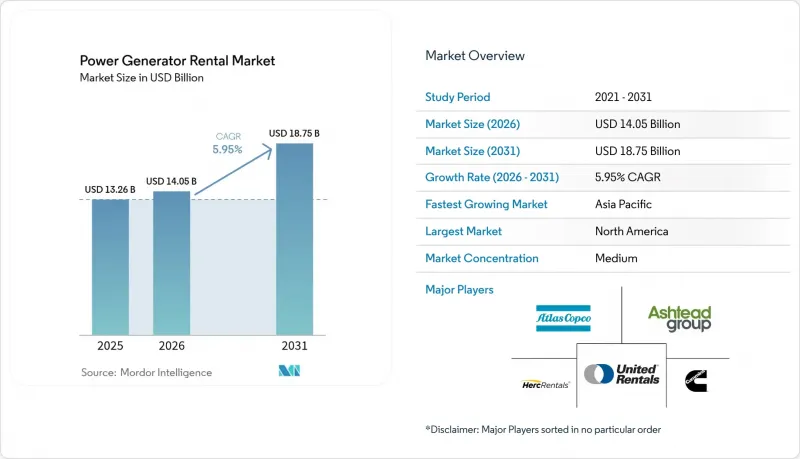
This report is Segmented by Fuel Type (Diesel, Natural Gas, Hybrid/Battery-integrated, and Hydrogen and Others), Power Rating (Below 100 KVA, 101 To 500 KVA, 501 To 1, 000 KVA, and More), Application (Standby/Backup, Prime/Continuous, and Peak Shaving), End User (Construction, Oil and Gas, Mining, Manufacturing, Data Centers, and Others), and Geography (North America, Europe, Asia-Pacific, and More).
Global Power Generator Rental Market Trends and Insights
Aging Grid Infrastructure & Outage Frequency
Utility assets in the United States and Western Europe average more than four decades in service, increasing vulnerability to severe weather-related outages that already account for nearly 80% of major service disruptions.Planned hardening programs often require extended feeder shutdowns, during which mobile sets maintain customer supply and support crews working on energized sections. Rental demand intensifies when storms exceed restoration resources and utilities dispatch fleets of trailer-mounted gen-sets to hospitals, telecom towers, and community shelters. Predictive analytics adopted by grid operators shorten maintenance intervals, paradoxically increasing the frequency of scheduled outages and sustaining rental call-outs. The flexibility to scale power up or down without owning fixed assets positions the power generator rental market as a core resilience tool for utilities, strengthening transmission and distribution infrastructure.
Infrastructure & Construction Boom in Emerging Economies
A surge in sovereign and multilateral spending-illustrated by the USD 1.2 trillion Infrastructure Investment and Jobs Act and parallel megaproject pipelines across India, Indonesia, and Saudi Arabia-creates thousands of active job sites lacking stable grid access. Construction firms prefer rentals to circumvent upfront equipment costs and to match power capacity with evolving site loads as projects move from earthwork to fit-out phases. Urbanization remains rapid; Asia-Pacific cities will add more than 90 million residents by 2030, accelerating demand for roads, metros, and wastewater plants that consume temporary electricity at each build stage. Beyond capital flexibility, renting allows contractors to comply instantly with local emission limits by swapping older engines for Stage V-rated models when authorities tighten air-quality rules. These factors will keep the power generator rental market on a steep growth curve in emerging zones over the long term.
Battery Energy-Storage Substitution
Lithium-ion system costs have fallen 80% since 2013, allowing commercial sites to deploy 1-4 hour batteries that shave peak tariffs and supply zero-emission backup power. Modeling indicates that integrating battery storage with onsite solar can reduce diesel runtime by up to 80% in hybrid microgrids serving festivals, film sets, or telecom towers. In Brazil, microgrid owners cut annual electricity bills by 33% when batteries displaced gen-sets during peak-rate windows. Regulatory incentives such as California's SGIP rebates accelerate adoption, squeezing short-duration rental hours in markets where silent, quick-response batteries satisfy reliability criteria. Nevertheless, batteries struggle to carry multi-day outages caused by hurricanes or transmission faults, which highlights a critical need for rental engines that can run indefinitely when refueled.
Other drivers and restraints analyzed in the detailed report include:
- Data-Center Capacity Expansion & Power-Delay Constraints
- Oil & Gas Field Maintenance / Shutdown Activities
- Volatile Diesel Prices & Rising Carbon Taxes
For complete list of drivers and restraints, kindly check the Table Of Contents.
Segment Analysis
Diesel continued leading the power generator rental market with a USD 9.11 billion value in 2025; its extensive refueling infrastructure and proven reliability underpin 68.72% share. Yet hybrid battery-diesel packages are registering the fastest 9.35% CAGR to 2031 as renters chase fuel savings, lower noise, and immediate compliance with Stage V limits. Operators confirm that intelligent controllers can idle engines and let batteries shoulder variable loads, cutting consumption up to 80% and extending service intervals. Natural-gas units hold steady in municipalities with pipeline networks and stricter particulate regulations, while hydrogen pilots in Germany and Japan show early promise for zero-carbon festivals and event power.
Competitive positioning is shifting: United Rentals' EHR Solar Battery Generator marries a 5 kW PV canopy, 45 kVA propane unit, and lithium pack into a containerized microgrid suited for ultra-low-noise urban refurbishments. Atlas Copco, Cummins, and Aggreko now bundle batteries across 10-100 kVA frames as standard. Hydrogen remains niche, but European subsidies fund field tests where PEM stacks replace diesel sets for remote telecom towers. Over the forecast horizon, hybrid deployments will erode diesel's hold, though absolute diesel demand will still rise in megawatt-scale mines and refineries where battery economics remain challenging.
Units rated 101-500 kVA generated USD 5.06 billion in 2025, equal to a 38.12% share of the power generator rental market and poised for a 6.62% CAGR as customers favor their load-matching versatility. A single 250 kVA set can energize tower cranes, batch plants, or edge data halls, yet remains towable by standard trucks, minimizing logistics costs. Below-100 kVA rentals address mobile clinics and retail outlets but face competition from battery packs in noise-sensitive districts.
Demand for 501-1,000 kVA machines concentrates in petrochemical shutdowns and mega-events requiring aggregated capacity. Above-1 MVA packages, frequently containerized and parallellable, serve utility grid-support roles during transformer replacements. Rental fleets increasingly deploy clusters of mid-range units instead of single high-capacity frames, boosting redundancy and letting operators service equipment without a full site outage. Stage V engine introductions with SCR and DPF modules add cost; therefore, standardized mid-range blocks deliver economies of scale in procurement, maintenance, and telematics integration that underpin their ongoing leadership.
Complete Report Scope:
- By Fuel Type
- Diesel
- Natural Gas
- Hybrid/Battery-integrated
- Hydrogen & Others
- By Power Rating
- Below 100 kVA
- 101 to 500 kVA
- 501 to 1,000 kVA
- Above 1,000 kVA
- By Application
- Standby/Backup
- Prime/Continuous
- Peak Shaving
- By End User
- Construction
- Oil and Gas
- Mining
- Manufacturing
- Data Centers
- Others
- By Geography
- North America
- United States
- Canada
- Mexico
- Europe
- Germany
- United Kingdom
- France
- Italy
- Russia
- Rest of Europe
- Asia-Pacific
- China
- India
- Japan
- South Korea
- ASEAN Countries
- Rest of Asia-Pacific
- South America
- Brazil
- Argentina
- Rest of South America
- Middle East and Africa
- Saudi Arabia
- United Arab Emirates
- South Africa
- Rest of Middle East and Africa
- North America
Geography Analysis
Asia-Pacific retained the largest regional stake in 2025, with USD 4.31 billion revenue translating into 32.48% of the power generator rental market share. Storm-damaged Philippine grids, India's Smart Cities program, and Indonesia's new capital construction funnel ongoing orders for trailer-mounted units, while regional hyperscale capacity added 2.996 MW in Q1 2024 alone. Hybrid rentals gain impetus in Australia, where subsidy schemes reward PV-battery-diesel microgrids on remote mine leases.
North America ranked second at USD 4.12 billion in 2025, and grid-hardening budgets combined with wildfire contingencies in California and Texas will underpin mid-single-digit growth. Stage 5/Tier 4 compliance is already baked into most rental fleets, allowing premium pricing for low-NOx inventory. Europe follows closely, with energy-price volatility since 2022 spurring factories to secure short-term rentals for peak-load shaving and emergency coverage. Emission-linked regulations, including non-road mobile machinery rules, create a replacement pulse favoring modern rental fleets over owned legacy stock.
South America, plus the Middle East & Africa, accounted for less than 15% of 2024 turnover but exhibits double-digit potential tied to resource extraction, petrochemical expansions, and national grid extensions. Brazilian peak-shaving incentives, Qatar's LNG maintenance cycles, and Nigeria's data-localization law all provide catalysts for rentals over outright purchase, hinting at accelerating uptake of hybrid and gas-fired sets as the decade advances.
- Aggreko plc
- United Rentals Inc.
- Ashtead Group plc (Sunbelt Rentals)
- Caterpillar Inc. (CAT Rental)
- Cummins Inc.
- Herc Rentals Inc.
- Atlas Copco AB
- Wartsila Corporation
- Generac Power Systems
- APR Energy
- Kohler-SDMO
- FG Wilson
- Wacker Neuson Group
- Speedy Hire plc
- Pramac
- Rolls-Royce Power Systems (MTU)
- Powerica Ltd.
- Atlas Copco (India) Ltd
- Modern Hiring Service
- Aggreko Energy Rental India Pvt Ltd
Additional Benefits:
- The market estimate (ME) sheet in Excel format
- 3 months of analyst support
TABLE OF CONTENTS
1 Introduction
- 1.1 Study Assumptions & Market Definition
- 1.2 Scope of the Study
2 Research Methodology
3 Executive Summary
4 Market Landscape
- 4.1 Market Overview
- 4.2 Market Drivers
- 4.2.1 Aging grid infrastructure & outage frequency
- 4.2.2 Infrastructure & construction boom in emerging economies
- 4.2.3 Data-center capacity expansion & power-delay constraints
- 4.2.4 Oil & gas field maintenance/shutdown activities
- 4.2.5 Hybrid solar-battery-diesel rental packages for micro-grids
- 4.2.6 Pilot adoption of hydrogen-fueled rental generators
- 4.3 Market Restraints
- 4.3.1 Battery energy-storage substitution
- 4.3.2 Volatile diesel prices & rising carbon taxes
- 4.3.3 Tier-4 Final engine supply shortages
- 4.3.4 Shift to gas-turbine micro-grid rentals
- 4.4 Supply-Chain Analysis
- 4.5 Regulatory Landscape
- 4.6 Technological Outlook
- 4.7 Porter's Five Forces
- 4.7.1 Bargaining Power of Suppliers
- 4.7.2 Bargaining Power of Consumers
- 4.7.3 Threat of New Entrants
- 4.7.4 Threat of Substitutes
- 4.7.5 Intensity of Competitive Rivalry
5 Market Size & Growth Forecasts
- 5.1 By Fuel Type
- 5.1.1 Diesel
- 5.1.2 Natural Gas
- 5.1.3 Hybrid/Battery-integrated
- 5.1.4 Hydrogen & Others
- 5.2 By Power Rating
- 5.2.1 Below 100 kVA
- 5.2.2 101 to 500 kVA
- 5.2.3 501 to 1,000 kVA
- 5.2.4 Above 1,000 kVA
- 5.3 By Application
- 5.3.1 Standby/Backup
- 5.3.2 Prime/Continuous
- 5.3.3 Peak Shaving
- 5.4 By End User
- 5.4.1 Construction
- 5.4.2 Oil and Gas
- 5.4.3 Mining
- 5.4.4 Manufacturing
- 5.4.5 Data Centers
- 5.4.6 Others
- 5.5 By Geography
- 5.5.1 North America
- 5.5.1.1 United States
- 5.5.1.2 Canada
- 5.5.1.3 Mexico
- 5.5.2 Europe
- 5.5.2.1 Germany
- 5.5.2.2 United Kingdom
- 5.5.2.3 France
- 5.5.2.4 Italy
- 5.5.2.5 Russia
- 5.5.2.6 Rest of Europe
- 5.5.3 Asia-Pacific
- 5.5.3.1 China
- 5.5.3.2 India
- 5.5.3.3 Japan
- 5.5.3.4 South Korea
- 5.5.3.5 ASEAN Countries
- 5.5.3.6 Rest of Asia-Pacific
- 5.5.4 South America
- 5.5.4.1 Brazil
- 5.5.4.2 Argentina
- 5.5.4.3 Rest of South America
- 5.5.5 Middle East and Africa
- 5.5.5.1 Saudi Arabia
- 5.5.5.2 United Arab Emirates
- 5.5.5.3 South Africa
- 5.5.5.4 Rest of Middle East and Africa
- 5.5.1 North America
6 Competitive Landscape
- 6.1 Market Concentration
- 6.2 Strategic Moves (M&A, Partnerships, PPAs)
- 6.3 Market Share Analysis (Market Rank/Share for key companies)
- 6.4 Company Profiles (includes Global level Overview, Market level overview, Core Segments, Financials as available, Strategic Information, Products & Services, and Recent Developments)
- 6.4.1 Aggreko plc
- 6.4.2 United Rentals Inc.
- 6.4.3 Ashtead Group plc (Sunbelt Rentals)
- 6.4.4 Caterpillar Inc. (CAT Rental)
- 6.4.5 Cummins Inc.
- 6.4.6 Herc Rentals Inc.
- 6.4.7 Atlas Copco AB
- 6.4.8 Wartsila Corporation
- 6.4.9 Generac Power Systems
- 6.4.10 APR Energy
- 6.4.11 Kohler-SDMO
- 6.4.12 FG Wilson
- 6.4.13 Wacker Neuson Group
- 6.4.14 Speedy Hire plc
- 6.4.15 Pramac
- 6.4.16 Rolls-Royce Power Systems (MTU)
- 6.4.17 Powerica Ltd.
- 6.4.18 Atlas Copco (India) Ltd
- 6.4.19 Modern Hiring Service
- 6.4.20 Aggreko Energy Rental India Pvt Ltd
7 Market Opportunities & Future Outlook
- 7.1 White-space & unmet-need assessment

