PUBLISHER: Mordor Intelligence | PRODUCT CODE: 2123767

PUBLISHER: Mordor Intelligence | PRODUCT CODE: 2123767
Offshore Drilling - Market Share Analysis, Industry Trends & Statistics, Growth Forecasts (2026 - 2031)
According to Mordor Intelligence, the offshore drilling market size reached USD 31.22 billion in 2025 and is projected to climb to USD 32.81 billion in 2026, eventually advancing to USD 41.68 billion by 2031 at a 4.90% CAGR, underscoring a steady upswing in upstream spending on complex wells and longer-life reservoirs.
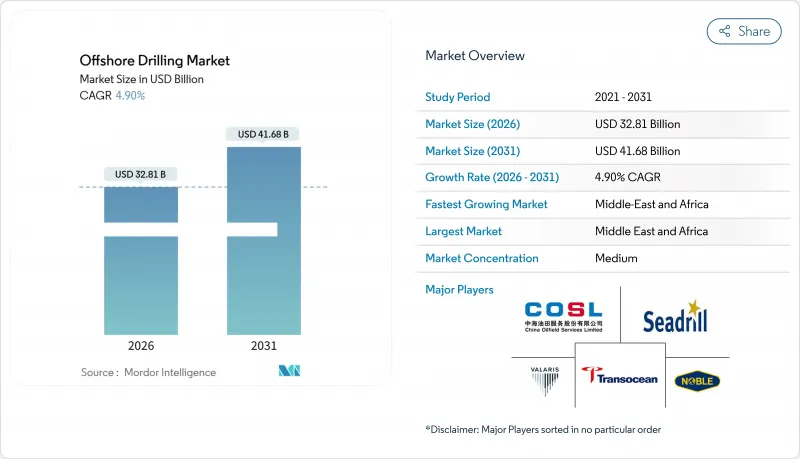
This report is Segmented by Well Type (Conventional and Unconventional), Water Depth (Shallow Water, Deepwater, and Ultra-Deepwater), Service (Exploration and Development Drilling, Production/Workover, Plug and Abandonment, and Subsea Support), and Geography (North America, Europe, Asia-Pacific, South America, and Middle East and Africa). The Market Sizes and Forecasts are Provided in Terms of Value (USD).
Global Offshore Drilling Market Trends and Insights
Growing Jack-up Demand in Middle East Mega-Programs
Multi-year contracts signed by national oil companies in the Arabian Gulf keep jack-up utilization above 90% even as Saudi production cuts introduce spot-rate volatility. ADNOC's USD 1.15 billion award for two high-specification units in May 2025, locked in fifteen-year charters and expanded the contractor's fleet past 140 rigs, mirroring QatarEnergy's requirement for additional capacity tied to a 126 million-tonnes LNG build-out. Shelf Drilling and Borr Drilling benefit from this surge, while India's ONGC pursues a similar long-term model in the Krishna-Godavari basin. The offshore drilling market, therefore, enjoys improved backlog visibility, though episodic oversupply remains possible whenever OPEC+ quotas constrain Saudi activity.
Deepwater Discoveries in Brazil, Guyana & Namibia
Ultra-deepwater finds exceeding 7,500 feet are redefining commercial breakevens, with Petrobras, ExxonMobil, and TotalEnergies sanctioning multi-billion-barrel fields that favor dynamic-positioning drillships. Atapu-2 and Sepia-2 anchor Transocean and Noble backlogs through the decade, while Equinor's Bacalhau delivered first oil at sub-USD 35/bbl breakevens in 2025. Namibia's Orange Basin attracts early-stage capital, indicating that the offshore drilling market will lean increasingly on frontier basins for future growth.
Accelerating Switch to Offshore Wind Lease Blocks
Seabed acreage and heavy-lift vessels are being redirected to UK, U.S., and Dutch wind projects, tightening resource pools that once served offshore hydrocarbon campaigns. Labor premiums for crane operators and subsea technicians climbed 25-30% between 2024 and 2025, squeezing operating margins for drilling contractors.
Other drivers and restraints analyzed in the detailed report include:
- E&P CAPEX Rebound Above 2014 Levels
- Hybrid-Powered "Low-Carbon" Rigs Slash Fuel Burn
- Volatile Brent Breakevens Curb FIDs
For complete list of drivers and restraints, kindly check the Table Of Contents.
Segment Analysis
Conventional wells controlled 90.33% of the offshore drilling market share in 2025, reflecting decades of accumulated subsurface data that de-risk projects in the Gulf of Mexico, the North Sea, and offshore. Predictable geology and proven completion techniques let operators convert prospects quickly, keeping development cycles short and cash-flow visibility high. However, unconventional offshore wells are expanding at a 10.49% CAGR through 2031 as horizontal drilling and hydraulic-fracturing methods, refined onshore, migrate to shallow-water settings and unlock tight reservoirs previously viewed as non-commercial. Extended-reach and multilateral designs allow producers to tap new pay zones from existing platforms, trimming upfront capital and stretching field life. The unconventional offshore drilling market size associated with these developments, therefore, represents a growing slice of new-project sanctioning as conventional discovery rates wane and lease inventories mature.
Momentum is sharpest in basins where legacy assets offer infrastructure head starts, letting operators drill long-step-out laterals without building new hubs. BP's "design one and build many" template for compact facilities exemplifies how simplified topsides, standardized wellhead trees, and factory-style execution lower break-evens and shorten schedules. Contractors that supply precision rotary-steerable systems, high-horsepower frac spreads, and real-time downhole telemetry stand to benefit as operators seek tighter well spacing and higher stimulated reservoir volumes. Because unconventional programs often involve a higher well count per field, service intensity rises, anchoring a durable demand stream that augments traditional exploration and appraisal work. As a result, the offshore drilling market is transitioning toward a dual-track model in which high-spec rigs chase deepwater prospects while adaptable jackups and platform rigs exploit near-field unconventional targets.
Complete Report Scope:
- By Well Type
- Conventional
- Unconventional
- By Water Depth
- Shallow Water (Below 400 ft)
- Deepwater (400 to 5,000 ft)
- Ultra-deepwater (Above 5,000 ft)
- By Service
- Exploration and Development Drilling
- Production/Workover
- Plug and Abandonment
- Subsea Support
- By Geography
- North America
- United States
- Canada
- Mexico
- Europe
- Germany
- United Kingdom
- Norway
- Russia
- Rest of Europe
- Asia-Pacifc
- China
- India
- Thailand
- Vietnam
- Australia
- Rest of Asia-Pacifc
- South America
- Brazil
- Trinidad and Tobago
- Rest of South America
- Middle East and Africa
- Saudi Arabia
- United Arab Emirates
- Qatar
- Egypt
- Nigeria
- Angola
- Namibia
- Rest of Middle East and Africa
- North America
Geography Analysis
The Middle East and Africa lead the offshore drilling market with a 31.09% share and a 5.50% forecast CAGR. Long-term LNG-linked projects in Qatar, gas development in Saudi Arabia, and deepwater prospects in Nigeria and Angola underpin expansion. South America follows at roughly 22%, driven mainly by Brazil's pre-salt and Guyana's Stabroek Block. North America's 18% share centers on the Gulf of Mexico, where high-pressure technology unlocks new reservoirs but competes with shale capital. Europe's 15% share is anchored by Norwegian output, but wind-lease priority narrows hydrocarbon acreage. Asia-Pacific's 14% stake reflects China's Bohai Bay, India's KG Basin, and Australia's Scarborough gas project, each sustaining localized rig demand despite weather and logistics hurdles. These regional dynamics collectively give the offshore drilling market a balanced mix of mature and frontier opportunities.
- Transocean Ltd.
- Valaris plc
- China Oilfield Services Ltd. (COSL)
- Noble Corp.
- Seadrill Ltd.
- Shelf Drilling Ltd.
- Borr Drilling Ltd.
- ADNOC Drilling
- PetroSaudi
- KCA Deutag
- Saipem SpA
- Odfjell Drilling
- Stena Drilling
- Maersk Drilling (Noble)
- Baker Hughes Co.
- Halliburton Co.
- Schlumberger Ltd.
- Weatherford Int'l
- Petrofac Ltd.
- Exalo Drilling
Additional Benefits:
- The market estimate (ME) sheet in Excel format
- 3 months of analyst support
TABLE OF CONTENTS
1 Introduction
- 1.1 Study Assumptions & Market Definition
- 1.2 Scope of the Study
2 Research Methodology
3 Executive Summary
4 Market Landscape
- 4.1 Market Overview
- 4.2 Market Drivers
- 4.2.1 Growing jack-up demand in Middle East mega-programs
- 4.2.2 Deepwater discoveries in Brazil, Guyana & Namibia
- 4.2.3 E&P CAPEX rebound above 2014 levels
- 4.2.4 Hybrid-powered "low-carbon" rigs slash fuel burn
- 4.2.5 Autonomous drilling & digital twins lift uptime
- 4.2.6 Growing demand for natural gas and developing gas infrastructure
- 4.3 Market Restraints
- 4.3.1 Accelerating switch to offshore wind lease blocks
- 4.3.2 Volatile Brent breakevens curb FIDs
- 4.3.3 Offshore-crew shortage inflates OPEX
- 4.3.4 ESG-driven capital drought for newbuild rigs
- 4.4 Supply-Chain Analysis
- 4.5 Regulatory Landscape
- 4.6 Technological Outlook
- 4.7 Key Offshore Projects Pipeline
- 4.7.1 Existing Projects
- 4.7.2 Planned and Announced Projects
- 4.8 Porter's Five Forces
- 4.8.1 Bargaining Power of Suppliers
- 4.8.2 Bargaining Power of Buyers
- 4.8.3 Threat of New Entrants
- 4.8.4 Threat of Substitutes
- 4.8.5 Competitive Rivalry
5 Market Size & Growth Forecasts
- 5.1 By Well Type
- 5.1.1 Conventional
- 5.1.2 Unconventional
- 5.2 By Water Depth
- 5.2.1 Shallow Water (Below 400 ft)
- 5.2.2 Deepwater (400 to 5,000 ft)
- 5.2.3 Ultra-deepwater (Above 5,000 ft)
- 5.3 By Service
- 5.3.1 Exploration and Development Drilling
- 5.3.2 Production/Workover
- 5.3.3 Plug and Abandonment
- 5.3.4 Subsea Support
- 5.4 By Geography
- 5.4.1 North America
- 5.4.1.1 United States
- 5.4.1.2 Canada
- 5.4.1.3 Mexico
- 5.4.2 Europe
- 5.4.2.1 Germany
- 5.4.2.2 United Kingdom
- 5.4.2.3 Norway
- 5.4.2.4 Russia
- 5.4.2.5 Rest of Europe
- 5.4.3 Asia-Pacifc
- 5.4.3.1 China
- 5.4.3.2 India
- 5.4.3.3 Thailand
- 5.4.3.4 Vietnam
- 5.4.3.5 Australia
- 5.4.3.6 Rest of Asia-Pacifc
- 5.4.4 South America
- 5.4.4.1 Brazil
- 5.4.4.2 Trinidad and Tobago
- 5.4.4.3 Rest of South America
- 5.4.5 Middle East and Africa
- 5.4.5.1 Saudi Arabia
- 5.4.5.2 United Arab Emirates
- 5.4.5.3 Qatar
- 5.4.5.4 Egypt
- 5.4.5.5 Nigeria
- 5.4.5.6 Angola
- 5.4.5.7 Namibia
- 5.4.5.8 Rest of Middle East and Africa
- 5.4.1 North America
6 Competitive Landscape
- 6.1 Market Concentration
- 6.2 Strategic Moves (M&A, Partnerships, PPAs)
- 6.3 Market Share Analysis (Market Rank/Share for key companies)
- 6.4 Company Profiles (includes Global level Overview, Market level overview, Core Segments, Financials as available, Strategic Information, Products & Services, and Recent Developments)
- 6.4.1 Transocean Ltd.
- 6.4.2 Valaris plc
- 6.4.3 China Oilfield Services Ltd. (COSL)
- 6.4.4 Noble Corp.
- 6.4.5 Seadrill Ltd.
- 6.4.6 Shelf Drilling Ltd.
- 6.4.7 Borr Drilling Ltd.
- 6.4.8 ADNOC Drilling
- 6.4.9 PetroSaudi
- 6.4.10 KCA Deutag
- 6.4.11 Saipem SpA
- 6.4.12 Odfjell Drilling
- 6.4.13 Stena Drilling
- 6.4.14 Maersk Drilling (Noble)
- 6.4.15 Baker Hughes Co.
- 6.4.16 Halliburton Co.
- 6.4.17 Schlumberger Ltd.
- 6.4.18 Weatherford Int'l
- 6.4.19 Petrofac Ltd.
- 6.4.20 Exalo Drilling
7 Market Opportunities & Future Outlook
- 7.1 White-space & Unmet-Need Assessment

