PUBLISHER: Mordor Intelligence | PRODUCT CODE: 2123977

PUBLISHER: Mordor Intelligence | PRODUCT CODE: 2123977
Probiotic Ingredients - Market Share Analysis, Industry Trends & Statistics, Growth Forecasts (2026 - 2031)
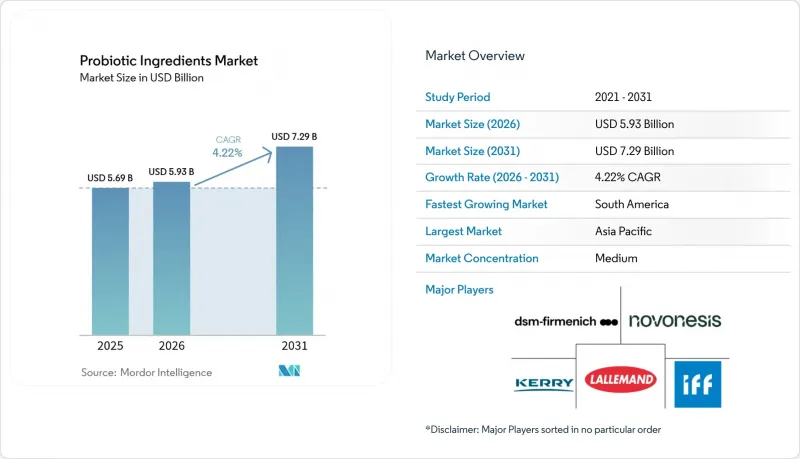
According to Mordor Intelligence, the probiotic ingredients market size is expected to grow from USD 5.69 billion in 2025 to USD 5.93 billion in 2026 and is forecast to reach USD 7.29 billion by 2031 at 4.22% CAGR over 2026-2031.
This report Segments the Industry by Product Type (Bacteria and Yeast), Form (Powder and Liquid), Application (Food and Beverage, Dietary Supplements, and Animal Feed), and Geography (North America, South America, Europe, Asia-Pacific, and Middle East and Africa). The Market Forecasts are Provided in Terms of Value (USD).
Global Probiotic Ingredients Market Trends and Insights
Rising Demand for Digestive Health Products
The increasing awareness of the integral relationship between gut health and overall wellness has significantly boosted the demand for digestive health products, with probiotics at the forefront of this growth. This paradigm shift from reactive to preventive healthcare has firmly established probiotics as a staple in daily wellness regimens. Advancements in scientific research continue to reveal their multifaceted benefits, extending beyond digestive support to include immune system enhancement and potential mental health improvements through the gut-brain axis. For instance, studies conducted by Stanford University have highlighted the evolving role of probiotics, uncovering new opportunities for market expansion . This scientific backing resonates with a more informed and health-conscious consumer base, which increasingly favors strain-specific probiotics designed to address targeted health concerns over generic, one-size-fits-all solutions. As the trend toward personalized nutrition accelerates, companies are strategically adapting their product development strategies to focus on clinically validated probiotic strains with proven efficacy. This approach not only meets consumer demand but also positions businesses to thrive in an increasingly competitive and dynamic market.
Growing Demand for Functional Foods and Beverages
The probiotic market has expanded beyond traditional dairy products into functional foods and beverages, reflecting consumer demand for health-enhancing food products. The market growth is driven by new product development, including probiotic-enriched granola bars, salad dressings, plant-based yogurts, and fermented beverages such as kombucha and kefir. Companies like Danone and PepsiCo are diversifying their probiotic product portfolios with convenient formats for health-conscious consumers, while new market entrants focus on specific consumer segments with gut health products. Also, advancements in microencapsulation technology have enhanced probiotic stability during manufacturing, extended product shelf life, and improved survival through digestion. This technology enables the integration of live cultures into products with high heat or acidity, such as baked goods and citrus beverages, while maintaining their efficacy. Companies like Ganeden, acquired by Kerry Group, have developed shelf-stable probiotic products, improving distribution efficiency and market penetration, particularly in developing regions. The integration of convenience, taste, and digestive health benefits is increasing consumer adoption of probiotic products.
Limited Shelf Life and Stability Challenges
Maintaining probiotic organism viability throughout shelf life represents a significant operational challenge that limits market growth. The World Health Organization (WHO) and Food and Agriculture Organization (FAO) require probiotics to contain 10^6 to 10^7 CFU of viable bacteria to provide health benefits. However, maintaining these levels from production through consumption remains a key operational issue. Besides, real-time PCR stability analyses demonstrate that viable counts frequently decrease below stated label claims, particularly in expired products, impacting consumer trust and product performance. This operational constraint specifically affects smaller manufacturers with restricted access to stabilization technologies, while larger companies leverage their established formulation capabilities. The industry has implemented technical solutions, including microencapsulation, protective delivery systems, and moisture-controlling packaging, to improve probiotic viability. However, these solutions increase operational complexity and manufacturing costs.
Other drivers and restraints analyzed in the detailed report include:
- Expanding Application in Animal Feed for Gut Health
- Popularity of Plant-based and Fermented Probiotic Products
- Storage and Distribution Challenges in Hot Climates
For complete list of drivers and restraints, kindly check the Table Of Contents.
Segment Analysis
In 2025, bacteria-based probiotics dominate the market, holding a commanding 77.05% share. Lactobacillus and bifidobacterium strains, known for their safety and health benefits, are the backbone of most commercial formulations. This stronghold of bacterial probiotics is rooted in their extensive research history and consumer trust, especially in traditional uses like yogurt and fermented foods. Recent breakthroughs in identifying and characterizing bacterial strains have broadened their application scope. Next-generation probiotics (NGPs) are now emerging, targeting specific health issues beyond just digestive wellness. A notable frontier in this realm is the rise of precision microbiome therapies. Here, researchers harness cutting-edge technologies, including genomics and AI, to scrutinize microbiota, crafting personalized treatments that pinpoint specific core probiotics to bolster health and tackle diseases.
Yeast-based probiotics, though commanding a smaller slice of the market, are on an upswing, boasting a robust 7.02% CAGR from 2026 to 2031. This growth is attributed to their unique advantages in select applications. Leading this yeast segment are Saccharomyces cerevisiae and Saccharomyces boulardii. Research underscores their resilience in gastrointestinal settings and their potential to ease lactose intolerance. Yeast cells come with inherent stability perks, showcasing resistance to antibiotics, bile salts, and acidic environments. This resilience gives them an edge in applications where bacterial probiotics might struggle. Current studies on yeast-based probiotics in dairy highlight the critical nature of strain selection, focusing on gastrointestinal survival, safety, and unique probiotic traits, hinting at a vibrant future for innovation in this domain.
Complete Report Scope:
- By Product Type
- Bacteria
- Lactobacillus
- Bifidobacterium
- Others
- Yeast
- Saccharomyces Cerevisiae
- Saccharomyces Boulardi
- Others
- Bacteria
- By Form
- Powder
- Liquid
- By Application
- Food and Beverage
- Yogurt
- Infant Formula
- Probiotic Drinks
- Other Food and Beverages
- Dietary Supplements
- Animal Feed
- Food and Beverage
- By Geography
- North America
- United States
- Canada
- Mexico
- Rest of North America
- South America
- Brazil
- Argentina
- Colombia
- Chile
- Peru
- Rest of South America
- Europe
- Germany
- United Kingdom
- Italy
- France
- Netherlands
- Poland
- Belgium
- Sweden
- Spain
- Rest of Europe
- Asia-Pacific
- China
- India
- Japan
- Australia
- Indonesia
- South Korea
- Thailand
- Singapore
- Rest of Asia-Pacific
- Middle East and Africa
- South Africa
- Saudi Arabia
- United Arab Emirates
- Nigeria
- Egypt
- Morocco
- Turkey
- Rest of Middle East and Africa
- North America
Geography Analysis
In 2025, the Asia-Pacific region commands a dominant 33.12% share of the probiotic ingredients market, fueled by cultural affinities for fermented foods, heightened health awareness, and brisk economic growth. Within this landscape, China, Japan, and India emerge as the primary growth engines, each showcasing unique market dynamics and consumer inclinations. Japan's deep-rooted probiotic traditions pave the way for ongoing innovations. In contrast, China's burgeoning middle class is opening doors to premium probiotic offerings. Unlike Europe, where regulations can be stringent, the Asia-Pacific's more lenient regulatory stance facilitates broader probiotic marketing, bolstering market growth. A July 2024 study in Frontiers in Microbiology underscores the pivotal role of gut microbiota and probiotics in leukemia treatments among Asian demographics. The findings hint at probiotics' potential in alleviating chemotherapy's side effects and enhancing patient recovery. Such insights not only broaden the perception of probiotics beyond mere digestive aids but also spotlight burgeoning avenues in medical nutrition and adjunctive therapies.
South America, starting from a smaller market size than Asia-Pacific or North America, is on a rapid ascent, projected to grow at a 4.95% CAGR from 2026 to 2031. Brazil, with its strong dairy sector and a populace increasingly attuned to health, stands as the region's probiotic powerhouse. While the South American market is buoyed by rising yogurt consumption and a burgeoning functional food segment, economic fluctuations in certain nations pose hurdles. As the probiotic market burgeons, South American regulatory bodies are adapting, with Brazil often leading the way and influencing its neighbors. A special feature in SciELO Press Releases spotlights the innovative edge of probiotic-infused functional foods, underscoring their pronounced health benefits. This sentiment resonates strongly in Brazil and Argentina, where a surge in gut health awareness is prompting manufacturers to roll out products that align with local tastes and dietary habits.
In North America, the probiotic ingredients market is bolstered by high consumer awareness of digestive and immune health, a strong presence of functional food and supplement brands, and ongoing innovations in delivery formats that appeal to diverse consumer groups. Moreover, the United States market exhibits substantial growth in probiotic supplement consumption. According to the Council for Responsible Nutrition, 74% of Americans utilized dietary supplements, including probiotics, in 2023 . This market behavior reflects the systematic integration of probiotic ingredients into mainstream dietary supplement formulations, driven by increasing consumer demand for digestive health products. Additionally, Europe constitutes a significant market segment due to its established fermented food industry and regulatory framework supporting probiotic health claims, contributing to growth in both mainstream and specialty segments. The Middle East and Africa market demonstrates substantial growth potential, driven by heightened health awareness, increasing urbanization, and strategic investments from food and beverage manufacturers responding to consumer demand for gut health products.
- Novonesis A/S
- Kerry Group plc
- International Flavors & Fragrances Inc.
- DSM-Firmenich
- Lallemand Inc.
- Archer Daniels Midland Company
- Lactina Ltd.
- Probiotical S.p.A.
- Symrise AG (Probi AB)
- Advanced Enzyme Technologies Ltd.
- Royal FrieslandCampina N.V.
- Synbio Tech Inc.
- Sami-Sabinsa Group
- Greenfiber International S.A.
- Winclove Probiotics B.V.
- Marubeni Corporation (Orffa International Holding B.V.)
- Associated British Foods PLC
- Nutris
- Sanzyme Biologics Private Limited
- Rajvi Enterprise
Additional Benefits:
- The market estimate (ME) sheet in Excel format
- 3 months of analyst support
TABLE OF CONTENTS
1 INTRODUCTION
- 1.1 Study Assumptions and Market Definition
- 1.2 Scope of the Study
2 RESEARCH METHODOLOGY
3 EXECUTIVE SUMMARY
4 MARKET LANDSCAPE
- 4.1 Market Overview
- 4.2 Market Drivers
- 4.2.1 Rising Demand for Digestive Health Products
- 4.2.2 Growing Demand for Functional Foods and Beverages
- 4.2.3 Expanding Application in Animal Feed for Gut Health
- 4.2.4 Popularity of Plant-based and Fermented Probiotic Products
- 4.2.5 Innovations in Probiotic Formulations
- 4.2.6 Favorable Regulations Boost Probiotic Credibility
- 4.3 Market Restraints
- 4.3.1 Limited Shelf Life and Stability Challenges
- 4.3.2 Storage and Distribution Challenges in Hot Climates
- 4.3.3 Alternative Health Solutions Overshadow Probiotics
- 4.3.4 Premium Pricing Limits Adoption in Price-sensitive Markets
- 4.4 Supply Chain Analysis
- 4.5 Regulatory Outlook
- 4.6 Porter's Five Forces Analysis
- 4.6.1 Threat of New Entrants
- 4.6.2 Bargaining Power of Buyers/Consumers
- 4.6.3 Bargaining Power of Suppliers
- 4.6.4 Threat of Substitute Products
- 4.6.5 Intensity of Competitive Rivalry
5 MARKET SIZE AND GROWTH FORECASTS (VALUE)
- 5.1 By Product Type
- 5.1.1 Bacteria
- 5.1.1.1 Lactobacillus
- 5.1.1.2 Bifidobacterium
- 5.1.1.3 Others
- 5.1.2 Yeast
- 5.1.2.1 Saccharomyces Cerevisiae
- 5.1.2.2 Saccharomyces Boulardi
- 5.1.2.3 Others
- 5.1.1 Bacteria
- 5.2 By Form
- 5.2.1 Powder
- 5.2.2 Liquid
- 5.3 By Application
- 5.3.1 Food and Beverage
- 5.3.1.1 Yogurt
- 5.3.1.2 Infant Formula
- 5.3.1.3 Probiotic Drinks
- 5.3.1.4 Other Food and Beverages
- 5.3.2 Dietary Supplements
- 5.3.3 Animal Feed
- 5.3.1 Food and Beverage
- 5.4 By Geography
- 5.4.1 North America
- 5.4.1.1 United States
- 5.4.1.2 Canada
- 5.4.1.3 Mexico
- 5.4.1.4 Rest of North America
- 5.4.2 South America
- 5.4.2.1 Brazil
- 5.4.2.2 Argentina
- 5.4.2.3 Colombia
- 5.4.2.4 Chile
- 5.4.2.5 Peru
- 5.4.2.6 Rest of South America
- 5.4.3 Europe
- 5.4.3.1 Germany
- 5.4.3.2 United Kingdom
- 5.4.3.3 Italy
- 5.4.3.4 France
- 5.4.3.5 Netherlands
- 5.4.3.6 Poland
- 5.4.3.7 Belgium
- 5.4.3.8 Sweden
- 5.4.3.9 Spain
- 5.4.3.10 Rest of Europe
- 5.4.4 Asia-Pacific
- 5.4.4.1 China
- 5.4.4.2 India
- 5.4.4.3 Japan
- 5.4.4.4 Australia
- 5.4.4.5 Indonesia
- 5.4.4.6 South Korea
- 5.4.4.7 Thailand
- 5.4.4.8 Singapore
- 5.4.4.9 Rest of Asia-Pacific
- 5.4.5 Middle East and Africa
- 5.4.5.1 South Africa
- 5.4.5.2 Saudi Arabia
- 5.4.5.3 United Arab Emirates
- 5.4.5.4 Nigeria
- 5.4.5.5 Egypt
- 5.4.5.6 Morocco
- 5.4.5.7 Turkey
- 5.4.5.8 Rest of Middle East and Africa
- 5.4.1 North America
6 COMPETITIVE LANDSCAPE
- 6.1 Market Concentration
- 6.2 Strategic Moves
- 6.3 Market Ranking Analysis
- 6.4 Company Profiles (includes Global-level Overview, Market-level Overview, Core Segments, Financials (if available), Strategic Information, Market Rank/Share, Products & Services, Recent Developments)
- 6.4.1 Novonesis A/S
- 6.4.2 Kerry Group plc
- 6.4.3 International Flavors & Fragrances Inc.
- 6.4.4 DSM-Firmenich
- 6.4.5 Lallemand Inc.
- 6.4.6 Archer Daniels Midland Company
- 6.4.7 Lactina Ltd.
- 6.4.8 Probiotical S.p.A.
- 6.4.9 Symrise AG (Probi AB)
- 6.4.10 Advanced Enzyme Technologies Ltd.
- 6.4.11 Royal FrieslandCampina N.V.
- 6.4.12 Synbio Tech Inc.
- 6.4.13 Sami-Sabinsa Group
- 6.4.14 Greenfiber International S.A.
- 6.4.15 Winclove Probiotics B.V.
- 6.4.16 Marubeni Corporation (Orffa International Holding B.V.)
- 6.4.17 Associated British Foods PLC
- 6.4.18 Nutris
- 6.4.19 Sanzyme Biologics Private Limited
- 6.4.20 Rajvi Enterprise
7 MARKET OPPORTUNITIES AND FUTURE OUTLOOK

