PUBLISHER: Mordor Intelligence | PRODUCT CODE: 2123998

PUBLISHER: Mordor Intelligence | PRODUCT CODE: 2123998
Wireless Speaker - Market Share Analysis, Industry Trends & Statistics, Growth Forecasts (2026 - 2031)
According to Mordor Intelligence, the global wireless speaker market size size in 2026 is estimated at USD 38.84 billion, growing from 2025 value of USD 36.41 billion with 2031 projections showing USD 53.66 billion, growing at 6.68% CAGR over 2026-2031.
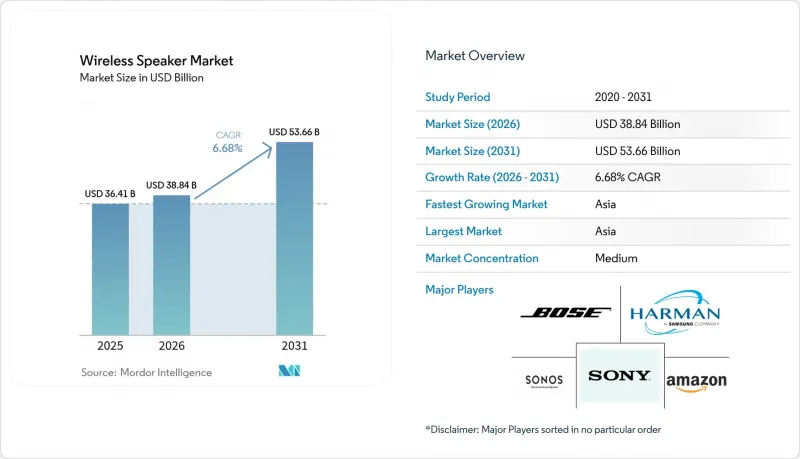
This report is Segmented by Connectivity Type (Bluetooth, Wi-Fi, Smart Speakers, and Cellular/LTE), Form Factor (Portable Mini, Soundbars, Smart-Display, and More), Distribution Channel (Online E-Commerce, Specialty Audio Retail, Mass-Merchandisers, and OEM-Fitted Networks), End-User (Residential, Commercial, Hospitality, and More), and Geography. The Market Forecasts are Provided in Terms of Value (USD).
Global Wireless Speaker Market Trends and Insights
Voice-assistant Integration Accelerating Smart-speaker Uptake in Emerging Asia
Smart-speaker adoption in China and India jumped when vendors embedded local-language, conversational AI and kept entry prices below USD 40. Amazon's February 2025 launch of Alexa+, a generative-AI overlay that works on 600 million existing Echo devices, extended hardware life and introduced a USD 19.99 monthly revenue stream. Google's pivot to Gemini AI for ambient computing signals a broader architectural shift toward cloud-native, multimodal voice experiences. Asian OEMs gain fast-follower advantage because they can license mature voice stacks instead of building proprietary solutions, cutting bill-of-material costs while raising perceived intelligence. Network effects from existing smart-home assets such as bulbs or cameras further lower adoption friction for first-time buyers.
Dolby Atmos Soundbar Upgrades Fueling ASP Growth in Urban China and South Korea
City-dwelling consumers in these markets are moving away from legacy 2.1-channel bars toward Dolby Atmos-enabled bundles that include wireless surrounds. MediaTek and Dolby unveiled FlexConnect in January 2025, allowing soundbars to auto-calibrate with any compatible speaker in the room, removing HDMI-cable constraints. Sony's BRAVIA Theatre line uses 360 Spatial Sound Mapping to simulate multi-speaker environments without ceiling drivers. Higher audio immersion supports USD 300-plus price points, lifting overall wireless speaker market average-selling-price even as unit volumes stay flat.
Smart-speaker Privacy Concerns Limiting Household Adoption in France and Canada
Supervisory authorities such as France's CNIL remind users that voice data may feed undisclosed algorithm training, prompting stricter consent settings. Surveys show over half of French and Canadian households fear unintentional eavesdropping despite appreciating convenience. Vendors respond with local-processing modes and physical mute toggles, yet scepticism slows replacement cycles and keeps the addressable base below neighbouring markets.
Other drivers and restraints analyzed in the detailed report include:
- Automotive OEM Detachable-speaker Partnerships in Premium EVs
- Hybrid Workspaces Driving Enterprise Bluetooth Conference Speakers in Europe
- Class-D Amplifier IC Shortages Delaying Mid-tier ODM Production in Asia
For complete list of drivers and restraints, kindly check the Table Of Contents.
Segment Analysis
Bluetooth held 51.62% of the wireless speaker market share in 2025, anchoring its dominance on ubiquity and pairing simplicity. Smart-speaker connectivity, helped by Wi-Fi dual-band chips and edge-AI advances, is forecast to rise at an 8.12% CAGR, gradually eating into basic Bluetooth volumes. The wireless speaker market size for cellular-enabled units remains low-single-digit, but satellite connectivity proofs-of-concept targeting RVs and maritime users hint at new price tiers. Emerging Bluetooth LE Audio with Auracast narrows latency, offering broadcast mode that can stream a concert feed to hundreds of personal speakers, reinforcing relevance for public venues. Legacy AirPlay-only devices continue to shrink as consumers request cross-platform support.
Wi-Fi-centric speakers outside the smart category sustain interest among audiophiles who prioritise lossless playback. Multi-room platforms now expose Matter-compatible schemas, easing interoperability pains. As chipset prices fall below USD 8, several tier-two Asian makers plan to upgrade entry-level models to Wi-Fi-plus-Bluetooth, balancing cost and ecosystem access.
Portable minis contributed the largest shipment volume, translating into 40.55% of the wireless speaker market size in 2025. Nevertheless, soundbars delivered superior revenue growth, advancing at a 8.95% CAGR, because cinema-grade Atmos decoding lifts average prices. Party speakers add light shows and microphone inputs, tapping Gen-Z social-video behaviour. Rugged clip-on variants meet demand for biking and hiking audio, featuring IP67 ratings and 12-hour batteries. Floor-standing wireless towers occupy a high-margin niche serving living-room audiophiles unwilling to route speaker cables.
Smart-display speakers remain a hybrid segment merging voice, touch and video chat, finding adoption in kitchens for recipe walkthroughs or surveillance camera feeds. As mini-LED costs fall, manufacturers experiment with eight-inch panels on swivel mounts, preserving compact footprints.
Complete Report Scope:
- By Connectivity Type
- Bluetooth
- Wi-Fi (incl. Combo, excl. Smart)
- Smart Speakers
- Cellular/LTE Speakers
- By Form Factor
- Portable Mini/Pocket-Sized
- Soundbars
- Smart-Display Speakers
- Floor-Standing/Tower
- Clip-on/Sports and Outdoor
- By Distribution Channel
- Online E-commerce
- Specialty Audio Retail
- Mass-Merchandisers/Hypermarkets
- OEM-Fitted and Installer Networks
- By End-User
- Residential
- Commercial
- Hospitality Corporate/Enterprise
- Automotive OEM
- Others (Education, Public Venues)
- By Geography
- North America
- United States
- Canada
- Mexico
- Europe
- Germany
- United Kingdom
- France
- Nordics
- Rest of Europe
- South America
- Brazil
- Rest of South America
- Asia-Pacific
- China
- Japan
- India
- South-East Asia
- Rest of Asia-Pacific
- Middle East and Africa
- Middle East
- Gulf Cooperation Council Countries
- Turkey
- Rest of Middle East
- Africa
- South Africa
- Rest of Africa
- Middle East
- North America
Geography Analysis
Asia-Pacific contributed 34.42% of 2025 revenue and is projected to rise at a 6.78% CAGR thanks to scale manufacturing, cost-competitive brands and rapid 5G handset take-up. China anchors volume, combining local AI platforms with sub-USD 25 entry devices. South Korea and Japan chase premium niches, though codec fragmentation postpones audiophile upgrades. India's import-tariff hikes encourage domestic assembly, with several handset brands diversifying into speakers to capture accessory spend.
North America retains a sizeable premium segment, driven by subscription ecosystems linking smart speakers to home-security and media bundles. United States consumers show willingness to pay for AI enhancements such as Amazon Alexa+, whereas Canada's adoption curve flattens because privacy concerns curb living-room placement. Mexico benefits from cross-border fulfilment centres that cut delivery times for mid-range products.
Europe remains a mixed picture. Western Europe outperforms on multi-room adoption, with Scandinavian markets favouring sustainable materials and repairability. France's cautious stance on always-listening devices slows smart-speaker uptake, while Germany's hi-fi enthusiasts wait for unified lossless Bluetooth before replacing wired rigs. Central and Eastern Europe expand entry-level Bluetooth sales via e-commerce, offsetting weaker retail networks.
South America sees brisk demand for ultra-portable speakers that double as content-creation props for short-video platforms. Brazil's high duties push brands to move final assembly onshore or consider MicroSD-equipped models that sidestep streaming data costs. Chile and Colombia import mid-priced soundbars as fibre broadband coverage widens.
- Amazon.com Inc.
- Google LLC
- Apple Inc. (Beats)
- Sonos Inc.
- Bose Corporation
- Samsung Electronics Co. Ltd (Harman)
- Sony Group Corp.
- LG Electronics Inc.
- Panasonic Corp.
- Logitech International S.A.
- Pioneer Electronic Corp.
- Bang and Olufsen A/S
- Xiaomi Corp.
- Baidu Inc.
- Sharp Corp.
- Anker Innovations Ltd.
- JBL (Harman)
- Klipsch Group Inc.
- Edifier Technology Co. Ltd.
- Marshall Group AB
Additional Benefits:
- The market estimate (ME) sheet in Excel format
- 3 months of analyst support
TABLE OF CONTENTS
1 INTRODUCTION
- 1.1 Study Assumptions and Market Definition
- 1.2 Scope of the Study
2 RESEARCH METHODOLOGY
3 EXECUTIVE SUMMARY
4 MARKET LANDSCAPE
- 4.1 Market Overview
- 4.2 Market Drivers
- 4.2.1 Increasing Multi-room Audio Ecosystems Adoption in North America and Western Europe
- 4.2.2 Voice-Assistant Integration Accelerating Smart-Speaker Uptake in Emerging Asia
- 4.2.3 Dolby Atmos Soundbar Upgrades Fueling ASP Growth in Urban China and South Korea
- 4.2.4 Gen-Z Short-Video Consumption Spurring Ultra-Portable Speaker Demand in South America
- 4.2.5 Automotive OEM Detachable Speaker Partnerships in Premium EVs
- 4.2.6 Hybrid Workspaces Driving Enterprise Bluetooth Conference Speakers in Europe
- 4.3 Market Restraints
- 4.3.1 Bluetooth Codec Fragmentation Dampening Audiophile Upgrades in Japan and Germany
- 4.3.2 High Import Tariffs on Finished Audio Devices in Brazil and India
- 4.3.3 Smart-Speaker Privacy Concerns Limiting Household Adoption in France and Canada
- 4.3.4 Class-D Amplifier IC Shortages Delaying Mid-Tier ODM Production in Asia
- 4.4 Industry Value Chain Analysis
- 4.5 Regulatory or Technological Outlook
- 4.6 Porter's Five Forces Analysis
- 4.6.1 Bargaining Power of Suppliers
- 4.6.2 Bargaining Power of Consumers
- 4.6.3 Threat of New Entrants
- 4.6.4 Threat of Substitute Products
- 4.6.5 Intensity of Competitive Rivalry
5 MARKET SIZE AND GROWTH FORECASTS (VALUES)
- 5.1 By Connectivity Type
- 5.1.1 Bluetooth
- 5.1.2 Wi-Fi (incl. Combo, excl. Smart)
- 5.1.3 Smart Speakers
- 5.1.4 Cellular/LTE Speakers
- 5.2 By Form Factor
- 5.2.1 Portable Mini/Pocket-Sized
- 5.2.2 Soundbars
- 5.2.3 Smart-Display Speakers
- 5.2.4 Floor-Standing/Tower
- 5.2.5 Clip-on/Sports and Outdoor
- 5.3 By Distribution Channel
- 5.3.1 Online E-commerce
- 5.3.2 Specialty Audio Retail
- 5.3.3 Mass-Merchandisers/Hypermarkets
- 5.3.4 OEM-Fitted and Installer Networks
- 5.4 By End-User
- 5.4.1 Residential
- 5.4.2 Commercial
- 5.4.3 Hospitality Corporate/Enterprise
- 5.4.4 Automotive OEM
- 5.4.5 Others (Education, Public Venues)
- 5.5 By Geography
- 5.5.1 North America
- 5.5.1.1 United States
- 5.5.1.2 Canada
- 5.5.1.3 Mexico
- 5.5.2 Europe
- 5.5.2.1 Germany
- 5.5.2.2 United Kingdom
- 5.5.2.3 France
- 5.5.2.4 Nordics
- 5.5.2.5 Rest of Europe
- 5.5.3 South America
- 5.5.3.1 Brazil
- 5.5.3.2 Rest of South America
- 5.5.4 Asia-Pacific
- 5.5.4.1 China
- 5.5.4.2 Japan
- 5.5.4.3 India
- 5.5.4.4 South-East Asia
- 5.5.4.5 Rest of Asia-Pacific
- 5.5.5 Middle East and Africa
- 5.5.5.1 Middle East
- 5.5.5.1.1 Gulf Cooperation Council Countries
- 5.5.5.1.2 Turkey
- 5.5.5.1.3 Rest of Middle East
- 5.5.5.2 Africa
- 5.5.5.2.1 South Africa
- 5.5.5.2.2 Rest of Africa
- 5.5.5.1 Middle East
- 5.5.1 North America
6 COMPETITIVE LANDSCAPE
- 6.1 Market Concentration
- 6.2 Strategic Moves
- 6.3 Market Share Analysis
- 6.4 Company Profiles {(includes Global level Overview, Market level overview, Core Segments, Financials as available, Strategic Information, Market Rank/Share for key companies, Products and Services, and Recent Developments)}
- 6.4.1 Amazon.com Inc.
- 6.4.2 Google LLC
- 6.4.3 Apple Inc. (Beats)
- 6.4.4 Sonos Inc.
- 6.4.5 Bose Corporation
- 6.4.6 Samsung Electronics Co. Ltd (Harman)
- 6.4.7 Sony Group Corp.
- 6.4.8 LG Electronics Inc.
- 6.4.9 Panasonic Corp.
- 6.4.10 Logitech International S.A.
- 6.4.11 Pioneer Electronic Corp.
- 6.4.12 Bang and Olufsen A/S
- 6.4.13 Xiaomi Corp.
- 6.4.14 Baidu Inc.
- 6.4.15 Sharp Corp.
- 6.4.16 Anker Innovations Ltd.
- 6.4.17 JBL (Harman)
- 6.4.18 Klipsch Group Inc.
- 6.4.19 Edifier Technology Co. Ltd.
- 6.4.20 Marshall Group AB
7 MARKET OPPORTUNITIES AND FUTURE OUTLOOK
- 7.1 White-space and Unmet-Need Assessment

