PUBLISHER: Mordor Intelligence | PRODUCT CODE: 2124029

PUBLISHER: Mordor Intelligence | PRODUCT CODE: 2124029
Tetrahydrofuran (THF) - Market Share Analysis, Industry Trends & Statistics, Growth Forecasts (2026 - 2031)
According to Mordor Intelligence, the tetrahydrofuran market size is expected to grow from 0.98 million tons in 2025 to 1.02 million tons in 2026 and is forecast to reach 1.25 million tons by 2031 at a 4.16% CAGR over 2026-2031.
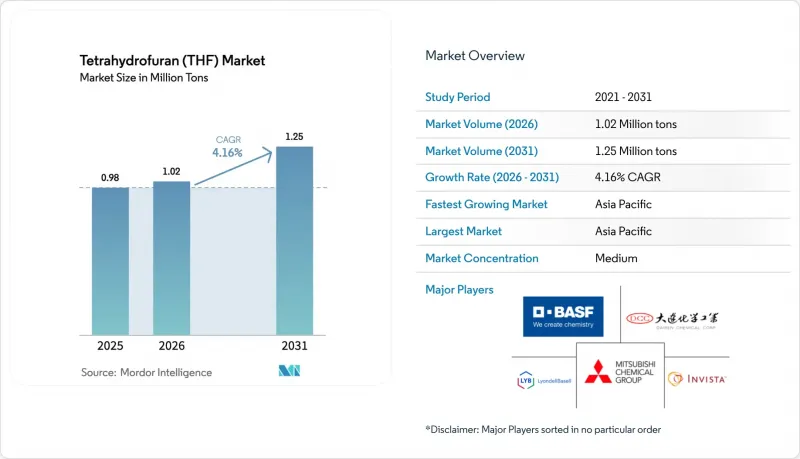
This report is Segmented by Process Route (Maleic Anhydride-BDO Route, and Bio-Based Route), Application (Polytetramethylene Ether Glycol (PTMEG), Solvent, and More), End-Use Industry (Polymer, Textile, and More), Distribution Channel (Direct Sales/OEM and Distributors and Traders), and Geography (Asia-Pacific, North America, Europe, and More). Market Forecasts are Provided in Terms of Volume (Tons).
Global Tetrahydrofuran (THF) Market Trends and Insights
Rising Demand for Spandex Fiber and PTMEG in Asia
PTMEG production absorbed 78.89% of global tetrahydrofuran market volume in 2025 and is forecast to rise at a 4.38% CAGR to 2031, mainly on expanding spandex capacity in China, India, and Indonesia. Fourth-quarter 2024 inventory build-ups prompted temporary PTMEG rate cuts, illustrating cyclical vulnerability. Vietnamese investments in bio-BDO and low-carbon PTMEG demonstrate a shift toward reduced-emission fibers that allow apparel brands to meet Scope 3 targets without altering fabric specifications. Chinese producers are doubling PTMEG lines to secure in-house THF, signaling a preference for captive integration as a hedge against feedstock swings. Improved inland-to-coast rail logistics lowered freight cost by up to 12%, supporting the competitiveness of coal-based BDO plants in northern China.
Capacity Additions in Lithium-Ion Battery Electrolyte Plants
Battery-grade THF remains niche, yet its role in low-temperature electrolyte blends is growing as EV platforms demand wider operating windows. Ultra-high-purity grades with peroxide levels below 10 ppm and moisture under 50 ppm command 30-40% premiums over commodity solvent. A 60,000-ton expansion in high-purity BDO allows producers to serve this segment while offsetting the yield penalties of deep purification. Research on fluorinated carbonates hints that THF's growth could plateau if solid-state batteries are commercialized after 2028, prompting producers to diversify into pharmaceutical and specialty-polymer niches.
Stricter OSHA and REACH Exposure Limits Reshaping Supply Chains
While the U.S. OSHA 8-hour PEL remains 200 ppm, many employers adopt the 50 ppm threshold recommended by ACGIH and embedded in several EU member-state rules. Meeting the lower limit requires closed-loop handling and continuous vapor monitoring, capital investments that small repackagers struggle to fund. EU industrial-emission rules now embed REACH obligations into operating permits, extending lead times for new capacity to as long as two years and encouraging consolidation around large, vertically integrated suppliers.
Other drivers and restraints analyzed in the detailed report include:
- PVC Capacity Expansions in Asia Driving Solvent Demand
- Shift to Greener Pharmaceutical Solvents in Europe
- Volatile BDO and Maleic Anhydride Feedstock Prices Compressing Margins
For complete list of drivers and restraints, kindly check the Table Of Contents.
Segment Analysis
The maleic anhydride hydrogenation pathway retained 90.12% share of 2025 production because decades of catalyst optimization, heat integration, and internal hydrogen supply keep variable costs low. Recent upgrades achieved12% conversion-unit efficiency gains, underscoring continual incremental improvement. The THF volume from bio-based routes is projected to grow at a 5.89% CAGR through 2031. Bio-based routes draw attention for regulatory-credit benefits rather than parity economics. Biomass-balance THF, certified at European and U.S. sites, captures premiums in markets willing to pay for embedded renewable carbon. Still, separation costs consume up to 80% of bio-route expenditures, demanding captive integration with high-value PTMEG or specialty-polymer lines to stay competitive.
The tetrahydrofuran market size for bio-based volumes remains modest, yet early-stage investments in succinic acid and furfural platforms signal longer-term diversification. Captive projects in Vietnam and eastern China show producers pairing bio-BDO with PTMEG to lock in offtake and spread purification overheads. Displacement of petrochemical routes will remain incremental through 2031 unless carbon-pricing regimes tighten materially.
PTMEG production retained 78.89% share of the tetrahydrofuran market size in 2025 and is on track for a 4.38% CAGR, reflecting the steady expansion of spandex fiber across apparel, medical-textile, and vehicle-interiors segments. Oversupply events in late-2024 exposed short-term pricing risk, but long-term apparel adoption trends support continued volume growth. Solvent uses, including pharmaceutical synthesis and PVC adhesives, form the secondary demand tier. Biomass-balance certification enhances pharma uptake, yet potential carcinogenic reclassification in the U.S. could temper growth.
Niche arenas - battery electrolytes, UV-curable inks, semiconductor cleaning - offer higher margins but modest tonnage. Producers capable of delivering sub-10 ppm peroxide purity can achieve price multiples of 1.3-1.4 over standard grades. Continued investment in high-purity BDO back-integration supports this specialty trajectory.
Complete Report Scope:
- By Process Route
- Maleic Anhydride-BDO Route
- Bio-based (Succinic/Furfural) Route
- By Application
- Polytetramethylene Ether Glycol (PTMEG)
- Solvent
- Other Applications
- By End-Use Industry
- Polymer
- Textile
- Pharmaceutical
- Paints and Coatings
- Other End-Uses
- By Distribution Channel
- Direct Sales / OEM
- Distributors and Traders
- By Geography
- Asia-Pacific
- China
- India
- Japan
- South Korea
- ASEAN
- Rest of Asia-Pacific
- North America
- United States
- Canada
- Mexico
- Europe
- Germany
- United Kingdom
- France
- Italy
- Spain
- Rest of Europe
- South America
- Brazil
- Argentina
- Chile
- Rest of South America
- Middle-East and Africa
- Saudi Arabia
- South Africa
- Rest of Middle-East and Africa
- Asia-Pacific
Geography Analysis
Asia-Pacific controlled 85.24% of global volume in 2025, fueled by consolidated spandex hubs in coastal China, inland coal-to-BDO complexes, and expanding PVC pipe demand in India. Recent tariff changes raised costs on Taiwanese imports, steering buyers toward domestic Chinese suppliers and reinforcing regional self-sufficiency. Trial runs at a 600,000-ton coal-based BDO plant in northeast China leverage low-cost hydrogen and power, yet most output feeds internal biodegradable-polyester chains, curbing merchant availability and propping up coastal spot prices. The tetrahydrofuran market in this region is forecast to grow at a 4.36% CAGR through 2031 as integrated players expand downstream footprints.
North America shows mature but specialized demand shaped by stringent safety oversight. A 100,000-ton BDO unit in Texas targets pharmaceutical and electronics-grade THF niches, while a 2025 price increase of USD 0.10 per pound illustrates supplier focus on margin preservation over share expansion. Ongoing investigations into solvent incidents heighten compliance costs, accelerating distributor attrition and pushing end-users toward direct procurement from major producers.
Europe blends the strictest regulatory framework with the fastest uptake of bio-balance grades. Biomass-certified THF enjoys premiums of 15-20% as compounders chase Scope 3 cuts, yet facilities must navigate lengthy permitting cycles under updated industrial-emission directives. A 60,000-ton high-purity BDO expansion in Germany underpins supply for pharmaceutical and battery-grade THF, aligning with the region's specialization in high-value applications.
South America and the Middle East-Africa remain smaller in tonnage but feature strategic capacity plans. A feedstock allocation granted in Saudi Arabia for a mixed-feed cracker could place new THF capacity online after 2028, while a USD 6.4 billion petrochemical complex in China backed by Middle-Eastern investment illustrates outward integration rather than local THF build-outs.
- Ashland
- Banner Chemicals Limited
- BASF SE
- BHAGWATI Chemicals
- DCC
- Hefei TNJ Chemical Industry Co., Ltd.
- Henan GP Chemicals Co., Ltd.
- INVISTA
- LyondellBasell Industries Holdings B.V.
- Mitsubishi Chemical Group Corporation
- Mitsui Chemicals Inc.
- Nan Ya Plastics Corporation
- REE Atharva Lifescience Pvt. Ltd.
- Shanxi Sanwei Group Co., Ltd.
- Shenyang East Chemical Science-Tech Co., Ltd.
- Sipchem Company
- The Chemours Company
Additional Benefits:
- The market estimate (ME) sheet in Excel format
- 3 months of analyst support
TABLE OF CONTENTS
1 Introduction
- 1.1 Study Assumptions and Market Definition
- 1.2 Scope of the Study
2 Research Methodology
3 Executive Summary
4 Market Landscape
- 4.1 Market Overview
- 4.2 Market Drivers
- 4.2.1 Rising demand for spandex fibre/PTMEG in Asia
- 4.2.2 Capacity additions in Li-ion battery electrolyte plants
- 4.2.3 PVC capacity expansions in Asia (pipe and profile)
- 4.2.4 Shift to greener pharma solvents in Europe
- 4.2.5 Growth of UV-curable digital inks (industrial inkjet)
- 4.3 Market Restraints
- 4.3.1 Stricter OSHA and REACH exposure limits on THF
- 4.3.2 Volatile BDO and maleic anhydride feedstock prices
- 4.3.3 Rising insurance premiums after major fire/explosion losses
- 4.4 Value Chain Analysis
- 4.5 Porter's Five Forces
- 4.5.1 Bargaining Power of Suppliers
- 4.5.2 Bargaining Power of Buyers
- 4.5.3 Threat of New Entrants
- 4.5.4 Threat of Substitutes
- 4.5.5 Competitive Rivalry
5 Market Size and Growth Forecasts (Volume)
- 5.1 By Process Route
- 5.1.1 Maleic Anhydride-BDO Route
- 5.1.2 Bio-based (Succinic/Furfural) Route
- 5.2 By Application
- 5.2.1 Polytetramethylene Ether Glycol (PTMEG)
- 5.2.2 Solvent
- 5.2.3 Other Applications
- 5.3 By End-Use Industry
- 5.3.1 Polymer
- 5.3.2 Textile
- 5.3.3 Pharmaceutical
- 5.3.4 Paints and Coatings
- 5.3.5 Other End-Uses
- 5.4 By Distribution Channel
- 5.4.1 Direct Sales / OEM
- 5.4.2 Distributors and Traders
- 5.5 By Geography
- 5.5.1 Asia-Pacific
- 5.5.1.1 China
- 5.5.1.2 India
- 5.5.1.3 Japan
- 5.5.1.4 South Korea
- 5.5.1.5 ASEAN
- 5.5.1.6 Rest of Asia-Pacific
- 5.5.2 North America
- 5.5.2.1 United States
- 5.5.2.2 Canada
- 5.5.2.3 Mexico
- 5.5.3 Europe
- 5.5.3.1 Germany
- 5.5.3.2 United Kingdom
- 5.5.3.3 France
- 5.5.3.4 Italy
- 5.5.3.5 Spain
- 5.5.3.6 Rest of Europe
- 5.5.4 South America
- 5.5.4.1 Brazil
- 5.5.4.2 Argentina
- 5.5.4.3 Chile
- 5.5.4.4 Rest of South America
- 5.5.5 Middle-East and Africa
- 5.5.5.1 Saudi Arabia
- 5.5.5.2 South Africa
- 5.5.5.3 Rest of Middle-East and Africa
- 5.5.1 Asia-Pacific
6 Competitive Landscape
- 6.1 Market Concentration
- 6.2 Strategic Moves
- 6.3 Market Share(%)/Ranking Analysis
- 6.4 Company Profiles (includes Global level Overview, Market level overview, Core Segments, Financials as available, Strategic Information, Products and Services, and Recent Developments)
- 6.4.1 Ashland
- 6.4.2 Banner Chemicals Limited
- 6.4.3 BASF SE
- 6.4.4 BHAGWATI Chemicals
- 6.4.5 DCC
- 6.4.6 Hefei TNJ Chemical Industry Co., Ltd.
- 6.4.7 Henan GP Chemicals Co., Ltd.
- 6.4.8 INVISTA
- 6.4.9 LyondellBasell Industries Holdings B.V.
- 6.4.10 Mitsubishi Chemical Group Corporation
- 6.4.11 Mitsui Chemicals Inc.
- 6.4.12 Nan Ya Plastics Corporation
- 6.4.13 REE Atharva Lifescience Pvt. Ltd.
- 6.4.14 Shanxi Sanwei Group Co., Ltd.
- 6.4.15 Shenyang East Chemical Science-Tech Co., Ltd.
- 6.4.16 Sipchem Company
- 6.4.17 The Chemours Company
7 Market Opportunities and Future Outlook
- 7.1 White-space and Unmet-Need Assessment

