PUBLISHER: Mordor Intelligence | PRODUCT CODE: 2124051

PUBLISHER: Mordor Intelligence | PRODUCT CODE: 2124051
Aliphatic Hydrocarbon Solvents And Thinners - Market Share Analysis, Industry Trends & Statistics, Growth Forecasts (2026 - 2031)
According to Mordor Intelligence, the aliphatic hydrocarbon solvents and thinners market size is estimated at 4.07 Million tons in 2026, and is expected to reach 5.01 Million tons by 2031, at a CAGR of 3.51% during the forecast period (2026-2031).
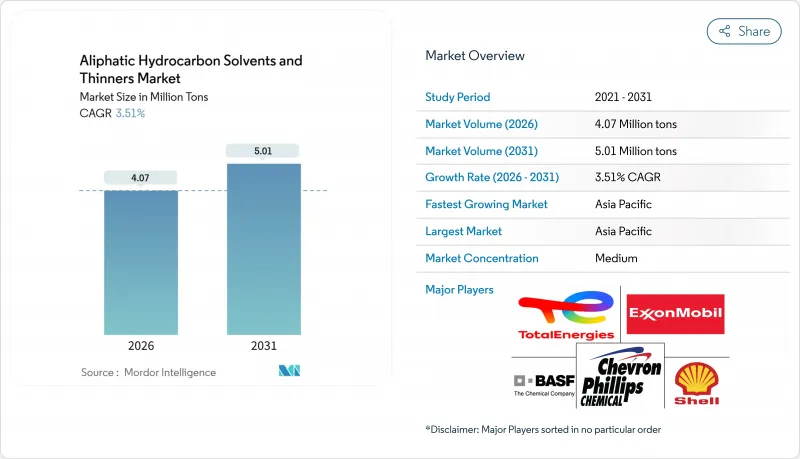
This report is Segmented by Solvent Type (Hexane, Heptane, Mineral Spirits, Gasoline, and Others), Application (Paints and Coatings, Adhesives, Cleaning and Degreasing, Rubber Manufacturing, and Others), and Geography (Asia-Pacific, North America, Europe, South America, and Middle East and Africa). The Market Forecasts are Provided in Volume (Tons).
Global Aliphatic Hydrocarbon Solvents And Thinners Market Trends and Insights
Increasing Application in Paints and Coatings
Global paint output climbed to 48.3 million tons in 2024, and solvent-borne formulations still represented 38% of that total despite continued water-borne gains. Capacity additions-such as BASF's 50,000-ton-per-year alkyd-resin line in Shanghai-specifically target OEM primers and metal topcoats that require aliphatic thinners to remain within China's GB 24409-2020 VOC limits. Maintenance repainting, rather than new construction, increasingly drives tonnage because older assets need higher film-build and multi-coat systems. In India, organized producers lifted manufacturing capacity by 1.2 million liters per day through 2025, translating into incremental solvent demand that supports local suppliers. Yet policy developments, including California's proposed 2027 limit of 100 g/L VOC in industrial maintenance coatings, foreshadow lower solvent intensity in western U.S. markets. Formulators therefore walk a tightrope: maximize solvency and dry-time performance while staying under tightening VOC ceilings.
Expanding Demand from Adhesives and Sealants
Solvent-based adhesive systems retain niche relevance wherever extended open time, rapid green-strength, and low-temperature application remain mandatory. A hexane-heptane blend released by Henkel in 2024 cut cure time by 30% and lifted laminating line speeds to 325 m/min, illustrating how incremental solvent chemistry advances can unlock throughput gains without new equipment. Rapid parcel growth in Asia-Pacific keeps pressure-sensitive label and tape output rising, thereby sustaining mineral-spirits demand. The Middle East's USD 2.8 trillion active project pipeline underpins polyurethane-sealant volumes, and each square meter of curtain wall still requires solvent-containing sealant. Although water-borne acrylics nibble at construction segments, solvent formulations continue to dominate demanding facade and expansion-joint jobs where bond reliability outweighs VOC considerations.
Stringent VOC and Hazardous-Air-Pollutant Regulations
The U.S. EPA slashed VOC limits on architectural finishes to 50 g/L for flat paints and 150 g/L for non-flat coatings in December 2024, cutting solvent loading to roughly 15 wt %. California doubled down, imposing a 10 g/L ceiling on interior flats through SCAQMD Rule 1113, effectively banning solvents in the largest local market. China followed suit with GB 30981.1-2025, capping aromatic content in industrial cleaning solvents at 0.5 wt %. Compliance costs escalate; a mid-sized German paint maker spent USD 2.5 million in 2024 on reformulations alone, underscoring how regulatory stringency erodes demand even where low-aromatic grades offer interim relief.
Other drivers and restraints analyzed in the detailed report include:
- Growth in Construction Activities Globally
- Rising Automotive Refinishing Volumes
- Growing Adoption of Water-Borne and High-Solids Coatings
For complete list of drivers and restraints, kindly check the Table Of Contents.
Segment Analysis
Hexane commanded 29.30% of the aliphatic hydrocarbon solvents and thinners market in 2025, owing to its indispensability in oilseed extraction and synthetic-rubber workflows. Global usage in edible-oil processing reached 1.18 million tons in 2024 following capacity additions across Brazil, Argentina, and the U.S. Midwest. Heptane, while smaller, is forecast to post the fastest 4.38% CAGR through 2031 because pharmaceutical synthesis values its higher flash point and lower toxicity. Mineral spirits remain the workhorse of paint thinning and industrial cleaning but must absorb incremental hydrotreatment costs to comply with Europe's ultra-low-aromatic thresholds. Gasoline's share continues to slide as occupational-safety rules favor higher-flash-point alternatives. Specialty blends, including VM&P naphtha and odorless variants, supply niche printing-ink and aerosol-propellant segments, adding diversity but limited incremental growth.
Mineral-spirits suppliers pursue differentiation via purity. ShellSol D60's aromatic content below 1 wt % achieved 18% penetration in European industrial cleaning in 2024. ExxonMobil's Baytown retrofit underscores the drive to cut naphthalene content under 10 ppm, opening pharmaceutical and food-contact markets. As solvent-quality specifications tighten, players with hydrotreating assets can command premiums, keeping this segment profitable despite volume headwinds.
Complete Report Scope:
- By Solvent Type
- Hexane
- Heptane
- Mineral Spirits
- Gasoline
- Others
- By Application
- Paints and Coatings
- Adhesives
- Cleaning and Degreasing
- Rubber Manufacturing
- Others
- By Geography
- Asia-Pacific
- China
- India
- Japan
- South Korea
- ASEAN Countries
- Rest of Asia-Pacific
- North America
- United States
- Canada
- Mexico
- Europe
- Germany
- United Kingdom
- France
- Italy
- NORDIC Countries
- Rest of Europe
- South America
- Brazil
- Argentina
- Rest of South America
- Middle-East and Africa
- Saudi Arabia
- South Africa
- Rest of Middle-East and Africa
- Asia-Pacific
Geography Analysis
Asia-Pacific accounted for 41.08% of 2025 volume, and the aliphatic hydrocarbon solvents and thinners market in the region is projected to post a 4.32% CAGR through 2031. China leads on urban facade repainting and industrial infrastructure, generating steady offtake. India's 5.9 million vehicle output plus ongoing road-building propel solvent demand, and organized paint capacity expansions promise downstream pull. Mature markets Japan and South Korea grow modestly on automotive refinishing, while ASEAN members register mid-single-digit gains tied to electronics assembly and construction.
North America's share masks diverging patterns. The United States uses solvent-borne paints mainly in exterior wood, high-gloss, and specialty primers, but Step-change VOC rules steadily erode per-liter solvent intensity. Canada leverages colder climates that favor solvent-borne curing. Mexico gains from automotive nearshoring and maintains stricter fire-code allowances for mineral-spirits cleaning.
Europe faces the toughest VOC regimes. Germany's usage slipped as automotive lines switched to water-borne basecoats. The United Kingdom preserved demand in marine and offshore protective coatings. Nordic countries defend mineral-spirits wood-finishing traditions, while Eastern Europe remains a pocket of growth where regulatory alignment lags. Russia grew on local refining and import-substitution policies.
South America is dominated by Brazil, tied to construction and vehicle refinishing. Argentina's contraction was mitigated by lithium-brine extraction, which employs hexane for lithium chloride separation. The Middle East and Africa combined delivered substantial growth, led by Saudi Arabia's megaprojects and South Africa's aging vehicle parc requiring solvent-rich refinish systems.
- BASF
- Brenntag SE
- Calumet Specialty Products Partners L.P.
- Chevron Phillips Chemical Company LLC
- Citgo Petroleum Corporation
- Exxon Mobil Corporation
- Gadiv Petrochemical Industries Ltd.
- Gandhar Oil Refinery (India) Limited.
- Honeywell International Inc.
- Hunt Refining Company
- Idemitsu Kosan Co.,Ltd.
- LyondellBasell Industries N.V.
- MG Organics Pvt. Ltd.
- Phillips 66
- Recochem Inc.
- Sasol Limited
- Shell plc
- SK geo centric Co., Ltd.
- TotalEnergies
Additional Benefits:
- The market estimate (ME) sheet in Excel format
- 3 months of analyst support
TABLE OF CONTENTS
1 Introduction
- 1.1 Study Assumptions and Market Definition
- 1.2 Scope of the Study
2 Research Methodology
3 Executive Summary
4 Market Landscape
- 4.1 Market Overview
- 4.2 Market Drivers
- 4.2.1 Increasing Application in Paints and Coatings
- 4.2.2 Expanding Demand from Adhesives and Sealants
- 4.2.3 Growth in Construction Activities Globally
- 4.2.4 Rising Automotive Refinishing Volumes
- 4.2.5 Shift Toward Low-Aromatic Health-Safer Grades
- 4.3 Market Restraints
- 4.3.1 Stringent VOC and Hazardous-Air-Pollutant Regulations
- 4.3.2 Growing Adoption of Water-Borne and High-Solids Coatings
- 4.3.3 Volatility in Naphtha-Based Feedstock Supply
- 4.4 Value Chain Analysis
- 4.5 Porter's Five Forces Analysis
- 4.5.1 Bargaining Power of Suppliers
- 4.5.2 Bargaining Power of Buyers
- 4.5.3 Threat of New Entrants
- 4.5.4 Threat of Substitutes
- 4.5.5 Degree of Competition
5 Market Size and Growth Forecasts (Volume)
- 5.1 By Solvent Type
- 5.1.1 Hexane
- 5.1.2 Heptane
- 5.1.3 Mineral Spirits
- 5.1.4 Gasoline
- 5.1.5 Others
- 5.2 By Application
- 5.2.1 Paints and Coatings
- 5.2.2 Adhesives
- 5.2.3 Cleaning and Degreasing
- 5.2.4 Rubber Manufacturing
- 5.2.5 Others
- 5.3 By Geography
- 5.3.1 Asia-Pacific
- 5.3.1.1 China
- 5.3.1.2 India
- 5.3.1.3 Japan
- 5.3.1.4 South Korea
- 5.3.1.5 ASEAN Countries
- 5.3.1.6 Rest of Asia-Pacific
- 5.3.2 North America
- 5.3.2.1 United States
- 5.3.2.2 Canada
- 5.3.2.3 Mexico
- 5.3.3 Europe
- 5.3.3.1 Germany
- 5.3.3.2 United Kingdom
- 5.3.3.3 France
- 5.3.3.4 Italy
- 5.3.3.5 NORDIC Countries
- 5.3.3.6 Rest of Europe
- 5.3.4 South America
- 5.3.4.1 Brazil
- 5.3.4.2 Argentina
- 5.3.4.3 Rest of South America
- 5.3.5 Middle-East and Africa
- 5.3.5.1 Saudi Arabia
- 5.3.5.2 South Africa
- 5.3.5.3 Rest of Middle-East and Africa
- 5.3.1 Asia-Pacific
6 Competitive Landscape
- 6.1 Market Concentration
- 6.2 Strategic Moves
- 6.3 Market Share/Ranking Analysis
- 6.4 Company Profiles (includes Global level Overview, Market level overview, Core Segments, Financials as available, Strategic Information, Market Rank/Share for key companies, Products and Services, and Recent Developments)
- 6.4.1 BASF
- 6.4.2 Brenntag SE
- 6.4.3 Calumet Specialty Products Partners L.P.
- 6.4.4 Chevron Phillips Chemical Company LLC
- 6.4.5 Citgo Petroleum Corporation
- 6.4.6 Exxon Mobil Corporation
- 6.4.7 Gadiv Petrochemical Industries Ltd.
- 6.4.8 Gandhar Oil Refinery (India) Limited.
- 6.4.9 Honeywell International Inc.
- 6.4.10 Hunt Refining Company
- 6.4.11 Idemitsu Kosan Co.,Ltd.
- 6.4.12 LyondellBasell Industries N.V.
- 6.4.13 MG Organics Pvt. Ltd.
- 6.4.14 Phillips 66
- 6.4.15 Recochem Inc.
- 6.4.16 Sasol Limited
- 6.4.17 Shell plc
- 6.4.18 SK geo centric Co., Ltd.
- 6.4.19 TotalEnergies
7 Market Opportunities and Future Outlook
- 7.1 White-space and Unmet-Need Assessment

