PUBLISHER: Mordor Intelligence | PRODUCT CODE: 2124057

PUBLISHER: Mordor Intelligence | PRODUCT CODE: 2124057
India Food And Beverage Packaging - Market Share Analysis, Industry Trends & Statistics, Growth Forecasts (2026 - 2031)
According to Mordor Intelligence, India food and beverage packaging market size in 2026 is estimated at USD 40.73 billion, growing from 2025 value of USD 38.27 billion with 2031 projections showing USD 55.67 billion, growing at 6.44% CAGR over 2026-2031.
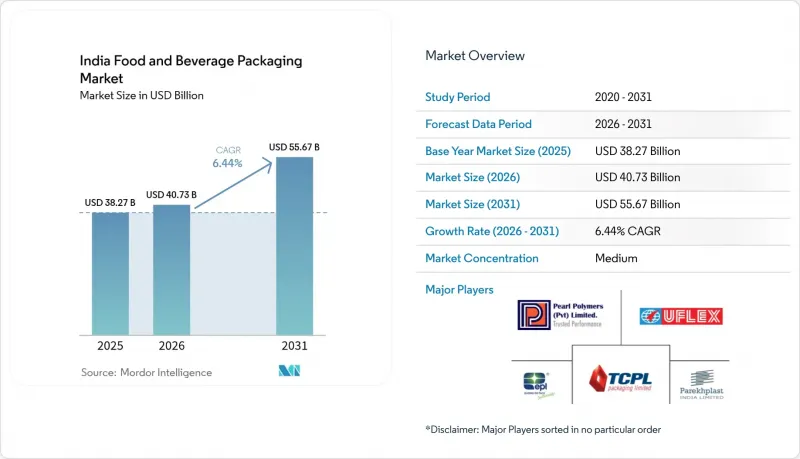
This report is Segmented by Material Type (Paper and Paperboard, Plastic, Metal, and Container Glass), Product Type (Paper and Paperboard Products, Plastic Products, Metal Products, and Container Glass Products), Packaging Format (Rigid, and Flexible), End-Use Category (Food, and Beverage). The Market Forecasts are Provided in Terms of Value (USD).
India Food And Beverage Packaging Market Trends and Insights
Rising Processed-Food Penetration Drives Packaging Innovation
Processed-food consumption is surging as urbanization and disposable income climb. Domestic food sales are on track to hit USD 1,274 billion by 2027, pulling advanced multilayer films and retort pouches into the spotlight. Snack producers want portion-controlled packs that keep flavor intact during last-mile delivery. Ready-to-eat meals need pouches that survive steam sterilization and preserve nutrients. Bureau of Indian Standards specifications ensure direct-contact materials comply with food-grade requirements, pushing converters to adopt certified inks and adhesives.
E-commerce and D2C Brands Reshape SKU-Level Differentiation
Online retail surpassed INR 12.2 trillion in 2024, expanding 18.7% annually and fueling demand for tamper-evident, moisture-resistant, and visually striking packs. D2C labels rely on packaging to create memorable unboxing moments. Short production runs have triggered rapid uptake of digital presses that enable quick design changes without high plate costs. Brands now opt for smaller pack sizes and premium finishes that survive the logistics chain and convey sustainability credentials.
SMEs Face Technology and Compliance Barriers
SMEs make up 85% of India's 22,000 registered packaging firms but often lack capital for solvent-less laminators or toluene-free ink systems. Only one-fifth of converters have met the IS 15495 standard that bars toxic solvents in food packs. Limited technical training and fragmented supply chains restrict smaller factories from serving premium customers who insist on globally certified packs.
Other drivers and restraints analyzed in the detailed report include:
- Mandated rPET Content Accelerates Sustainable Transition
- Cold-Chain Infrastructure Expansion Enables Export Growth
- Volatile Polymer Prices Create Margin Pressures
For complete list of drivers and restraints, kindly check the Table Of Contents.
Segment Analysis
Paper and paperboard products captured 39.18% of the India food and beverage packaging market size in 2025. Plastic still holds the overall lead with 55.92% share, yet recycled-content mandates and consumer eco-preferences push kraft and barrier-coated papers forward at a 7.35% CAGR. The India food and beverage packaging market share for plastic is forecast to slip mildly as converters blend virgin with certified recyclate to meet rPET rules. FSSAI's 2025 amendment now allows recycled PET in direct food contact once plants meet stringent tests. Barrier-paper innovators such as Koehler offer mono-material papers that pass grease and oxygen tests while easing curbside recycling.
Paper's ascent is visible in beverage multipacks and QSR trays, yet polymer demand persists in high-humidity snacks and dairy pouches. Multilayer PE and BOPP remain cost-efficient for flavor retention. Metal cans hold a niche in premium ready drinks and export-oriented processed meats, buoyed by their unmatched light and gas barriers. Glass caters to high-value spices and condiments that target aroma conservation. Material strategies, therefore, converge on hybrid portfolios rather than outright substitution.
Paperboard cartons lead unit volumes, but metal containers are pacing fastest at a 6.96% CAGR through 2031. Craft beer, energy drinks, and nutraceutical powders favor 2-piece aluminum cans that chill rapidly and prolong shelf life. ITC's INR 20,000 crore outlay earmarks a third for paperboards and moulded fiber, yet also supports high-stiffness laminated cartons for e-commerce shipping. Rigid plastic tubs address mass dairy, and flexible laminates dominate salty snacks. Single-use cellulose plates are rising in cloud kitchens.
Metal's growth also draws on advances in BPA-non-intent coatings that align with global safety standards. Aerosol whipped-cream exports use internally lacquered steel to prevent flavor scalping. Consumer willingness to pay premiums for sleek matte finishes favors metal over alternative formats.
Complete Report Scope:
- By Material Type
- Paper and Paperboard
- Plastic
- Polyethylene Polypropylene (PP)
- High-density Polyethylene (HDPE) and Low-density Polyethylene (LDPE)
- Polyethylene Terephthalate (PET)
- Polyvinyl Chloride (PVC)
- Polystyrene (PS)
- Other Plastics
- Metal
- Container Glass
- By Product Type
- Paper and Paperboard Product Type
- Folding Carton and Rigid Boxes
- Corrugated Boxes and Containers
- Single-use Paper Products
- Other Paper and Paperboard Product Types
- Plastic Product Type
- Rigid Plastics
- Bottles and Jars
- Caps and Closures
- Bulk-Grade Products
- Other Rigid Plastics Product Types
- Flexible Plastics
- Pouches
- Bags
- Films and Wraps
- Other Flexible Plastics Product Types
- Rigid Plastics
- Metal Product Type
- Cans
- Caps and Closures
- Aerosol Containers
- Other Metal Product Types
- Container Glass Product Type
- Bottles
- Jars
- Paper and Paperboard Product Type
- By Packaging Format
- Rigid Packaging Format
- Flexible Packaging Format
- By End-Use Category
- Food
- Dairy Products
- Meat, Poultry and Seafood
- Bakery and Confectionery
- Fruits and Vegetables
- Ready-to-Eat and Meal Kits
- Snacks and Savouries
- Nutraceuticals and Supplements
- Other Food
- Beverage
- Carbonated Soft Drinks and Juices
- Beer
- Wine and Spirits
- Bottled Water
- Milk and Dairy Beverages
- Energy, Sports and Functional Drinks
- Other Beverage
- Food
List of Companies Covered in this Report:
- Uflex Limited
- TCPL Packaging Limited
- EPL Limited
- Parekhplast India Limited
- Parksons Packaging Limited
- Piramal Glass Private Limited
- Haldyn Glass Limited
- Hindusthan National Glass & Industries Limited
- AGI Greenpac Limited
- Smufit WestRock_plc
- Pearl Polymers Ltd
- Manjushree Technopack Ltd
- Huhtamaki India Ltd
- Amcor Flexibles India
- Oji India Packaging Pvt Ltd
- ITC Packaging & Printing
- Deccan Cans & Printers Pvt Ltd
- Hindustan Tin Works Ltd
- Mold-Tek Packaging Ltd
- Hitech Corporation Ltd
Additional Benefits:
- The market estimate (ME) sheet in Excel format
- 3 months of analyst support
TABLE OF CONTENTS
1 INTRODUCTION
- 1.1 Study Assumptions and Market Definition
- 1.2 Scope of the Study
2 RESEARCH METHODOLOGY
3 EXECUTIVE SUMMARY
4 MARKET LANDSCAPE
- 4.1 Market Overview
- 4.2 Market Drivers
- 4.2.1 Rising processed-food penetration
- 4.2.2 Imports of automated FandB packaging machinery
- 4.2.3 E-commerce and D2C brands' demand for SKU-level differentiation
- 4.2.4 Mandated 30 % rPET content by 2025 accelerates bottle redesign
- 4.2.5 Cold-chain ready meal exports spurring retort-pouch investments
- 4.2.6 Surge in cloud-kitchen demand for dual-ovenable paper trays
- 4.3 Market Restraints
- 4.3.1 SMEs' limited access to best-practice manufacturing
- 4.3.2 Volatile polymer prices squeezing converter margins
- 4.3.3 8 % decade-low profitability in flexible packaging due to over-capacity
- 4.3.4 Talent shortage in food-grade ink and coating formulation
- 4.4 Industry Supply-Chain Analysis
- 4.5 Regulatory Landscape
- 4.6 Technological Outlook
- 4.7 Porter's Five Forces Analysis
- 4.7.1 Bargaining Power of Suppliers
- 4.7.2 Bargaining Power of Buyers
- 4.7.3 Threat of New Entrants
- 4.7.4 Threat of Substitutes
- 4.7.5 Intensity of Competitive Rivalry
5 MARKET SIZE AND GROWTH FORECASTS (VALUE)
- 5.1 By Material Type
- 5.1.1 Paper and Paperboard
- 5.1.2 Plastic
- 5.1.2.1 Polyethylene Polypropylene (PP)
- 5.1.2.2 High-density Polyethylene (HDPE) and Low-density Polyethylene (LDPE)
- 5.1.2.3 Polyethylene Terephthalate (PET)
- 5.1.2.4 Polyvinyl Chloride (PVC)
- 5.1.2.5 Polystyrene (PS)
- 5.1.2.6 Other Plastics
- 5.1.3 Metal
- 5.1.4 Container Glass
- 5.2 By Product Type
- 5.2.1 Paper and Paperboard Product Type
- 5.2.1.1 Folding Carton and Rigid Boxes
- 5.2.1.2 Corrugated Boxes and Containers
- 5.2.1.3 Single-use Paper Products
- 5.2.1.4 Other Paper and Paperboard Product Types
- 5.2.2 Plastic Product Type
- 5.2.2.1 Rigid Plastics
- 5.2.2.1.1 Bottles and Jars
- 5.2.2.1.2 Caps and Closures
- 5.2.2.1.3 Bulk-Grade Products
- 5.2.2.1.4 Other Rigid Plastics Product Types
- 5.2.2.2 Flexible Plastics
- 5.2.2.2.1 Pouches
- 5.2.2.2.2 Bags
- 5.2.2.2.3 Films and Wraps
- 5.2.2.2.4 Other Flexible Plastics Product Types
- 5.2.2.1 Rigid Plastics
- 5.2.3 Metal Product Type
- 5.2.3.1 Cans
- 5.2.3.2 Caps and Closures
- 5.2.3.3 Aerosol Containers
- 5.2.3.4 Other Metal Product Types
- 5.2.4 Container Glass Product Type
- 5.2.4.1 Bottles
- 5.2.4.2 Jars
- 5.2.1 Paper and Paperboard Product Type
- 5.3 By Packaging Format
- 5.3.1 Rigid Packaging Format
- 5.3.2 Flexible Packaging Format
- 5.4 By End-Use Category
- 5.4.1 Food
- 5.4.1.1 Dairy Products
- 5.4.1.2 Meat, Poultry and Seafood
- 5.4.1.3 Bakery and Confectionery
- 5.4.1.4 Fruits and Vegetables
- 5.4.1.5 Ready-to-Eat and Meal Kits
- 5.4.1.6 Snacks and Savouries
- 5.4.1.7 Nutraceuticals and Supplements
- 5.4.1.8 Other Food
- 5.4.2 Beverage
- 5.4.2.1 Carbonated Soft Drinks and Juices
- 5.4.2.2 Beer
- 5.4.2.3 Wine and Spirits
- 5.4.2.4 Bottled Water
- 5.4.2.5 Milk and Dairy Beverages
- 5.4.2.6 Energy, Sports and Functional Drinks
- 5.4.2.7 Other Beverage
- 5.4.1 Food
6 COMPETITIVE LANDSCAPE
- 6.1 Market Concentration
- 6.2 Strategic Moves
- 6.3 Market Share Analysis
- 6.4 Company Profiles (includes Global-level Overview, Market-level Overview, Core Segments, Financials as available, Strategic Information, Market Rank/Share, Products and Services, Recent Developments)
- 6.4.1 Uflex Limited
- 6.4.2 TCPL Packaging Limited
- 6.4.3 EPL Limited
- 6.4.4 Parekhplast India Limited
- 6.4.5 Parksons Packaging Limited
- 6.4.6 Piramal Glass Private Limited
- 6.4.7 Haldyn Glass Limited
- 6.4.8 Hindusthan National Glass & Industries Limited
- 6.4.9 AGI Greenpac Limited
- 6.4.10 Smufit WestRock_plc
- 6.4.11 Pearl Polymers Ltd
- 6.4.12 Manjushree Technopack Ltd
- 6.4.13 Huhtamaki India Ltd
- 6.4.14 Amcor Flexibles India
- 6.4.15 Oji India Packaging Pvt Ltd
- 6.4.16 ITC Packaging & Printing
- 6.4.17 Deccan Cans & Printers Pvt Ltd
- 6.4.18 Hindustan Tin Works Ltd
- 6.4.19 Mold-Tek Packaging Ltd
- 6.4.20 Hitech Corporation Ltd
7 MARKET OPPORTUNITIES AND FUTURE OUTLOOK
- 7.1 White-space and Unmet-Need Assessment

