PUBLISHER: Mordor Intelligence | PRODUCT CODE: 2124061

PUBLISHER: Mordor Intelligence | PRODUCT CODE: 2124061
Fumaric Acid - Market Share Analysis, Industry Trends & Statistics, Growth Forecasts (2026 - 2031)
According to Mordor Intelligence, the fumaric acid market size is estimated at 307.93 kilotons in 2026, and is expected to reach 376.09 kilotons by 2031, at a CAGR of 4.08% during the forecast period (2026-2031).
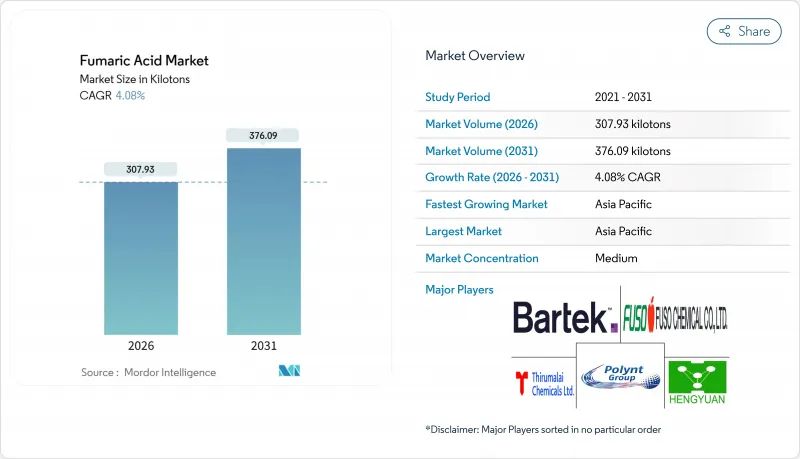
This report is Segmented by Grade (Food Grade and Technical Grade), Application (Food and Beverage Processing, Unsaturated Polyester Resin, and More), End-User Industry (Chemical, Food and Beverage, and More), and Geography (Asia-Pacific, North America, Europe, South America, and Middle-East and Africa). The Market Forecasts are Provided in Terms of Volume (Tons).
Global Fumaric Acid Market Trends and Insights
Clean-Label Demand for Bio-Fermented Fumaric Acid in Asian Convenience Foods
Spiking consumer scrutiny over ingredient declarations is reshaping acidulant sourcing in Japan, South Korea, and China. Japan's April 2024 Food Sanitation Act amendments require explicit labeling of synthetic additives, spurring a reformulation wave among convenience-store chains. South Korea's November 2024 guidance encourages producers to disclose production routes, further nudging demand toward fermentation-derived material. Chinese firms such as Yantai Hengyuan and Changmao Biochemical added an estimated 15,000 tons of bio-capacity across 2024-2025, narrowing the historical 25% price premium for food-grade bio-material to roughly 12% by 2025. Rising middle-class incomes in ASEAN are expected to mirror this trend, expanding regional uptake.
Shift to Unsaturated Polyester Resins for Lightweight EV and Wind-Blade Composites
Electric-vehicle platforms now incorporate about 450 pounds of plastics and composites compared with 310 pounds in ICE vehicles, a delta largely driven by weight-offsetting battery mass. European automakers seeking to meet 2025 fleet-wide CO2 targets are specifying glass-fiber UPR parts that contain 8%-12% fumaric-based co-monomers. Offshore wind projects similarly favor fumaric-modified UPR for blades over 80 meters long, where enhanced fatigue resistance is critical. Counterbalancing forces include premium-segment moves to carbon-fiber prepregs and bio-epoxy systems, but the overall pull from mass-market EVs supports continued volume growth.
Volatility in Maleic-Anhydride Feedstock and Benzene Spot Prices
Spot maleic-anhydride quotations see-sawed between USD 1,050 and USD 1,400 per ton in China during 2024-2025, mirroring benzene price swings. Several small Chinese fumaric acid producers idled units in Q1 2024 when benzene briefly spiked past CNY 7,200 per ton. European operators faced a double hit from volatile benzene and natural-gas prices that averaged EUR 35-45 per MWh in 2024. Lacking long-term maleic contracts, producers struggle to lock in stable margins, prompting vertical integration and portfolio diversification.
Other drivers and restraints analyzed in the detailed report include:
- Europe and North America Antibiotic-Free Feed Laws Boosting Fumaric-Acid Acidulants
- Growth of Specialty Water-Treatment Polymers in Semiconductor Fabs
- EU CO2-Footprint Taxation on Petro-Route Acids (CBAM)
For complete list of drivers and restraints, kindly check the Table Of Contents.
Segment Analysis
Food-grade accounted for 66.28% of the Fumaric Acid market in 2025, expanding at a 4.51% CAGR to 2031. Bartek's new line is devoted wholly to food-grade output, illustrating strategic emphasis on higher-margin, regulation-intensive channels. Technical-grade demand, tied closely to UPR and alkyd resins, lags amid CBAM costs and volatile maleic feedstocks, yet remains vital for construction and automotive coatings.
Bio-fermentation has compressed the historic 20-25% price premium down to 12-15% by 2025, increasing addressable demand in price-sensitive developing markets. BASF expects its CO2-negative process to reach commercial readiness by 2027, potentially redefining the carbon disclosure landscape for food additives. Producers with dual-spec plants can toggle between grades to cushion swings in either segment, a hedge increasingly favored by integrated chemical houses.
Complete Report Scope:
- By Grade
- Food Grade
- Technical Grade
- By Application
- Food and Beverage Processing
- Unsaturated Polyester Resin (UPR)
- Alkyd Resin
- Rosin Paper Sizing
- Personal Care and Cosmetics
- Other Applications
- By End-user Industry
- Chemical
- Food and Beverage
- Cosmetics
- Pharmaceutical
- Other End-user Industries
- By Geography
- Asia-Pacific
- China
- India
- Japan
- South Korea
- ASEAN Countries
- Rest of Asia-Pacific
- North America
- United States
- Canada
- Mexico
- Europe
- Germany
- United Kingdom
- France
- Italy
- Rest of Europe
- South America
- Brazil
- Argentina
- Rest of South America
- Middle-East and Africa
- Saudi Arabia
- South Africa
- Rest of Middle-East and Africa
- Asia-Pacific
Geography Analysis
Asia-Pacific controlled 60.21% of global volume in 2025 and is set for a 4.88% CAGR through 2031. China alone contributes major world capacity, with clusters in Shandong, Hebei, and Jiangsu and a growing share of bio-fermentation units. India is scaling output to meet pharmaceutical and food-grade demand, while Japan and South Korea rely on imports aligned with stringent purity laws. ASEAN nations, especially Vietnam and Thailand, are emerging demand bases as rising urban incomes fuel convenience-food uptake.
North America benefits from Bartek's capacity doubling, positioning the region as a net exporter of bio-grade material. Europe is reshaping supply chains in response to CBAM. Germany, France, and Italy are key consumption nodes, with regional resin producers qualifying low-carbon feedstock. EFSA's favorable feed-additive ruling further enlarges the European addressable pool.
South America and the Middle East and Africa together account for lower global demand. Brazil leads South America via its food sector, while Argentina trials fumaric acid in livestock rations. Gulf Cooperation Council nations are exploring backward integration for construction-grade resins, and South Africa provides incremental pharmaceutical and food-processing demand.
- Anhui Sealong Biotechnology Co., Ltd.,
- Anmol Chemicals Private Limited
- Bartek Ingredients Inc.
- Changmao Biochemical Engineering Co., Ltd.
- ESIM Chemicals GmbH
- FUSO CHEMICAL CO., LTD.
- Henan Shuguang Chemical
- Huntsman International LLC
- Isegen South Africa (Pty) Ltd
- Merck KGaA
- Ningbo Jujia Biotech
- Polynt S.p.A.
- Tate & Lyle
- Thirumalai Chemicals
- UPC Group of Companies
- XST Biological Co. Ltd
- Yantai Hengyuan Biotechnology Co., Ltd.
- Yongsan Chemicals Inc.
Additional Benefits:
- The market estimate (ME) sheet in Excel format
- 3 months of analyst support
TABLE OF CONTENTS
1 Introduction
- 1.1 Study Assumptions and Market Definition
- 1.2 Scope of the Study
2 Research Methodology
3 Executive Summary
4 Market Landscape
- 4.1 Market Overview
- 4.2 Market Drivers
- 4.2.1 Clean-Label Demand for Bio-Fermented Fumaric Acid in Asian Convenience Foods
- 4.2.2 Shift to Unsaturated Polyester Resins for Lightweight EV and Wind-Blade Composites
- 4.2.3 Europe and North America Antibiotic-Free Feed Laws Boosting Fumaric Acid Acidulants
- 4.2.4 Growth of Specialty Water-Treatment Polymers in Semiconductor Fabs
- 4.2.5 Cradle-To-Gate Carbon-Negative Fermentation Technologies Attracting Green-Finance
- 4.3 Market Restraints
- 4.3.1 Volatility In Maleic-Anhydride Feedstock and Benzene Spot Prices
- 4.3.2 EU CO2-Footprint Taxation on Petro-Route Acids (CBAM)
- 4.3.3 Competitive Threat from Succinic and Malic Acid in Shelf-Stable Foods
- 4.4 Value Chain Analysis
- 4.5 Porter's Five Forces
- 4.5.1 Bargaining Power of Suppliers
- 4.5.2 Bargaining Power of Buyers
- 4.5.3 Threat of New Entrants
- 4.5.4 Threat of Substitutes
- 4.5.5 Competitive Rivalry
5 Market Size and Growth Forecasts (Volume)
- 5.1 By Grade
- 5.1.1 Food Grade
- 5.1.2 Technical Grade
- 5.2 By Application
- 5.2.1 Food and Beverage Processing
- 5.2.2 Unsaturated Polyester Resin (UPR)
- 5.2.3 Alkyd Resin
- 5.2.4 Rosin Paper Sizing
- 5.2.5 Personal Care and Cosmetics
- 5.2.6 Other Applications
- 5.3 By End-user Industry
- 5.3.1 Chemical
- 5.3.2 Food and Beverage
- 5.3.3 Cosmetics
- 5.3.4 Pharmaceutical
- 5.3.5 Other End-user Industries
- 5.4 By Geography
- 5.4.1 Asia-Pacific
- 5.4.1.1 China
- 5.4.1.2 India
- 5.4.1.3 Japan
- 5.4.1.4 South Korea
- 5.4.1.5 ASEAN Countries
- 5.4.1.6 Rest of Asia-Pacific
- 5.4.2 North America
- 5.4.2.1 United States
- 5.4.2.2 Canada
- 5.4.2.3 Mexico
- 5.4.3 Europe
- 5.4.3.1 Germany
- 5.4.3.2 United Kingdom
- 5.4.3.3 France
- 5.4.3.4 Italy
- 5.4.3.5 Rest of Europe
- 5.4.4 South America
- 5.4.4.1 Brazil
- 5.4.4.2 Argentina
- 5.4.4.3 Rest of South America
- 5.4.5 Middle-East and Africa
- 5.4.5.1 Saudi Arabia
- 5.4.5.2 South Africa
- 5.4.5.3 Rest of Middle-East and Africa
- 5.4.1 Asia-Pacific
6 Competitive Landscape
- 6.1 Market Concentration
- 6.2 Strategic Moves
- 6.3 Market Share(%)/Ranking Analysis
- 6.4 Company Profiles (includes Global level Overview, Market level overview, Core Segments, Financials as available, Strategic Information, Products and Services, and Recent Developments)
- 6.4.1 Anhui Sealong Biotechnology Co., Ltd.,
- 6.4.2 Anmol Chemicals Private Limited
- 6.4.3 Bartek Ingredients Inc.
- 6.4.4 Changmao Biochemical Engineering Co., Ltd.
- 6.4.5 ESIM Chemicals GmbH
- 6.4.6 FUSO CHEMICAL CO., LTD.
- 6.4.7 Henan Shuguang Chemical
- 6.4.8 Huntsman International LLC
- 6.4.9 Isegen South Africa (Pty) Ltd
- 6.4.10 Merck KGaA
- 6.4.11 Ningbo Jujia Biotech
- 6.4.12 Polynt S.p.A.
- 6.4.13 Tate & Lyle
- 6.4.14 Thirumalai Chemicals
- 6.4.15 UPC Group of Companies
- 6.4.16 XST Biological Co. Ltd
- 6.4.17 Yantai Hengyuan Biotechnology Co., Ltd.
- 6.4.18 Yongsan Chemicals Inc.
7 Market Opportunities and Future Outlook
- 7.1 White-Space and Unmet-Need Assessment
- 7.2 Emergence of New Potential Application Areas

